

Can Adults Retake GCSE Arabic? How It Works
Adults retake GCSE Arabic through a course or private entry. Learn how to find a centre, arrange speaking, select a tier and plan your revision.
A qualification left unfinished can feel heavier with time. Yet the practical route back is usually simpler than the worry surrounding it. When adults retake GCSE Arabic, they can either join an exam-focused course or prepare independently and enter through an approved exam centre as a private candidate.
There is no requirement to return to school full-time. The important steps are choosing the correct qualification, finding a centre that can conduct the speaking assessment, entering before its deadline and preparing for all four language skills. If you are also retaking GCSE maths, the same calm principle applies: confirm the specification first, then build revision around the assessments you will actually sit.
GCSE Arabic retake checklist
Before paying for tuition or an exam entry, check the following:
- Confirm that you want GCSE Arabic rather than International GCSE Arabic.
- Check the current specification and awarding organisation.
- Decide whether you need a taught course, private tuition or independent revision.
- Find an approved centre that accepts private candidates for Arabic.
- Confirm that the centre can administer the speaking assessment.
- Choose Foundation or Higher tier with appropriate advice.
- Ask about fees, internal deadlines, identification and access arrangements.
- Obtain and check your statement of entry.
- Prepare separately for listening, speaking, reading and writing.
Do not begin by buying every available revision book. Begin with the entry. A strong revision plan is of little use if the chosen centre cannot offer the speaking assessment or has already closed its entries.
 An adult learner discovers an unexpectedly long qualification treasure map
Can adults retake GCSE Arabic at any age?
Yes. Adults can take or retake GCSE Arabic. GCSEs are commonly associated with secondary school, but the qualification itself is not restricted to sixteen-year-olds.
An adult who is not enrolled at the centre where the assessments take place will normally be entered as a private candidate. The school, college or independent exam centre makes the formal entry with the exam board. The candidate prepares independently, through a tutor or through a course, and pays the centre's relevant fees.
Not every centre accepts private candidates, and a centre accepting private candidates for maths may not necessarily offer Arabic. Language qualifications create additional administration because the centre must arrange and record a speaking assessment. Always ask about the exact subject and specification rather than asking only whether the centre accepts external candidates.
Which GCSE Arabic qualification should you take?
Current published Pearson information confirms that Pearson Edexcel GCSE Arabic, specification code 1AA0, is available in the June 2027 series. It is offered at Foundation and Higher tier.
That is not the same qualification as Pearson Edexcel International GCSE Arabic (First Language). The names sound similar, but their content, assessment structure and availability can differ. Before enrolling, ask the provider to state in writing:
- the full qualification title;
- the specification code;
- the exam series;
- the tier;
- whether the course fee includes the exam entry;
- where and how the speaking assessment will be completed.
This distinction matters especially when searching online. A course described as “GCSE-level Arabic” may improve your language skills without preparing you for specification 1AA0. General Modern Standard Arabic evening classes can be valuable, but they are not automatically GCSE exam courses.
Foundation or Higher tier
Pearson GCSE Arabic requires candidates to take the same tier across all papers. You cannot, for example, enter Foundation listening and Higher writing. The centre must settle your tier before the speaking assessment.
Foundation is designed around grades 1-5, while Higher is designed around grades 4-9. Higher should not be chosen simply because you speak Arabic at home. Heritage speakers may communicate confidently but still need practice with formal reading, accurate writing, translation, timed responses and the precise speaking format.
A tutor or centre should assess all four skills before recommending a tier. The goal is not to select the most impressive label. It is to choose the paper on which your knowledge can be demonstrated reliably.
How GCSE Arabic is assessed
The Pearson Edexcel qualification assesses four skills, each contributing 25%25\%25% of the final qualification.
| Paper | Skill | Weighting |
|---|---|---|
| Paper 1 | Listening and understanding | 25%25\%25% |
| Paper 2 | Speaking | 25%25\%25% |
| Paper 3 | Reading and understanding | 25%25\%25% |
| Paper 4 | Writing | 25%25\%25% |
Listening, reading and writing are scheduled written assessments. Speaking is conducted by the centre and externally assessed by Pearson. It includes a role play, a picture-based task and a conversation. Dictionaries are not permitted in the assessments, including the preparation period for speaking.
The structure creates an important lesson: fluency in one area cannot completely carry the others. Someone who speaks naturally may still lose marks through weak spelling or unfamiliar reading vocabulary. Another learner may write accurately but need practice responding aloud without long pauses.
For a normal entry, the components are completed within one assessment series. Pearson also publishes transferred-speaking entry options for eligible retake candidates. If you previously completed the speaking component, ask the centre to check whether a transfer is permitted in your circumstances rather than assuming that the old result will carry forward.
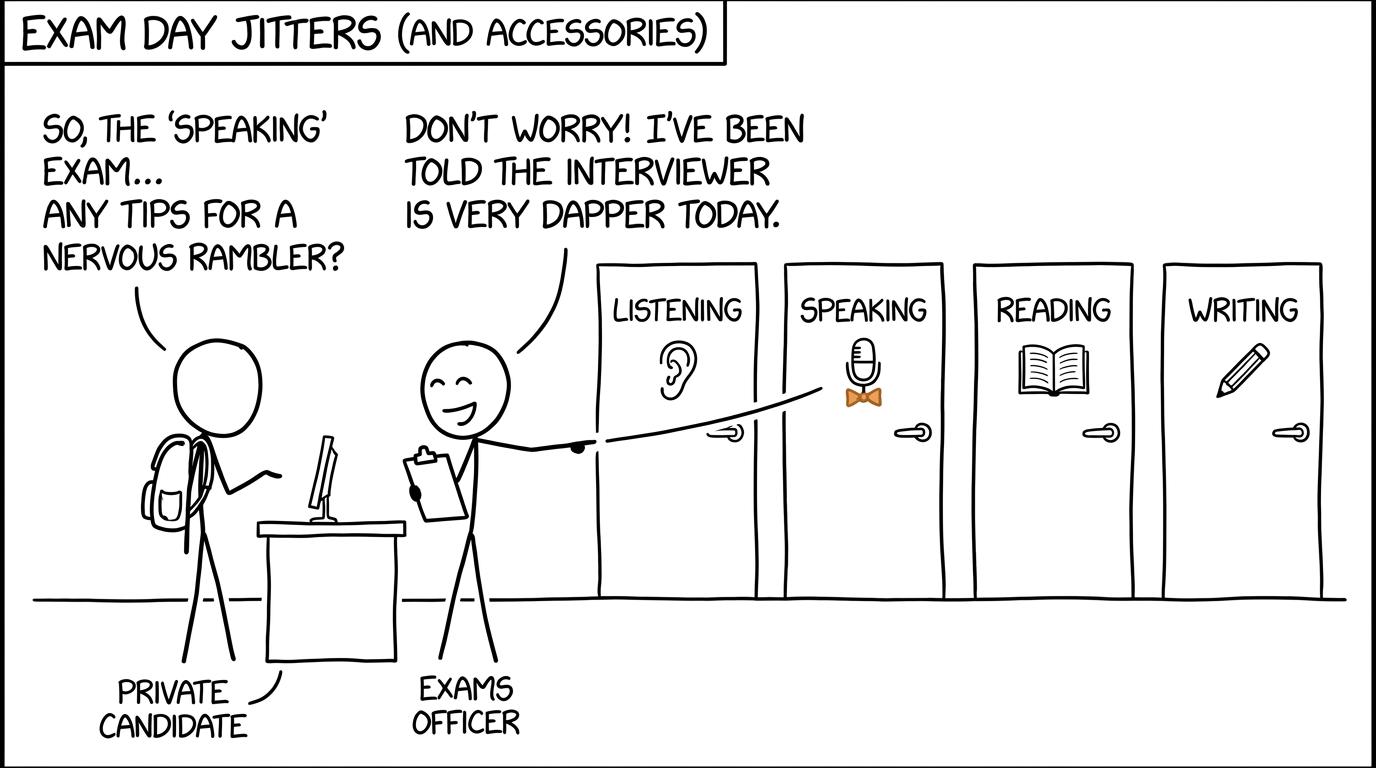 A private candidate meets four unusually formal exam doors
Ways to prepare for an adult GCSE Arabic retake
Join an evening or adult education class
An evening class provides routine, teacher feedback and regular speaking practice. It can suit adults who know they revise better when another person sets the pace.
However, check whether the class follows the GCSE Arabic specification. Some adult courses teach conversational Arabic without covering translation, exam timings or the required speaking tasks. Also ask whether the provider makes the exam entry or whether you must arrange a separate centre.
Take an online GCSE course
An online course can work well around employment or family commitments. Look for live speaking practice, marked writing and explicit coverage of Foundation or Higher tier. Recorded lessons alone may not reveal pronunciation problems or weaknesses in spontaneous conversation.
Check the cancellation terms, course duration and what “exam support” actually means. It may mean guidance only, not an included exam place.
Use a private tutor
A tutor can diagnose gaps quickly and tailor lessons to a heritage speaker, beginner or previous candidate. Before committing, ask whether the tutor has recent experience with specification 1AA0 and its speaking tasks.
Tuition and exam entry are usually separate arrangements. A tutor cannot make an official entry unless they are working through an approved centre.
Prepare independently
Self-study offers the greatest flexibility, but it requires a clear structure. Download the current specification and assessment materials from the awarding organisation, then divide revision between the four skills rather than practising only what feels comfortable.
The discipline resembles independent maths revision. MathsGenie's guide to self-studying GCSE maths explains why a sequence of learning, practice, marking and retesting works better than passive reading. For maths-specific support, the GCSE maths revision hub organises free lessons, questions and papers by board and tier.
How to enter as a private candidate
Finding the centre is often the part adults underestimate. Approved schools, colleges and independent centres decide for themselves whether to accept private candidates and which subjects they can administer.
Contact centres early and ask these questions:
- Do you accept private candidates for Pearson Edexcel GCSE Arabic 1AA0?
- Can you conduct and record the speaking assessment?
- What is your internal entry deadline?
- What is the total fee, including speaking and administration?
- Which identification documents do you require?
- When must the tier be confirmed?
- How will results and certificates be collected?
- Can you process any required access arrangements?
The awarding organisation has a formal entry deadline, but centres normally set earlier internal deadlines and may close once their capacity is full. For summer 2027, Pearson has published a GCSE Arabic speaking window running from 15 April to 20 May 2027. Your centre will allocate a specific appointment within that period.
Once entered, check the statement of entry carefully. Your name, date of birth, subject, specification and tier should all be correct.
If you need extra time, modified papers or another access arrangement, disclose this when first approaching the centre. Arrangements require evidence and processing; they should not be left until the examination week.
Building a realistic revision plan around adult life
Adult revision rarely fails because the learner lacks ambition. It more often fails because the plan assumes every evening will be quiet.
A better plan has a small minimum. Use short weekday sessions for vocabulary, listening or one writing task, then reserve a longer weekend block for timed assessment practice and marking. The 20-minute GCSE revision routine offers a useful model for keeping short sessions purposeful.
If Arabic sits alongside a GCSE maths retake, separate the subjects rather than allowing the more comfortable one to take over. You could use Arabic for short language-recall sessions and schedule maths practice through the MathsGenie resources hub, where mini tests, predicted papers and other revision tools are organised in one place.
 A busy adult discovers that a past paper is content to wait beside the tea
Treat practice papers as information, not judgement. After each attempt, record whether the problem was knowledge, accuracy, timing or misunderstanding the question. The same diagnostic approach is explained in MathsGenie's guide to finding weak GCSE topics.
For maths, use Edexcel GCSE Maths past papers with their mark schemes and available solutions. If the exams are approaching, the one-month GCSE maths revision plan can help you balance topic work, mini tests and full papers without abandoning Arabic preparation.
Common mistakes when retaking GCSE Arabic
Assuming an evening class includes the examination
Course tuition and exam entry are often separate. Obtain confirmation of what the fee includes before enrolling.
Booking a centre that cannot provide speaking
A centre may offer written GCSE exams but not have the staff or facilities needed for Arabic speaking. Confirm the complete qualification before paying.
Confusing GCSE with International GCSE
Check the full title and specification code. Resources for a different qualification may not match your assessment.
Choosing Higher tier from speaking ability alone
Tier decisions should reflect listening, speaking, reading and writing. Informal fluency does not automatically produce accurate examination writing.
Revising only familiar skills
It is tempting to keep practising conversation because it feels natural, or reading because it feels safe. Since every skill contributes 25%25\%25%, neglected areas remain expensive.
Leaving access arrangements too late
The exam centre must process applications and review evidence before the relevant deadlines. Raise your needs during the first conversation.
Letting one retake displace every other subject
If you are also preparing for GCSE maths, use a visible weekly plan. MathsGenie's guide to using Edexcel past papers properly shows how fewer, carefully reviewed papers can be more valuable than an unstructured pile of attempts.
Your next step
Adults can retake GCSE Arabic, but success begins with administration rather than revision: identify the qualification, secure a centre, confirm speaking arrangements and choose the right tier. Once those foundations are in place, consistent preparation becomes far easier.
If maths is part of your return to GCSE study, make MathsGenie your free revision base. Start with revision lessons, move into targeted practice questions, check your work with mark schemes and video solutions, then build confidence through mini tests, past papers and predicted papers. A retake is not a return to the past. Done thoughtfully, it is a clearer second attempt with better tools.










