Exam Anxiety GCSE Business: A Practical Plan
Exam anxiety GCSE Business advice: use case-study drills, command words, calculation practice and a calm exam-day routine to feel prepared and in control.
The difficult thing about GCSE Business is not always remembering the content. Sometimes it is opening a case study, seeing several paragraphs of unfamiliar information and wondering how you are supposed to turn it into a precise answer before time runs out.
If exam anxiety GCSE Business is making revision or assessment feel overwhelming, the practical answer is to make the paper more familiar. Practise its separate demands: recalling business knowledge, applying it to a case study, developing chains of analysis, making justified judgements and completing calculations accurately. You do not need to feel completely calm before you begin. You need a routine that still works when you feel nervous.
A quick anxiety-management checklist
Before exploring the details, use this as your immediate plan:
- Confirm your exam board and the content assessed on each paper.
- Divide the specification into small, named topics.
- Practise command words rather than simply rereading notes.
- Rehearse extracting evidence from unfamiliar business contexts.
- Build confidence with percentages, averages, financial calculations and graphs.
- Complete short timed sections before attempting full papers.
- Mark your work and record why each mark was lost.
- Prepare an exam-day routine before you need it.
- Speak to a trusted adult if anxiety is persistent or affecting everyday life.
The principle is simple: replace one large, vague fear with several small tasks that can be practised.
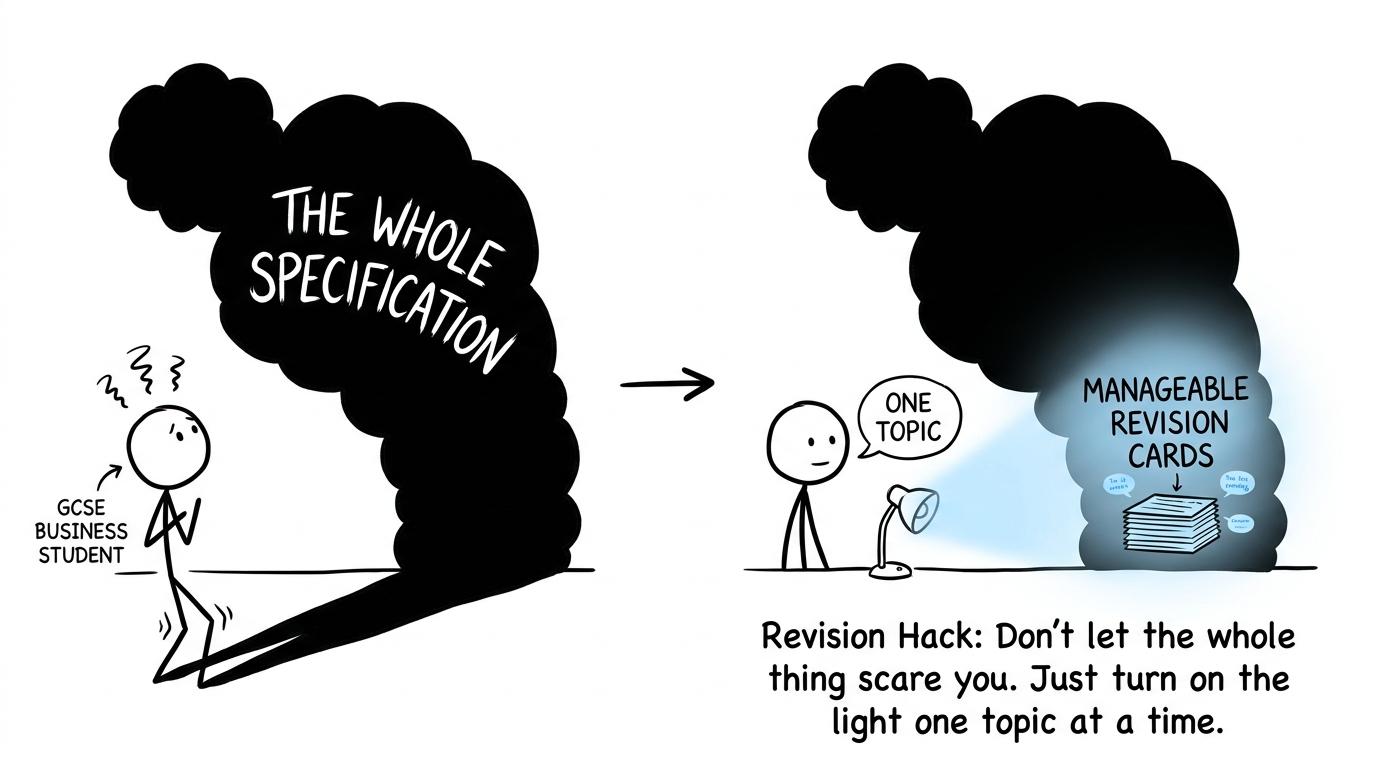 A student shrinking the intimidating whole specification by focusing on one topic
Identify what is making GCSE Business feel difficult
Anxiety often describes several different problems at once. Naming the precise problem helps you choose a useful response.
You might be worried about:
- forgetting definitions;
- misunderstanding command words;
- failing to apply an answer to the business in the case study;
- running out of time on extended responses;
- going blank during a calculation;
- deciding which side of an argument is stronger;
- facing an unfamiliar industry or business model.
These require different forms of revision. If definitions are weak, retrieval cards may help. If application is weak, practise identifying details such as the organisation's size, objectives, customers, ownership and financial position. If timing is the problem, a timed question is more useful than another hour of highlighting.
Keep a short anxiety log after practice. Write down the question type, what happened and the next action. Instead of recording "I am bad at finance", write "I confused revenue with profit, so I will review financial terminology and complete five calculation questions". Specificity turns worry into a revision decision.
Revise for the way GCSE Business is assessed
GCSE Business is not a memory test with a few calculations attached. Across AQA, Edexcel, OCR and Eduqas, students are expected to demonstrate knowledge, apply it to business contexts, and analyse or evaluate information. Exact paper structures and mark tariffs vary, so check your own specification and recent assessment materials rather than borrowing another board's timing strategy.
Separate knowledge, application and judgement
Organise revision around three questions:
- What do I know? Definitions, concepts, advantages, disadvantages and relationships.
- How does it affect this business? The consequence for the organisation described in the stimulus.
- What conclusion follows? A decision supported by evidence and sensitive to the circumstances.
This separation is reassuring because it shows where an answer became stuck. You may know that market research reduces uncertainty but need more practice explaining why a particular small business would benefit. Or you may analyse both options well but stop before making a justified recommendation.
Use command words from your exam board's materials. "Identify", "explain", "analyse", "discuss", "recommend" and "evaluate" do not ask for interchangeable answers. Compare your response with the mark scheme and examiner guidance, paying attention to how application and developed reasoning are rewarded.
Turn case studies into evidence hunts
An unfamiliar context can look threatening because the name, product and market are new. But the paper is not asking you to become an expert in that industry. It is giving you evidence to use.
Before answering a longer question, locate:
- the business objective;
- its size and ownership;
- the relevant figures;
- customer or employee information;
- a constraint such as limited finance, capacity or time;
- evidence that supports each possible decision.
This turns reading into a job with a clear output. Annotate lightly and use only details that affect your reasoning. Copying a sentence from the case study is not application by itself; explain why that detail changes the likely business outcome.
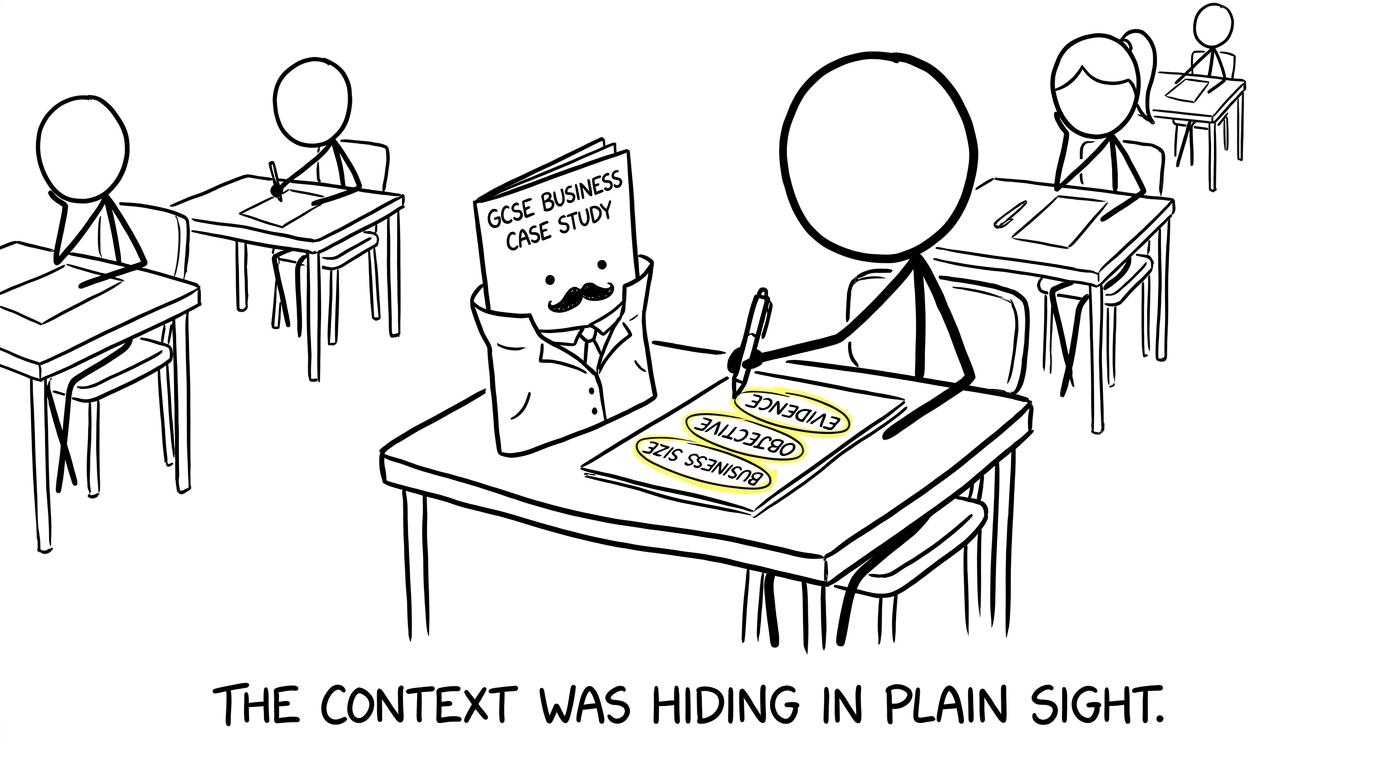 A GCSE Business case study disguised as a suspect while the student calmly finds contextual clues
Reduce anxiety around GCSE Business calculations
Current GCSE Business specifications include quantitative skills. Official specifications commonly require at least 10%10\%10% of the qualification marks to assess quantitative skills, although the exact questions and coverage differ by board. That makes calculation practice worthwhile, but it should remain connected to business interpretation.
Typical skills include:
- percentages and percentage change;
- averages;
- revenue, costs and profit;
- cash-flow calculations;
- break-even and contribution;
- gross and net profit margins;
- average rate of return;
- interpreting tables, charts and financial data.
You should know the relevant formulae required by your specification and understand what each result means. Common relationships include:
Profit=revenue−total costs\text{Profit} = \text{revenue} - \text{total costs}Profit=revenue−total costsand
Percentage change=new value−original valueoriginal value×100\text{Percentage change} = \frac{\text{new value} - \text{original value}}{\text{original value}} \times 100Percentage change=original valuenew value−original value×100For the underlying numerical skills, MathsGenie's free percentages revision resources and percentage change practice can help make the method more automatic. If interpreting business data feels uncomfortable, the GCSE Statistics revision hub provides further practice with averages, tables and graphs.
Create a one-page formula retrieval sheet from your own Business specification. Cover it, reproduce it from memory, check it and repeat later. Then practise selecting the correct formula from the wording of a question. Formula recall without selection is not enough.
During an assessment, write down the relevant relationship, substitute carefully, include units and consider whether the answer is reasonable. Even when the arithmetic is correct, remember that a Business question may also ask you to interpret the result or use it to support a decision.
Build familiarity without overwhelming yourself
Government and NHS guidance on exam pressure recommends manageable revision goals, realistic planning, past-paper practice and asking for support. For GCSE Business, that means increasing the realism gradually.
Begin with one untimed question. Move to a short timed group of questions, then one paper section and finally a full paper under appropriate conditions. This is not avoiding difficulty. It is controlled exposure to it.
A focused session might contain:
- brief retrieval of one topic;
- one case-study question;
- one calculation or data-interpretation task;
- marking and one written correction.
MathsGenie's twenty-minute GCSE revision routine offers a useful structure for short practice sessions. You can adapt the same learn, attempt, mark and revisit cycle to Business. Use the MathsGenie revision planner to give each session a defined purpose rather than writing "revise Business" across an entire evening.
Keep a marks-leak list. Label losses as knowledge, application, analysis, judgement, calculation, timing or misreading. The approach in finding your weakest GCSE topics can help you turn marked work into targeted revision.
Use a GCSE Business exam-day routine
A routine reduces the number of decisions you must make while anxious.
Before the exam, check the time, location and required equipment. Bring the permitted calculator and writing equipment specified by your school. Protect your sleep rather than attempting an all-night review; NHS guidance notes that most teenagers need around eight to ten hours of sleep and that sleep supports thinking and concentration.
When the paper begins:
- read the instructions carefully;
- scan the structure and mark allocations;
- identify command words;
- calculate a sensible time budget using your own paper's marks and duration;
- underline relevant contextual evidence;
- move on temporarily if one question is consuming too much time;
- leave space and return later.
If your mind goes blank, pause. Put both feet on the floor, relax your shoulders and breathe slowly for a short period. Then restart with a concrete action: underline the command word, define the central concept or identify one relevant detail from the stimulus. The goal is not to force the whole answer to appear at once. It is to create the next line.
For a calm final-evening structure, adapt MathsGenie's GCSE night-before plan. Review familiar material, prepare your equipment and stop at a planned time.
Common mistakes that make Business anxiety worse
Rereading instead of retrieving
Familiar notes can create the feeling that you know a topic. Close the book and recall definitions, chains of reasoning and formulae without prompts. Testing reveals what needs attention while there is still time to fix it.
Completing only comfortable questions
Repeatedly answering short definition questions will not prepare you for evaluation or unfamiliar contexts. Mix question types and revisit areas that your marking identifies as weak.
Memorising generic paragraphs
A memorised advantage or disadvantage may earn limited credit if it ignores the case study. Learn flexible reasoning structures, then connect them to the organisation's objectives and evidence.
Treating calculations as separate from Business
A figure matters because of what it suggests about performance, risk or a decision. Practise both obtaining the result and explaining its relevance. The GCSE Maths revision hub can strengthen the numerical foundations, while the Business mark scheme shows how to use those skills in context.
Attempting full papers too early
A full paper can be useful, but it is a poor daily tool if it produces panic and no careful review. Start with shorter sections and build stamina. When numerical weaknesses appear, choose your board and tier through MathsGenie's GCSE topics by exam board guide before doing targeted practice.
Comparing answers immediately afterwards
Post-exam conversations rarely change a submitted paper. If discussing answers increases your anxiety, step away, note one useful lesson and redirect your attention to the next assessment.
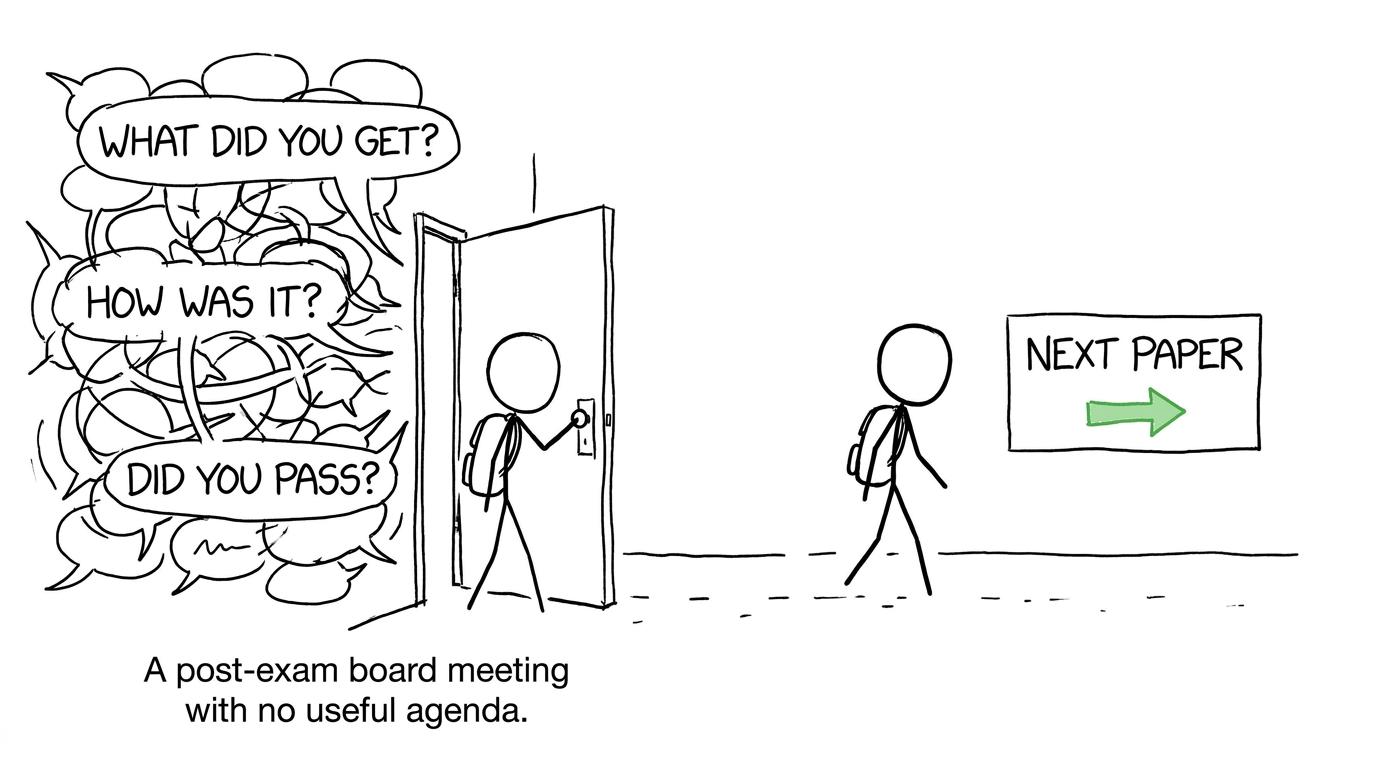 A student leaving an unhelpful post-exam discussion and calmly focusing on the next paper
When anxiety needs more support
Some nervousness before an examination is common. However, tell a parent, carer, teacher, pastoral lead or another trusted adult if anxiety is severe, persistent, disrupts sleep or eating, stops you attending school, or interferes with daily life. NHS guidance recommends seeking help when anxiety or low mood persists and affects everyday functioning; a GP can also be a starting point.
If you have a disability, special educational need, illness or temporary injury, speak to your school's special educational needs coordinator or exams officer as early as possible. Access arrangements are evidence-based adjustments and must normally reflect your needs and usual way of working. They are not something to leave until exam day.
Turn uncertainty into a repeatable plan
Confidence in GCSE Business rarely arrives before practice. More often, it grows from evidence: you recalled the formula, found the contextual clue, finished a timed section or improved an answer after reading the mark scheme.
Start with one Business topic and one measurable task today. For the quantitative side of the course, use MathsGenie's free revision lessons and practice questions to strengthen percentages, averages and data skills. Then test your broader exam habits with mini tests, past papers and predicted papers, checking methods through mark schemes and video solutions. Small, reviewed attempts make the exam less mysterious, and give anxiety less empty space to fill.