How to Get Grade 6 GCSE German
How to get grade 6 GCSE German: build vocabulary, improve all four skills, use mark schemes and turn daily revision into reliable exam marks.
A student can spend an hour copying German vocabulary and still remember almost none of it the next morning. That is not a lack of ability. It is a revision problem.
If you are wondering how to get grade 6 GCSE German, the short answer is this: take Higher tier, build reliable vocabulary and grammar, practise listening, speaking, reading and writing every week, and use marked exam work to identify exactly where you lose marks. A grade 666 does not demand flawless German. It requires a consistent performance across the course and enough control to communicate clearly when the paper becomes less predictable.
The habits that create that consistency are usually smaller than students expect. Ten focused minutes of retrieval can be more useful than an hour of highlighting. One carefully reviewed listening task can reveal more than completing three and checking only the score.
Your grade 6 GCSE German checklist
Before changing your revision, check that you are doing the following:
- Confirm your exam board, specification and tier with your teacher.
- Prepare for Higher tier, because Foundation tier is limited to grades 111 to 555.
- Practise all four skills: listening, speaking, reading and writing.
- Learn vocabulary through active recall rather than repeated copying.
- Revisit vocabulary and grammar after increasing gaps.
- Record recurring errors in an error log.
- Complete timed tasks and study the relevant mark schemes.
- Ask your teacher to assess speaking and writing regularly.
- Use official past or sample materials that match your specification.
The reformed French, German and Spanish GCSEs in England were awarded for the first time in summer 202620262026. Current AQA German, for example, has four components, each worth 25%25\%25%, and students take all four at the same tier. Your board may use different task formats, so follow its current specification rather than an old revision video or inherited workbook.
Start with the evidence, not your feelings
Students often describe German with broad judgements: “I am bad at listening” or “I cannot remember vocabulary.” Those statements feel true, but they are too vague to guide revision.
Complete a short task in each skill and classify every lost mark. Was the cause unknown vocabulary, a misunderstood question, weak grammar, inaccurate spelling, missing detail, slow processing or poor timing? Your revision plan should be built from those answers.
This diagnostic approach will already be familiar if you use MathsGenie for maths. The guide to finding your weakest GCSE topics explains how to gather evidence, log mistakes and retest weaknesses. The subject is different, but the principle is identical: revise what the evidence says you need, not what feels most comfortable.
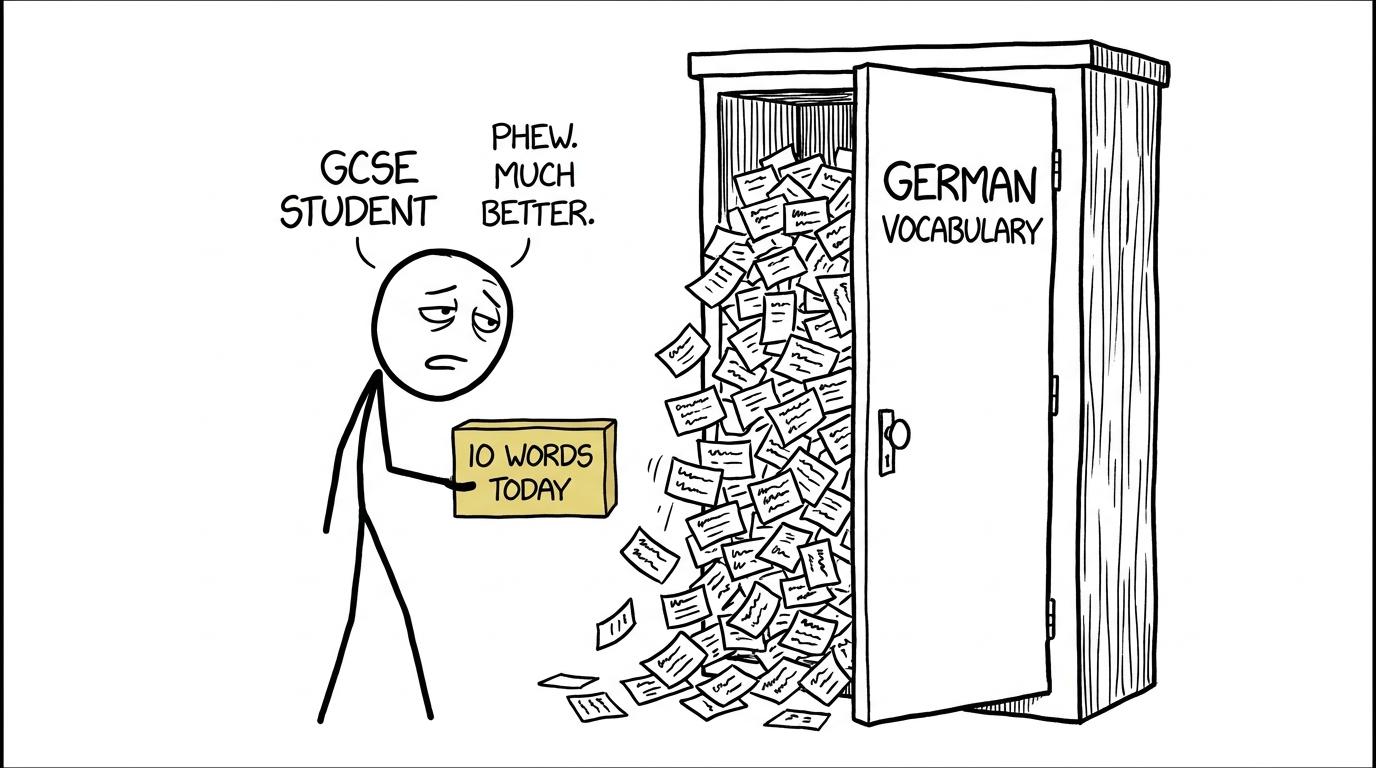 A student calmly tackles a cupboard overflowing with German vocabulary by choosing ten words for today
Build vocabulary that survives exam pressure
Vocabulary is the raw material of every German paper. If a word is only familiar when you see it in the same order on a worksheet, you do not yet own it.
For the current AQA specification, students are expected to know 1,2001{,}2001,200 lexical items at Foundation tier and a further 500500500 at Higher tier. That does not mean learning a giant list in one direction. You need to recognise words while listening and reading, then retrieve useful language while speaking and writing.
A productive vocabulary session has three stages:
- Recall: cover the answer and retrieve the meaning before checking.
- Use: say or write the item in a relevant context.
- Schedule: revisit difficult items after a short gap, then again later.
Learn nouns with their gender and plural where required. Learn verbs with the forms and constructions specified by your board. Group vocabulary by meaning, but occasionally mix topics so that recall is not dependent on a familiar page layout.
Keep the daily target modest enough to repeat. The important measurement is not how many cards you viewed. It is how many items you could retrieve accurately several days later. The same active-recall principle is explored in MathsGenie’s guide to stopping GCSE content from being forgotten.
Make grammar a communication tool
Grammar revision can become a collection of disconnected rules. Grade 666 performance needs something more practical: enough grammatical control to place events in time, express and justify opinions, add detail and connect ideas.
Prioritise the grammar listed in your own specification. This commonly includes secure verb forms, word order, cases, adjective forms, modal verbs, negatives, questions and a range of time frames. Higher-tier requirements extend beyond the Foundation list, so do not assume that a general vocabulary app covers everything you may be assessed on.
Create a grammar audit with three categories:
- structures you can use without notes;
- structures you recognise but cannot produce reliably;
- structures you do not yet understand.
Work on the middle category first. It is often where the fastest gains sit. After relearning a structure, use it in a short speaking or writing task, check it, and return to it later. Passive recognition is not enough when the exam requires you to produce German independently.
Improve listening without simply replaying the audio
Listening feels difficult because several things happen at once: sounds must be separated, words recognised and meaning retained while the recording continues.
Use a deliberate review routine. Before listening, read the question and identify what information is required. On the first play, follow the overall message. On the next, focus on evidence such as opinions, time references, negatives and changes of speaker. Then check the transcript if one is provided.
Do not finish by writing “I did not hear it.” Find the reason. Perhaps you knew the written word but not its sound. Perhaps a negative changed the meaning. Perhaps you stopped listening after an unfamiliar phrase. Each cause needs a different fix.
Regular dictation is particularly useful because it tests sound-to-spelling accuracy. The current AQA listening assessment includes dictation, but exact formats vary, so use materials prepared for your board and specification.
Turn speaking into a weekly habit
Speaking cannot be stored up for the final fortnight. It depends on quick retrieval, and quick retrieval grows through frequent use.
Practise aloud several times each week. Record short responses without reading a complete script, listen back and note one language correction and one fluency improvement. Then record the response again. This creates a tight feedback loop rather than a growing folder of recordings you never revisit.
Prepare flexible language for opinions, reasons, comparisons, past experiences and future intentions. Avoid memorising one long answer for every possible question. A small bank of adaptable structures is more resilient when the examiner changes the wording or asks an unexpected follow-up.
Accuracy matters, but silence earns little. Train yourself to keep communicating, repair an answer where possible and move forward.
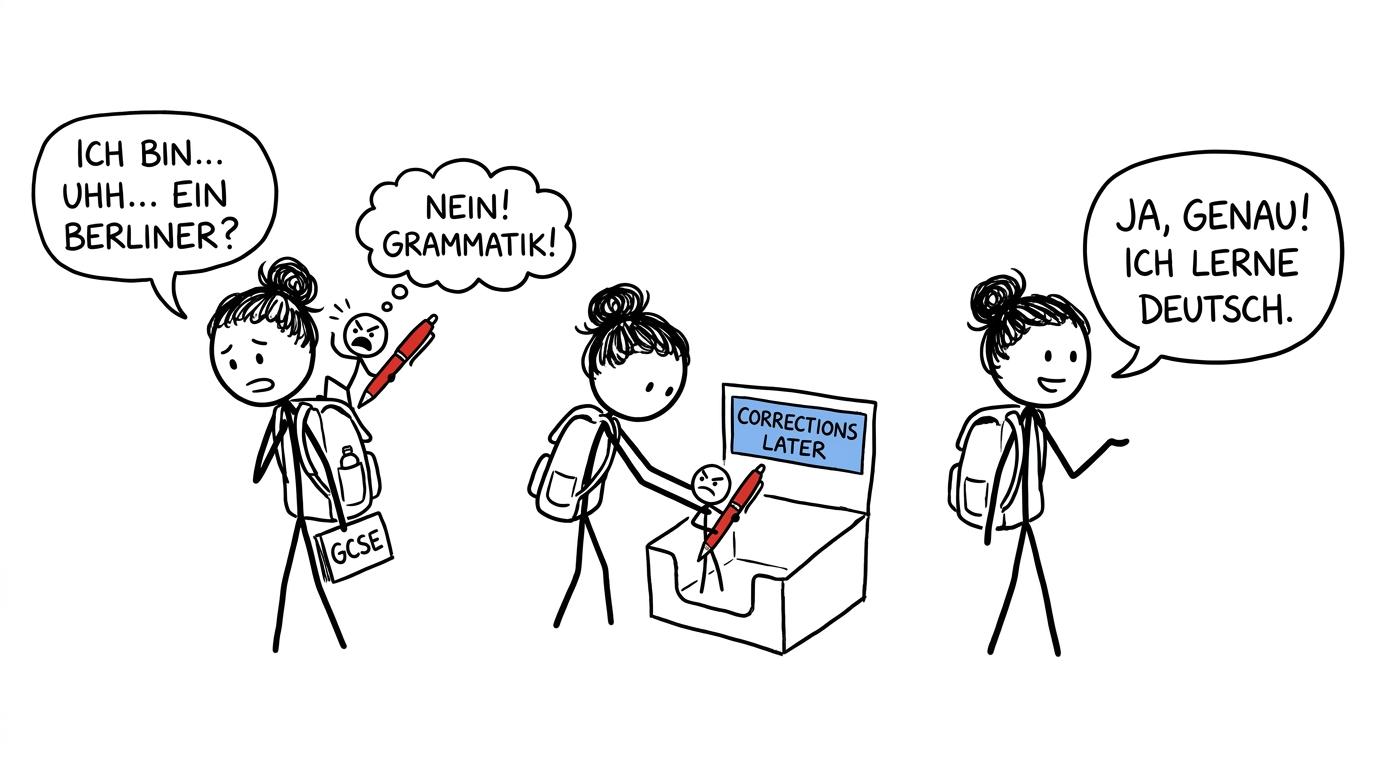 A student puts the perfectionist red pen aside and continues speaking German
Read for meaning before translating
Word-by-word translation is slow and often misleading. German sentences contain clues in verb position, endings, connectives and context. Begin by identifying who is involved, when the event happens, the main opinion and whether the meaning changes direction.
Train with short, timed texts. Underline evidence for each answer, then check whether you answered the precise question rather than writing everything you understood. Keep a list of deceptive or easily confused words, but record them in context rather than as isolated curiosities.
Translation still matters. When translating into English, preserve the meaning rather than German word order. When translating into German, favour language you can control accurately. Review mistakes by category: vocabulary, verb, word order, case, agreement or omitted information.
Write for the task and the mark scheme
A long answer is not automatically a strong answer. Before writing, identify every content requirement and make sure each one is addressed. If the task expects different time frames, opinions or reasons, plan where they will appear.
Write with controlled ambition. Accurate, varied language is more valuable than complicated sentences whose meaning collapses. After finishing, check systematically:
- Have all bullet points been covered?
- Are verbs in the intended time frame?
- Is the verb in the correct position?
- Do nouns, articles and adjectives agree where required?
- Have negatives and spellings been checked?
- Is the meaning clear throughout?
Mark schemes show what the assessment rewards, while teacher feedback tells you how your own work currently meets those criteria. Use both. The MathsGenie article on using past papers properly offers a useful review cycle: attempt, mark, log, relearn and retest.
Follow a weekly revision rhythm
A sustainable week might contain vocabulary retrieval on most days, two short grammar sessions, two listening or reading tasks, and regular speaking and writing. The precise duration matters less than repeated contact with every skill.
Use this cycle:
- Retrieve: recall old vocabulary or grammar without notes.
- Practise: complete one focused task.
- Check: use answers, a transcript, a mark scheme or teacher feedback.
- Correct: write the exact reason for each mistake.
- Retest: return to the weakness on another day.
Nearer the exam, add timed sections and complete papers. Do not rely on predicted content at the expense of the full specification. Grade boundaries are set after exams have been marked and can change from year to year, so there is no reliable universal percentage that guarantees a grade 666.
For help organising revision alongside German, use MathsGenie’s one-month GCSE revision plan or its guide to building a GCSE revision timetable. The examples focus on maths, but the habits of diagnosis, retrieval, timed practice and correction transfer directly.
Common mistakes when aiming for grade 6
Revising only vocabulary
Vocabulary matters, but it must be understood in speech, recognised in texts and produced through grammar. Include all four skills every week.
Using old specification materials without checking
Task formats and prescribed content can change. Confirm the specification code and use current materials from your teacher or exam board.
Treating completed work as learned work
Finishing a paper does not improve a weakness by itself. Review the errors and retest them later.
Avoiding speaking until confidence appears
Confidence usually follows repeated speaking; it rarely arrives first. Short, frequent recordings are more useful than occasional rehearsed performances.
Chasing a fixed grade boundary
Past boundaries can provide context, but they cannot guarantee the boundary for your exam series. Focus on improving the quality and consistency of your responses.
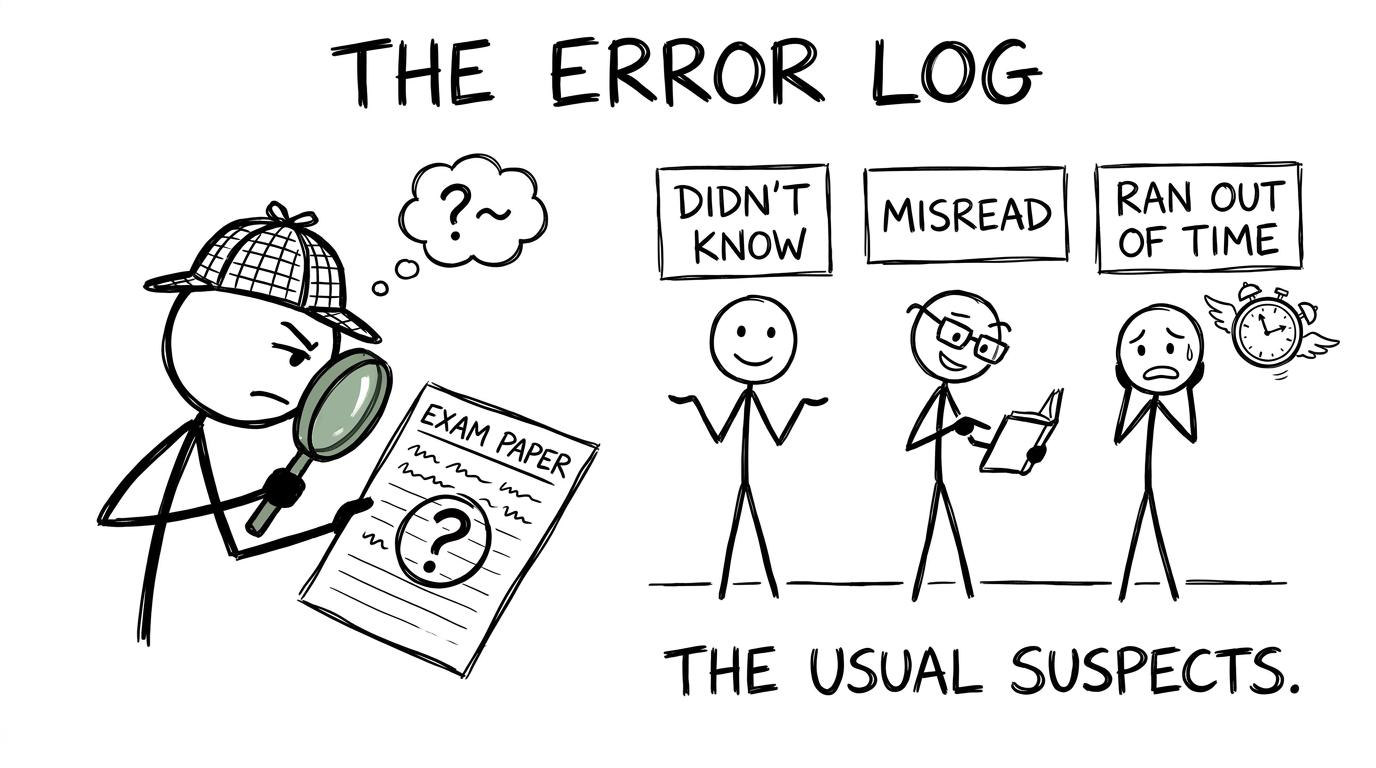 A revision detective identifies whether lost marks came from knowledge, misreading or timing
Make grade 6 the result of a system
The jump to grade 666 rarely comes from one heroic revision weekend. It comes from replacing vague effort with a repeatable system: retrieve, practise, check, correct and return.
Start today with one short German task and an honest error log. Then organise the rest of your GCSE workload through the free MathsGenie GCSE revision hub. Use its revision lessons and practice questions to repair maths gaps, past-paper tools to build exam discipline, and mini tests to check whether learning has lasted. As exams approach, predicted papers, mark schemes and video solutions can complete the loop.
German and maths reward different knowledge. Good revision, however, has the same quiet logic in both: find the weakness, practise it properly and return until it is reliable.