How to Get Grade 6 in GCSE English Literature
How to get grade 6 GCSE English Literature: improve analysis, learn flexible quotations and use timed practice to turn feedback into marks consistently.
A Literature essay can feel convincing while you are writing it, then return with a mark that seems to say otherwise. Usually, the problem is not effort. It is that effort has been spent on remembering the story, collecting quotations or producing long answers rather than demonstrating what the examiner rewards.
If you are searching for how to get grade 6 GCSE English Literature, the short answer is this: build a clear argument, support it with carefully chosen textual references, analyse the writer's methods and practise doing those things under timed conditions. A grade 6 does not require a perfect essay. It requires consistent, relevant analysis across the paper.
English Literature is also untiered, unlike GCSE maths. There is no foundation or higher paper, and grade boundaries vary by exam board and exam series. Your safest target is therefore stronger performance, not a guessed number of marks.
Your grade 6 revision checklist
Focus on these habits:
- Confirm your exam board, specification, set texts and question types.
- Learn a compact bank of short, adaptable quotations.
- Connect each quotation to themes, characters and writer's methods.
- Begin every answer with a defensible interpretation.
- Analyse language, form and structure rather than retelling events.
- Use context to deepen an interpretation, not as a separate history lesson.
- Practise planning, paragraphs and full responses under time pressure.
- Review work against the relevant mark scheme and act on one specific weakness.
- Keep your maths revision moving through short, regular maintenance sessions.
The last point matters. Students preparing for several GCSEs cannot allow one subject to consume the entire timetable. MathsGenie's free revision planner can help you protect time for both English and maths without turning every evening into an impossible list.
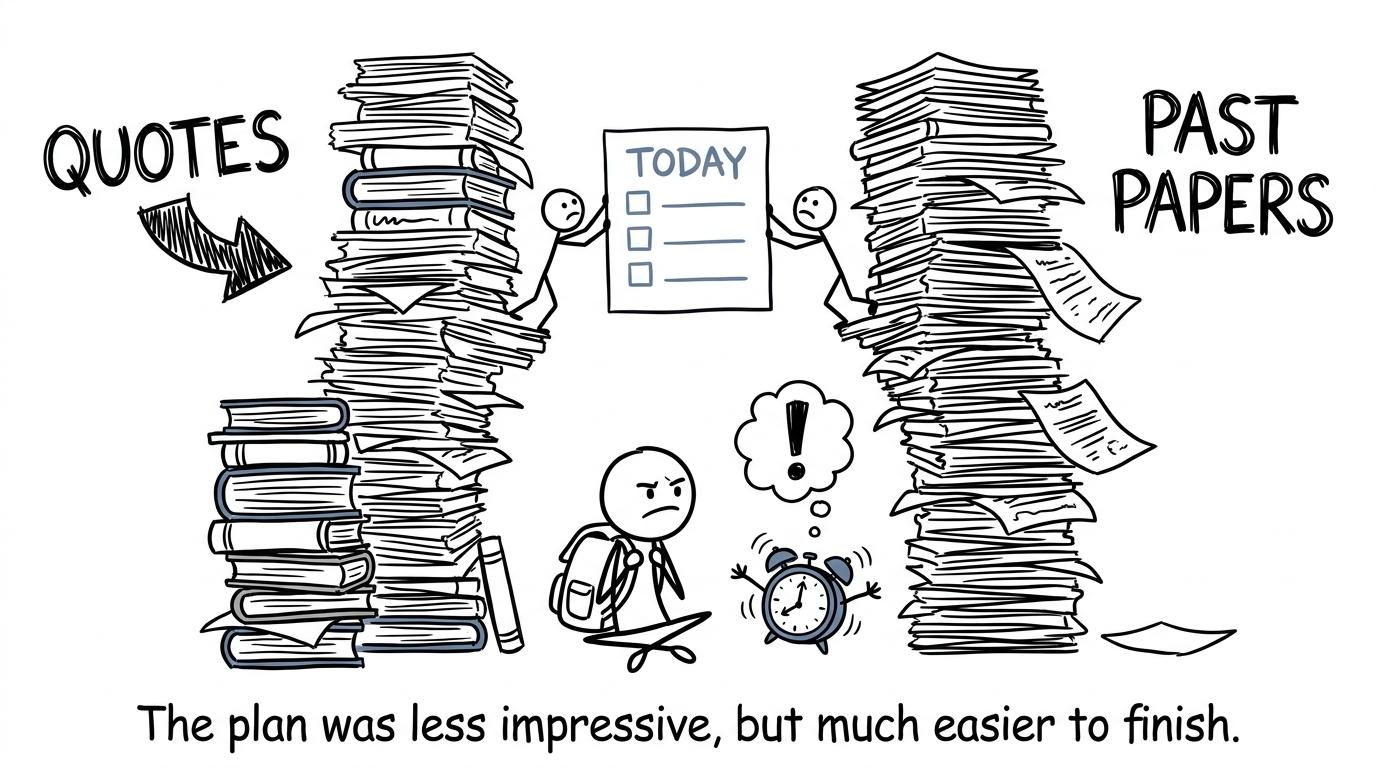 A student choosing a manageable daily revision checklist instead of two enormous piles of work
Understand what the examiner is rewarding
Across GCSE English Literature specifications, the assessment objectives cover four broad abilities. Exact weighting and where each objective is assessed depend on your board and question, so check the current specification and mark scheme for AQA, Edexcel, OCR or Eduqas.
AO1: interpretation and textual support
AO1 rewards an informed response to the text. You need to answer the question, maintain a critical style and support your interpretation with relevant references.
A grade 6 response normally does more than announce that a character is powerful, guilty or isolated. It presents an argument about how that idea develops and why it matters. Each paragraph should advance that argument rather than starting again with an unrelated observation.
AO2: analysis of the writer's methods
AO2 concerns language, form and structure. It carries substantial weight across the qualification, which is why naming techniques without analysing them limits an answer.
After identifying a method, ask:
- What does this choice suggest?
- How does it shape the reader's or audience's understanding?
- Why is it important at this point in the text?
- Does the meaning change when connected to another scene, chapter or stanza?
Relevant terminology can make analysis precise, but terminology is not analysis by itself. Explaining a contrast clearly is more valuable than attaching an impressive label without exploring its effect.
AO3 and AO4: context and accurate writing
AO3 rewards understanding of texts and their contexts. Effective context is attached to interpretation. It might clarify a writer's purpose, an audience's response or the significance of an idea. Memorised facts placed between analytical paragraphs rarely achieve that.
AO4 concerns vocabulary, sentence structures, spelling and punctuation. It accounts for a smaller proportion of the overall qualification and may be assessed only in particular questions. Check your board's materials so that you know where accuracy is explicitly rewarded.
Diagnose why you are not yet reaching grade 6
The useful question is not, “Why am I bad at Literature?” It is, “Where are my marks disappearing?”
Complete one response under realistic conditions and sort the weaknesses into categories:
- Knowledge: uncertain events, character development, themes or quotations.
- Focus: answering a familiar topic instead of the question set.
- Evidence: using vague references or quotations that do not support the point.
- Analysis: identifying techniques without explaining meanings and effects.
- Structure: disconnected paragraphs without a sustained argument.
- Context: adding facts rather than developing interpretation.
- Timing: leaving a response incomplete or rushing the final section.
Maths students already understand this process. After marking a paper, “algebra went badly” is too vague to guide revision. You identify the exact skill that failed. Literature needs the same precision.
For a more detailed diagnostic approach, use MathsGenie's guide to GCSE English Literature revision when you are stuck at a pass.
Learn fewer quotations more deeply
Trying to memorise dozens of complete quotations can create the feeling of progress without improving your answers. Build a smaller quotation bank that can travel across several themes and questions.
For every short quotation, record:
- the character, speaker or narrative moment;
- two or three themes it could support;
- one language feature worth analysing;
- a structural connection elsewhere in the text;
- relevant context, where assessed;
- a possible alternative interpretation.
Short embedded quotations are often easier to recall and analyse than complete speeches. However, accuracy still matters. Never invent wording when a precise reference to the event would be safer.
Retrieval practice is the key habit. Cover the quotation, recall it, check it and revisit it later. Simply rereading a colourful quotation sheet tests recognition, not whether the words will be available in the examination.
MathsGenie's guide to revising GCSE English Literature without wasting time explains how to turn quotation banks, planning and feedback into a repeatable routine.
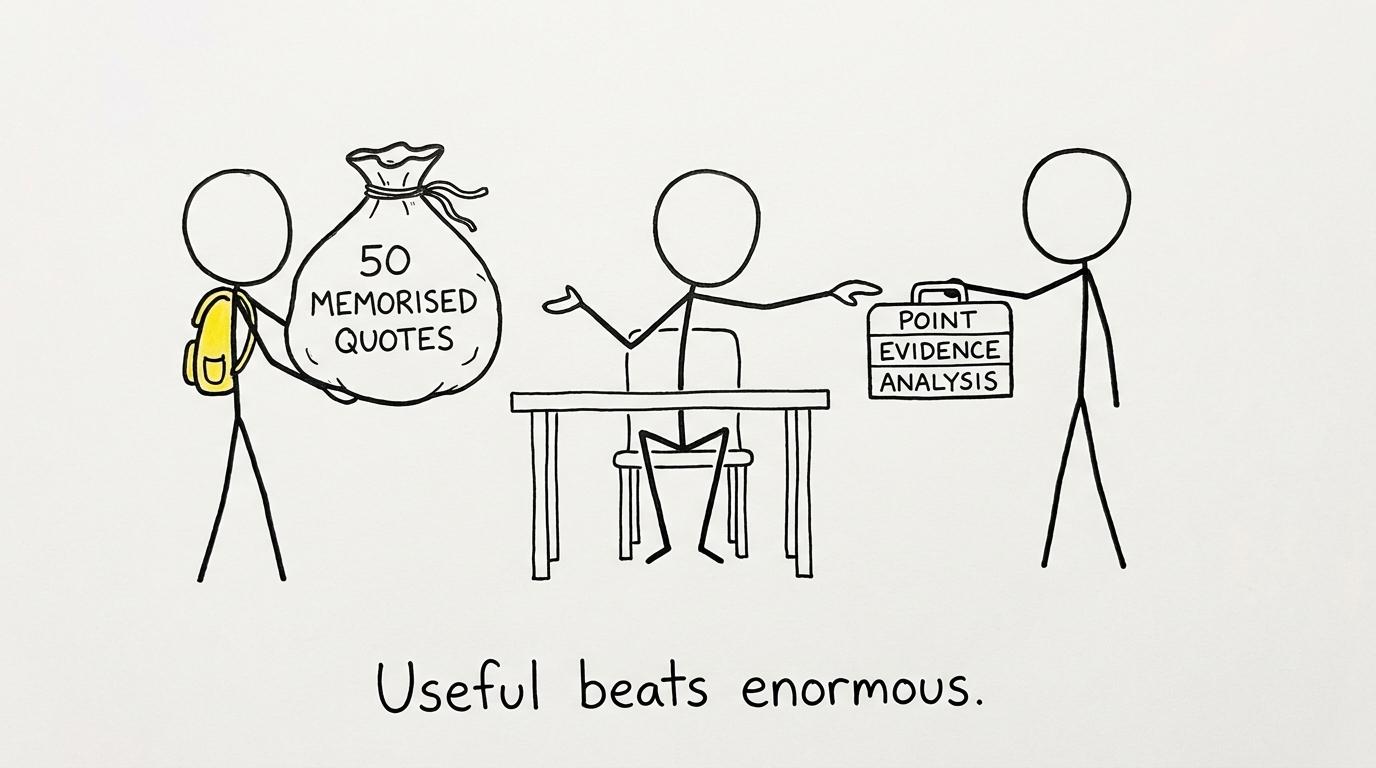 An examiner choosing a compact analysis toolbox over an enormous sack of memorised quotations
Build paragraphs around an argument
A paragraph structure should support thinking, not replace it. Use a flexible sequence:
- Claim: make a precise point that answers the question.
- Evidence: select a short quotation or textual reference.
- Method: identify a meaningful choice in language, form or structure.
- Analysis: explain what that choice suggests and why it matters.
- Connection: link to the wider text, context or another possible interpretation.
- Return: reconnect the paragraph to the central argument.
Before writing, state your overall interpretation in one sentence. Then select moments from different parts of the text that can prove it. This helps you show development rather than producing three versions of the same paragraph.
If you study Macbeth, the Macbeth plot summary and exam guidance can help you locate significant moments. Use summaries to rebuild knowledge, but return to the text and analytical questions before treating revision as complete.
Turn practice into a feedback loop
Writing essay after essay is not automatically effective. Improvement comes from the loop between an attempt and the next attempt:
- Plan or write a response.
- Compare it with the current mark scheme.
- Ask your teacher for feedback where possible.
- Identify one recurring weakness.
- Practise that skill separately.
- Retest it in another response.
Begin with short tasks if full essays feel unmanageable. A timed plan can train question selection. One paragraph can train close analysis. A complete response can then test whether those skills survive time pressure.
Use past questions from the correct specification. The Edexcel GCSE English Literature revision hub, for example, provides board-specific revision resources and past papers. Students preparing for AQA can also use the principles in MathsGenie's English Literature resit revision plan, whether or not they are resitting.
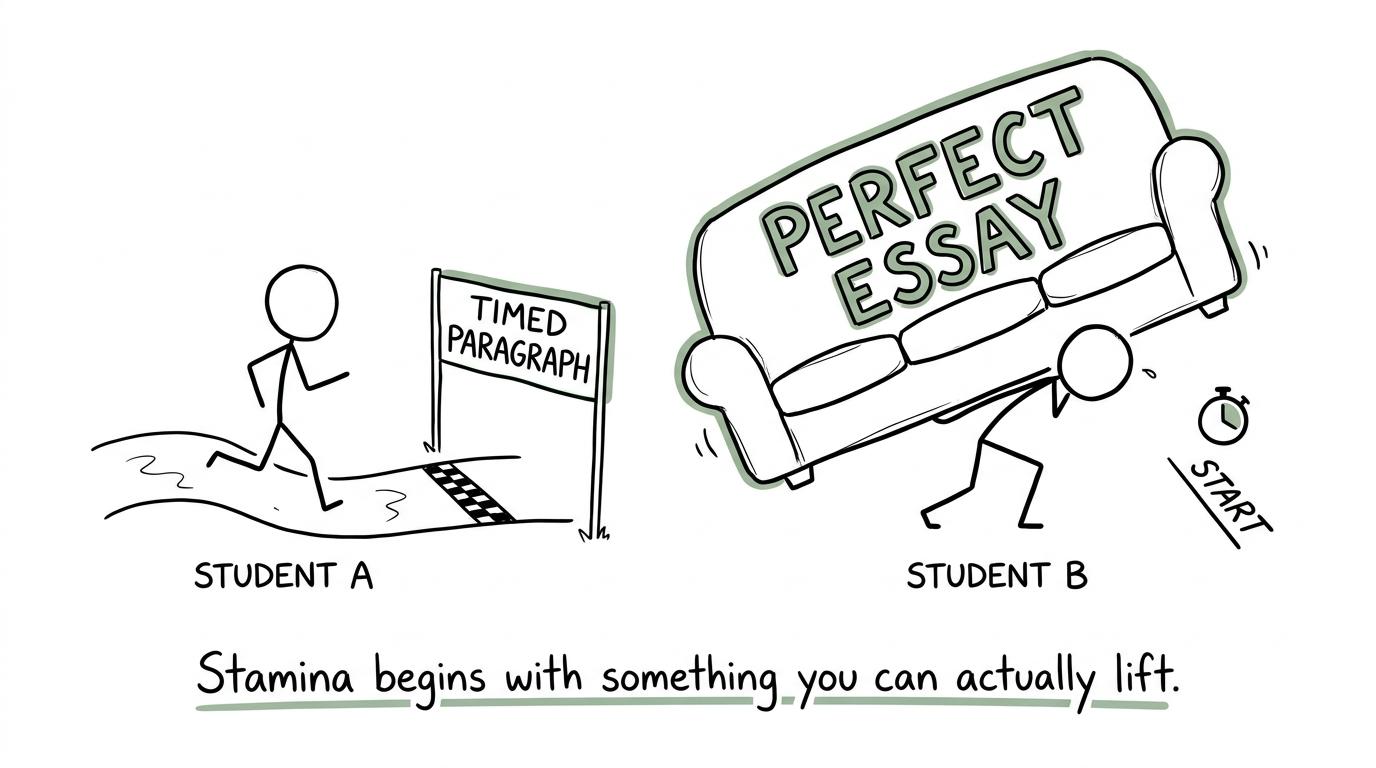 A student practising a manageable timed paragraph while another tries to carry a perfect essay
Revise English without losing momentum in maths
The target audience for this guide has another pressure: maths exams are approaching too. English revision can expand endlessly because there is always another quotation or interpretation to learn. Give each session a defined finish line.
A balanced week might contain:
- two short quotation-retrieval sessions;
- one timed Literature paragraph;
- one longer plan or response;
- immediate review after each task;
- several focused maths sessions covering weak topics;
- one maths mini test or paper section.
When English examinations are close, reduce maths volume rather than stopping completely. A short topic lesson or mini test preserves familiarity. Afterwards, rebuild exam stamina with GCSE predicted papers, past papers, mark schemes and video solutions.
The GCSE English Literature exam-week checklist can help you organise the final days without relying on frantic rereading.
Common mistakes that hold students below grade 6
Retelling the plot
Knowing what happens is necessary, but narration earns limited credit. After every reference, explain how the writer constructs meaning and how it supports your answer.
Forcing a memorised essay onto the question
A polished answer to the wrong question remains the wrong answer. Underline the character, theme and command wording before planning.
Treating technique spotting as analysis
“The writer uses a metaphor” is a starting point. Explore the associations, effect, significance and connection to the text's wider ideas.
Adding context in isolated paragraphs
Context should illuminate the passage or interpretation. Avoid biographical and historical facts that do not change what you can say about the text.
Memorising quotations without practising recall
Familiarity can be misleading. Test quotations with the book closed and use them in plans so that memory becomes application.
Ignoring timing until the final week
Timed writing is a separate skill. Build it gradually through plans, paragraphs and complete responses.
Chasing a fixed boundary
Grade boundaries are set for each exam series and can change. They also differ between exam boards and specifications. Use previous boundaries only as context, as explained in MathsGenie's guide to GCSE English Literature grade boundaries. Focus on gaining marks across every question rather than aiming for an assumed cut-off.
Make grade 6 the result of a system
The habits that tend to move a student towards grade 6 are not dramatic. They are specific: retrieve a useful quotation, plan an argument, analyse a precise method, complete a timed response and correct one weakness before trying again.
That is also how reliable maths revision works. Learn, practise, mark, fix and retest.
Start by completing one diagnostic Literature response this week. Then use MathsGenie to organise the rest of your GCSE workload: revision lessons and practice questions to repair gaps, mini tests to check progress, and past papers or predicted papers with mark schemes and video solutions to build examination confidence. The goal is not to feel endlessly busy. It is to make each session leave you better prepared than the one before it.