

GCSE English Literature Exam Week Checklist (Simple)
GCSE exam week checklist for English Literature, plus smart maths revision you can keep ticking off with YesGenie past papers, mini tests and predicted papers.
When GCSE exam week hits, English Literature can feel like a suitcase you’re expected to carry with one hand: quotes, context, themes, essay structure, unseen poetry. Meanwhile, your maths papers are still waiting in the wings, quietly demanding method marks and calm working. The problem isn’t that you don’t care. It’s that, in GCSE exam week, your brain starts treating everything as urgent, so nothing feels doable.
This checklist is designed to make English Literature feel manageable without sacrificing your maths revision. Think of it as a small set of moves you can repeat: prepare, practise, review, sleep. You’ll leave this week with cleaner paragraphs in English and steadier marks in maths.
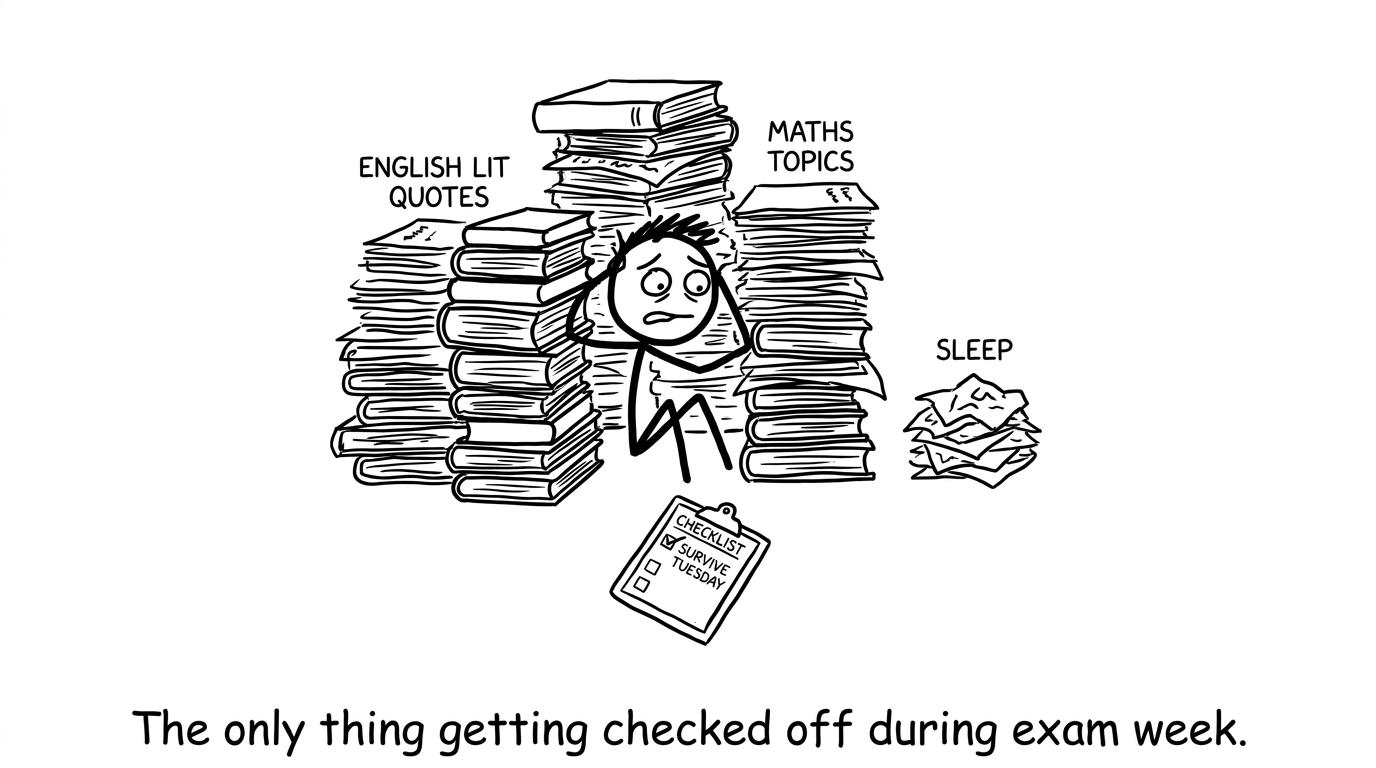 A student ticking a calm checklist during exam week
The simple exam-week checklist (save this)
Keep this as your daily loop during GCSE exam week:
- Know the paper: exam board (AQA, Edexcel, OCR, Eduqas/WJEC), texts, timings, question types.
- Create a quote core: 101010 to 151515 versatile quotes per text (not 505050 you’ll never use).
- Plan paragraphs, not essays: 333 to 444 adaptable paragraph plans per theme/character.
- Do one timed response: alternate between a 454545-minute and a 151515-minute sprint.
- Mark it: use the mark scheme language (AO1/AO2/AO3) to upgrade your next attempt.
- Keep maths ticking: one mini test or a short paper section each day.
- Protect sleep: you’re revising for marks, not punishment.
For your maths routine alongside English, you can lean on YesGenie’s built-in structure: GCSE Past Papers, Edexcel GCSE Maths Predicted Papers, and Edexcel GCSE Maths Mini Tests.
Night before the English Literature exam
The night before a GCSE English Literature paper isn’t for “learning everything”. It’s for reducing panic and increasing control.
Confirm what you’re actually sitting
Write this at the top of your page (yes, physically):
- Exam board: AQA / Edexcel / OCR / Eduqas
- Paper: the exact component (e.g. Shakespeare + modern text / poetry + unseen)
- Start time and travel plan
- Allowed equipment
This sounds basic, but it removes the low-level uncertainty that drains focus.
Build a “quote core” (small, sharp, reusable)
Your job is to choose quotes that flex. A great quote isn’t just “nice”. It attaches to multiple themes.
A simple way to sort quotes:
- Power (control, status, authority)
- Conflict (internal/external)
- Identity (self, society, change)
- Love/loyalty (relationships, sacrifice)
- Fear/ambition (desire, consequences)
Aim for 101010 to 151515 quotes per main text. If you already have 303030, cut them down to your most versatile.
Plan 333 paragraphs you can reuse
Instead of attempting full essays, create adaptable paragraph plans. For example:
- Paragraph on character change (beginning vs end)
- Paragraph on power dynamic (who controls who, and how language shows it)
- Paragraph on writer’s message (what the audience is meant to think/feel)
Your paragraphs should follow the same skeleton each time:
- Point (answer the question)
- Evidence (short quote)
- Analysis (methods: language/structure/form)
- Context (only if it adds meaning)
- Link back to question
If you have 303030 minutes left, do a 151515-minute plan and a 151515-minute paragraph write-up.
Morning of the exam: calm routines that work
On GCSE mornings, the biggest risk is emotional sprinting. You rush, then you arrive already tired.
Use a two-step warm-up
- 5 minutes: read your “quote core” once.
- 10 minutes: write one paragraph from memory.
Stop there. You’re not trying to “peak” by doing loads. You’re trying to enter the exam with your engine already on.
Eat and drink like you’ve got another paper later (because you do)
English Literature is rarely your only GCSE exam that week. Treat your body like it has a schedule to keep.
In the exam: how to turn knowledge into marks
English Literature marks don’t come from knowing the plot. They come from showing the examiner how you think.
Spend time like it’s a budget
A simple time split:
- 555 minutes: annotate the question and choose your angle
- 888 to 101010 minutes: plan 333 to 444 paragraphs
- Remaining time: write
- Final 333 minutes: check and improve (add methods, tighten links)
If your paper is 909090 minutes and you’re writing two substantial answers, you can think in proportions. For instance, a 404040 mark question is about twice the weight of a 202020 mark question, so spend about twice the time.
Write analysis like a method, not a mood
Examiners reward precision. A simple method for AO2 (language/structure/form):
- Identify a device (metaphor, imperative, caesura, enjambment, semantic field)
- Say what it suggests
- Say why it matters to the theme/question
That’s the English equivalent of showing your working in maths.
Keep maths revision alive during English week (without burning out)
Here’s the part most people get wrong in GCSE exam week: they swing between subjects instead of maintaining both. The answer is a tiny, reliable maths routine.
The “one-page maths” rule
Every day of English week, do one of these:
- One mini test, then review mistakes
- One topic worksheet section
- One half-paper (about 454545 minutes)
YesGenie makes this easy to keep consistent:
- Resources on YesGenie for predicted papers, mini tests, and short paper formats
- Edexcel GCSE Maths Revision Guides to refresh a topic quickly
- GCSE Past Papers when you’re ready to practise under time pressure
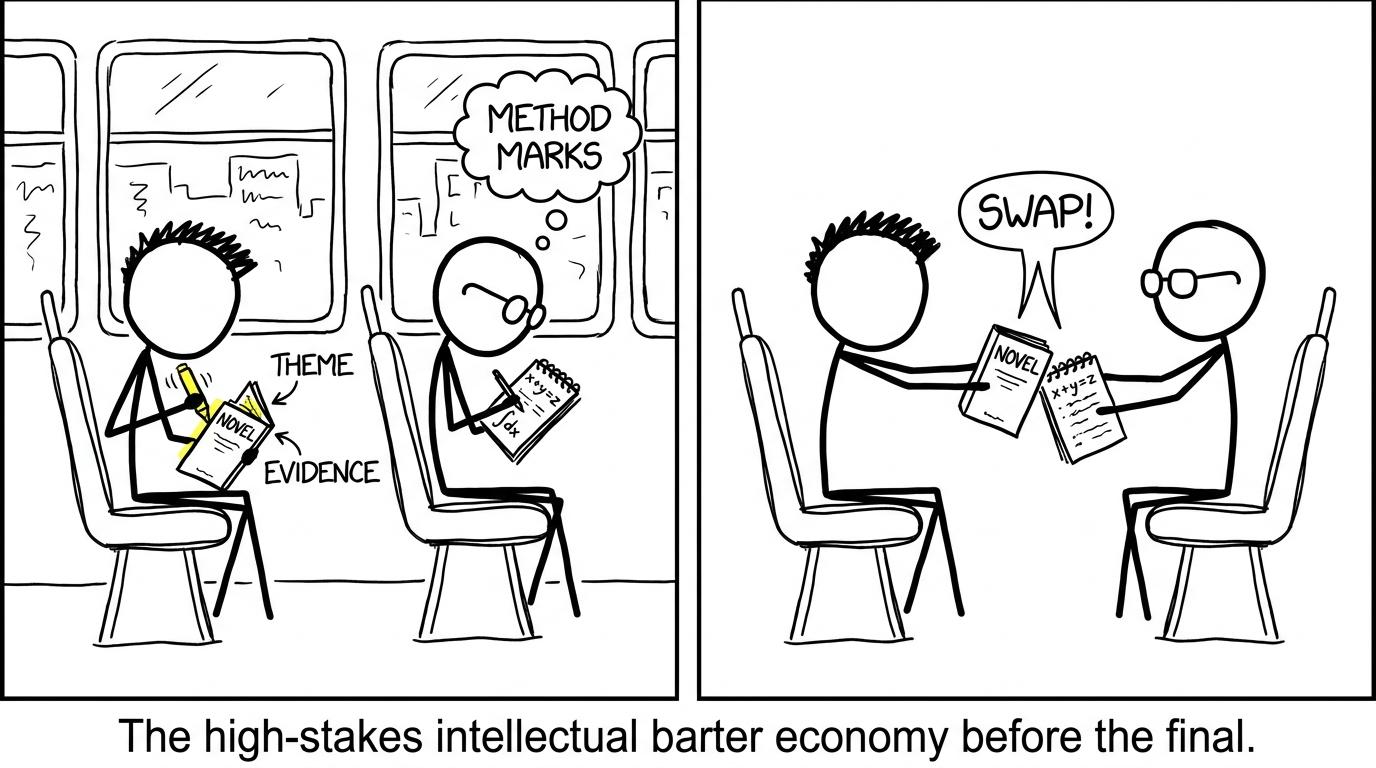 Two students swapping “Theme/Evidence” and “Method marks”
A worked maths example you can do in 6 minutes
On busy GCSE days, pick one short skill and do it cleanly. Example: solve a quadratic.
Solve x2−5x+6=0x^2 - 5x + 6 = 0x2−5x+6=0.
Factorise:
x2−5x+6=(x−2)(x−3) x^2 - 5x + 6 = (x-2)(x-3) x2−5x+6=(x−2)(x−3)Set each bracket to 000:
x−2=0⇒x=2 x-2=0 \Rightarrow x=2 x−2=0⇒x=2 x−3=0⇒x=3 x-3=0 \Rightarrow x=3 x−3=0⇒x=3So the solutions are x=2x=2x=2 and x=3x=3x=3.
That’s not just “maths practice”, but it’s training yourself to stay systematic when you’re tired.
The day after the exam: review without spiralling
After a GCSE English Literature exam, it’s tempting to replay every line you wrote. That rarely helps.
Do a 10-minute post-mortem (then move on)
Write:
- What went well (one sentence)
- What to change next time (one sentence)
- One quote/method you wish you used
Then close it. Use the time you saved to do maths revision you can actually measure.
If you’re switching back to maths heavily, choose one route on YesGenie:
- Do a Mini Test to find weaknesses fast
- Do a Predicted Paper for realistic exam practice
- Use Other Resources for self-assessment and quick targeting
Common mistakes during GCSE exam week (and what to do instead)
- Mistake: memorising huge quote lists. In GCSE English, lots of quotes can feel safe but often reduce your recall. Instead, choose fewer quotes and practise using them in different arguments.
- Mistake: writing essays without plans. You end up repeating the story, not answering the question. Plan 333 to 444 paragraphs and make every paragraph link back to the question.
- Mistake: ignoring the mark scheme language. AO1/AO2/AO3 exist for a reason. Even if you never mention them in the exam, you should write in a way that clearly hits them.
- Mistake: dropping maths revision “until English is done”. Your maths fluency fades quickly during GCSE exam week. Keep it alive with one small, timed task per day.
- Mistake: doing only untimed work. Untimed revision feels productive but doesn’t teach pace. Use timed mini tests and past paper questions, then mark and correct.
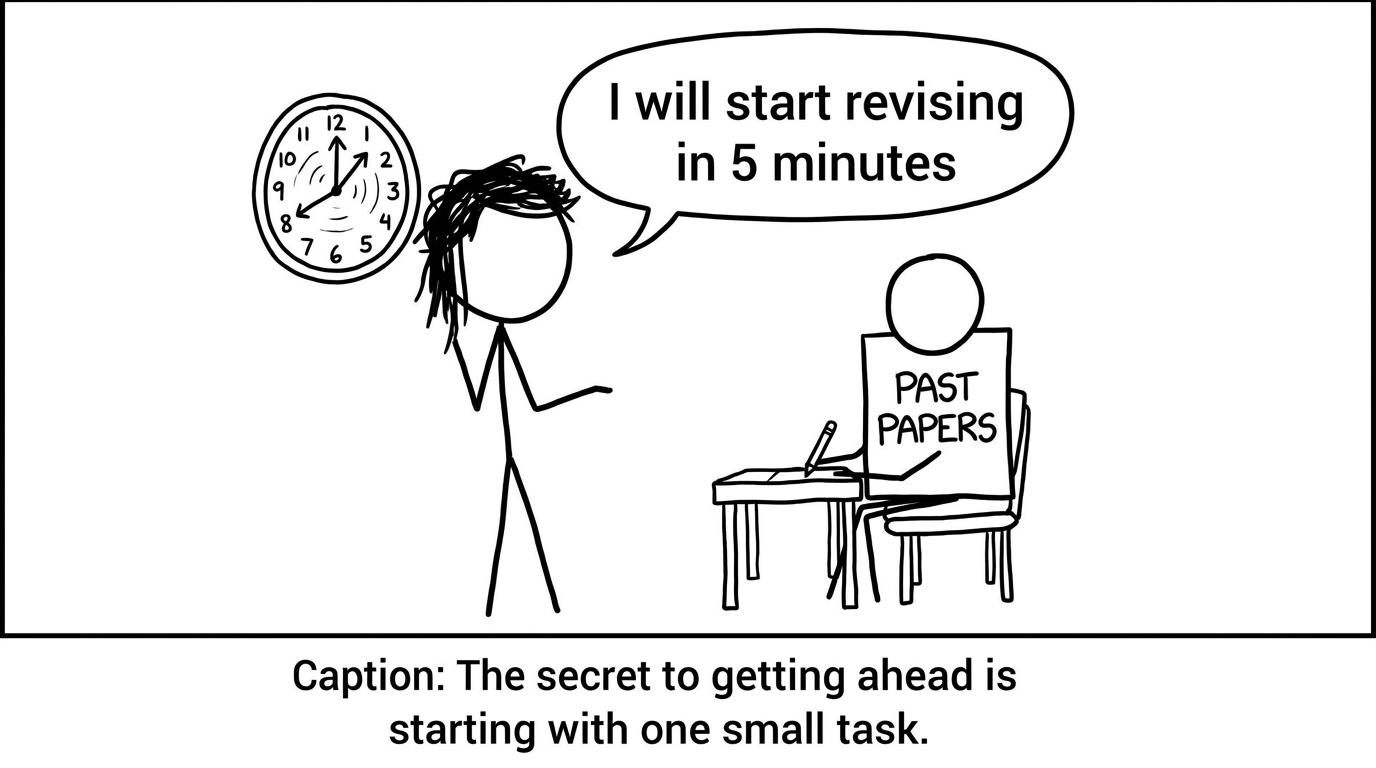 A clock spinning while “Past Papers” starts now
A final checklist to carry into the week
If you’re in GCSE exam week right now, keep it simple:
- Tonight: build the quote core and three paragraph plans.
- Tomorrow: write one timed response and mark it.
- Every day: do one small maths task and review mistakes.
- Two days before maths: switch to past papers and predicted papers.
English Literature rewards calm structure. Maths rewards calm structure too. YesGenie exists for that exact reason: free revision lessons, practice questions, mark schemes, video solutions, mini tests, and realistic GCSE past papers and predicted papers all in one place. Pick your next small task now, open a resource, and let the week become a set of boxes you can tick off, one at a time.










