GCSE English Literature Revision When You’re Stuck at a Pass
GCSE English Literature revision guide for students stuck at a pass grade. Simple methods to boost analysis, quotes, structure and exam timing.
If you are stuck at a pass grade, GCSE English Literature can feel like a locked door: you can see the higher marks, but the key never quite turns. You rewrite the same quotes, you highlight the same pages, you walk into the exam hoping the “right” question appears. Meanwhile your GCSE maths revision feels more honest; you practise, you check the mark scheme, you improve.
The good news is that English Literature has patterns too. Not formulas, but habits: the way you select evidence, the way you explain a writer’s choices, and the way you build an argument under time pressure. Once you treat those habits like skills you can rehearse, your GCSE grade stops being a mystery and starts being something you can climb.
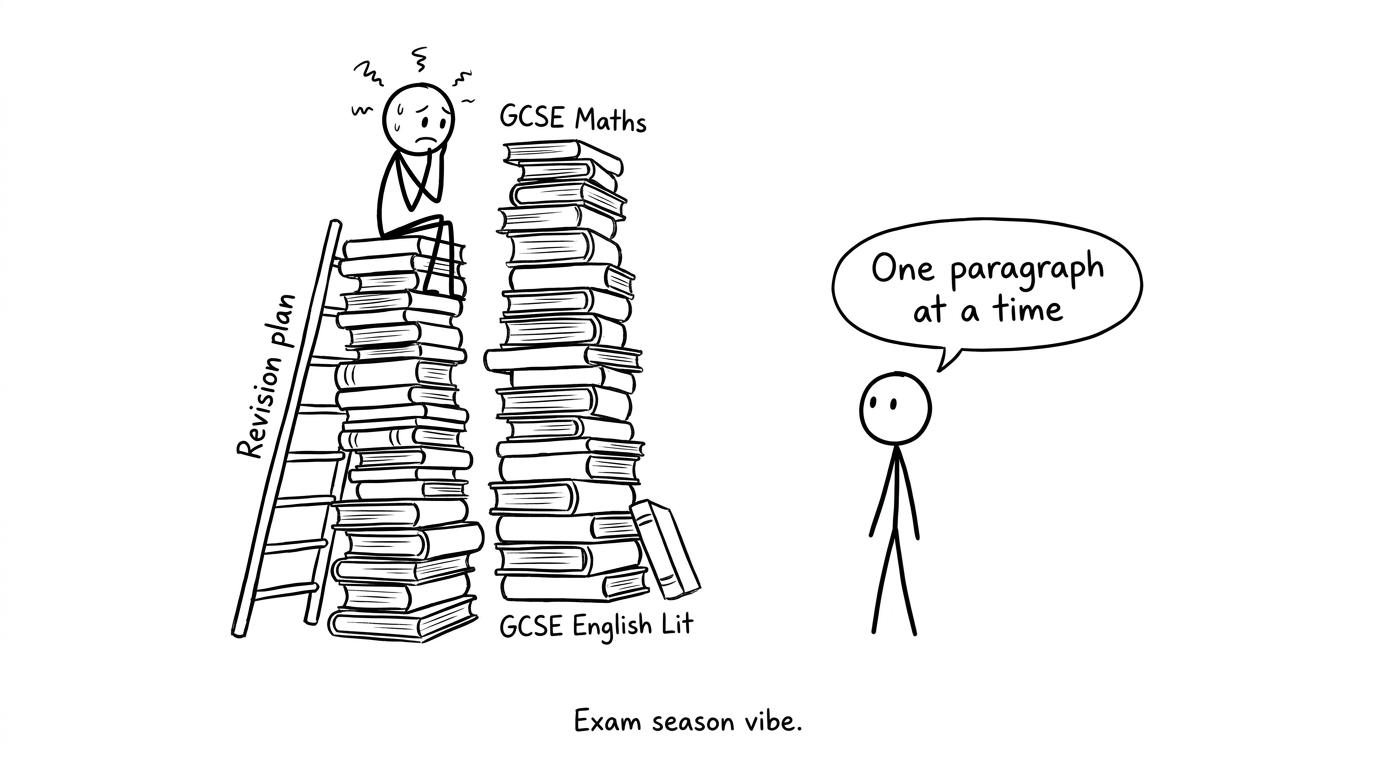 Two stacks labelled GCSE Maths and GCSE English Lit with a revision ladder
A quick checklist to move from a pass to a strong grade
Use this as your “higher tier mindset”, even if English isn’t split into foundation/higher like maths.
- Know what your exam board (AQA, Edexcel, OCR, Eduqas) rewards: argument, methods, context, comparison (depending on paper).
- Learn fewer quotes but learn them better (zoom in on language and structure).
- Practise planning answers quickly, then writing one strong paragraph at a time.
- Use a repeatable paragraph structure so you don’t freeze.
- Mark your own work against a mark scheme style checklist (like you do in maths).
- Do timed practice regularly, because timing is where pass-grade scripts often leak marks.
If you want that same “clear system” feeling in maths, keep your revision anchored with YesGenie’s GCSE Past Papers and the Resources hub alongside your English plan.
Why you’re stuck at a pass grade (and why it’s fixable)
Most pass-grade responses aren’t “wrong”. They’re just thin. They often do three things:
- Retell the story instead of analysing the writing.
- Drop a quote and move on, as if the quote is the analysis.
- Make a point, but don’t develop it into a chain of reasoning.
That’s the exact same problem as doing a GCSE maths question, writing down the final answer, and skipping the working: the examiner can’t award marks for what isn’t shown. In English, your “working” is your explanation of effect, meaning, and intention.
So the target isn’t to read more. It’s to show more thinking per sentence.
Build your “English method” like a maths method
When you’re revising GCSE maths, you don’t aim to “know algebra” in a vague way. You aim to know what to do when you see a quadratic, a ratio table, a circle theorem. English Literature is similar: you need a method that triggers automatically when you see a question.
The paragraph method that lifts pass-grade answers
Use this structure (it works across AQA, Edexcel, OCR and Eduqas with small tweaks):
- Point: a clear argument that answers the question.
- Evidence: a short quote (or two words) that proves the point.
- Analyse: zoom in on one method (word choice, imagery, contrast, rhythm, stage directions, narrative voice).
- Link: link back to the question.
- Alternative: add a second interpretation or a different angle (this is where grades 6-9 start to appear).
Think of it as a five-mark “mini solution”. In maths, a good solution shows a chain of steps; in English, a good paragraph shows a chain of meaning.
Worked example: turning a pass paragraph into a higher-grade paragraph
Imagine an essay question like: How does Shakespeare present ambition in Macbeth?
Pass-grade style (what often happens)
Macbeth is ambitious because he wants to be king. He kills Duncan and then he becomes more evil. Shakespeare shows ambition is bad.
It answers the question, but it’s mostly plot.
Improved paragraph (same idea, more marks)
Shakespeare presents Macbeth’s ambition as a force that corrupts his judgement, because it replaces moral certainty with dangerous imagination. When Macbeth admits he has “vaulting ambition”, the image suggests an uncontrolled leap that can overshoot its target, implying that his desire for power is not steady leadership but reckless risk. The adjective “vaulting” also carries a sense of performance and athletic show; ambition becomes something he wants to display, not simply achieve. This matters because Shakespeare makes Macbeth recognise the problem before he acts, so the tragedy is not ignorance but surrender. Alternatively, Macbeth’s awareness could make him seem more responsible: he chooses ambition even when he can already name its consequences.
Same topic. More method. More thinking on the page.
How to memorise quotes without drowning in them
Most students stuck at a pass grade try to solve the problem with volume: 30 quotes per character, colour-coded, and forgotten by the next week.
Instead, revise GCSE English Literature with “quote clusters”:
- Pick 5-8 versatile quotes per text.
- For each quote, learn:
- one language point (a key word)
- one structure point (position, contrast, repetition, turning point)
- one context point (only if your exam board requires it)
- one alternative interpretation
This is like learning a GCSE maths formula and also learning when it applies, what the variables mean, and common traps.
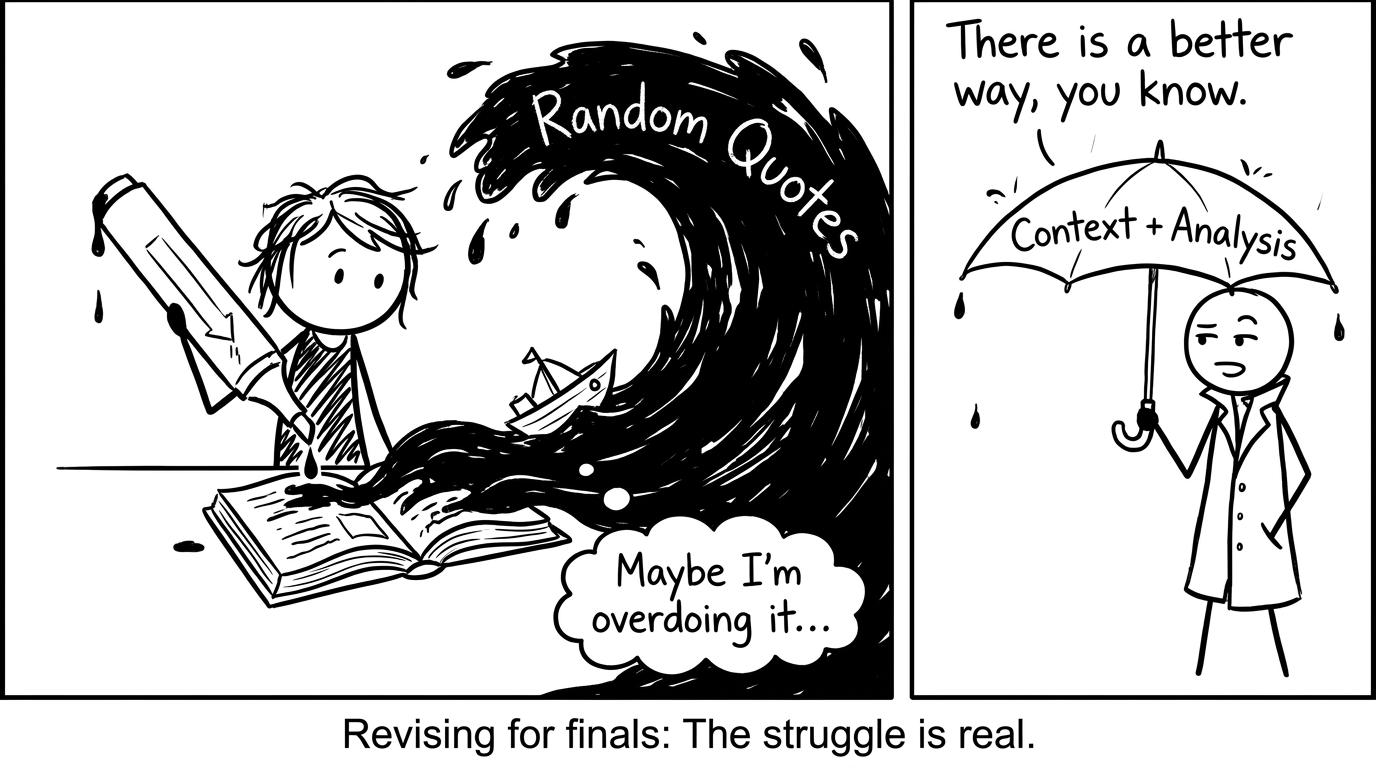 Highlighter flood labelled Random Quotes, umbrella labelled Context + Analysis
Unseen poetry: use a method, not a mood
Unseen poetry is where pass-grade students often panic because they feel they need to “get it right”. But the exam rewards how well you justify your reading.
A reliable unseen method
- Read once: What is the poem’s message in one sentence?
- Read again: Underline shifts (tone change, turn, contrast).
- Pick 3 methods you can genuinely discuss (even simple ones):
- imagery
- contrast
- repetition
- sound (alliteration, harsh consonants)
- form/structure (stanzas, enjambment, ending)
- Write 2-3 paragraphs, each driven by one method.
If you struggle to start, begin with certainty: “The poet presents…” and then prove it with the words on the page.
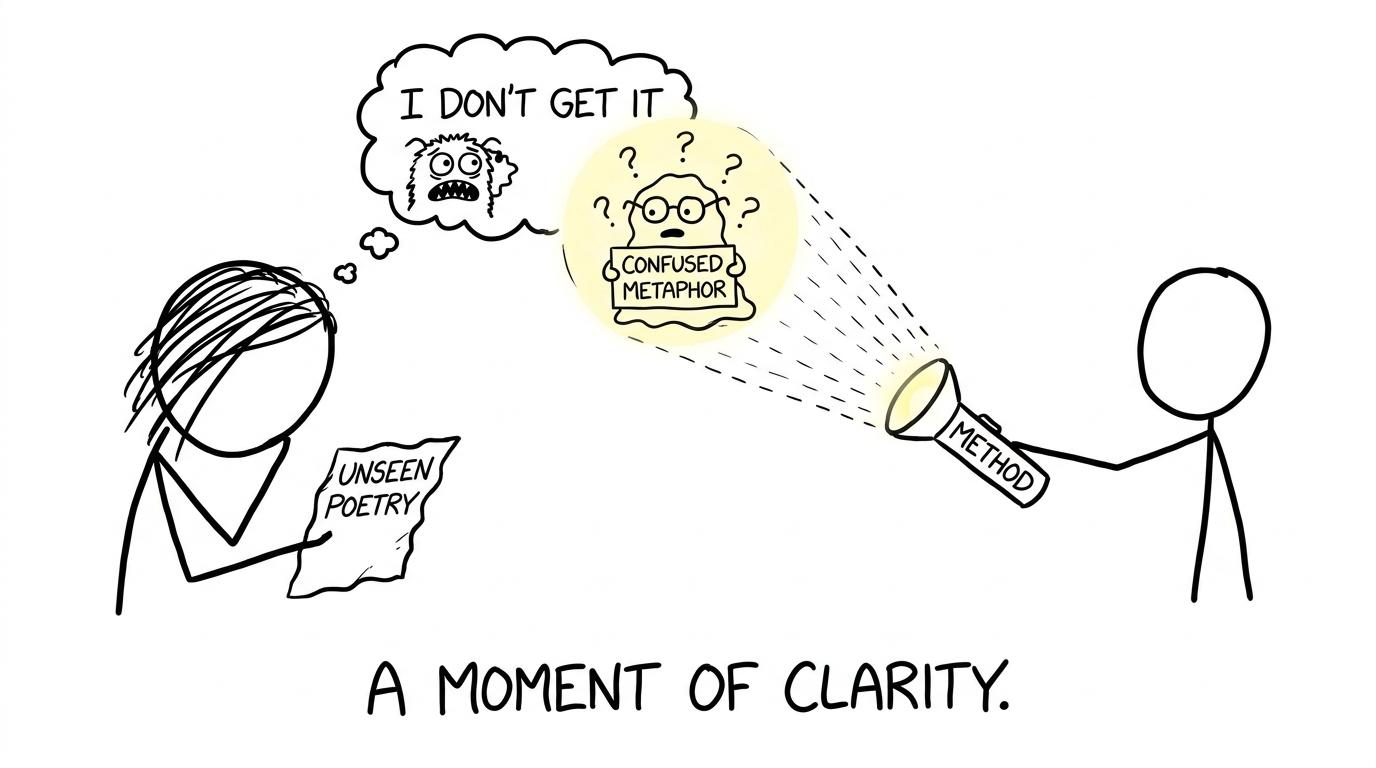 Unseen Poetry monster revealed as a confused metaphor with glasses
Timing: the quiet reason you’re capped at a pass
In GCSE English Literature, many students have decent ideas but run out of time, meaning:
- one question gets half an answer
- the conclusion disappears
- the comparison is rushed
A simple fix is to practise “thin but finished” answers first. A complete response with two strong paragraphs usually beats an unfinished response with three half-paragraphs.
A practical timing routine:
- Plan: 3-5 minutes (bullet points only)
- Write: keep paragraphs tight and analytical
- Leave 2 minutes: add an alternative interpretation to one paragraph (easy marks)
This is the same logic as GCSE maths papers: a fully completed paper with fewer silly mistakes often beats ambitious attempts that collapse under time.
For your maths timing, YesGenie’s Mini Tests and Edexcel GCSE Maths Predicted Papers are perfect “exam stamina” practice.
Use mark schemes like a mathematician (even in English)
You don’t need to become an examiner, but you do need to understand what gets rewarded.
After any practice essay, do a quick self-check:
- Did I answer the question directly in every paragraph?
- Did I analyse specific words and writer’s choices?
- Did I explain effects (on meaning, reader/audience, theme)?
- Did I include a thoughtful alternative interpretation?
- Did I stay focused, not retelling the plot?
In maths, you might use a mark scheme to see where method marks are gained. On YesGenie you can see that idea in action through past paper views like Paper 2: Mark Scheme, then watch how solutions earn marks step-by-step.
Common mistakes that keep you at a pass grade
- Narrating instead of analysing: If your paragraph could be said by someone who hasn’t read the text recently, it’s probably plot.
- Over-quoting: Long quotes often hide a lack of analysis. Two or three words are usually enough.
- Feature spotting: Saying “this is a metaphor” without explaining what it suggests and why it matters.
- Context dumping: Adding historical facts that don’t connect to your argument.
- One-interpretation writing: Higher grades often come from acknowledging ambiguity and offering a second reading.
- Ignoring the question’s key words: For example “how” (methods) versus “to what extent” (argument and judgement).
A revision routine that works alongside maths
Many YesGenie students revise GCSE maths heavily because it’s the subject that gates sixth form choices. That’s sensible. But English Literature can be improved with shorter, sharper sessions.
Try a weekly routine:
- Two short quote sessions (15-20 minutes): build quote clusters and practise analysing one word.
- One timed paragraph (10 minutes): plan and write one paragraph only.
- One timed essay/response (40-45 minutes): mark it with the checklist above.
Then protect your maths progress with structured practice: Edexcel GCSE Maths Revision, Edexcel GCSE Maths Past Papers, and the broader GCSE Past Papers library.
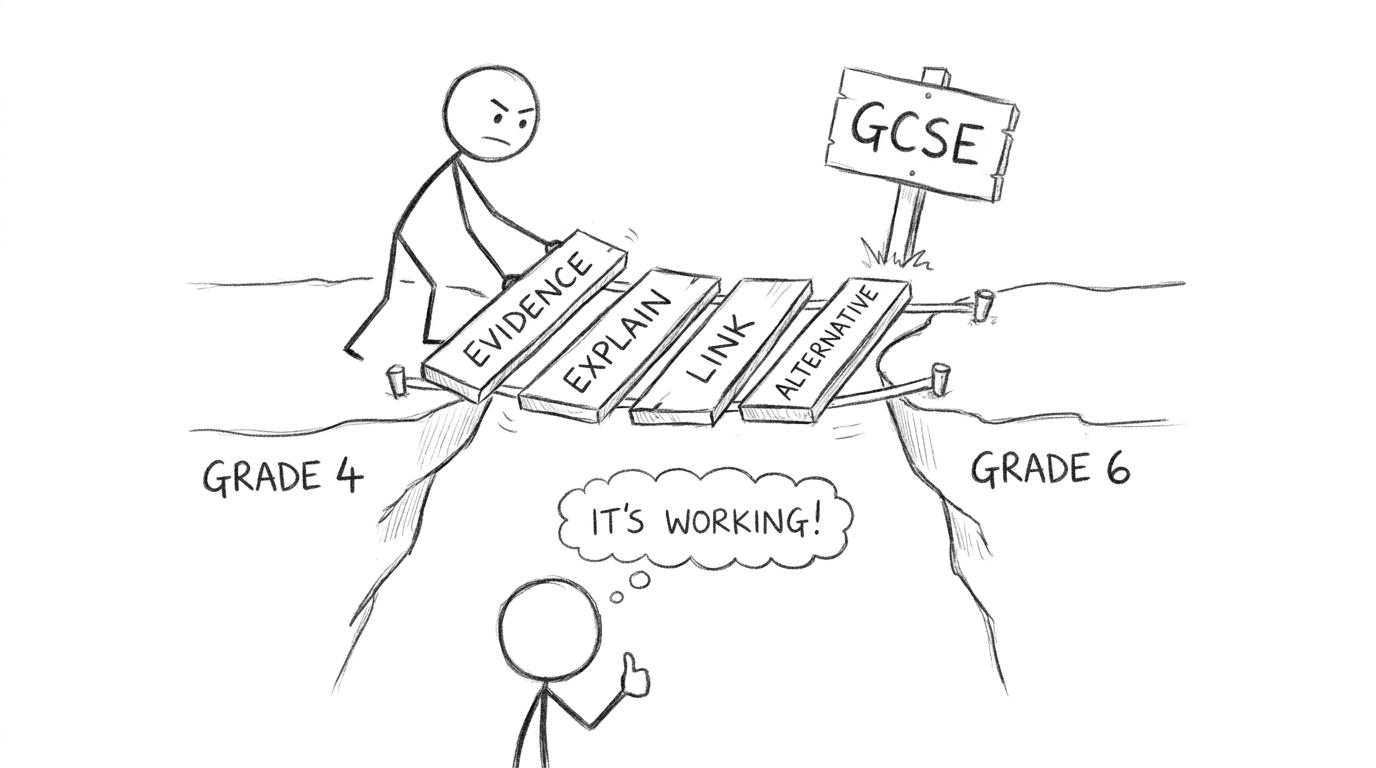 Bridge from Grade 4 to Grade 6 built with planks labelled Evidence, Explain, Link, Alternative
Closing: make GCSE English Lit predictable again
When you’re stuck at a pass grade, GCSE English Literature doesn’t need a dramatic reinvention. It needs a method you can trust: fewer quotes, stronger analysis, clearer paragraph structure, and timed practice that trains you to finish.
Keep your revision balanced. Let English improve through smart, repeatable habits, and let maths stay strong through practice questions, mark schemes, and exam-style papers. If you want a calm, structured way to keep building GCSE confidence, use YesGenie’s free revision lessons, topic practice, GCSE Past Papers, and Resources including predicted papers and mini tests. Show up, practise, review, and repeat; that’s how pass grades turn into progress.