Revise GCSE English Literature Without Wasting Time
GCSE English Literature revision that saves time: smart quote banks, fast essay plans, mark-scheme habits, and a maths-style routine that works.
GCSE season does something strange to time. A week can disappear into colour-coded notes, twenty-minute YouTube spirals, and a growing feeling that you’ve been “busy” without getting better. If you’re a maths student, that feeling is even sharper: you know what effective revision looks like because you’ve felt it in GCSE maths: practise questions, mark schemes, and feedback you can actually use. This guide shows you how to revise GCSE English Literature without wasting time by borrowing the same disciplined approach you already use in maths.
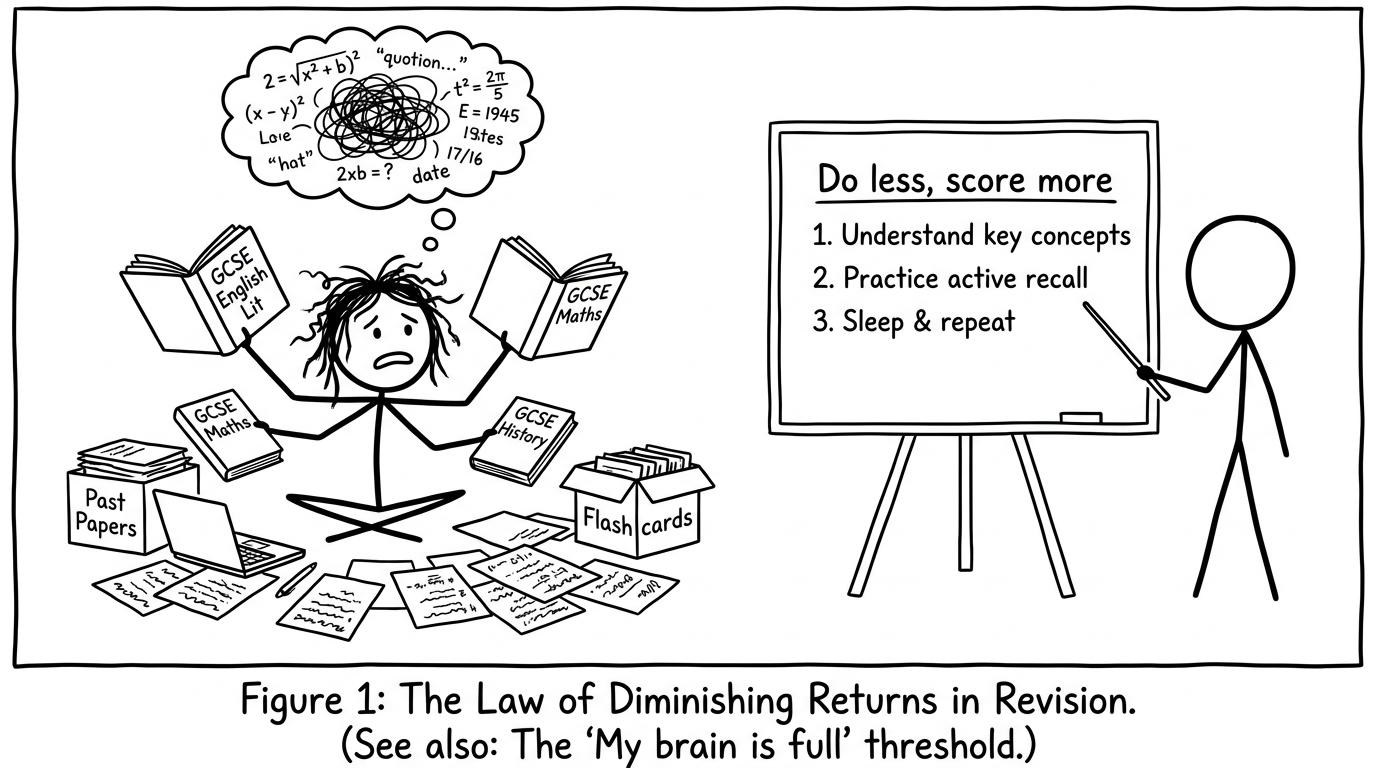 A student tries to revise everything at once while a friend points to a simple checklist
The no-waste checklist (steal this from maths revision)
When revision works, it’s usually because it’s doing three things:
- Reducing uncertainty: you know what you’ll do in the exam, not just what the text is about.
- Forcing recall: you retrieve quotes, ideas, and methods from memory.
- Creating feedback loops: you compare your work to a mark scheme or model answer and close the gap.
That’s the same reason GCSE past papers are so powerful for maths. The trick is to apply the “past paper mindset” to literature.
If you want a home base for the rest of your subjects too, it helps to keep your maths revision simple and centralised, for example using Edexcel GCSE Maths Revision alongside Edexcel GCSE Maths Past Papers and the topic list in Edexcel GCSE Maths Revision Guides. The point isn’t to do everything; it’s to know what “effective” feels like, then copy the pattern.
Why English Literature revision wastes time (and what to replace it with)
Most wasted time comes from revision that looks like effort:
- Re-reading the whole play/novel repeatedly.
- Highlighting until the page glows.
- Writing huge character profiles you’ll never use.
- Memorising random context facts without linking them to an argument.
The replacement is smaller and sharper. In maths, you don’t “revise algebra” by reading a textbook, you answer questions, check solutions, and redo the ones you missed. English Literature is the same shape: question, response, feedback ]},{ improvement.
Here’s your translation table:
- Maths method $ ightarrow$ Literature method
- Formula sheet $ ightarrow$ Quote bank + key ideas
- Past papers $ ightarrow$ Past questions + timed planning + paragraph practice
- Mark scheme feedback $ ightarrow$ AO checklist + self-marking against bands
Build a quote bank like a formula sheet
A GCSE English Literature quote bank should be short enough to hold in your head when you’re tired. Think 12 quotes per text (roughly 4 per theme, overlapping across characters). If you’re doing a Shakespeare play, a 19th-century novel, and an anthology, you’re still only learning a manageable set.
The “12-quote” structure (fast and exam-proof)
For each quote, store four things:
- Micro-quote: 3-8 key words you can drop into a sentence.
- Technique: what you can say about the writing.
- Theme: where it fits across multiple questions.
- Link: one other moment in the text you can connect to.
This works because GCSE questions reward selection more than coverage. You’re not trying to prove you remember the book. You’re trying to prove you can argue.
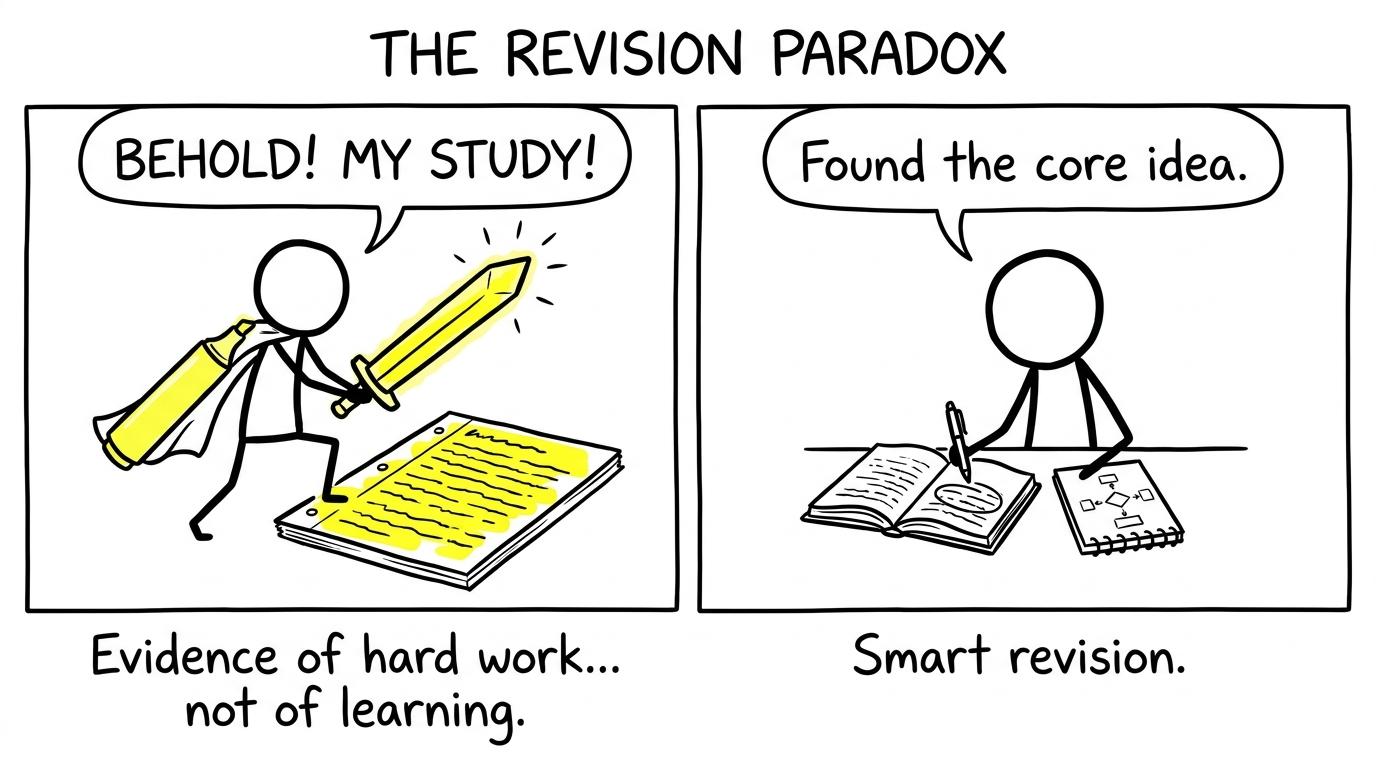 A student highlights an already highlighted page; another circles one key quote
Practise essay planning like you practise problem solving
Maths students often underestimate how much GCSE English Literature is a skills paper. Planning is the skill. It’s the difference between a paragraph that wanders and one that earns marks quickly.
Worked example: a 7-minute plan (the method, not the model answer)
Imagine a typical question:
How does the writer present power in the play/novel?
Step 1: Decide your argument in one sentence (30 seconds).
Your thesis should be simple and debatable. Example shape:
- “The writer presents power as unstable: it looks absolute in public, but it depends on fear, language, and reputation.”
Step 2: Choose 3 points that prove the thesis (2 minutes).
- Point A: Power is performed (public image).
- Point B: Power uses language (commands, persuasion, manipulation).
- Point C: Power collapses (consequences, reversal, exposure).
Step 3: Attach 1-2 quotes to each point (2 minutes).
Use your micro-quotes. If you can’t remember the full line, don’t panic; short embedded quotes are fine.
Step 4: Add context only where it changes the meaning (1 minute).
Context should not be a history paragraph. It should be a lever that shifts your interpretation:
- “In a society structured by class/gender/religion, ‘power’ is often inherited or policed, which makes private rebellion more dangerous.”
Step 5: Add one alternative reading (1 minute).
This is the equivalent of checking your answer makes sense. It’s the line that signals control:
- “Alternatively, the writer suggests power is less about status and more about self-belief, because…”
That’s it. If you can do that under pressure, GCSE English Literature becomes much less mysterious.
Use a simple “marks-per-minute” rule
In maths, you can feel when you’re wasting time: staring at a question rarely increases your marks. Literature has the same trap: writing more isn’t always writing better.
A helpful way to think is marks-per-minute.
If a question is worth 303030 marks and you have 454545 minutes, then your average pace is:
3045=23 \frac{30}{45}=\frac{2}{3} 4530=32That’s about 0.670.670.67 marks per minute. You don’t need to calculate this in the exam, but the idea matters: your writing should be earning marks steadily. If you’ve written half a page without making a clear point, linking to a quote, and analysing language/structure/form, your marks-per-minute is dropping.
A paragraph framework that protects your time
Use a repeatable paragraph shape:
- Point (your claim)
- Evidence (embedded micro-quote)
- Analysis (writer’s method + effect)
- Link (to theme/question and to another moment)
For maths students, it’s like always showing: method, substitution, conclusion.
Self-marking: turn the mark scheme into a coach
You don’t need a teacher in the room to improve. You need a consistent way to judge your work.
After any paragraph or plan, run an AO scan:
- AO1: clear argument, references to the text.
- AO2: analysis of language/structure/form.
- AO3: context linked to interpretation.
Be honest in the way you already are with maths mark schemes: if AO2 is thin, your next practice must deliberately include technique and effect.
To keep that feedback loop alive across your timetable, it helps to use structured resources in other subjects too: for example the Resources hub when you’re building mini routines, and quick-hit practice like Starters for short bursts of retrieval.
A two-week revision routine that fits around maths
Maths often needs daily practice, so English Literature revision has to be efficient. Here’s a routine that respects that.
Week 1: build tools
- Day 1-2: create the 12-quote bank per text.
- Day 3-4: practise 7-minute plans for common themes.
- Day 5-7: write one paragraph per day and self-mark using AOs.
Week 2: practise under constraints
- Alternate days: one timed plan and one timed response.
- End of each session: write a tiny improvement target (e.g. “Use structural analysis in paragraph 2”).
Keep your maths momentum at the same time by continuing your normal routine: topic practice through something like Best Buy Questions (GCSE Maths), then exam technique with Edexcel GCSE Maths Past Papers. The combination matters: GCSE English Literature improves through method; GCSE maths improves through method; your week improves through not reinventing the wheel.
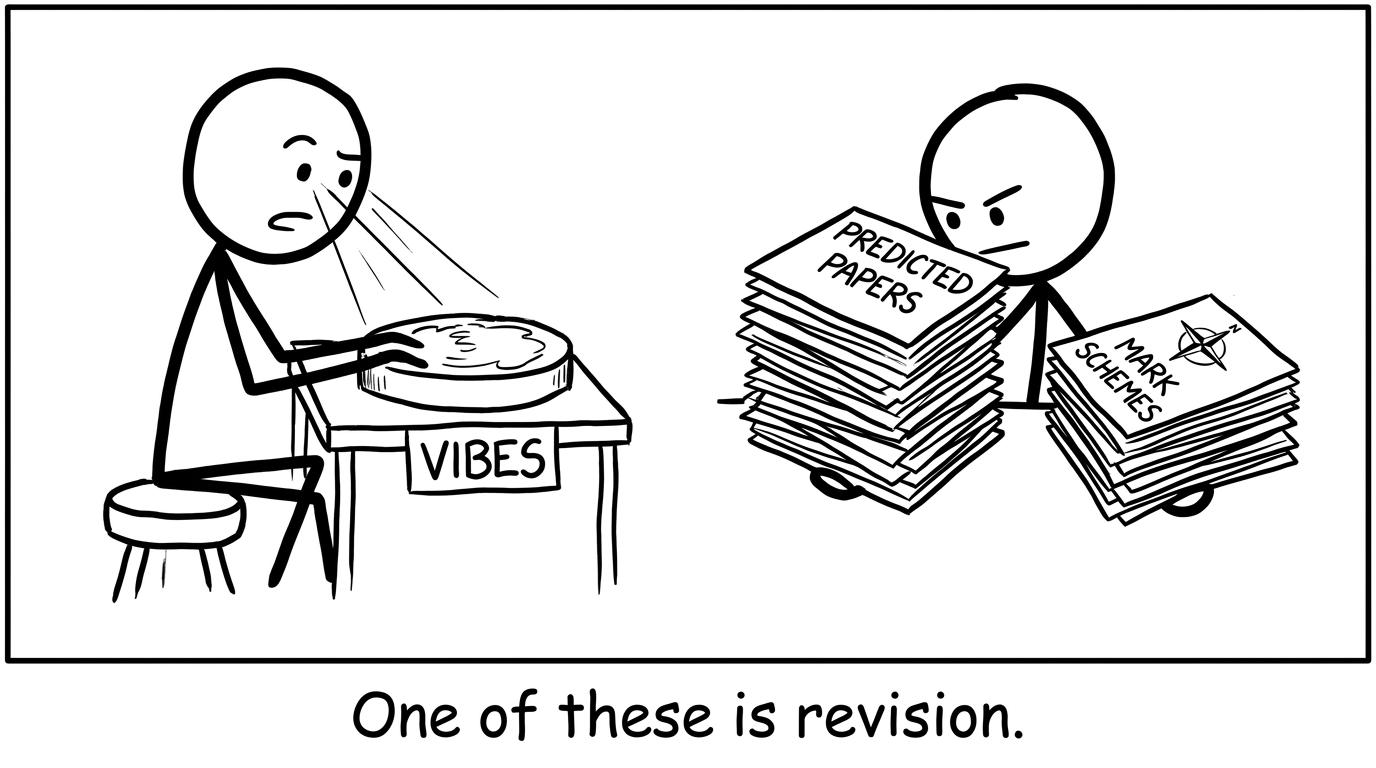 A student uses a crystal ball labelled 'Vibes' while another uses predicted papers and mark schemes like a map
Common mistakes that waste time (and quick fixes)
-
Mistake: re-reading instead of retrieving. Fix: close the book and write what you remember about a scene, then check and patch gaps.
-
Mistake: quotes with no analysis. Fix: after every quote, write “This suggests…” and “The writer achieves this by…”
-
Mistake: context dumped at the end. Fix: only add context if it changes interpretation of the quote or character choice.
-
Mistake: planning too long. Fix: cap plans at 7 minutes. If you can’t decide, pick the cleanest argument and move on.
-
Mistake: writing a story summary. Fix: ban yourself from retelling plot unless it directly supports your point.
-
Mistake: perfectionism. Fix: treat practice like maths; rough attempts plus feedback beat perfect notes.
Closing: revise GCSE smart, not loud
There’s a quiet confidence that comes from doing the right things repeatedly. In GCSE English Literature, that means a small quote bank, fast planning, and feedback that tells you exactly what to fix next. In GCSE maths, it means practise questions, mark schemes, and learning from mistakes.
If you want revision that doesn’t waste time, build your routine around resources that make feedback easy. Use YesGenie to keep maths simple and central: start with Edexcel GCSE Maths Revision, practise with Edexcel GCSE Maths Past Papers and the wider GCSE past papers, and use the Resources hub to add mini tests and structured practice when you need it.
Do less, but do it properly. That’s how GCSE grades move.