

GCSE English Literature Resit: Your Revision Plan
GCSE English Literature resit guide: confirm your exam entry, diagnose lost marks and follow a calm, milestone-based revision plan after results day.
Results day can make one grade feel like a verdict. It is not. If you are considering a GCSE English Literature resit, your first steps are practical: speak to your school or college, check whether a review of marking is sensible, confirm your exam board and arrange an entry for the next available series. Then build revision around the weaknesses that actually cost you marks.
For GCSE English Literature qualifications regulated in England, the usual November resit opportunity does not apply. November GCSE exams are available for English Language and maths, subject to eligibility rules, while English Literature is normally taken in the following summer series. Confirm the arrangements with your centre because rules and specifications can differ in Wales and between qualifications.
Your resit preparation checklist
Before serious revision begins:
- Ask your teacher to review your script or marks, if available.
- Discuss whether a review of marking is appropriate before the deadline.
- Confirm your exam board: AQA, Edexcel, OCR, Eduqas or WJEC.
- Check which texts, poetry cluster and specification you will follow.
- Arrange your exam entry through a school, college or approved centre.
- Request access arrangements early if you need them.
- Complete one timed response to diagnose your weaknesses.
- Create a weekly routine covering knowledge, analysis and timed writing.
Private candidates cannot enter themselves directly. An approved exam centre must make the entry, so do not leave this until the spring.
Milestone one: make the right decision after results day
Disappointment encourages speed. Good decisions usually need evidence.
Ask your school or college how close your mark was to the next grade boundary and whether a teacher can look at the marked script. A review of marking is not a guaranteed grade increase: marks can remain unchanged, rise or fall. Your centre can explain the available post-results services, deadlines and possible fees.
If resitting GCSE English Literature remains the right choice, establish exactly what you are retaking. Open the GCSE English Literature revision hub and choose the correct exam board rather than revising a familiar-looking paper from another specification.
AQA, Edexcel, OCR and Eduqas do not organise texts and questions identically. Even assessment objectives can be applied differently across components. Your specification, paper structure and mark schemes must become the boundaries of your plan.
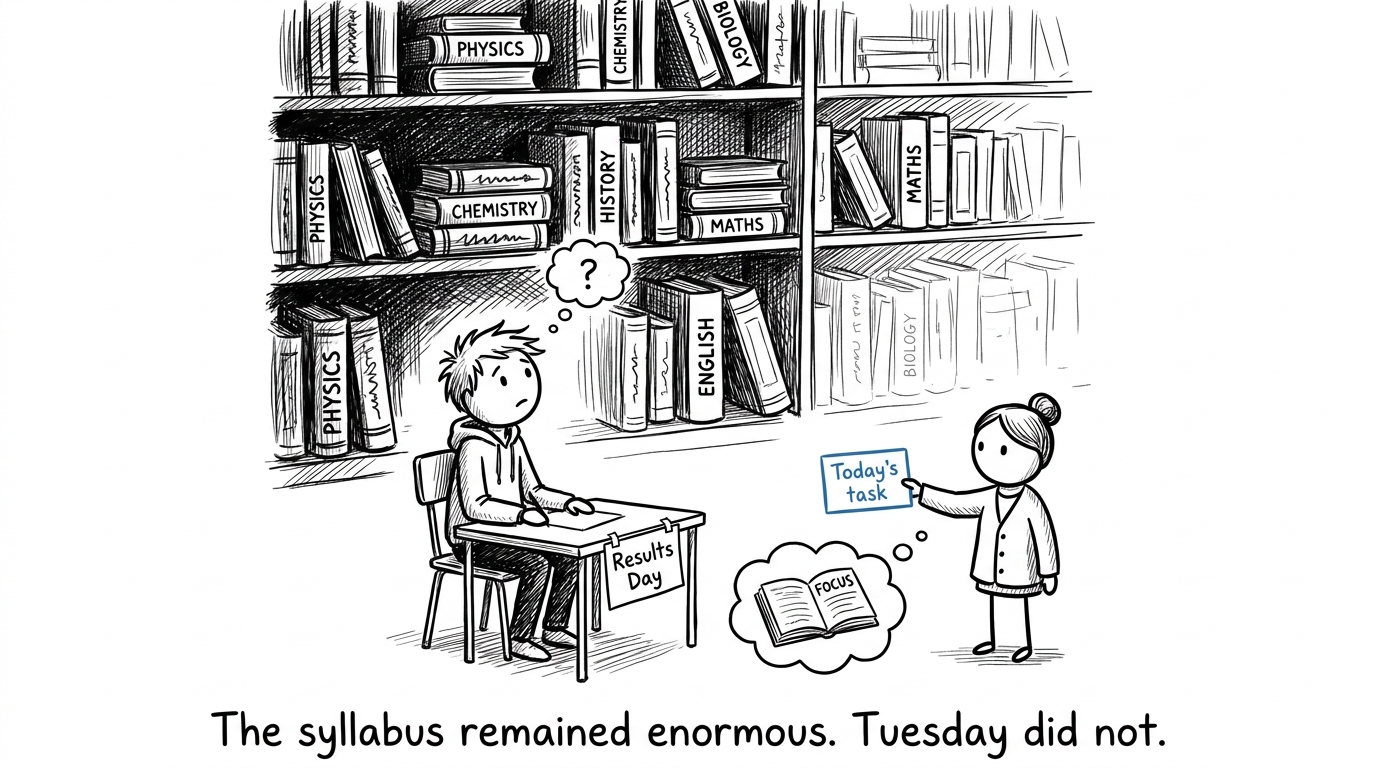 A student discovers that one manageable revision task is less frightening than the whole syllabus
Milestone two: diagnose where the marks disappeared
During the first fortnight, do one timed question from the correct paper. AQA students can use the AQA English Literature past papers, while the main hub provides routes to other boards.
Marking your own literature response is less mechanical than marking a maths paper, but it can still reveal patterns. Sort each weakness into one of these categories:
- Knowledge: uncertain plot, character development, themes or quotations.
- Question focus: writing about the text without answering the exact task.
- Analysis: identifying a method but not explaining its effect or significance.
- Argument: disconnected paragraphs without a sustained interpretation.
- Context: adding historical facts rather than using context to illuminate meaning.
- Timing: an unfinished response or rushed final section.
Use the guidance on finding your weakest English Literature topics to turn this diagnosis into a short action list. If possible, ask a teacher to check one response so your self-assessment is anchored to GCSE standards.
Milestone three: rebuild knowledge without drowning in notes
Over the autumn term, reread each set text and build compact revision materials. The aim is not to reproduce the novel or play from memory. It is to know enough flexible evidence to answer unfamiliar questions.
For each text, prepare:
- a timeline of essential events;
- character arcs and important relationships;
- recurring themes and writer’s methods;
- short, versatile quotations;
- relevant contextual ideas connected to interpretation;
- links between poems, where comparison is assessed.
Test quotation recall rather than repeatedly highlighting notes. Cover the quotation, retrieve it, check it and revisit it later. For further structure, use MathsGenie’s guide to revising English Literature without wasting time.
AQA candidates should remember that the assessments are closed book, although required extracts and stimulus materials are supplied in the papers. Check the current rules for your own board instead of assuming every assessment works in the same way.
Milestone four: turn knowledge into exam writing
From January onwards, shift the balance towards planning and writing. Each week should include a mixture of quick recall, essay plans, individual paragraphs and timed responses.
A useful paragraph should make a claim that answers the question, support it with precise textual evidence, analyse language, form or structure, and explain why the idea matters. Context should deepen the interpretation rather than interrupt it.
After every response, record one improvement target. “Revise poetry” is too broad. “Compare the poets’ use of structure in one timed paragraph” gives you something you can actually complete.
Use AQA English Literature revision resources or the relevant board page, such as Eduqas English Literature revision, to keep practice aligned with your specification.
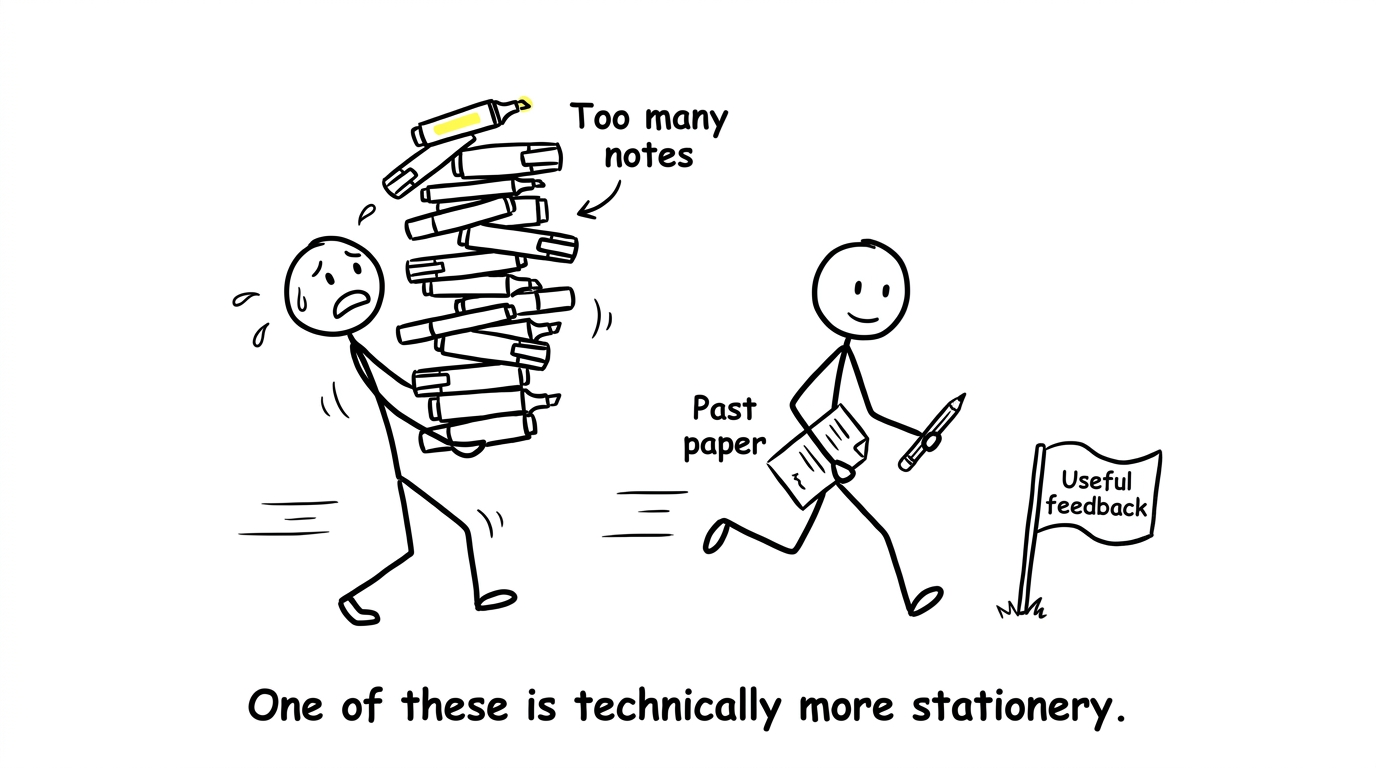 One student carries too many highlighters while another calmly reaches useful feedback with a past paper
Milestone five: rehearse the complete papers
In the final term, complete full papers under timed conditions. Use the precise timings for your current specification and remove notes unless the assessment permits them.
Do not simply record a mark and move on. Review where your argument weakened, which quotations were unavailable under pressure and where time disappeared. Then practise that weakness separately before attempting another paper.
The English Literature exam-week checklist can help you simplify the final days. If you are also preparing for a maths resit, keep the subjects in separate, manageable sessions. MathsGenie’s GCSE maths revision hub provides lessons, worksheets, practice questions, past papers, predicted papers and mark schemes without disrupting your literature plan.
Common GCSE English Literature resit mistakes
Assuming the resit is in November
For qualifications regulated in England, November availability covers GCSE English Language and maths, not English Literature. Plan for the next summer series unless your centre confirms different arrangements for your qualification.
Changing exam board without checking the consequences
Different boards use different texts, components and question styles. Confirm your entry and specification before buying books or preparing quotations.
Rereading instead of retrieving
Rereading feels fluent because the page supplies the information. Closed-book recall requires you to retrieve ideas and quotations without that support.
Writing constantly without using feedback
Five essays with the same weakness are repetition, not progress. Mark each response, select one repair target and test it in the next task.
Neglecting other resit subjects
English Literature should not consume every available hour. If maths is also part of your plan, use short GCSE maths worksheets and timed practice to maintain momentum in both subjects.
A resit is a second attempt with better information
The advantage of resitting GCSE English Literature is not simply having more time. It is having evidence. You now know what the papers feel like, where pressure affected your writing and which parts of the course need rebuilding.
Start by confirming your entry. Diagnose one response. Build concise knowledge, practise purposeful paragraphs and finish with timed papers. MathsGenie gives you free English Literature past papers, questions and revision resources, alongside maths revision lessons, worksheets, mini tests, predicted papers, mark schemes and video solutions. Choose your exam board today and turn the next small task into the beginning of a calmer resit year.











