

GCSE English Literature Grade Boundaries 2026
GCSE English Literature grade boundaries explained for 2026: learn how marks become grades, when boundaries appear and what to check on results day.
Waiting for a result creates an uncomfortable gap between what you remember writing and what the examiner eventually records. In that gap, rumours grow quickly. A difficult poetry question becomes “the boundaries must fall”, while an accessible Shakespeare extract becomes “everyone will need nearly full marks”.
The useful answer is simpler: GCSE English Literature grade boundaries are the minimum total marks needed for each grade. They are set after marking, can change each year and are not confirmed in advance. As of 30 July 2026, the official English Literature grade boundaries 2026 have not been published. They will become available on GCSE results day, Thursday 20 August 2026.
GCSE English Literature results day checklist
Before analysing your result, check these five things:
- Your exam board: AQA, Edexcel, OCR or Eduqas.
- Your exact English Literature specification.
- Your overall grade and, if available, total raw mark.
- The official qualification-level boundary for that specification.
- How far your mark sits above or below the next boundary.
MathsGenie's GCSE grade boundaries hub provides a straightforward place to compare published figures. Do not use another board's table, even when the papers have the same maximum mark.
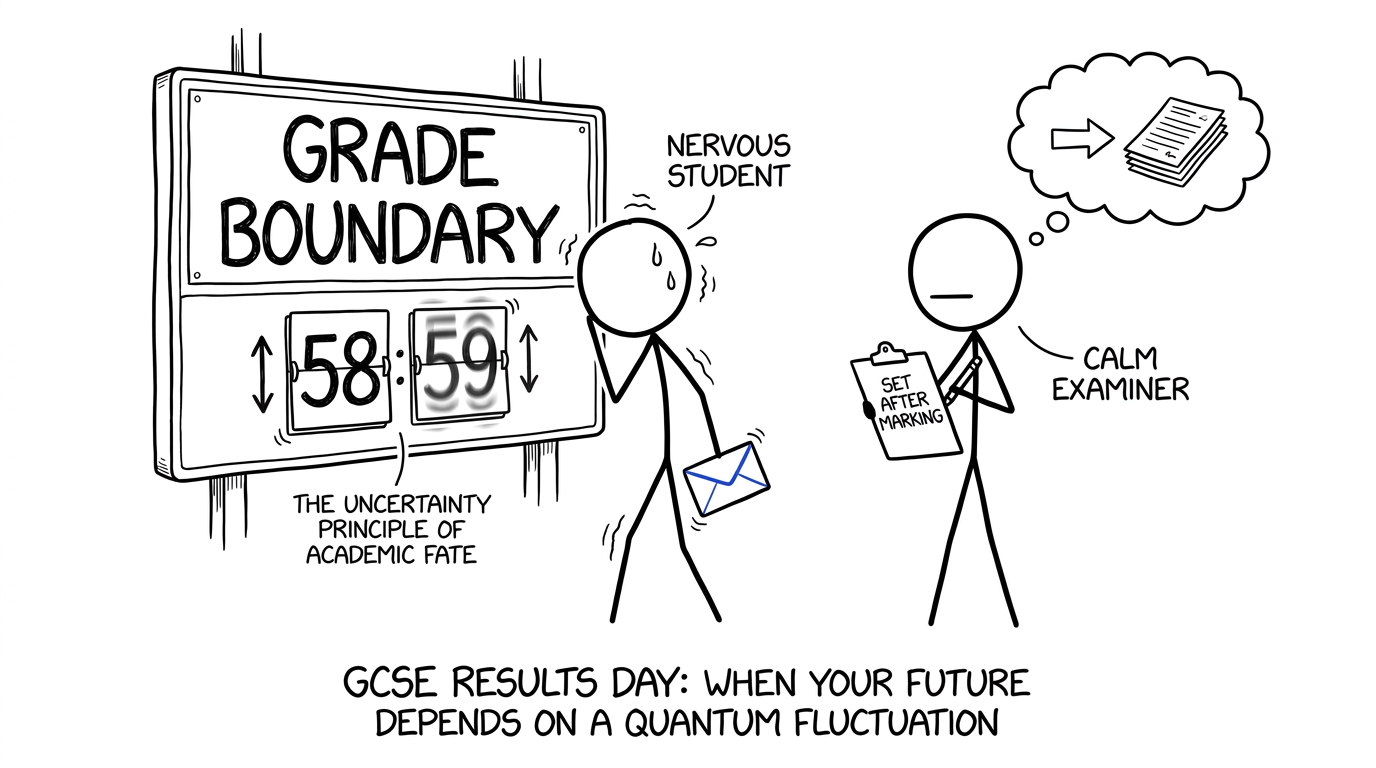 A nervous student watching a grade boundary results board
How GCSE English Literature grade boundaries work
A grade boundary is a threshold, not a target decided before the exam. Suppose the grade 555 boundary is 878787 marks. A total of 878787 earns grade 555, while 868686 remains within the grade 444 range.
Exam boards set boundaries after scripts have been marked. They examine statistical evidence, compare performance with previous years and ask senior examiners to review work around possible thresholds. This allows boundaries to reflect the difficulty of that year's papers while maintaining comparable grading standards.
There is no fixed percentage that always earns a grade 444, 777 or 999. There is also no predetermined quota requiring a set number of students to pass or fail.
English Literature is untiered under the mainstream AQA, Edexcel, OCR and Eduqas GCSE specifications. Unlike GCSE Maths, there is no foundation or higher tier boundary to select. Students taking the same specification can access grades 999 to 111.
Overall boundaries matter most
Your final grade normally comes from the combined result across the qualification. Exam boards may also publish notional boundaries for individual papers, but these are intended for analysis. They do not create separate paper grades that are then averaged.
This matters because a weaker poetry paper can be balanced by stronger work elsewhere. The decisive comparison is usually:
combined qualification markagainstoverall grade boundary\text{combined qualification mark} \quad \text{against} \quad \text{overall grade boundary}combined qualification markagainstoverall grade boundaryWhat are the English Literature grade boundaries 2026?
Nobody can reliably state the official figures before results day. Online predictions may use historical averages, but the 2026 boundaries can only be set using evidence from the 2026 papers and completed marking.
The most recent confirmed summer boundaries can provide context, not a promise. These were the June 2025 qualification-level figures:
| Exam board | Maximum mark | Grade 999 | Grade 777 | Grade 555 | Grade 444 |
|---|---|---|---|---|---|
| AQA | 160160160 | 136136136 | 108108108 | 777777 | 626262 |
| Edexcel | 160160160 | 135135135 | 115115115 | 878787 | 737373 |
| OCR | 160160160 | 133133133 | 101101101 | 666666 | 494949 |
| Eduqas | 200200200 | 150150150 | 126126126 | 989898 | 858585 |
The differences do not mean one board is automatically easier. Specifications, questions and assessment structures differ, while regulators require comparable standards. You can explore the historical Edexcel English Literature boundaries and Eduqas English Literature boundaries on MathsGenie.
Worked grade boundary example
Consider a hypothetical student who took Edexcel English Literature in June 2025. They received 424242 marks on one paper and 333333 on the other:
42+33=7542+33=7542+33=75Their overall mark was therefore 757575 out of 160160160. The 2025 Edexcel grade 444 boundary was 737373, while grade 555 required 878787.
Because
73≤75<87,73\leq75<87,73≤75<87,the student received grade 444. They were 222 marks above the grade 444 boundary and 121212 marks below grade 555.
Their percentage was
75160×100=46.875%≈46.9%.\frac{75}{160}\times100=46.875\%\approx46.9\%.16075×100=46.875%≈46.9%.That percentage is descriptive only. It does not establish a permanent pass percentage for future exams.
What to do when you receive your result
First, read the result that actually exists rather than comparing it with the grade you feared overnight. Your results slip may show only the final grade, so ask your school or exams officer whether your component and total marks are available.
If you are close to the next boundary, speak to a teacher before requesting a review of marking. A review checks whether the mark scheme was applied correctly; it is not an automatic search for extra marks. Marks can rise, stay unchanged or fall, and deadlines and charges depend on the exam board and your centre.
A grade 444 is commonly described as a standard pass and grade 555 as a strong pass, but sixth forms, colleges and courses set their own entry requirements. If your result affects an offer, contact the institution promptly and ask what evidence or alternatives it will consider.
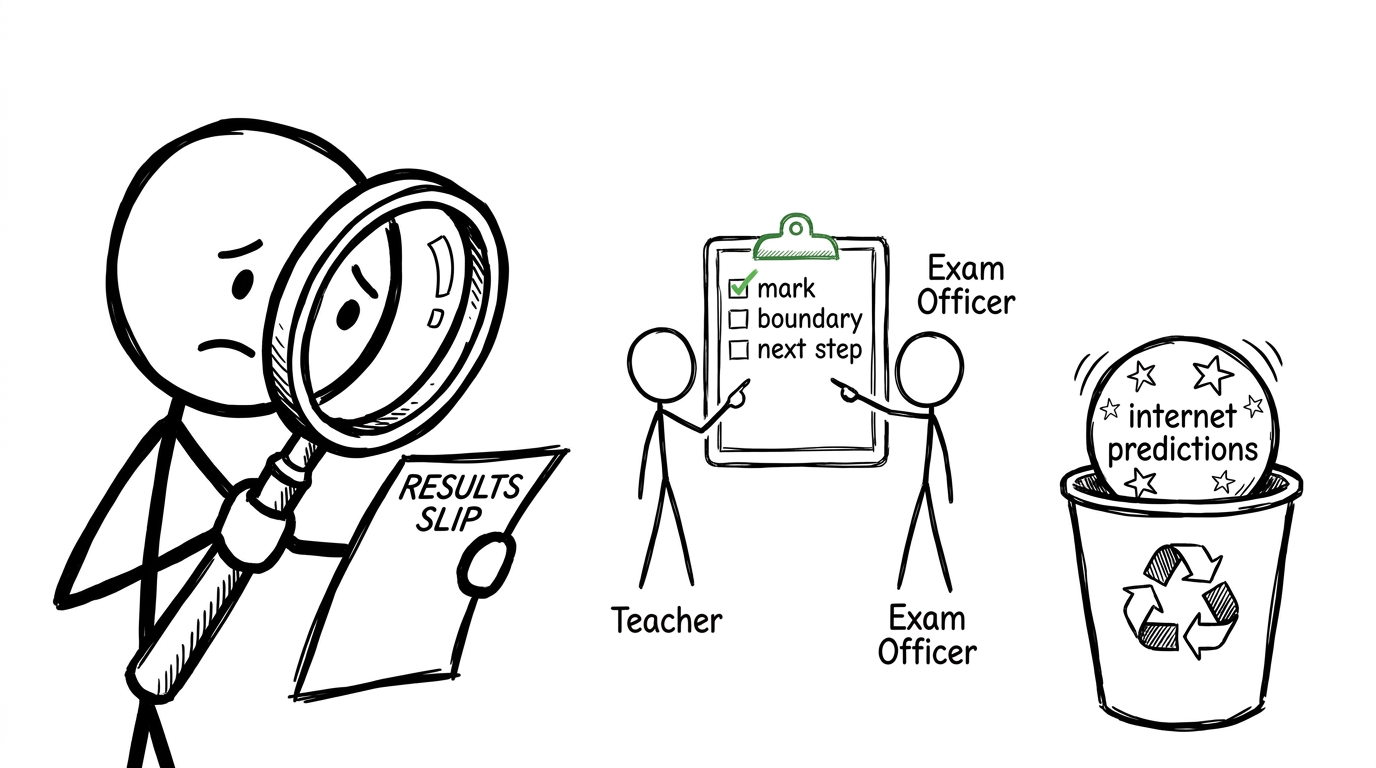 A student checking a results slip while a crystal ball of predictions is discarded
Common mistakes on GCSE English Literature results day
Treating predictions as confirmed boundaries
Historical data can suggest a range, but it cannot reveal the official 2026 threshold. Use published results-day figures only.
Comparing different exam boards
AQA and OCR may both have totals out of 160160160, yet their papers and boundaries are not interchangeable. Always match the board and specification code.
Averaging supposed paper grades
Notional component boundaries are not separate final grades. Compare your combined mark with the overall qualification boundary.
Assuming a review can only help
A reviewed mark may move up or down. Ask a teacher to inspect the mark breakdown and consider how many marks are needed before making a decision.
Confusing English Language with English Literature
These are separate GCSEs with separate boundaries. Check the subject title carefully before interpreting your result.
Turn the result into a useful next step
A result is a record of one assessment series, not a complete description of what you can do. If you are awaiting a resit decision, planning sixth-form work or simply want to understand where marks were lost, return to evidence: the specification, past questions and mark schemes.
Start with MathsGenie's free GCSE English Literature revision hub, then choose your board. The AQA English Literature revision resources and OCR English Literature revision resources bring together revision guides, practice questions, past papers and mark schemes.
For a more focused routine, use the guide to revising GCSE English Literature without wasting time and learn how to identify your weakest English Literature skills. Revision lessons, flashcards, mini tests, predicted papers and structured practice can then turn a boundary from something you worry about into something you understand.











