

How Long Should You Revise GCSE French Per Week?
How long revise GCSE French per week? Build a realistic plan based on months left, balance four skills, and protect enough time for GCSE maths revision.
Revision time has a strange habit of expanding in your imagination. A French vocabulary list can feel endless, while the next maths paper quietly waits for attention. If you are asking how long revise GCSE French per week, the practical answer is usually between 1.51.51.5 and 444 hours of independent revision, depending on how close the exams are and how secure your knowledge already is.
With more than 666 months remaining, around 1.51.51.5 to 222 hours each week may be enough. At 333 to 666 months, aim for 222 to 333 hours. During the final 666 to 121212 weeks, many students will benefit from 333 to 444 focused hours. These are planning estimates, not official exam-board requirements. Your teacher's feedback, target grade and current performance matter more than any universal total.
The deeper lesson is simple: French improves through frequent contact. Four short sessions normally achieve more than one exhausting Sunday evening, while leaving enough space for your other GCSEs.
Your GCSE French weekly revision checklist
Use this as a starting point, then adjust it using your results and teacher feedback:
- Check how many months remain before your speaking and written assessments.
- Count active homework towards your total if it genuinely involves retrieval or exam practice.
- Divide revision between listening, speaking, reading and writing.
- Include vocabulary and grammar within those four skills rather than treating them as separate subjects.
- Use several short sessions instead of one weekly marathon.
- Review mistakes and revisit weak material later in the week.
- Protect regular time for maths and your other GCSE subjects.
- Increase the schedule gradually as the exams approach.
For your maths planning, the GCSE maths revision timetable guide can help you build a balanced week rather than allowing one subject to consume every free evening.
How long should you revise GCSE French per week?
A realistic schedule changes as the examination gets closer.
| Time before the exam | Suggested French revision each week | Suitable pattern |
|---|---|---|
| More than 666 months | 1.51.51.5 to 222 hours | 444 short sessions |
| 333 to 666 months | 222 to 333 hours | 444 or 555 sessions |
| 666 to 121212 weeks | 333 to 444 hours | 555 or 666 sessions |
| Fewer than 666 weeks | 444 to 555 hours where sustainable | Frequent short practice plus timed tasks |
Treat these ranges as a sensible ceiling and floor, not a promise of a particular grade. A student confidently recalling vocabulary and producing accurate extended answers may need less time than someone rebuilding major gaps. Higher-tier candidates may also require longer practice with complex grammar and extended responses, but foundation-tier revision still needs to cover every assessed skill.
If your school sets substantial French homework, include useful active work in the total. Copying vocabulary while looking at the answers is less valuable than attempting to recall it first. Similarly, watching a French video can support exposure, but it should not replace focused listening questions, transcription or checking.
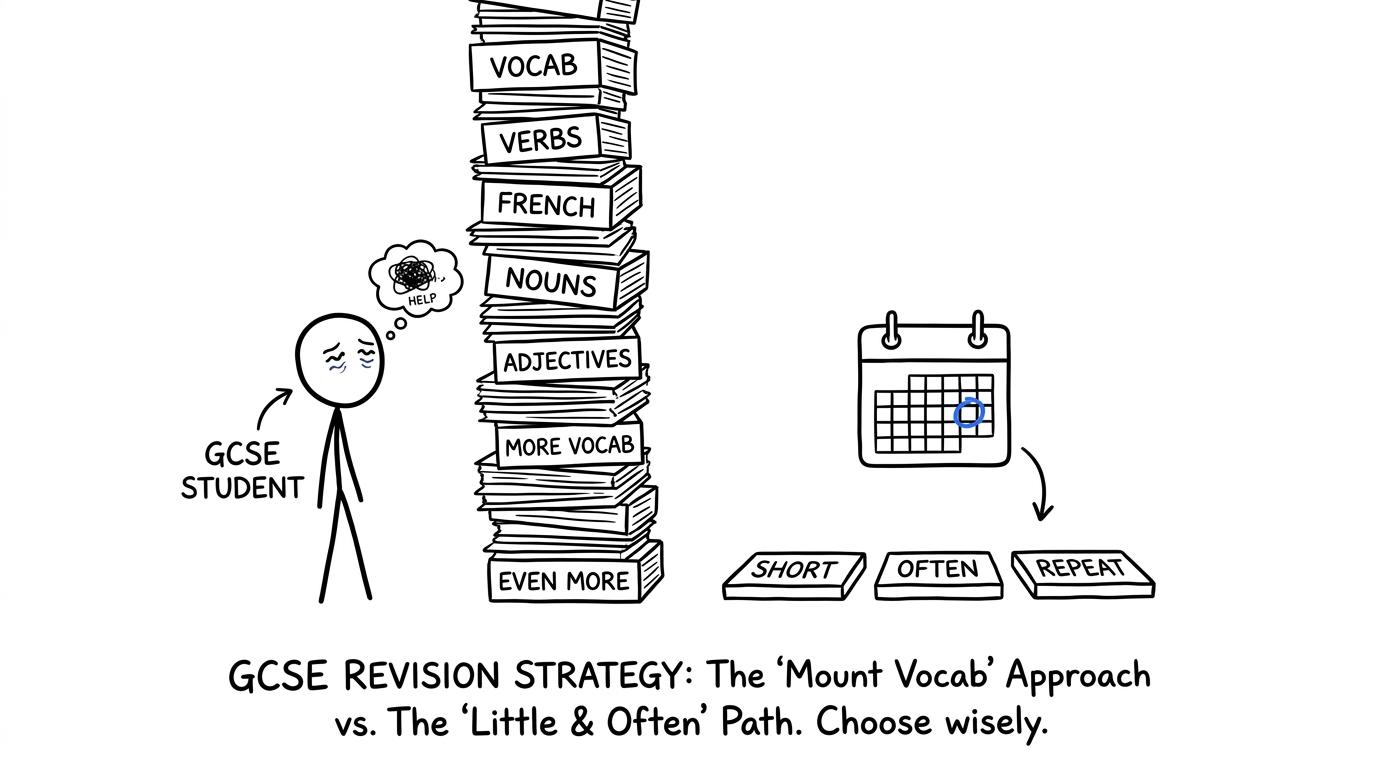 A student choosing short repeated French revision sessions instead of climbing a giant flashcard tower
Why short, repeated sessions work better
Language revision depends heavily on recall. You need to recognise vocabulary in listening and reading, then retrieve it independently when speaking or writing. That is difficult to develop through passive rereading alone.
Research into learning supports retrieval practice and spacing: trying to remember information and returning to it across different days can produce more durable learning than repeatedly reading the same page in one sitting. Feedback matters too. Incorrectly recalled vocabulary should be corrected before the error becomes familiar.
A useful 222-hour week might contain four sessions of 252525 minutes and one 202020-minute review:
4×25+20=120 minutes4 \times 25 + 20 = 120\text{ minutes}4×25+20=120 minutesThis pattern gives your brain several encounters with French without making each session intimidating. On particularly crowded school days, the same principle can protect your maths progress. MathsGenie's 20-minute GCSE maths revision routine shows how a small, closed task can keep another subject moving.
How to divide your French revision time
Current GCSE French courses assess communication through listening, speaking, reading and writing. For example, the current AQA and Pearson Edexcel specifications introduced for first assessment in summer 202620262026 give each of these four components 25%25\%25% of the qualification. Exact tasks and timings differ by exam board, so check whether you study AQA, Edexcel, OCR or Eduqas and follow your specification.
Your weekly plan should not automatically assign identical time to every skill. Equal assessment weighting does not mean equal personal need.
Listening and pronunciation
Use short audio extracts several times each week. Listen once for overall meaning, then again for details, verb tenses, negatives and numbers. Include dictation or sound-to-spelling practice where it matches your specification.
Pronunciation work also supports the speaking assessment. Reading aloud, recording yourself and comparing your pronunciation with an accurate model is more active than silently reviewing a transcript.
Speaking
Speaking is often postponed because it feels less comfortable to practise alone. That discomfort is useful information. Answer questions aloud, practise role-play language, describe visual material and ask a teacher or partner for feedback when possible.
Do not spend the whole session memorising one perfect paragraph. Examiners may change the question or context. Build flexible language that can be adapted.
Reading and vocabulary
Vocabulary revision should involve recall in both directions. Recognising a French word is not the same as being able to produce it. Mix flashcards with short texts, inference questions and translation into English.
Keep an error list containing words you repeatedly confuse. A short list built from real mistakes is more valuable than repeatedly reviewing hundreds of words you already know.
Writing and grammar
Writing practice should move from short accurate sentences towards the response lengths and task styles required by your tier and board. Practise verb forms, agreements, connectives, opinions and more than one time frame where appropriate.
After writing, check for recurring errors rather than merely reading the answer and moving on. Grammar improves when feedback changes the next attempt.
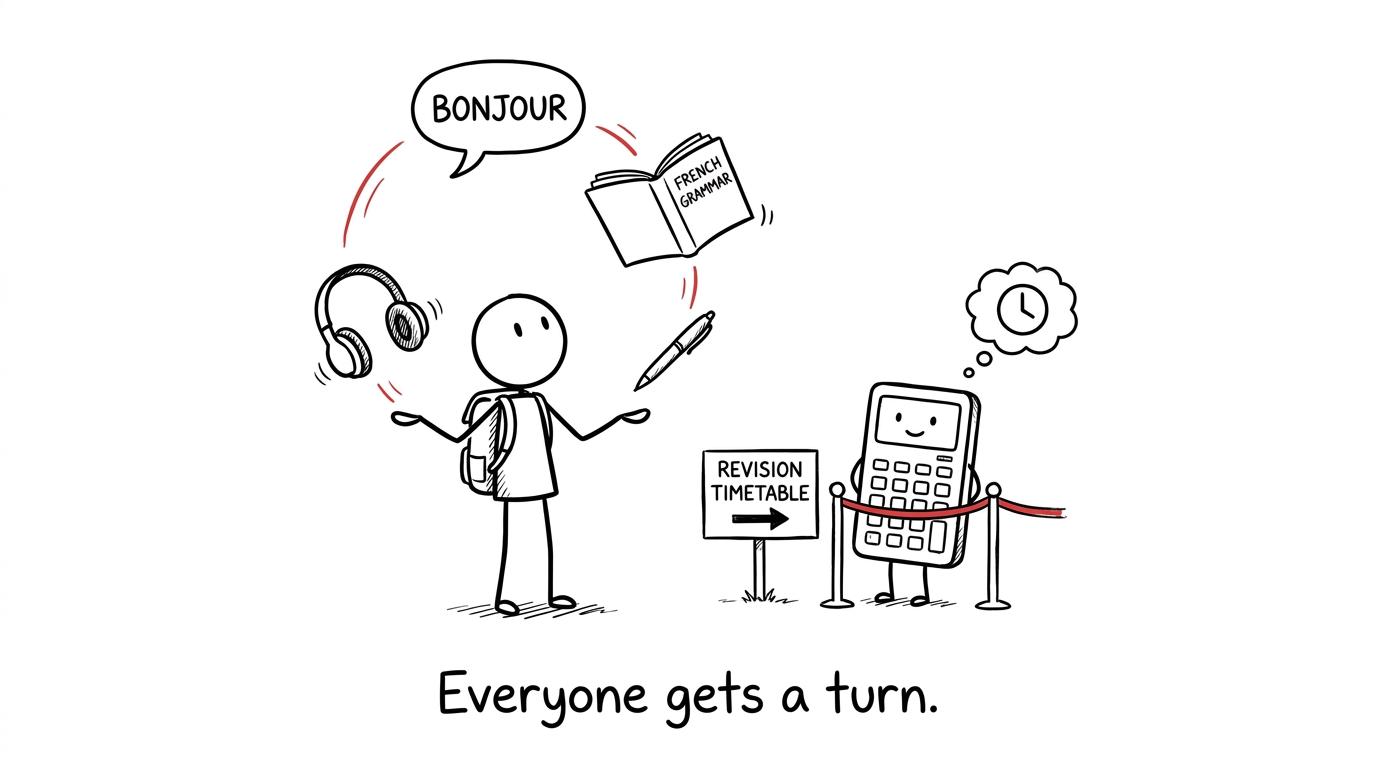 A student balancing listening, speaking, reading and writing while maths waits patiently for its revision turn
Adjust the hours using evidence
A timetable should respond to performance. Every fortnight, complete a short assessment or exam-style task under suitable conditions. Then classify each weakness:
- missing vocabulary;
- inaccurate grammar;
- difficulty understanding natural speech;
- hesitant pronunciation;
- weak examination technique;
- unfinished answers caused by timing.
Add time only where the evidence justifies it. If listening is consistently your weakest component, an additional 202020-minute listening session may help more than another general hour.
This diagnostic approach works equally well in maths. The guide to finding your weakest GCSE topics explains how mistakes can become a focused revision list rather than a reason to panic.
Balance French with GCSE maths revision
The target audience for this plan is not preparing for French in isolation. Maths contains a broad specification, and mathematical methods become reliable through repeated question practice. Dropping maths for several weeks to concentrate on languages simply exchanges one revision problem for another.
Start by placing fixed school commitments, sleep and rest into your timetable. Then assign short sessions to priority subjects. If French receives 333 hours in a week, avoid placing all 333 hours on the same day. A balanced pattern could include French on four or five days and maths on separate days or immediately after a proper break.
For maths, use the free GCSE Maths revision hub to choose your exam board and tier. You can move from revision lessons to practice questions, mini tests and papers without spending your revision time searching for materials.
As the examinations approach, use the one-month GCSE maths revision plan to coordinate timed practice with topic repair. The principle is the same in French: test, identify the gap, correct it and return later.
Common GCSE French revision mistakes
Counting passive exposure as focused revision
Music, films and social media in French can strengthen familiarity, but they do not automatically rehearse the precise skills assessed. Keep them as useful exposure alongside active recall and exam questions.
Revising vocabulary without using it
A remembered word becomes more flexible when you hear it, say it, read it and place it in a sentence. Vocabulary lists are ingredients, not finished answers.
Avoiding speaking until the final weeks
Speaking becomes less intimidating through repetition. A regular 101010-minute practice is easier to sustain and more useful than waiting for one large session before the assessment.
Spending equal time on everything
Your weakest component may require twice as much attention as your strongest. Let marked work and teacher feedback decide the balance.
Cramming and losing other subjects
French benefits from spacing, while maths depends on continued practice. Keep a minimum routine for both. If you need a better paper-review process in maths, read how to use GCSE past papers properly.
Measuring effort only in hours
Three unfocused hours with a phone nearby can achieve less than 454545 minutes of retrieval, practice and correction. Record completed tasks and corrected weaknesses, not just time spent at a desk.
Make the plan small enough to repeat
The best weekly target is not the largest number you can tolerate once. It is the amount you can repeat while sleeping properly, attending lessons and maintaining your other subjects.
Begin with 1.51.51.5 to 222 hours if the exams are still distant. Move towards 222 to 333 hours as your course develops, then use 333 to 444 purposeful hours during the final revision period if your workload allows it. Ask your French teacher to help you adjust the balance using mock results and speaking feedback.
For maths, let MathsGenie remove the friction from your next step. Choose your board and tier, use revision lessons and practice questions to repair weak topics, then test them with mini tests, Edexcel GCSE Maths past papers, predicted papers, mark schemes and video solutions. A calm timetable gives every subject a turn, and turns revision from a vague worry into work you can actually complete.











