Hate GCSE Chemistry? How to Revise When It Won't Click
Hate GCSE chemistry? How to revise with less friction, active recall and short exam practice, while strengthening the maths skills chemistry requires.
There is a particular kind of frustration that comes from opening a chemistry book and feeling your attention disappear before the first paragraph ends. The symbols look unfamiliar, the practical methods blur together, and revising anything else suddenly seems attractive.
If your search is hate GCSE chemistry how to revise, the short answer is this: do not wait to feel motivated. Make the task smaller, revise through questions rather than endless reading, and measure progress by what you can recall or answer. You do not have to enjoy chemistry. You need a routine that still works when enjoyment is absent.
That matters particularly when you are also preparing for GCSE maths. Chemistry contains calculations, graphs, ratios, units and formula rearrangement, so improving the right maths skills can remove one source of difficulty from both subjects.
The quick chemistry revision checklist
Use this as your starting plan:
- Confirm your exam board, course and tier.
- Break the specification into individual topics.
- Choose one small task for each session.
- Retrieve knowledge before checking your notes.
- Complete exam questions and mark them carefully.
- Keep a short list of recurring mistakes.
- Revisit weak material after a gap.
- Practise required or core practicals as examinable content.
- Strengthen the maths skills used in chemistry.
- Stop after a useful session rather than waiting until you are exhausted.
The aim is not to create the perfect timetable. It is to make beginning so easy that avoiding the work becomes harder than doing it.
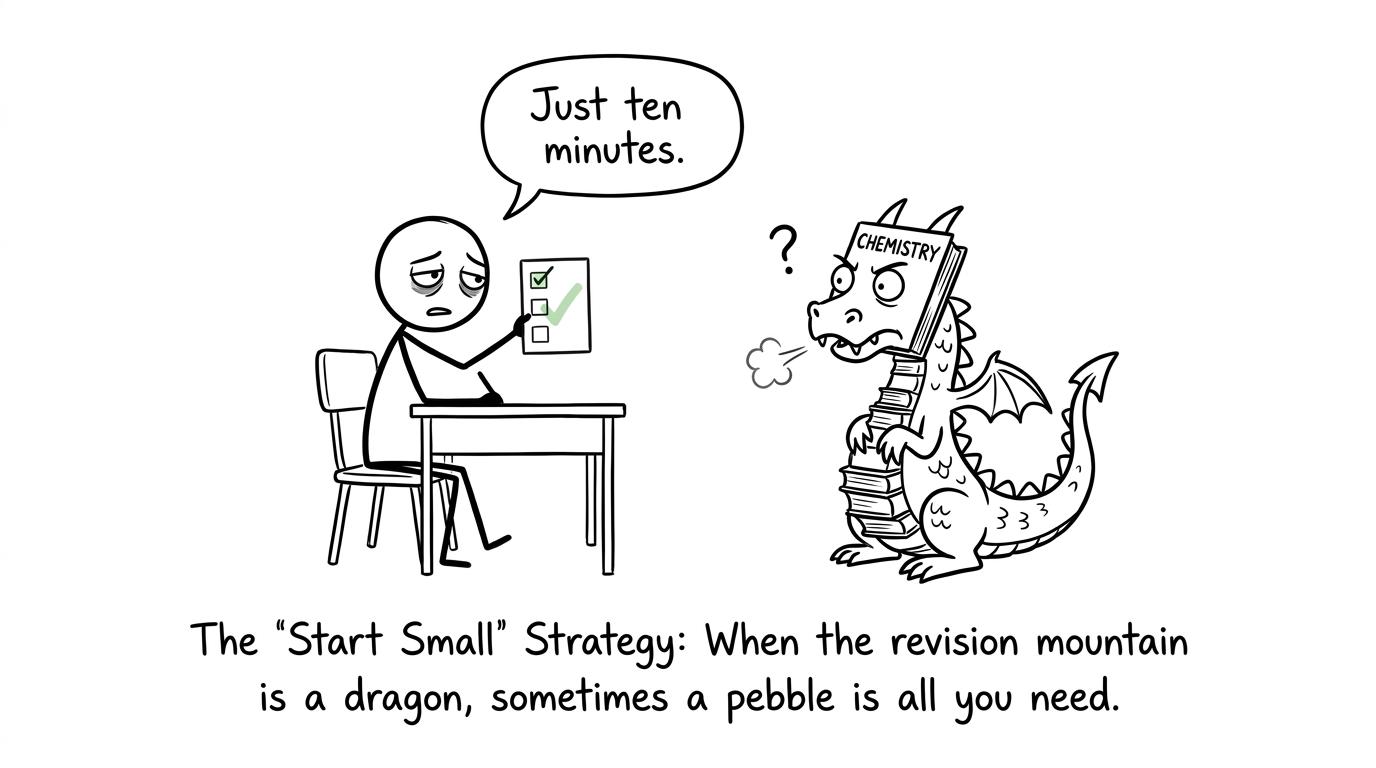 A student faces the chemistry revision dragon with a ten-minute checklist
Work out what you actually hate
“I hate chemistry” can describe several different problems. Each needs a different response.
You might dislike memorising facts. You might understand lessons but freeze when questions are worded differently. Perhaps quantitative chemistry falls apart because fractions or rearranging formulae feel uncertain. Or you may be so far behind that every page seems to depend on something you missed months ago.
Before revising, finish this sentence:
Chemistry is difficult for me when...
Be specific. Possible endings include “I have to balance equations”, “I cannot remember practical methods” or “I do not know what the question wants”. A specific problem gives you a possible next action. A general verdict does not.
Then use your exam board specification as a checklist. AQA, Edexcel, OCR and Eduqas organise and describe content differently, while Combined Science and separate GCSE Chemistry do not have identical coverage. Check your course and whether you sit foundation or higher tier rather than relying on a generic online topic list.
Make motivation unnecessary
Motivation is often treated as the fuel for revision. In practice, it is unreliable. A smaller starting rule is more useful.
Set a minimum such as:
- recall five facts without notes;
- answer three short questions;
- review one practical method;
- work for ten focused minutes.
You are allowed to continue, but the minimum counts as success. This removes the negotiation that happens when the task is “revise chemistry”, which has no clear finish line.
A visible routine also reduces decisions. The structure in MathsGenie's GCSE one-month revision plan is written for maths, but its core rhythm transfers well: retrieve something old, focus on one weak area, attempt questions and review mistakes.
If maths and chemistry are competing for your evening, place both inside one realistic plan. The GCSE maths revision timetable guide shows how to prioritise weaknesses and leave room for school, rest and catch-up time. Chemistry should occupy a defined block, not spread across the whole evening as background guilt.
Use active recall instead of comfortable rereading
Rereading feels productive because everything looks familiar. Unfortunately, recognition is not the same as being able to produce an answer in an exam.
Active recall means closing the source and trying to bring information back from memory. You could:
- write everything you remember about one process;
- draw and label practical apparatus from memory;
- use flashcards in both directions;
- explain why a result occurs without looking;
- answer a question before consulting notes.
Check immediately afterwards and correct what was missing. Evidence reviewed in secondary science guidance supports retrieval practice and spaced review over repeatedly rereading the same material. The important ingredient is effortful recall followed by feedback, not owning an elaborate set of flashcards.
Spacing matters too. Revisit a topic after a gap rather than completing one enormous session and abandoning it. A simple pattern is to learn or review today, retrieve it again a few days later, then test it the following week. Adjust the gaps if you are forgetting too much.
Revise chemistry through exam questions
Once you know the basic content, move to questions quickly. Exam practice reveals whether you can select and apply knowledge when the wording changes.
Use a short loop:
- Attempt a small set without notes.
- Mark it using the official mark scheme.
- Classify each lost mark.
- Write one precise correction.
- Reattempt the question later without help.
Your error categories might include missing knowledge, incorrect terminology, weak calculation, misread command word or incomplete practical detail. This is much more useful than recording only a total mark.
Do not begin with a full chemistry paper if that makes you avoid revision entirely. Start with topic questions, then mixed sections, and build towards timed papers. The same progression is explained in MathsGenie's guide to when to start GCSE past papers. A paper is most useful when its mistakes influence what you revise next.
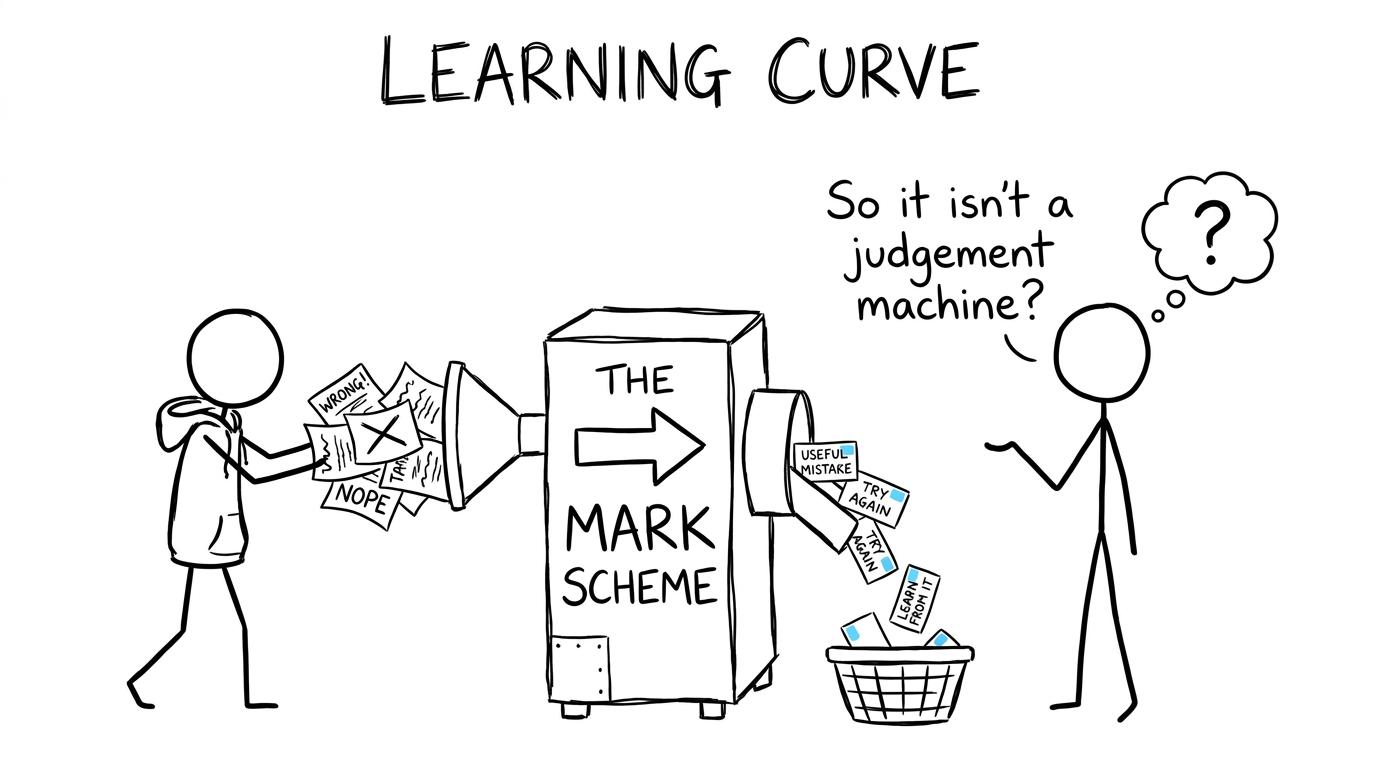 A mark scheme machine turns messy answers into useful mistake cards
Treat practicals as part of the written exam
Practical work is not a side chapter that disappears once you leave the laboratory. Current GCSE science assessment rules require practical knowledge to be tested in written examinations, with at least 15%15\%15% of marks relating to practical work.
The exact activities and terminology depend on your board. For example, AQA specifies required practical activities, Edexcel identifies mandatory core practicals, and OCR uses Practical Activity Groups. Use the specification for your course rather than memorising somebody else's list.
For each practical, know:
- the purpose and method;
- the independent, dependent and control variables;
- important apparatus and measurements;
- safety considerations;
- how results could be recorded or displayed;
- likely sources of error and improvements;
- the scientific explanation behind the observations.
Practise answering questions about unfamiliar versions of familiar practicals. Examiners can test whether you understand the method, not merely whether you can recite a classroom script.
Use maths to make chemistry less hostile
GCSE Chemistry includes substantial mathematical demand. Official subject requirements include skills such as ratios, percentages, significant figures, standard form, graphs and rearranging equations. If the science makes sense until numbers appear, the obstacle may be a repairable maths gap.
Useful crossover skills include:
- converting units consistently;
- substituting values into formulae;
- rearranging formulae;
- interpreting gradients and graphs;
- using ratios and proportional reasoning;
- handling percentages and percentage yield;
- calculating means and recognising anomalous results;
- presenting answers to an appropriate number of significant figures.
MathsGenie's free GCSE maths revision hub lets you select your exam board and practise individual skills through lessons, questions and short tests. If you are unsure which gaps matter, compare your confidence against the GCSE maths topics by board and tier.
Do not revise every maths topic merely because chemistry contains calculations. Identify the exact skill that interrupted your chemistry question, repair it, and return to the scientific context. Maths becomes a tool rather than another subject competing for time.
Build a low-friction weekly routine
A workable chemistry week does not need heroic sessions. It needs repeated contact with the subject.
Try this pattern:
| Session | Main purpose |
|---|---|
| Short session one | Recall an older topic and correct gaps |
| Short session two | Learn one weak idea and answer topic questions |
| Short session three | Review one required or core practical |
| Longer session | Complete a mixed or timed exam section |
| Final check | Mark, log errors and choose next week's priorities |
Keep the plan modest enough to survive a tiring week. If you complete extra work, that is useful. If the schedule only works when every evening goes perfectly, it is not really a schedule.
Maths revision can follow the same learn-practise-check cycle. MathsGenie's guide to the best order for learning GCSE maths topics can help you rebuild prerequisite skills before tackling harder applications. Later, use Edexcel GCSE Maths past papers, or the relevant page for your board, to practise under realistic conditions.
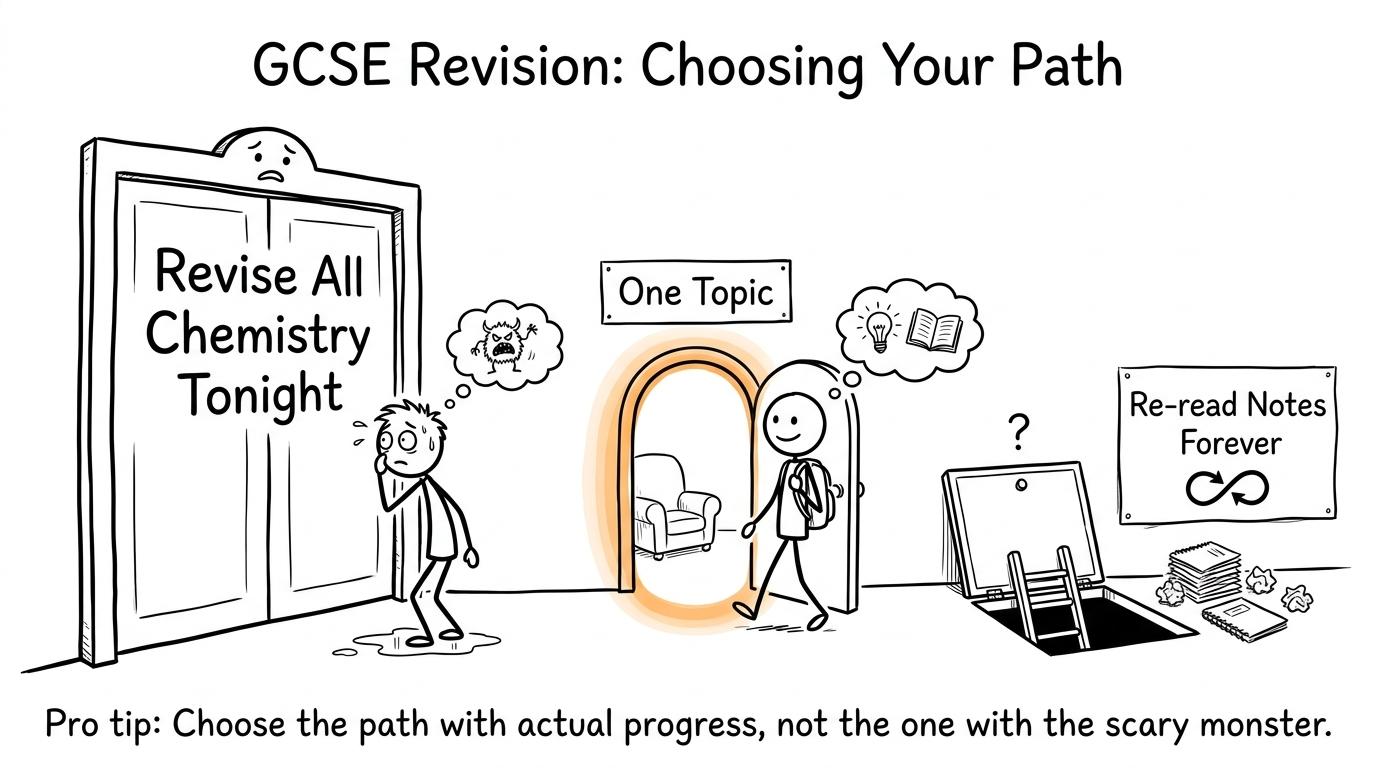 A student chooses one topic instead of trying to revise all chemistry at once
Common mistakes when revising a subject you dislike
Waiting until you feel ready
Readiness often arrives after beginning, not before it. Commit to the smallest useful action and let momentum be optional.
Making beautiful notes without testing yourself
Notes can organise information, but they do not prove recall. Follow note-making with closed-book questions or a memory dump.
Avoiding the worst topic
Revision naturally drifts towards material that feels comfortable. Use test results and your specification checklist to choose priorities, not mood.
Completing questions without reviewing them
Unreviewed practice can repeat the same misunderstanding. Mark carefully, identify why the error occurred and reattempt it later.
Ignoring command words and scientific language
“Describe”, “explain”, “calculate” and “evaluate” ask for different kinds of response. Compare your wording with mark schemes and note missing technical terms.
Treating practicals as pure memorisation
Methods matter, but so do variables, accuracy, data handling, safety and evaluation. Learn the reason for each significant step.
Planning an impossible amount
A crowded timetable can become evidence that you are failing before you begin. A smaller plan completed consistently is more valuable than an ambitious plan repeatedly abandoned.
You do not need to love chemistry to improve
Disliking a subject is not a character flaw, and it does not determine your final grade. Your job is smaller: choose one weak area, retrieve what you know, answer questions, learn from the mark scheme and return after a gap.
When calculations are part of the problem, use MathsGenie as your free maths revision base. Begin with revision lessons and practice questions, check progress through mini tests, then build exam confidence with past papers, predicted papers, mark schemes and video solutions. The MathsGenie GCSE revision area gives that process a clear home.
You may never look forward to chemistry revision. That is all right. A dependable system can carry you on the days when motivation does not.