

Group vs 1:1 Tutoring GCSE Biblical Hebrew
Group vs 1:1 tutoring GCSE Biblical Hebrew: compare feedback, cost, confidence and exam fit to choose support that matches your revision needs.
Choosing a tutor can feel like making an important decision with very little evidence. A group appears friendlier and more affordable. Individual tuition promises complete attention. Both sound useful, but useful in different ways.
For group vs 1:1 tutoring GCSE Biblical Hebrew, the short answer is this: one-to-one tuition is usually better when you have precise language gaps, need intensive feedback or feel uncomfortable asking questions publicly. A small group may be better when you are broadly on track, learn through discussion and want a more economical way to practise regularly. The quality and subject knowledge of the tutor matter more than the label alone.
For many students, the most sensible arrangement is a hybrid: regular small-group teaching for coverage and discussion, with occasional individual sessions to diagnose stubborn problems.
A quick decision checklist
Before comparing formats, ask:
- Can the tutor teach the current Pearson Edexcel GCSE Biblical Hebrew specification?
- Are your difficulties broad, or can you name the exact grammar, vocabulary or set-text areas causing trouble?
- Do you speak readily in front of other students?
- Will the group contain students working at a similar level and pace?
- Does the tutor provide marked work and specific feedback between sessions?
- Can you attend consistently without damaging revision time for maths and other GCSE subjects?
- Is the arrangement affordable enough to continue for a meaningful period?
A confident answer to these questions is more valuable than a promise that one format is automatically superior.
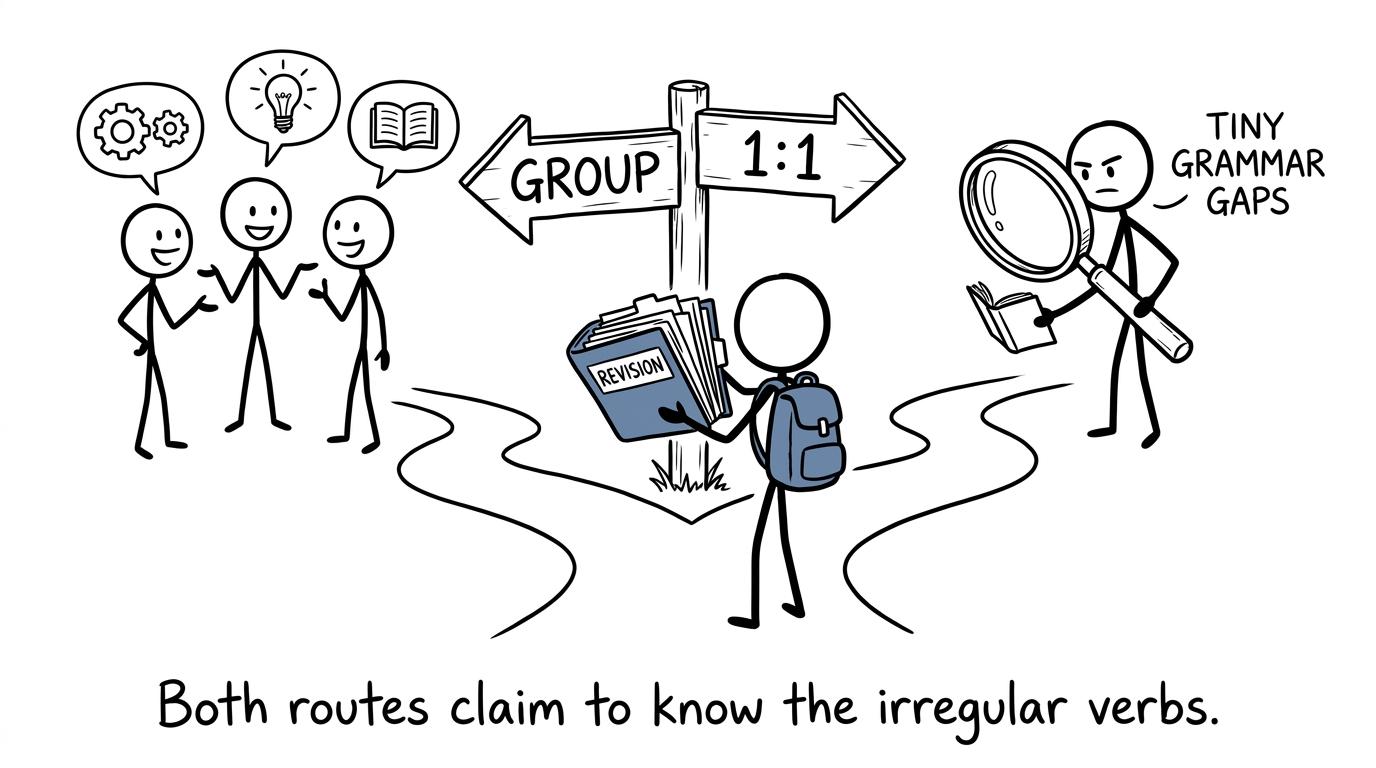 A student choosing between group and individual tutoring routes
What GCSE Biblical Hebrew tutoring needs to cover
The Pearson Edexcel GCSE Biblical Hebrew qualification has two externally examined components. Component 1 assesses language, including comprehension and translation from unseen passages. Students also complete either grammatical analysis or translation into pointed Biblical Hebrew, depending on the option followed.
Component 2 assesses literature. Students need knowledge of the prescribed texts, their content and context, alongside grammatical and literary features. They must also analyse evidence and construct reasoned responses.
The assessment objectives give language 50%50\%50% of the qualification, knowledge and understanding of literature 25%25\%25%, and analysis, evaluation and response 25%25\%25%. Effective tuition therefore cannot consist only of memorising vocabulary or informally discussing passages. It needs to develop several distinct forms of performance:
- accurate vocabulary recall;
- recognition of morphology and syntax;
- controlled translation into English;
- understanding of set texts;
- evidence-based literary analysis;
- confident work under examination conditions.
This matters when choosing a tutor. Someone may know Biblical Hebrew deeply but lack familiarity with GCSE question styles and mark schemes. Subject expertise is essential, but it must be joined to specification knowledge and clear teaching.
When one-to-one Biblical Hebrew tutoring is better
One-to-one tuition becomes valuable when the problem is narrow and personal. Perhaps you repeatedly misidentify particular forms, struggle to begin unseen translation or understand a set text but cannot turn that knowledge into a focused answer. In an individual session, the tutor can stop at the precise point where your reasoning goes wrong.
Feedback is immediate and specific
In a group, a tutor must divide attention. In an individual lesson, every translation choice, grammatical explanation and written response can be inspected closely. That makes it easier to distinguish between a forgotten word, a misunderstanding of syntax and an avoidable examination error.
This diagnostic quality is the strongest argument for one-to-one support. A good tutor does not simply explain more. They identify what needs explaining.
The pace can change around you
A student who has joined the course late may need concentrated work on foundations. Another may be secure in language but need demanding practice on literary analysis. Individual tuition can move quickly through secure material and slow down where understanding is fragile.
That flexibility is especially useful close to mock examinations or after a marked paper has exposed a recurring weakness. The same principle works in maths: finding your weakest GCSE topics is more useful than revising everything with equal intensity.
It can help quieter students participate
Some students understand more than they say. In a busy group, they may let another person answer first or avoid revealing uncertainty. One-to-one tuition removes that hiding place, but it can also remove the embarrassment attached to asking a basic question.
The limitation is that individual tuition can feel intense. It is usually more expensive per student, and there is no peer discussion to expose alternative interpretations or common misconceptions. A student can also become too dependent on prompts if the tutor does not build in independent work.
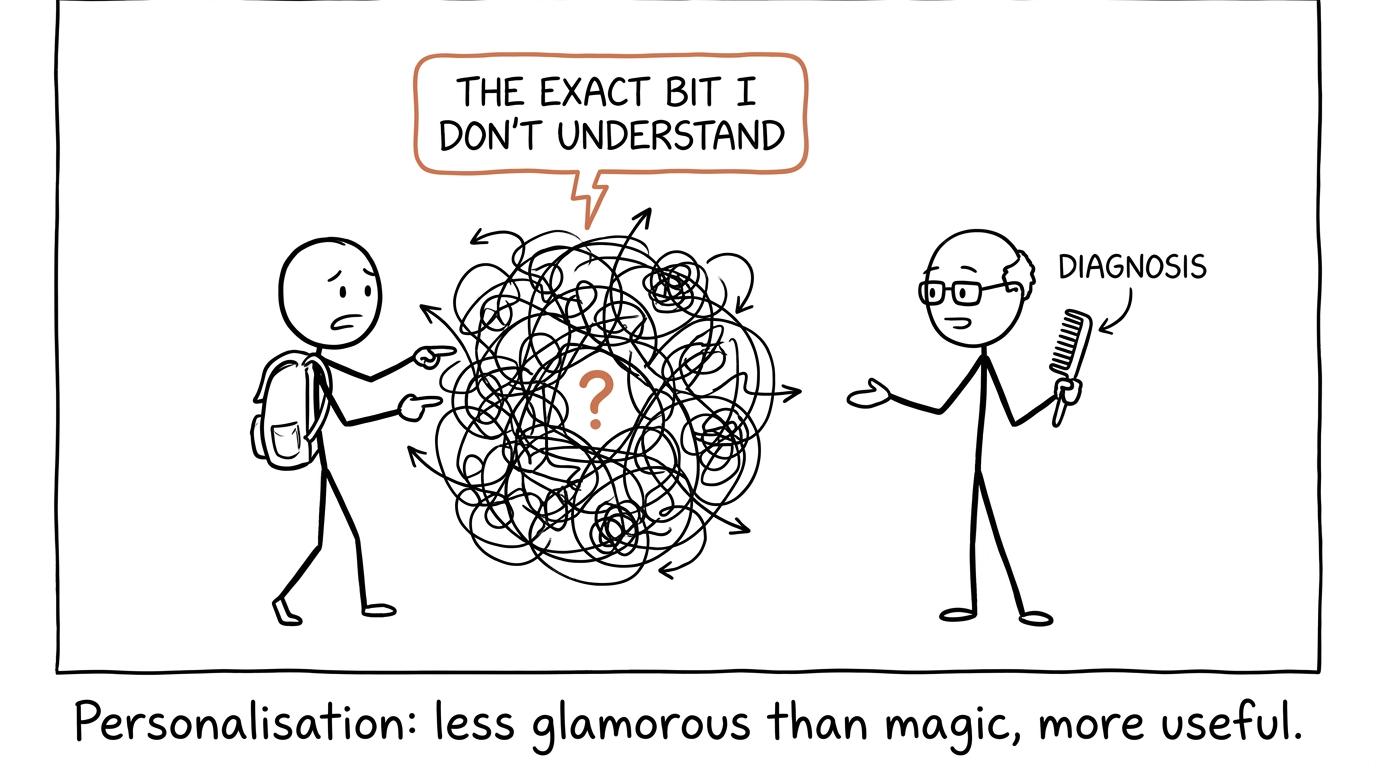 A tutor carefully untangling one student's exact revision problem
When group tutoring is better
Small-group tuition is not simply a cheaper version of individual teaching. At its best, it offers a different kind of learning.
Educational evidence beyond Biblical Hebrew suggests that both formats can improve attainment. The Education Endowment Foundation reports positive average effects for one-to-one and small-group tuition, although this research covers subjects and age groups more broadly. It should not be treated as a Biblical Hebrew-specific guarantee. The same evidence emphasises targeting, tutor quality, regular attendance and alignment with classroom teaching.
Discussion reveals more than one way to think
When students compare translations or discuss the force of a literary feature, they hear interpretations they may not have generated alone. Explaining an answer aloud also reveals whether understanding is secure. It is easy to recognise a correct explanation; producing one independently is harder.
Groups can make retrieval livelier, provide opportunities for low-stakes questioning and normalise mistakes. Discovering that several people confused the same grammatical form can make correction feel like part of learning rather than evidence of failure.
Regular tuition may be more sustainable
Because the tutor's time is shared, group sessions are commonly less expensive per student. That can make consistent tuition possible over a longer period. Regular, purposeful sessions may achieve more than a few isolated individual lessons, particularly when each meeting includes retrieval, application and feedback.
A group must remain genuinely small and well matched. EEF guidance generally describes small-group tuition as one tutor working with roughly two to five pupils. As groups grow, individual feedback becomes harder and the arrangement begins to resemble another classroom.
A good group creates useful accountability
Students are more likely to prepare when they know they will contribute. A well-run group can establish a steady rhythm: learn vocabulary, prepare a passage, discuss choices, submit work and correct errors.
However, accountability only works when expectations are clear. A group containing students with widely different prior knowledge can frustrate everyone. Faster students wait; less confident students become spectators.
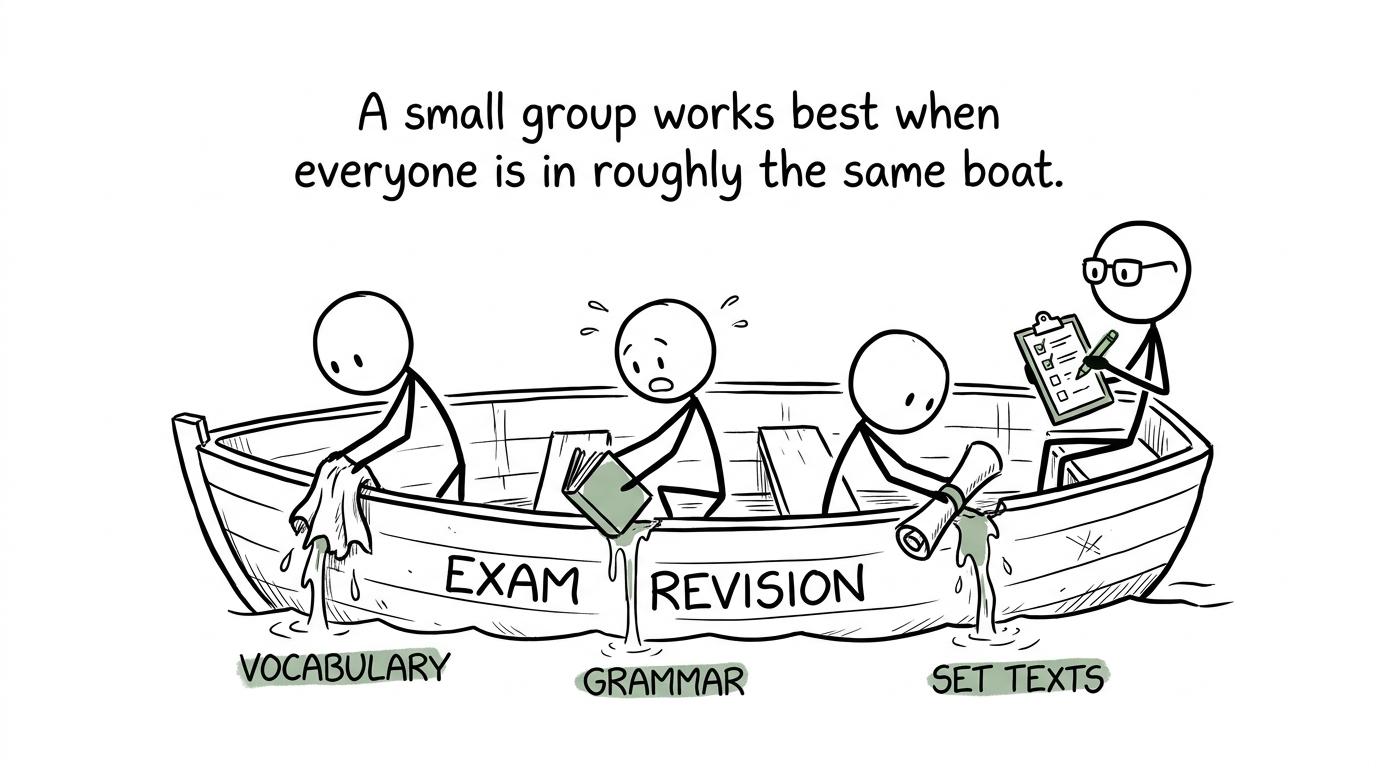 Students in a revision boat fixing different learning gaps
Group vs 1:1 tutoring GCSE Biblical Hebrew compared
| Consideration | Small-group tuition | One-to-one tuition |
|---|---|---|
| Tutor attention | Shared between learners | Focused entirely on one learner |
| Lesson pace | Set around the group | Adapted during the lesson |
| Feedback | Useful but less extensive | Immediate and highly specific |
| Discussion | Strong peer interaction | Direct tutor-student dialogue |
| Confidence | Supportive for social learners | Safer for private questions |
| Cost per student | Usually lower | Usually higher |
| Best suited to | Similar-level students needing regular practice | Students with precise gaps or urgent needs |
| Main risk | Mismatched levels or passive participation | Dependence on tutor prompts |
The important question is not, “Which format is best?” It is, “Which constraint is currently limiting my progress?”
Choose one-to-one support if diagnosis, privacy or pace is the main issue. Choose a group if regular practice, discussion and affordability matter more. Consider a hybrid if you need both.
How to assess a tutor before committing
Ask prospective tutors practical questions rather than relying on broad claims:
- Which GCSE Biblical Hebrew specification and set texts do you teach?
- How do you diagnose language and literature weaknesses?
- How much written work will you mark?
- Do students complete unseen translation independently?
- How do you teach analytical responses rather than factual recall alone?
- For a group, what are the maximum size and entry level?
- How is progress communicated to the student and parent or carer?
A trial lesson should leave you with more than a pleasant impression. You should know what was diagnosed, what will be practised and how improvement will be checked.
Fit tutoring around your wider GCSE revision
Tutoring is additional support, not your entire revision plan. You still need independent retrieval, timed practice and careful review of marked work. A tutor may explain a weakness, but only repeated independent use makes the correction dependable.
This is particularly important if you are also preparing for GCSE maths. Use the free GCSE Maths revision hub to choose resources for Edexcel, AQA, OCR or Eduqas, then organise your week with a realistic GCSE maths revision timetable.
On busy days, MathsGenie's 20-minute GCSE revision routine can keep maths moving without overwhelming your Hebrew preparation. Use GCSE mini tests for quick diagnosis and read the guide to using GCSE mark schemes as a revision coach to make feedback actionable.
The subject changes, but the learning cycle remains remarkably stable: attempt, mark, diagnose, repair and retest.
Common mistakes when choosing tuition
Choosing by price alone
The cheapest group is poor value if its level is unsuitable. The most expensive individual tutor is not automatically the most effective. Compare subject expertise, feedback, structure and consistency alongside cost.
Confusing knowledge with exam preparation
A tutor may provide fascinating contextual detail that is not required by the specification. Enrichment has value, but GCSE preparation must prioritise assessable language, prescribed literature and reasoned responses.
Joining a group without checking its composition
Ask about group size, current topics and expected prior knowledge. A well-matched group can accelerate learning; a mismatched one can make every session feel either rushed or repetitive.
Letting the tutor do the difficult thinking
Hints can make a passage feel manageable while disguising dependence. Students need periods of silent, unsupported work so the tutor can see what would happen in the examination.
Expecting tuition to replace practice
Progress is unlikely if work stops when the session ends. Schedule vocabulary retrieval, translation, set-text review and written analysis between lessons. Protect maths practice too, building towards GCSE past-paper revision and using GCSE predicted papers as a supplement rather than a substitute for official papers.
Make the choice that solves the real problem
One-to-one tutoring offers precision. Group tutoring offers interaction, shared accountability and often better affordability. Neither format can rescue weak attendance, poor specification knowledge or a lack of independent practice.
Begin with evidence from your own work. Identify whether you need personal diagnosis or regular guided practice, question the tutor carefully, and review the arrangement after several sessions. The right choice is the one that makes you increasingly independent.
For the maths part of your GCSE timetable, make MathsGenie your free revision base. Use revision lessons and practice questions to repair individual topics, mini tests to check progress, and past papers, predicted papers, mark schemes and video solutions to prepare for examination conditions. Good support should not leave you needing more support forever. It should teach you how to move forward on your own.










