

Grade 6 GCSE Economics: Enough for Sixth Form?
Grade 6 GCSE economics sixth form guidance: check A Level entry rules and the Maths, English and overall GCSE grades your chosen provider may require.
A results sheet can make one number feel larger than it really is. You see a grade 666 beside Economics and immediately wonder whether it opens the sixth-form door or leaves you standing outside it.
The short answer to the grade 6 GCSE Economics sixth form question is encouraging: a grade 666 is commonly enough to satisfy an Economics subject requirement for A Level study. However, it does not guarantee admission. Sixth forms and colleges set their own criteria, and many pay equal or greater attention to GCSE Maths, English and your overall grade profile.
Your task is not to guess whether a grade 666 is “good”. It is to compare your complete set of results with the published rules for the course you actually want.
The quick admissions checklist
Before applying for A Level Economics, check all five of these points:
- the sixth form or college's general GCSE entry requirement;
- the minimum GCSE Economics grade, if you took the subject;
- the required GCSE Maths grade;
- the required GCSE English Language or Literature grade;
- whether the provider considers near-misses or applications individually.
A typical policy might require several GCSEs at grades 999 to 555, alongside a grade 666 in Maths and a particular English grade. Another provider may ask for GCSE Economics at grade 666 only if you studied it. Some do not require prior Economics at all.
Requirements can change between admission years, so use the provider's current course guide rather than an old prospectus or a friend's recollection.
 A student choosing between official sixth-form requirements and group-chat rumours
Is a grade 6 in GCSE Economics good?
Yes. A grade 666 is a strong GCSE result. It sits above the standard pass grades and indicates that you have developed a secure understanding of much of the course.
For sixth-form admission, though, “good” and “enough” are different questions. Good describes the quality of the result. Enough depends on a particular admissions policy.
Current published requirements illustrate the variation. Some providers require a grade 666 in Economics if it was taken at GCSE, while others base Economics entry on grades in Maths, English or an essay-based subject. There is no single national GCSE Economics grade that every sixth form must use.
That variation exists partly because Economics is not available in every secondary school. A Level specifications therefore do not universally depend on prior GCSE Economics study. Pearson's A Level Economics specification, for example, states that there are no prior-learning requirements. Local providers can still impose their own admissions conditions.
This means a student who has never studied Economics may be admitted with strong Maths and English results, while a student with GCSE Economics may be expected to have achieved a particular grade in it. Neither rule is automatically transferable to another college.
Why your GCSE Maths grade may matter just as much
Economics combines written argument with numerical evidence. At A Level, students interpret data, calculate percentage changes, use ratios and index numbers, analyse graphs, and work with concepts such as costs, revenue, profit and elasticity.
Official A Level Economics subject content requires quantitative skills to account for at least 20%20\%20% of the overall A Level marks. Those skills are applied within economic contexts rather than tested as a separate maths paper.
That helps explain why many sixth forms ask for grade 666 in GCSE Maths even when GCSE Economics is not required. They want evidence that you can handle the numerical side of the course.
Useful foundations include:
- fractions, decimals, ratios and percentages;
- percentage increase and decrease;
- averages and interpreting distributions;
- reading tables, charts and time-series data;
- plotting and interpreting graphs;
- rearranging simple formulae;
- explaining what a calculation means in context.
Percentage change, for instance, is represented by:
percentage change=new value−original valueoriginal value×100\text{percentage change}=\frac{\text{new value}-\text{original value}}{\text{original value}}\times 100percentage change=original valuenew value−original value×100The calculation matters, but an Economics response must usually interpret the result too. A number without context rarely completes the argument.
If these foundations feel uncertain, use MathsGenie's GCSE Maths revision hub to select your exam board and tier. You can then strengthen an especially relevant skill through the percentage change revision guide and build confidence with the data resources in GCSE Statistics revision.
English and extended writing also influence entry
A Level Economics is not simply mathematics with money attached. Students must define concepts, develop chains of reasoning, use evidence, compare arguments and reach justified conclusions.
For that reason, some providers specify a minimum grade in English Language or Literature. Others ask for evidence of strength in an essay-based subject such as History or Geography.
A grade 666 in GCSE Economics suggests that you already have experience of combining knowledge, application, analysis and judgement. Before choosing the A Level, consider whether you can also:
- explain why an economic change may produce several effects;
- distinguish assertion from evidence;
- use data to support a written argument;
- consider limitations and alternative viewpoints;
- write a conclusion that answers the precise question.
The course rewards balance. Numerical confidence helps you understand the evidence; clear writing helps you turn that evidence into an argument.
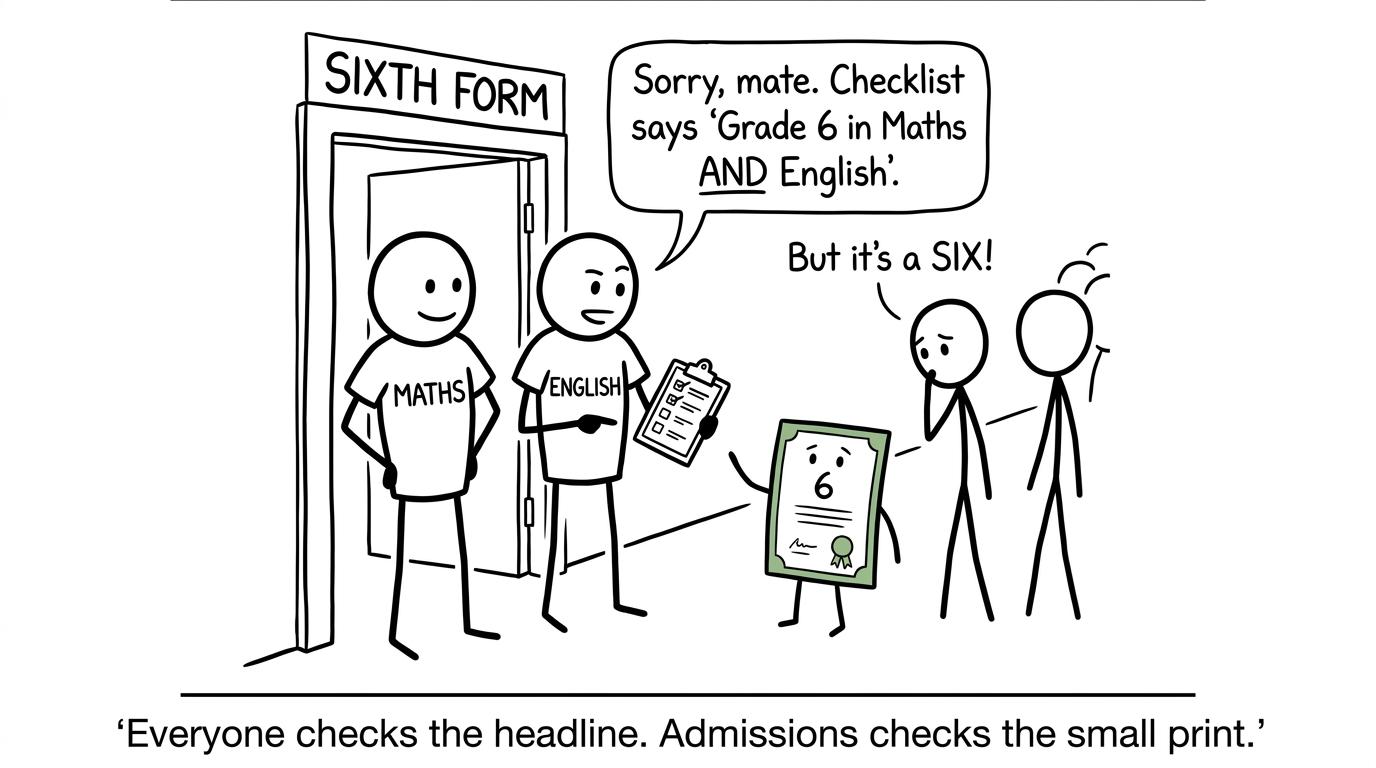 A grade certificate meeting the Maths and English admissions checks
How to check whether your grade 6 is enough
Start with the admissions page for every provider you are considering. Do not stop when you find the line labelled “Economics”. General sixth-form requirements may appear elsewhere.
Record each requirement separately
Create a shortlist with one row for each provider and separate columns for:
- overall GCSE profile;
- Economics requirement;
- Maths requirement;
- English requirement;
- any additional condition;
- whether your predicted or achieved grades meet it.
This prevents a common misunderstanding: meeting the subject requirement does not necessarily mean meeting the general entry requirement.
Check the wording carefully
These statements do not mean the same thing:
- “grade 666 in Economics”;
- “grade 666 in Economics if taken”;
- “grade 666 in a humanities subject”;
- “grade 666 in Maths and English”;
- “Economics GCSE is not required”.
Look for whether the grade is essential, recommended or considered alongside other results. If the wording remains unclear, contact the admissions team and ask about your exact combination of subjects and grades.
Ask about near-miss policies before results day
If you are predicted a grade 666 but achieve a grade 555, do not assume that the decision is automatic in either direction. Some providers enforce thresholds strictly; others may review places individually, particularly when other relevant grades are strong. Availability, overall results and local policy may all matter.
Ask a precise question: “If I achieve a grade 555 in GCSE Economics but meet the Maths, English and general entry requirements, can I still be considered for A Level Economics?” A specific question is more useful than asking whether the college is flexible.
What if your school does not offer GCSE Economics?
You can still apply to many A Level Economics courses. Prior Economics knowledge is not a universal national prerequisite, and many students begin the subject in Year 121212.
Admissions teams may instead look for evidence that you are prepared for the course's two main demands: quantitative reasoning and extended writing. Strong results in Maths, English, Geography, History or Business may therefore be relevant, depending on the provider's published policy.
Do not try to compensate by memorising an entire A Level textbook before September. A better foundation is to become fluent with percentages, ratios, graphs and data interpretation while developing an informed interest in economic issues.
A practical preparation plan for GCSE students
If your preferred course asks for grade 666 in Maths, focus on turning that target into a revision system rather than a source of pressure.
Begin with a diagnostic paper matching your exam board and foundation or higher tier. Mark it carefully, then classify lost marks as knowledge gaps, process errors or accuracy slips. MathsGenie's guide to using GCSE past papers properly explains how to turn each paper into targeted revision.
Build your week around three kinds of work:
- Learn: use a revision lesson to repair one weak method.
- Practise: complete focused exam questions and check the solutions.
- Test: use a mini test, timed section or full paper without notes.
A workable sequence is percentages and ratio, then graphs, averages and other statistical skills. The best order for learning GCSE Maths topics can help you organise those foundations without jumping randomly between chapters.
As exams approach, add timed papers. Past papers show how genuine questions are structured, while predicted papers provide fresh practice based on likely content. They should complement the specification and past papers, not replace them. The guide to when to start GCSE past papers will help you phase this sensibly.
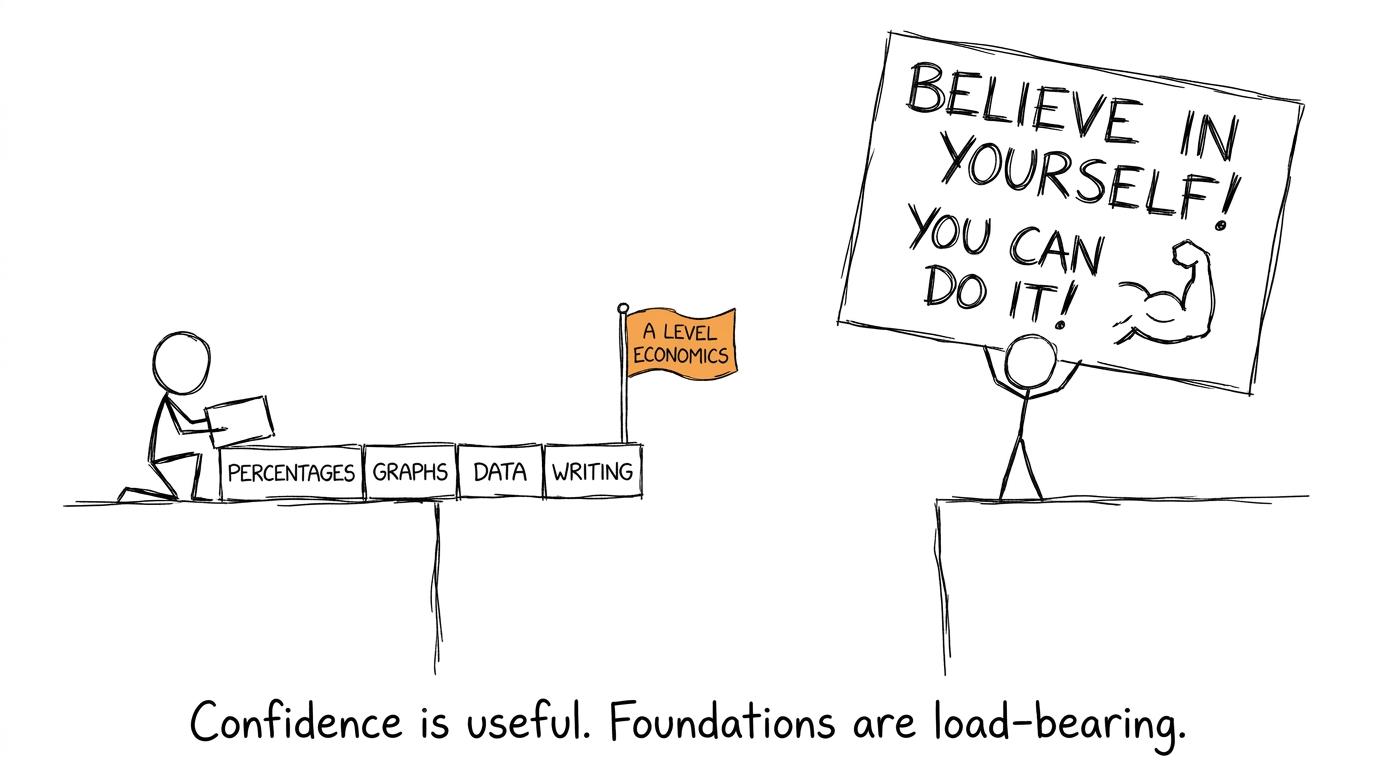 A student building a bridge from percentages, graphs, data and writing towards A Level Economics
Common mistakes when judging sixth-form eligibility
Looking only at the Economics grade
Your grade 666 may satisfy the subject rule but not a separate Maths, English or overall GCSE requirement. Read the complete admissions policy.
Treating one college's policy as a national rule
Exam boards such as AQA, Pearson Edexcel and OCR publish specifications, but individual sixth forms decide their admissions thresholds. A requirement found on one website does not apply everywhere.
Relying on outdated information
Course offers and entry criteria can change. Check that the prospectus applies to the year in which you intend to enrol.
Confusing “recommended” with “required”
A recommended grade describes useful preparation. A required grade is an admissions condition. If the language is ambiguous, ask the provider directly.
Neglecting Maths because Economics feels essay-based
At least 20%20\%20% of A Level Economics marks assess quantitative skills. Secure percentages, graphs, ratios and data interpretation now rather than waiting for Year 121212.
Revising without checking mistakes
Completing questions creates activity; correcting them creates progress. Use mark schemes and video solutions, record the exact reason for each lost mark, and retest the skill. A structured GCSE Maths revision timetable can make that cycle manageable.
Make the decision using evidence, not anxiety
A grade 666 in GCSE Economics is a positive result and will meet the subject threshold used by many providers. But the course you actually want may also require particular Maths and English grades, a broader set of GCSE results, or a grade in another essay-based subject.
So check the current policy, compare every condition with your predicted grades, and contact admissions if anything is unclear. Then work on the part you can still change.
MathsGenie gives you a free route from uncertainty to action: revision lessons to rebuild methods, practice questions to develop accuracy, mini tests to check recall, and past papers and predicted papers to prepare under exam conditions. Use the mark schemes and video solutions honestly, place each weak topic into your revision planner, and make your next session specific. The sixth-form decision may depend on several grades, but your next improvement can begin with one question today.











