Revision notes for Edexcel GCSE Maths Percentage Change. Open the guide for explanations and worked examples. Written against the Edexcel GCSE Maths (1MA1) specification, so the content matches what's examinable rather than general Maths background.
A percentage is a way of comparing something to 100.
Percentage
A percentage means “out of 100”. For example, 25% means 25 out of every 100.
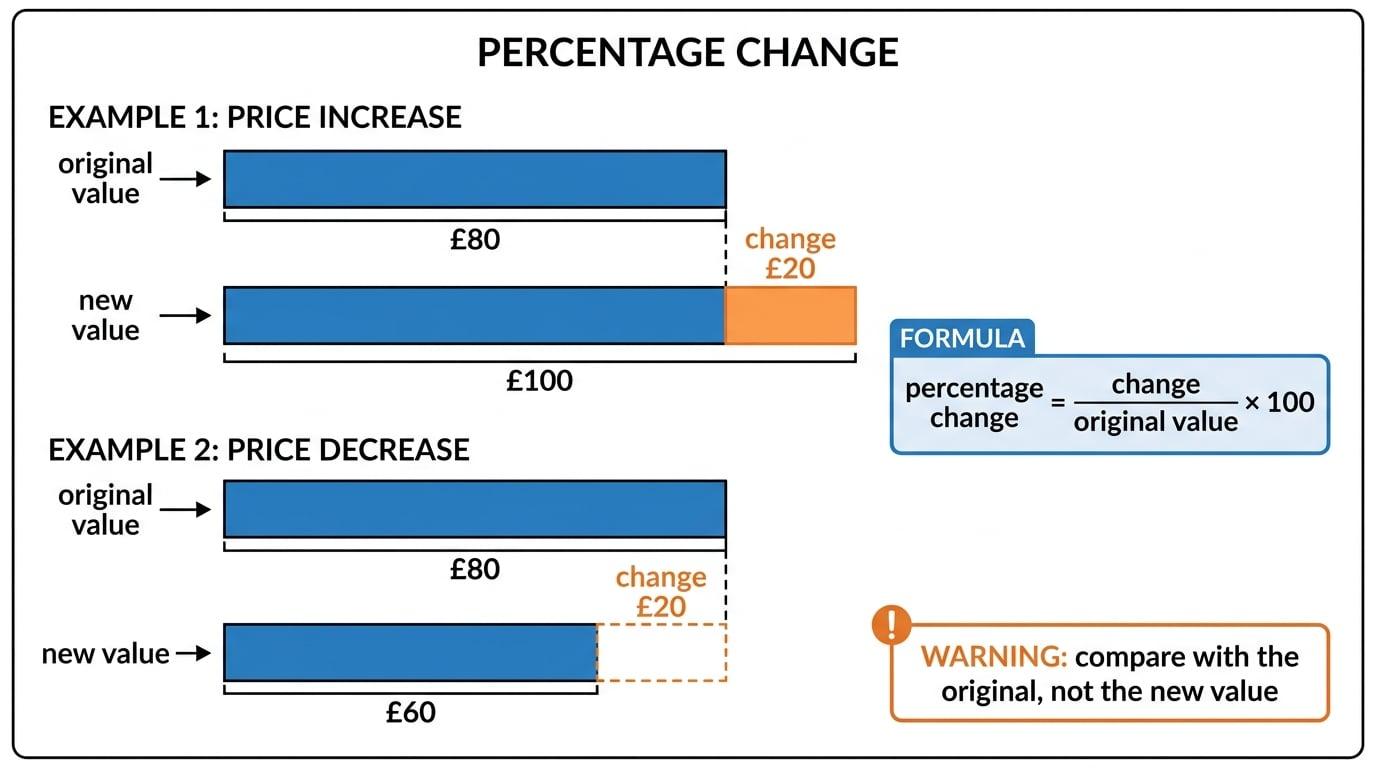
In percentage change questions, there is usually an original value and a new value.
The original amount is the base
For percentage change, divide by the amount you started with, not the amount you ended with.
Finding a change as a percentage
A coat originally costs £80. Its price is reduced by £20. Find the reduction as a percentage of the original price.

Identify the original amount and the change: original £80, change £20.
Compare the change with the original amount:
2080×100=25\frac{20}{80} \times 100 = 258020×100=25The reduction is 25% of the original price.
An increase means the new value is bigger than the original value.
A decrease means the new value is smaller than the original value.
Percentage change
Percentage change tells you how big the change is compared with the original value.
percentage change=changeoriginal value×100\text{percentage change} = \frac{\text{change}}{\text{original value}} \times 100percentage change=original valuechange×100The method is:
Percentage increase
Last year, a bill was £1680. This year, it is £1764. Work out the percentage increase, giving your answer to 1 decimal place.

Identify the original and new amounts: original £1680, new £1764.
Find the change:
1764−1680=841764 - 1680 = 841764−1680=84Divide the change by the original amount, then multiply by 100:
841680×100=5\frac{84}{1680} \times 100 = 5168084×100=5The bill went up, so the answer is 5.0% increase to 1 decimal place.
Percentage decrease
A yearly insurance cost was £386. The next year it was £354. Work out the percentage decrease to 1 decimal place.

Identify the original and new amounts: original £386, new £354.
Find the change:
386−354=32386 - 354 = 32386−354=32Divide by the original amount and multiply by 100:
32386×100=8.290…\frac{32}{386} \times 100 = 8.290\ldots38632×100=8.290…The cost went down, so the answer is 8.3% decrease to 1 decimal place.
Dividing by the new amount
Do not divide by the new value. If a price changes from £80 to £100, the original amount is £80, so the change is compared with £80.

A cost price is the amount paid to buy something.
A selling price is the amount received when it is sold.
A profit is made when the selling price is bigger than the cost price.
A loss is made when the selling price is smaller than the cost price.
For percentage profit or percentage loss, the original amount is the cost price.
Percentage profit
Aisha buys a flat for £185,000. She later sells it for £199,800. Calculate her percentage profit.

Find the profit by subtracting the cost price from the selling price:
199800−185000=14800199800 - 185000 = 14800199800−185000=14800Compare the profit with the original cost price:
14800185000×100=8\frac{14800}{185000} \times 100 = 818500014800×100=8Aisha made an 8% profit.
Percentage loss
Ben buys a car for £12,500. He sells it for £9,800. Work out his percentage loss.

Find the loss by subtracting the selling price from the cost price:
12500−9800=270012500 - 9800 = 270012500−9800=2700Compare the loss with the original cost price:
270012500×100=21.6\frac{2700}{12500} \times 100 = 21.6125002700×100=21.6Ben made a 21.6% loss.
Some questions do not give you the selling price straight away. You may need to calculate the total money made from selling items.
Useful conversions:
Convert units first
If the cost is in pounds, convert selling prices like 30p or 45p into pounds before adding them.
Selling bags of sweets
Maya buys 1.2 kg of sweets for £2.40. She puts 200 g of sweets into each bag. She sells each bag for 50p. Work out her percentage profit.

Convert 1.2 kg into grams:
1.2×1000=12001.2 \times 1000 = 12001.2×1000=1200Work out how many bags she can make:
1200÷200=61200 \div 200 = 61200÷200=6Convert 50p to £0.50, then find the total selling money:
6×0.50=3.006 \times 0.50 = 3.006×0.50=3.00Find the profit:
3.00−2.40=0.603.00 - 2.40 = 0.603.00−2.40=0.60Compare the profit with the original cost:
0.602.40×100=25\frac{0.60}{2.40} \times 100 = 252.400.60×100=25Maya made a 25% profit.
Sometimes the question tells you how to round.
A decimal place is a digit after the decimal point. For example, 8.3 has 1 decimal place.
A significant figure is an important digit, starting from the first non-zero digit. For example, 6.08 has 3 significant figures.
Round at the end
Keep the full calculator answer until the final step. Rounding too early can make your final answer slightly wrong.
Rounding to 3 significant figures
A company sold 14.8 million devices one year and 13.9 million the next year. Work out the percentage decrease to 3 significant figures.

Identify the original and new amounts: original 14.8 million, new 13.9 million.
Find the change:
14.8−13.9=0.914.8 - 13.9 = 0.914.8−13.9=0.9Divide by the original amount and multiply by 100:
0.914.8×100=6.081081…\frac{0.9}{14.8} \times 100 = 6.081081\ldots14.80.9×100=6.081081…Round to 3 significant figures: 6.08% decrease.
In the exam
Write down the original value first, especially if the question says “last year” and “this year”.
Find the change before using the percentage formula.
Always finish with a label: increase, decrease, profit, or loss.
Check yourself
Test yourself with 5 quick questions on this guide. Answer them all correctly to complete it.
Test yourself on this topic, or move on to the next guide.
How was this guide?