Is a Grade 4 in GCSE History Enough for Sixth Form?
Grade 4 GCSE History sixth form entry depends on your course and provider. Learn what a pass means, what to check and how maths may affect your place.
A results sheet can make one number feel larger than it is. You see a grade, then immediately imagine a closed door. But if you are wondering whether a grade 4 GCSE History sixth form result is enough, the short answer is: it may be enough for sixth-form entry, but it may not meet the subject-specific requirement for A Level History.
A grade 4 is officially recognised as a standard pass in England. However, sixth forms and colleges set their own admissions criteria. Some accept a grade 4 in History, while others ask for a grade 5 or 6 before allowing students to take History at A Level. Your overall GCSE profile, particularly English and maths, can matter too.
The useful question is therefore not simply, “Did I pass History?” It is, “Does this result meet the published requirements for the course and provider I actually want?”
The quick sixth-form entry checklist
Before making assumptions about your result, check these five things:
- the sixth form or college’s general GCSE entry requirements
- the specific requirement for your intended Level 3 course
- whether A Level History requires a grade 4, 5 or 6 in GCSE History
- whether English Language or English Literature has a separate minimum grade
- whether your GCSE maths result affects your overall programme
Requirements vary considerably. Current sixth-form admissions information reviewed for this article includes providers asking for grade 4, grade 5 or grade 6 in History or a related essay-based subject. That variation is why another student’s offer tells you very little about your own.
Always use the current prospectus or admissions policy for your intended year of entry. If the wording is unclear, contact the admissions team directly.
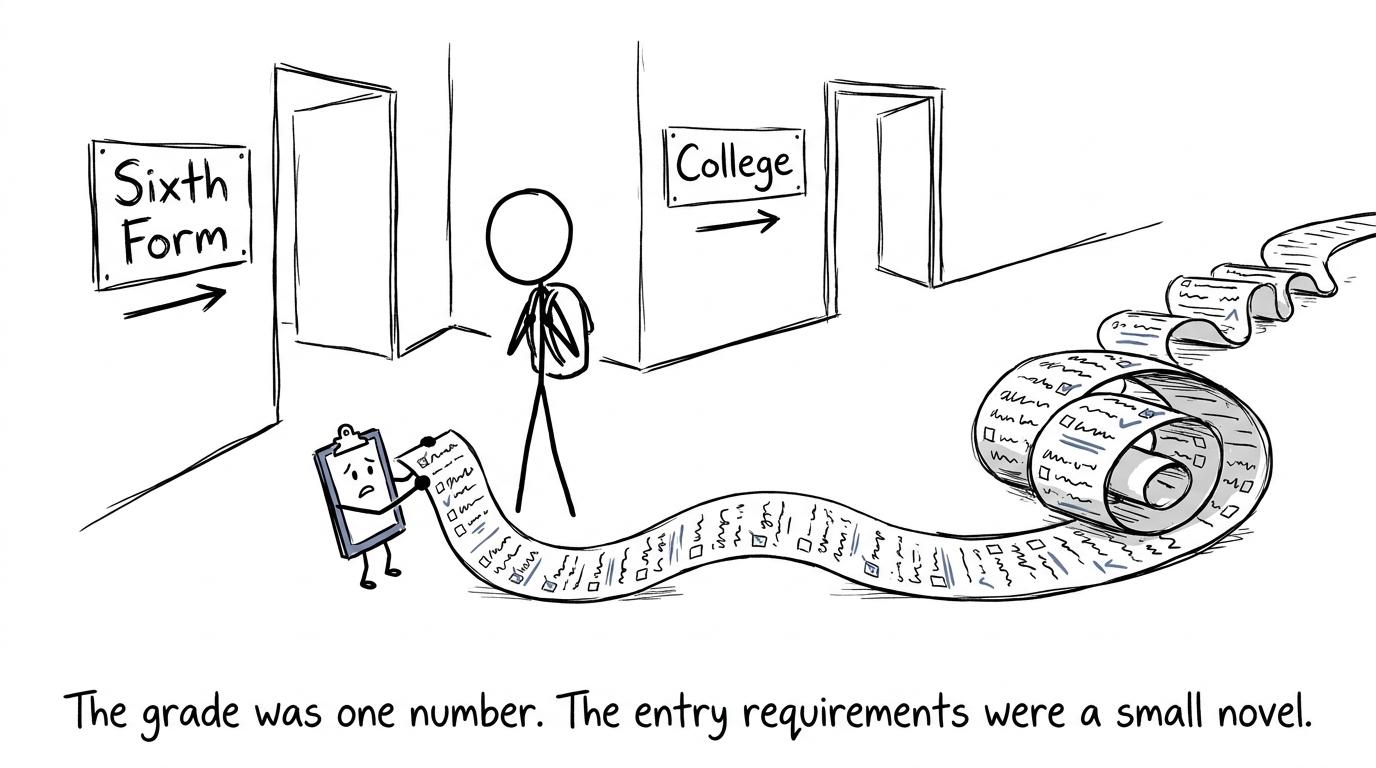 A student discovers that sixth-form entry requirements are longer than one GCSE grade
What does a grade 4 in GCSE History mean?
In England, GCSEs use the grades 9 to 1, with grade 9 being the highest. The Department for Education recognises grade 4 and above as a standard pass. The lower boundary of grade 4 is comparable with the lower boundary of the former grade C.
That makes a grade 4 a genuine achievement. It shows that you have reached the recognised Level 2 threshold in the subject.
What it does not provide is automatic entry to every sixth form or A Level. Schools and colleges can set higher requirements because A Level courses demand deeper knowledge, greater independence and, in History, sustained analysis of evidence and interpretations.
There is an important distinction:
- Passing GCSE History: a grade 4 achieves the standard-pass threshold.
- Entering a sixth form: you must meet the provider’s overall admissions criteria.
- Taking A Level History: you must also meet any subject-specific History or English requirement.
One result can satisfy the first condition without satisfying all three.
Is a grade 4 enough for the course you want?
If you want to take A Level History
A grade 4 may be accepted by some providers, particularly where admissions decisions also consider English grades, overall attainment or an essay-based subject. However, many sixth forms publish a minimum of grade 5 or 6 for A Level History.
This is not a national rule. It is a local admissions decision, so the exact answer must come from your chosen provider.
Look for phrases such as:
- “subject-specific entry requirements”
- “minimum grade in History”
- “grade in an essay-based subject”
- “English Language or Literature requirement”
- “general entry profile”
If the requirement is grade 5 and you receive a grade 4, speak to the sixth form rather than rejecting yourself. Ask whether there is any flexibility, whether another humanities grade can be considered, and whether your place can be reviewed. An exception is never guaranteed, but a clear conversation is better than guessing.
If you want another A Level
A grade 4 in History is less likely to be decisive if History is not one of your chosen subjects. Your sixth form may count it as one of the GCSE passes needed for general entry, while applying separate requirements to your intended subjects.
For example, A Level Mathematics commonly has a substantially higher subject-specific GCSE maths requirement than the provider’s general entry threshold. Sciences, languages and English subjects may also have their own criteria.
Read the requirement for every subject in your proposed combination. Meeting the overall sixth-form minimum does not necessarily mean that every combination is available.
If you want a vocational or mixed programme
Colleges and sixth forms may offer vocational Level 3 courses, mixed A Level and vocational programmes, or Level 2 routes with different entry profiles. A grade 4 in History may be entirely sufficient when History is not a required subject.
The course level, your English and maths grades, and any relevant subject requirements are usually more important than the History result in isolation. Check whether the programme requests a particular number of GCSE passes and whether specified subjects must be included.
Why English and maths may affect the decision
Students often focus on the GCSE named in the course title. Admissions policies are usually broader.
For History, English can matter because the A Level involves reading, selecting evidence, constructing arguments and writing extended responses. A provider may therefore ask for a particular grade in English Language or English Literature alongside, or instead of, a higher History grade.
Maths has a different significance. Under current Department for Education post-16 funding rules, students without grade 4 or above in GCSE maths and/or English must continue receiving teaching and support in the relevant subject as part of eligible 16 to 19 programmes. The precise qualification studied depends on prior attainment and programme circumstances.
That rule applies to English and maths, not GCSE History. You are not nationally required to resit History because you received a grade below 4. Nevertheless, individual course requirements still apply.
A secure maths result can also make your post-16 timetable simpler. If maths is competing with History for attention now, use the free GCSE Maths revision hub to identify the exact skills that need work rather than revising everything equally.
What to do before results day
Save the requirements now
Find the admissions policy and course guide for your intended entry year. Requirements can change, so use the current version rather than an old screenshot or a sibling’s prospectus.
Record three pieces of information:
- the general entry requirement
- the requirement for each chosen course
- the admissions contact details
If you have an offer, read its conditions carefully. An offer for the sixth form and confirmation of a particular subject combination may not be the same thing.
Make a first choice and a backup plan
A backup is not an admission of defeat. It is a way of protecting your choices.
If A Level History requires a grade above 4, identify another suitable provider or course before results day. You could consider a different sixth form with another entry threshold, a related subject, or a programme that keeps your longer-term options open.
The goal is not to predict disappointment. It is to avoid making a rushed decision while holding an envelope of results.
Ask a precise question
Instead of asking, “Is a grade 4 good enough?”, give the admissions team the relevant context:
- your intended course combination
- your achieved or predicted History grade
- your English grades
- your overall GCSE profile
- the exact published criterion you are asking about
Admissions staff can answer a specific question far more usefully than a general one.
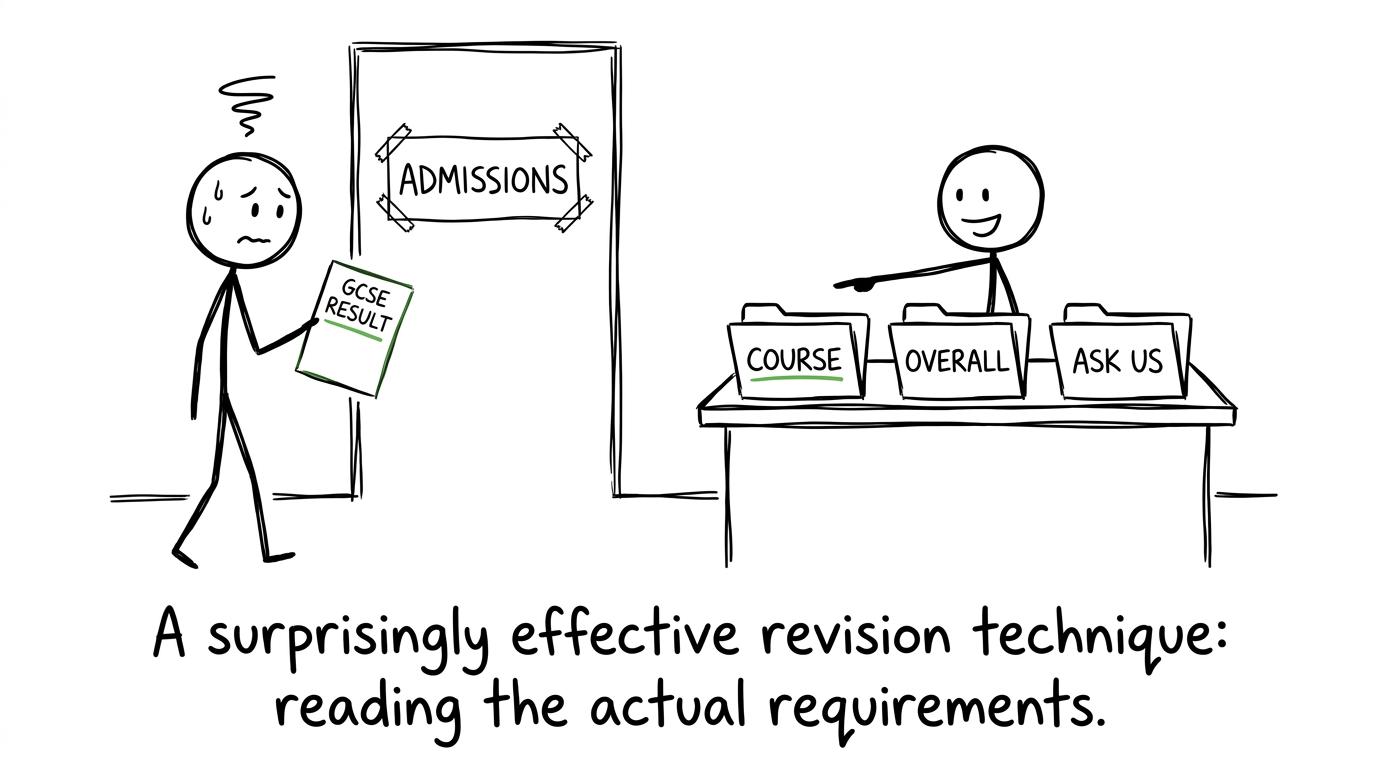 A student sensibly checks the course, overall and contact folders at admissions
How to improve your options while exams are still ahead
If you have not yet sat your exams, the entry requirement is not a verdict. It is a target.
Start by checking how close your current performance is to the grade requested by your preferred sixth form. Then direct revision towards the weaknesses that repeatedly cost marks. In History, that might involve knowledge, question interpretation, evidence selection, judgement or timing. Use your teacher’s feedback and your exam board’s specification rather than relying on a general feeling that you are “bad at essays”.
Protect your maths grade at the same time. Maths revision becomes more manageable when it is organised around evidence. The guide to finding your weakest GCSE topics explains how to diagnose gaps, while the GCSE maths revision timetable helps you turn those gaps into a realistic weekly plan.
On busy days, use the 20-minute maths revision routine. Short, deliberate practice is more useful than opening a textbook and hoping concentration appears.
When you need quick feedback, Edexcel GCSE Maths mini tests let you practise focused skills and check your work. Students following another board should begin at the main GCSE hub and select the appropriate Edexcel, AQA, OCR or Eduqas resources.
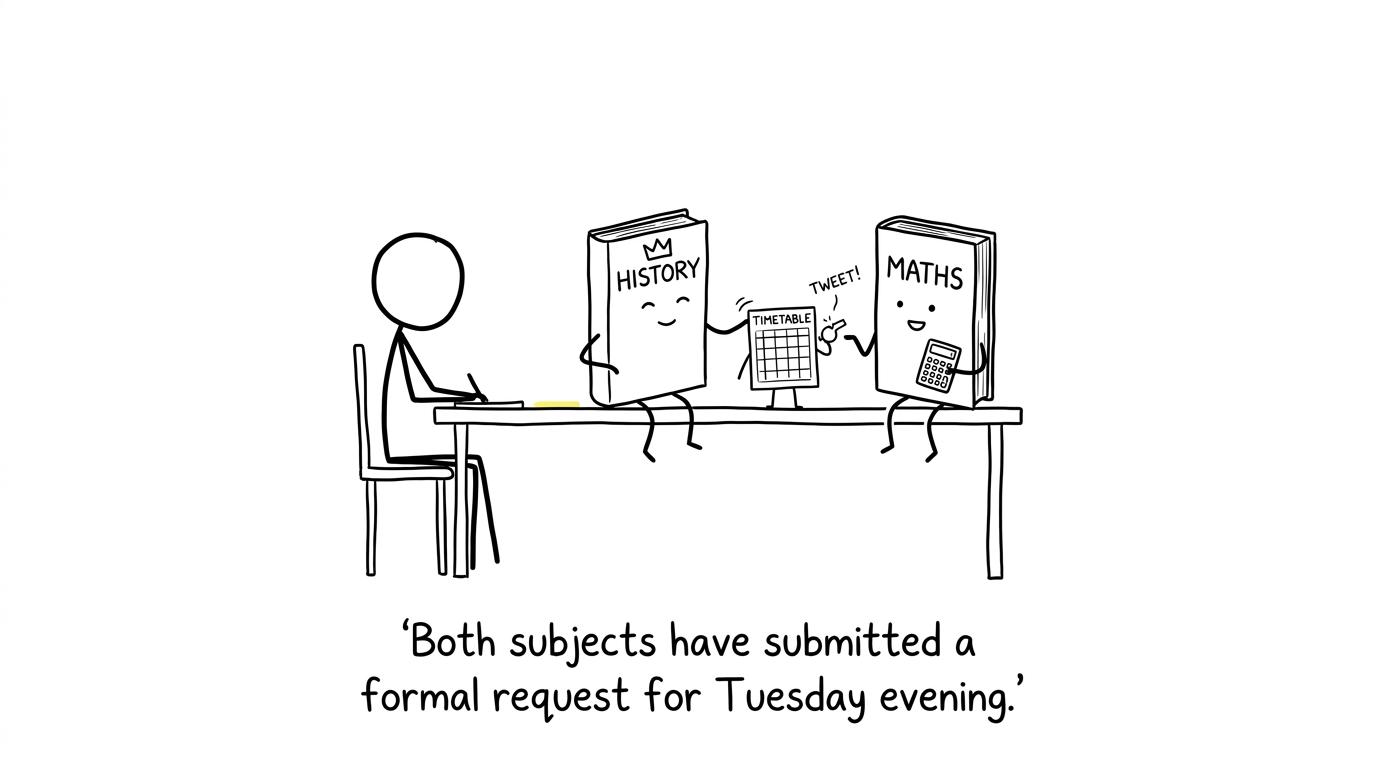 History and Maths politely compete for space in a student's revision timetable
Balancing History and maths revision
The temptation is to give all your time to the subject causing the most anxiety. That can create a second problem while you are trying to solve the first.
Instead, give each session a defined purpose. A History session might focus on one exam question or one gap in knowledge. A maths session might focus on one weak topic, followed by marking and correction. The subjects are different, but the useful revision loop is similar:
- attempt something without notes
- mark it honestly
- identify the exact weakness
- practise that weakness
- test it again later
As the exams approach, introduce complete papers gradually. The guide on when to start GCSE past papers helps you move from shorter practice to timed papers without using your best material too early.
If the exam window is close, a structured one-month GCSE maths revision plan can reduce daily decision-making. Nearer the final papers, use Edexcel GCSE Maths predicted papers alongside real past papers, mark schemes and video solutions. Predicted papers are practice tools, not guarantees of what will appear.
Common mistakes when judging a grade 4
Assuming a pass guarantees A Level entry
A grade 4 is a standard pass, but a provider can require grade 5 or 6 for A Level History. General admission and subject admission are separate checks.
Looking only at the History requirement
Your English grade, maths grade, total number of GCSE passes or wider grade profile may also affect the offer. Read the entire admissions section.
Using outdated entry information
A course booklet from a previous year may no longer apply. Check the intended year of entry and confirm unclear details with admissions staff.
Treating one sixth form’s rule as a national rule
There is no single national GCSE History grade for A Level History entry. Different providers make different decisions.
Giving up before asking
If you miss a published requirement, contact the provider promptly. Ask what alternatives exist and whether your overall results can be reviewed. Be realistic, but do not make the decision on their behalf.
Your next step
A grade 4 in GCSE History is a recognised standard pass. It may contribute to general sixth-form entry and may be enough for some courses. But if you want A Level History, you must check the subject-specific criteria of the sixth form or college you actually plan to attend. Some providers require a higher History or English grade.
Save the current requirements, prepare a backup and speak to admissions if anything is uncertain. Then return your attention to what remains under your control: the next revision session, the next corrected mistake and the next paper.
MathsGenie can help you protect one of the results that matters across many post-16 routes. Start with free revision lessons and practice questions, build confidence through mini tests, then use past papers, predicted papers, mark schemes and video solutions to turn revision into measurable progress. Create your revision planner, choose one weak topic and begin today.