

GCSE vs iGCSE Spanish: What's Actually Different?
GCSE vs iGCSE Spanish explained: compare exams, grading, tiers and language skills, and discover whether the qualification you sit matters in practice.
Choosing an exam course can feel strangely permanent. One timetable says GCSE Spanish; another says iGCSE Spanish. The names look different enough to suggest that one must be harder, more valuable or more demanding.
The short answer to gcse vs igcse spanish is reassuring: both assess listening, speaking, reading and writing, and both can support progression to further Spanish study. The important differences are the exam board, paper structure, grading system, tiering and precise tasks you will face. Your preparation should therefore follow your exact specification rather than a generic idea of what Spanish revision involves.
This matters especially if you are balancing Spanish with GCSE maths. You do not need another vague worry competing for revision time. You need to know which papers you are sitting, what each one rewards and how to prepare efficiently.
GCSE vs iGCSE Spanish at a glance
Use this checklist before making comparisons:
- GCSE Spanish in England changed from summer 2026, following first teaching of the reformed specifications in September 2024.
- Current GCSE courses from boards such as AQA, Pearson Edexcel and Eduqas use foundation and higher tiers.
- Pearson Edexcel International GCSE Spanish and Cambridge IGCSE Spanish are separate qualifications with different structures.
- Both routes assess the four core language skills: listening, speaking, reading and writing.
- Paper weightings, task styles, question language and grading can differ.
- Neither qualification is automatically easier.
- Your school normally chooses the qualification and exam board.
- The specification code on your entry information is more useful than the informal label used in conversation.
The central lesson is simple: compare specifications, not rumours.
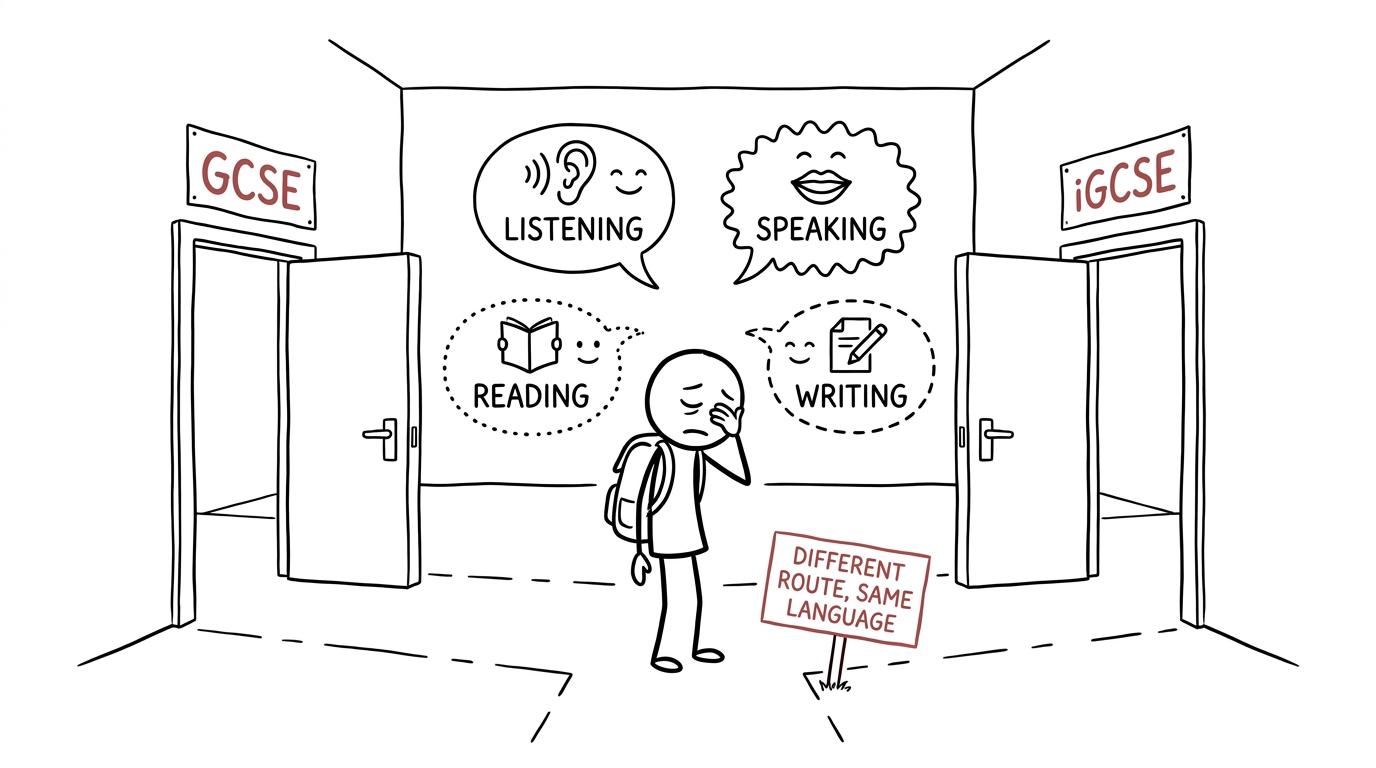 A student discovers that GCSE and iGCSE lead to the same four Spanish language skills
What does GCSE Spanish involve?
The reformed GCSE Spanish qualifications used in England apply to examinations from summer 2026. Although individual boards make their own assessment decisions, they work within national subject-content and assessment requirements.
Students are assessed in:
- listening and understanding;
- speaking;
- reading and understanding;
- writing.
For current AQA and Pearson Edexcel GCSE Spanish, each of these four components contributes 25%25\%25% of the overall qualification. Eduqas also assesses the same four skills through equally weighted components.
GCSE Spanish is tiered. Foundation tier generally makes grades 111 to 555 available, while higher tier targets grades 444 to 999, with limited provision for a grade below the normal higher-tier range depending on the board's awarding rules. Students normally enter the same tier for every component.
The revised GCSE content also places importance on specified vocabulary and grammar. Exam boards publish vocabulary and grammatical requirements so students and teachers can see what must be learned. Some carefully controlled unfamiliar language may still appear in permitted contexts, such as inference or dictation, but the published specification is the starting point.
Current assessments can include dictation in listening and reading aloud within speaking. The exact format, timing and marks depend on the board, so an AQA practice paper should not be treated as interchangeable with an Edexcel or Eduqas paper.
What does iGCSE Spanish involve?
The term “iGCSE Spanish” can be misleading because it does not refer to one universal examination. Two common examples are Cambridge IGCSE Spanish and Pearson Edexcel International GCSE Spanish.
Pearson Edexcel International GCSE Spanish
Pearson's International GCSE is graded from 999 to 111. Its current specification assesses Spanish through three externally assessed papers:
- listening, worth 25%25\%25%;
- reading and writing combined, worth 50%50\%50%;
- speaking, worth 25%25\%25%.
Unlike the current GCSE, it is not divided into foundation and higher tiers. Students follow one assessment route, with performance across the qualification determining the final grade.
The reading and writing skills are still assessed separately within their combined paper, but the structure means that half of the qualification is contained in one examination. That can affect revision planning and exam stamina even though all four language skills remain present.
Cambridge IGCSE Spanish
For Cambridge IGCSE Spanish examinations in 202520252025 to 202720272027, candidates take four papers: listening, reading, speaking and writing. Each contributes 25%25\%25%.
Cambridge uses grades from A∗A^*A∗ to GGG for this syllabus rather than the 999 to 111 scale. All candidates take the same papers, rather than choosing a foundation or higher tier. Written responses are required in Spanish, and the examination materials follow Cambridge's own syllabus and task conventions.
This is why asking whether “the iGCSE” has three or four papers has no single answer. You must know the awarding organisation as well as the qualification name.
The main differences that affect students
| Feature | Current GCSE Spanish | Pearson International GCSE | Cambridge IGCSE Spanish |
|---|---|---|---|
| Core skills | Listening, speaking, reading and writing | Listening, speaking, reading and writing | Listening, speaking, reading and writing |
| Typical component structure | Four components | Three papers, with reading and writing combined | Four papers |
| Tiering | Foundation or higher | No foundation/higher split | No foundation/higher split |
| Grading | 999 to 111 | 999 to 111 | A∗A^*A∗ to GGG |
| National GCSE subject content | Yes | No | No |
| Specification to follow | Your GCSE exam board | Pearson International GCSE | Cambridge IGCSE |
These distinctions change the route through the course, but not its basic purpose. Every student must understand spoken and written Spanish and communicate through speech and writing.
Tiering changes the decision, not the language
Foundation and higher tiers create an important GCSE decision. Your teacher must judge which tier gives you the most suitable access to marks and grades. That decision does not arise in the same way on the two International GCSE examples above.
A single-tier paper is not necessarily harder. It simply has to contain tasks that distinguish between a wider range of performances. Equally, foundation tier should not be described as an easy qualification: students still need accurate vocabulary, grammar, comprehension and communication.
The paper structure changes your revision rhythm
A student taking Pearson International GCSE has a substantial combined reading and writing paper. A Cambridge candidate prepares for four separate papers. A current GCSE student prepares for four components at one chosen tier.
That affects how you schedule timed practice. If one paper combines several demanding sections, you need to rehearse concentration across the whole paper. If skills are separated, you can practise each paper's timing more precisely.
This principle also applies to maths. The MathsGenie GCSE maths revision hub begins with the correct board and paper because useful practice must resemble the assessment you will actually sit.
Question language and task instructions may differ
Do not assume every board presents instructions in the same language. Current GCSE papers can use English for particular questions or instructions, while Cambridge IGCSE requires written responses in Spanish and uses its own assessment conventions. Pearson International GCSE states that its assessment is available only in Spanish.
This makes specimen and past-paper practice essential. Knowing Spanish is the main goal, but knowing how your board asks for an answer prevents avoidable confusion.
 A student learns that the exact exam specification is more useful than a generic revision book
Is iGCSE Spanish harder than GCSE Spanish?
There is no reliable blanket answer. Difficulty depends on the specific awarding organisation, the candidate's strengths and the task being attempted.
A student who dislikes tier decisions may prefer the idea of a single assessment route. Another may benefit from entering a GCSE tier designed around a narrower grade range. Someone confident in sustained reading and writing may respond well to a combined paper, while another student may prefer those skills to be examined separately.
Different grade boundaries cannot settle the argument either. Boundaries are set for particular papers and examination series. A raw-mark comparison across unrelated specifications ignores differences in questions, weighting and awarding.
The most productive question is not “Which one sounds harder?” It is “What does my specification require, and where am I currently losing marks?” That evidence-led approach is explored in MathsGenie's guide to finding your weakest GCSE topics.
Does it matter which qualification you sit?
It matters for your preparation, but it need not define your future.
You must revise the right vocabulary, grammar, speaking format and paper timings. You should use materials carrying the exact board name, qualification title and specification code. Mixing resources carelessly can leave you practising a task that does not appear in your examination.
For progression, schools, colleges and other institutions may set their own entry requirements. If you plan to take A Level Spanish or apply somewhere with a specific language requirement, check how that institution describes accepted qualifications and grades. Do not rely on an assumption that every admissions policy uses identical wording.
In most cases, students do not personally choose between GCSE and International GCSE. The school selects a course based on its curriculum, teaching approach and examination arrangements. Your strongest response is therefore not to worry about the label, but to understand the course you have.
How to revise when Spanish and maths compete for time
Revision becomes difficult when every subject presents itself as urgent. A calm plan gives each one a clear next action.
For Spanish, rotate the four skills rather than spending every session copying vocabulary. Include retrieval, listening, spoken responses, grammar, reading and timed writing. Use official specimen or past materials from your own board.
For maths, start with free GCSE maths lessons and practice questions, then use GCSE predicted papers nearer the examination period. MathsGenie's one-month GCSE revision plan can help turn a crowded calendar into manageable sessions.
The same feedback loop works across both subjects:
- attempt a defined task;
- check it against reliable criteria or a mark scheme;
- identify why marks were lost;
- practise that exact weakness;
- return to it later without notes.
When you are ready for full maths papers, read when to start GCSE past papers and build them into a realistic GCSE maths revision timetable. If you sit Edexcel maths, the guide to using Edexcel past papers properly explains how marking and reattempting convert practice into progress.
Common mistakes when comparing GCSE and iGCSE Spanish
Treating every iGCSE as the same qualification
Cambridge and Pearson specifications differ. Always identify the awarding organisation before comparing papers, grades or timings.
Using outdated GCSE information
Reformed French, German and Spanish GCSE specifications were first taught from September 202420242024 and assessed from summer 202620262026. Older resources may describe a previous speaking format or different listening tasks.
Assuming international means more difficult
The word describes the qualification family, not a guaranteed level of difficulty. Compare actual assessment objectives and papers.
Revising from the wrong board's materials
General vocabulary practice can still help, but timed paper preparation must match your specification. Check the logo, code, tier and examination series.
Focusing only on the final grade scale
A Cambridge grade of A∗A^*A∗ and a grade 999 belong to different grading systems. The labels alone do not tell you how the papers are structured or how a particular institution will state its requirements.
The difference matters most in your preparation
GCSE and iGCSE Spanish are not identical, but neither title tells the whole story. Current GCSE Spanish is tiered and follows national subject content. Pearson International GCSE uses three externally assessed papers and a 999 to 111 scale. Cambridge IGCSE uses four equally weighted papers and grades from A∗A^*A∗ to GGG.
What stays constant is the need to listen carefully, read accurately and communicate clearly in spoken and written Spanish. Learn the format in front of you rather than worrying about the label beside it.
Then bring the same precision to maths. Visit MathsGenie for free revision lessons, practice questions, mini tests, past papers, predicted papers, mark schemes and video solutions. Choose your board, identify the next weakness and make one focused revision session count.










