GCSE vs iGCSE Chemistry: What's Actually Different?
GCSE vs iGCSE Chemistry explained: compare content, papers, practicals, grading and maths, then revise confidently for the qualification you sit at school.
There is a particular kind of uncertainty that appears when two courses have almost the same name. You hear that one is more difficult, another is preferred by universities, and a third person insists there is no meaningful difference at all.
The short answer to GCSE vs iGCSE Chemistry is this: both teach the central ideas of secondary-school Chemistry, but their specifications, paper structures, practical assessment and grading routes can differ. The differences matter for how you revise. They do not mean that one qualification automatically makes you a better Chemistry student.
Your exact exam board matters more than the label alone. AQA GCSE Chemistry, Pearson Edexcel International GCSE Chemistry and Cambridge IGCSE Chemistry are not interchangeable courses. The safest strategy is to identify your specification code, learn its content and practise its papers.
The difference at a glance
Use this checklist before planning your revision:
- GCSE Chemistry in England follows national subject-content and assessment rules.
- International GCSE or iGCSE Chemistry is an umbrella term covering qualifications designed by individual awarding organisations.
- Both routes cover atomic structure, bonding, quantitative Chemistry, reactions, energetics, rates, acids, electrolysis and organic Chemistry.
- The ordering and depth of individual topics can differ.
- GCSE Chemistry is normally divided into foundation and higher tiers.
- Cambridge IGCSE uses Core and Extended routes, while Pearson Edexcel International GCSE Chemistry is structured differently again.
- Practical skills may be tested through written questions, a practical examination or an alternative-to-practical paper, depending on the qualification.
- The correct past papers and mark schemes are essential because question style varies.
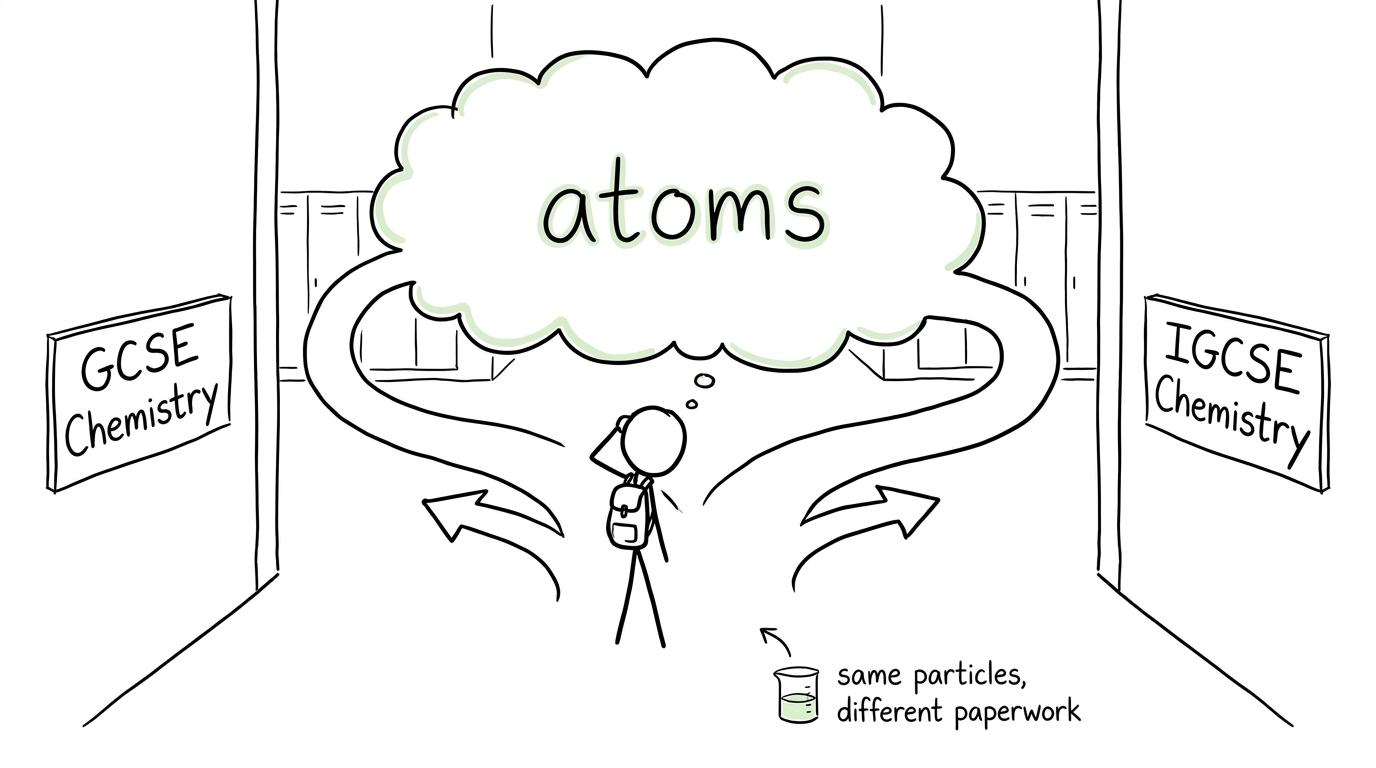 A student discovers that both Chemistry routes lead to atoms
GCSE and iGCSE are different qualifications
GCSE Chemistry specifications offered in England by boards such as AQA, Edexcel, OCR and Eduqas must operate within the relevant national framework. That creates common features, including grades 999 to 111, foundation and higher tiers, externally assessed written examinations and specified expectations for mathematical and practical skills.
International GCSE qualifications are created by their awarding organisations for use in international and UK settings. Cambridge calls its qualification IGCSE, while Pearson uses International GCSE. These courses are not simply GCSE papers with a different cover.
That distinction is important because there is no single universal iGCSE Chemistry format. Whenever somebody says, “iGCSE has three papers,” the sensible response is: “Which iGCSE?” Cambridge and Pearson use substantially different assessment models.
The same caution applies to GCSE. AQA, Edexcel, OCR and Eduqas organise content and questions differently even though they share a broad regulatory framework. Start by checking the front of a school assessment, your examination entry or the specification code provided by your teacher.
How the Chemistry content compares
The overlap is considerable. Whichever route you follow, you are likely to meet:
- particles, atoms, elements and compounds;
- ionic, covalent and metallic bonding;
- formulae and chemical equations;
- the mole and reacting quantities;
- acids, bases and salts;
- electrolysis;
- rates of reaction and equilibrium;
- energy changes;
- the periodic table and metal reactivity;
- organic Chemistry;
- separation, analysis and experimental methods.
This shared core is why moving between courses can initially feel straightforward. The vocabulary is familiar. The danger is assuming that familiar headings mean identical requirements.
A specification may require a reaction condition, test, calculation or explanation that another course omits or treats differently. Organic Chemistry is a common example: the families, reactions and level of detail required depend on the board. Environmental Chemistry and industrial processes may also be grouped differently.
Do not revise from a generic topic list alone. Use your current specification as a boundary: if a detail is listed, learn it; if it is not listed, do not let it displace material that can actually earn marks.
MathsGenie’s GCSE Chemistry revision hub lets you select the relevant board and work through appropriately organised resources. Students taking the domestic Edexcel qualification can go directly to Edexcel GCSE Chemistry revision.
Exam papers are where the clearest differences appear
The course title tells you what you are learning. The assessment structure tells you how you must demonstrate it.
GCSE Chemistry papers
AQA GCSE Chemistry, for example, is a linear qualification with two written papers. Each lasts 111 hour 454545 minutes, carries 100100100 marks and contributes 50%50\%50% of the qualification. Paper 111 and Paper 222 assess different topic groups, although later questions can draw on fundamental earlier ideas.
GCSE Chemistry is tiered. Foundation assessments target grades 111 to 555, while higher assessments target grades 444 to 999. Students take all components at the same tier. Other GCSE boards have their own content divisions and paper styles, so AQA timings should not be applied automatically to Edexcel, OCR or Eduqas.
Pearson Edexcel International GCSE Chemistry
Pearson Edexcel International GCSE Chemistry, specification 4CH14\mathrm{CH}14CH1, has two externally assessed written papers. In the linear specification, Paper 1C1\mathrm{C}1C lasts 222 hours, carries 110110110 marks and contributes 61.1%61.1\%61.1%. Paper 2C2\mathrm{C}2C lasts 111 hour 151515 minutes, carries 707070 marks and contributes 38.9%38.9\%38.9%.
Paper 1C1\mathrm{C}1C assesses the core content, while Paper 2C2\mathrm{C}2C can assess all content, including material identified for greater depth. Both can contain multiple-choice, short-answer, calculation and extended open-response questions.
Pearson also offers a modular International GCSE Chemistry specification in eligible international settings. This is another reason to check the exact code rather than relying on the word “iGCSE”.
Cambridge IGCSE Chemistry
For Cambridge IGCSE Chemistry, the current syllabus uses Core and Extended routes. Core candidates take a multiple-choice paper, a theory paper and a practical component. Extended candidates take more demanding versions of the multiple-choice and theory papers, plus the practical component.
The multiple-choice paper contributes 30%30\%30%, theory contributes 50%50\%50%, and practical assessment contributes 20%20\%20%. Depending on the centre, the practical component is either a laboratory Practical Test or a written Alternative to Practical paper.
Cambridge syllabus 062006200620 uses grades A* to G, while its 999 to 111 counterpart uses the numerical scale. Never assume that “Core” is merely another spelling of GCSE foundation tier: the routes have their own content, paper combinations and available grades.
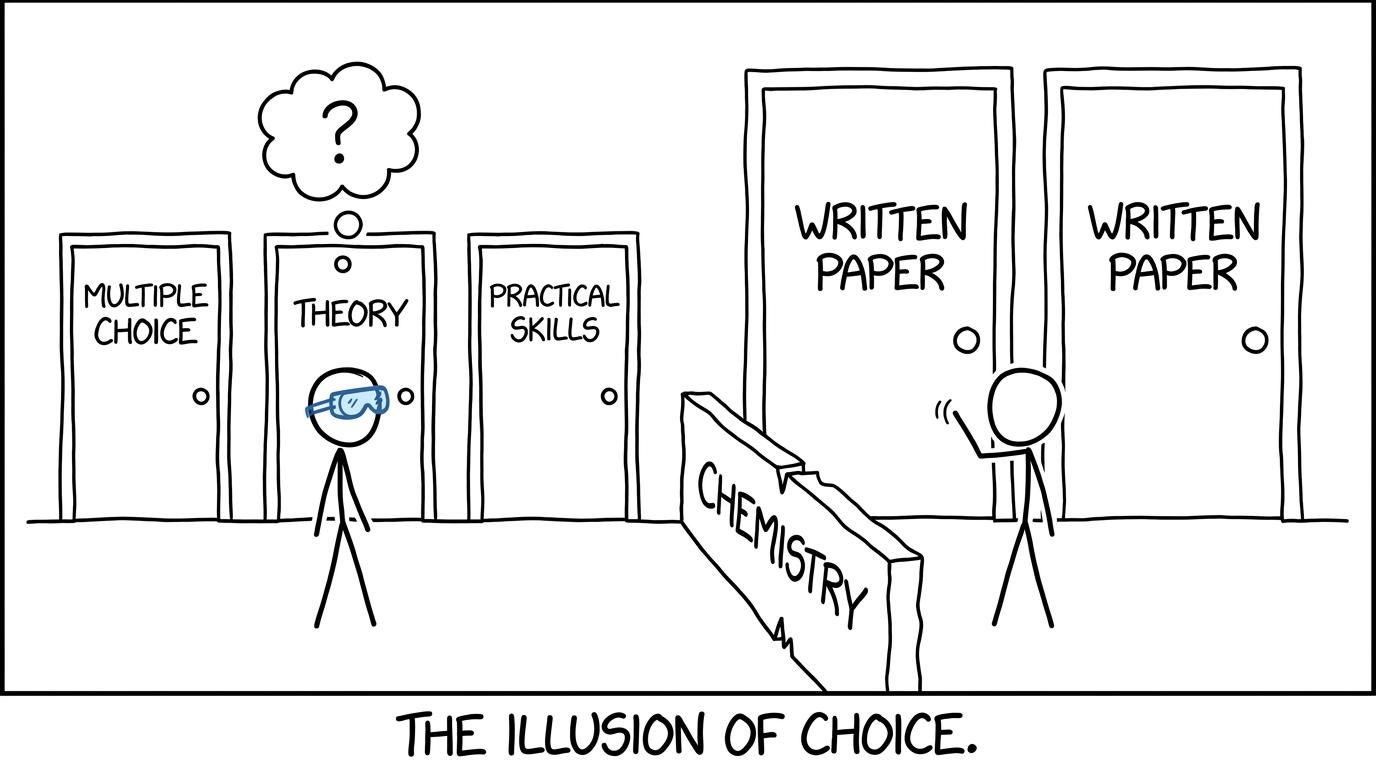 Students face different Chemistry exam doors
Practical Chemistry is assessed differently
Practical work is one of the most meaningful distinctions.
For GCSE single-science Chemistry in England, students must be given opportunities to complete or observe the specified practical activities. Practical understanding is then assessed through the written papers rather than through a separate laboratory examination. At least 15%15\%15% of GCSE science marks assess practical work, and single-science Chemistry includes at least eight specified practical activities.
Questions can ask you to select apparatus, identify variables, interpret results, evaluate a method or suggest an improvement. Remembering a classroom procedure is not enough; you must understand why each step was used.
Pearson Edexcel International GCSE also assesses experimental skills within its written papers. Cambridge IGCSE makes the practical component more visibly separate: candidates take either the hands-on Practical Test or the written Alternative to Practical.
So, does iGCSE involve more practical work? Not necessarily. It depends on the awarding organisation and the route selected by your centre. What changes most clearly is how practical understanding reaches the final assessment.
Does one course contain more maths?
Chemistry is often where students discover that maths is not confined to the maths timetable.
For GCSE Chemistry in England, at least 20%20\%20% of the marks must assess mathematical skills. Typical demands include:
- ratios from balanced equations;
- relative formula mass;
- moles and reacting masses;
- solution concentration;
- gas volumes;
- percentage yield and atom economy;
- rates and gradients;
- graphs, averages and significant figures;
- standard form and unit conversions.
Common relationships include:
n=mMrn=\frac{m}{M_r}n=Mrmand
c=nV.c=\frac{n}{V}.c=Vn.Both GCSE and international courses can assess these ideas, although the exact equations, expected depth and available formula support depend on the specification.
If calculations are costing you marks, revise the underlying skill separately. MathsGenie’s standard form revision and percentage change guide strengthen methods that transfer directly into science. For reaction calculations, the monitoring chemical reactions guide shows how quantitative Chemistry fits together.
Is iGCSE Chemistry harder than GCSE Chemistry?
There is no honest one-word answer.
Difficulty depends on the exact specifications being compared, your tier or route, and the kinds of questions you handle best. A separate multiple-choice paper may suit one student and unsettle another. A distinct practical component may feel clearer than practical questions scattered through written papers. Greater topic depth can be demanding, but so can a GCSE question that applies familiar knowledge in an unfamiliar context.
It is therefore misleading to rank every iGCSE above every GCSE. A higher-tier GCSE paper is not automatically easier than a Cambridge Extended paper, and Pearson International GCSE should not be treated as identical to Cambridge IGCSE.
For progression, the useful question is not, “Which label sounds more impressive?” It is, “Have I achieved a strong result and developed the knowledge needed for my next course?” If you have a specific sixth form, college or future entry requirement, check it directly rather than relying on general claims about recognition.
Does it matter which one you sit?
It matters operationally, not as a verdict on your ability.
It matters because you must learn the right content, enter the right tier or route, practise the right timings and understand the practical format. Using an AQA GCSE paper to prepare for Cambridge IGCSE may provide extra Chemistry practice, but it is not a reliable rehearsal for your actual examination.
It matters much less as a status question. You normally sit the qualification chosen by your school. Your best move is not to worry about the route you were assigned, but to become unusually familiar with its specification and mark scheme.
A productive revision cycle is:
- identify your board, code and tier or route;
- audit every specification topic;
- use revision lessons for genuine knowledge gaps;
- complete topic-specific practice questions;
- mark immediately and record why marks were lost;
- move into timed papers only after repairing the main gaps;
- use predicted papers as fresh rehearsal, not as a forecast.
If you are unsure where your marks are leaking, follow MathsGenie’s guide to finding your weakest Chemistry topics. The broader Chemistry revision plan for moving beyond a pass can help turn that diagnosis into a routine.
Common mistakes when comparing the courses
Treating every iGCSE as the same
Cambridge and Pearson do not use one shared specification or paper structure. Always include the awarding organisation and specification code in your revision searches.
Revising from the wrong past papers
A topic may overlap while the wording, mark allocation and expected depth differ. Cross-board questions can supplement revision, but your own board’s papers should lead it.
Confusing Core with foundation tier
Cambridge Core and GCSE foundation are separate systems. Their available grades, content and paper combinations must be checked independently.
Ignoring practical skills because there is no laboratory exam
Written practical questions still test apparatus, variables, methods, data and evaluation. No separate practical paper does not mean no practical assessment.
Learning equations without checking units
A memorised relationship is only useful when quantities use compatible units. Unit conversion, significant figures and calculator accuracy often decide whether a correct approach earns the final mark.
Assuming the supposedly harder course is automatically better
Course labels do not replace results, understanding or progression requirements. Concentrate on mastering the qualification you will actually sit.
Make your qualification work for you
The difference between GCSE and iGCSE Chemistry is real, but it is manageable. Most of the scientific foundations overlap; the decisive differences lie in specification detail, assessment structure, practical testing and grading routes.
Begin with your code, not a rumour. Build knowledge topic by topic, strengthen the maths underneath your calculations and then rehearse the exact paper format.
MathsGenie brings free revision lessons, practice questions, past papers, predicted papers, mini tests, mark schemes and video solutions into one organised system. Start at the GCSE Chemistry revision hub, then use the GCSE maths revision timetable to protect regular time for calculations and paper practice. The qualification may have been chosen for you. The quality of your preparation is still yours to shape.