5.1.1 The technique of titration
A titration measures the volume that reacts completely
Titration
A technique that finds the volume of one solution needed to react completely with a measured volume of another solution.
- Titrations are most often used for neutralisation reactions between an acid and an alkali.
- A fixed volume of one solution, often the alkali, is measured into a conical flask.
- The other solution is added gradually from a burette until the reaction is complete.
- A few drops of indicator in the flask change colour when neutralisation is complete.
- The volume added from the burette to reach this point is called the titre.
- If the concentration of one solution is known, the titre can later be used to work out the unknown concentration of the other.
Every step of a titration is designed to measure two volumes accurately: the fixed volume in the flask and the titre from the burette.
Pipettes measure fixed volumes and burettes measure variable volumes
Pipette
Glassware that measures and transfers one fixed volume of liquid accurately, such as 25.0 cm³.
Burette
A long graduated glass tube with a tap, used to add a variable volume of solution and measure it accurately.
- Rinse the pipette with a little of the solution it will measure, so that no water is left inside to dilute it.
- Use a pipette filler to draw the solution up until the bottom of the meniscus sits on the line, reading it at eye level.
- Let the solution run into the conical flask and touch the tip on the inside of the flask, but do not blow out the last drop.
- Rinse the burette with the solution it will hold, then fill it using a small funnel and remove the funnel before reading it.
- Open the tap briefly so that the jet below the tap fills and contains no air bubble.
- Read the burette at eye level from the bottom of the meniscus, recording each reading to the nearest 0.05 cm30.05\,\text{cm}^30.05cm3.
- Readings are written to two decimal places, so a reading halfway between 22.4022.4022.40 and 22.5022.5022.50 is recorded as 22.45 cm322.45\,\text{cm}^322.45cm3.
Rinse the conical flask with distilled water only, because water in the flask does not change the amount of alkali the pipette delivered, whereas rinsing it with alkali would add extra.
An indicator's sharp colour change shows the end point
Indicator
A substance that has different colours in acidic and alkaline solutions, so its colour change shows when neutralisation is complete.
End point
The point in a titration at which the indicator changes colour, showing that the reaction is complete.
- Add only a few drops of indicator, because the indicator is itself a weak acid and too much can affect the result.
- Phenolphthalein is colourless in acid and pink in alkali.
- Methyl orange is red in acid and yellow in alkali.
- The colour change you see depends on which solution starts in the flask, so describe it in the direction the titration runs.
- With alkali in the flask and acid in the burette, phenolphthalein turns from pink to colourless and methyl orange turns from yellow to red.
- Universal indicator is not used, because it changes colour gradually through many shades instead of at one sharp point.
- Standing the flask on a white tile makes the colour change easier to see.
Hydrochloric acid is added from a burette to 25.0 cm325.0\,\text{cm}^325.0cm3 of sodium hydroxide solution containing phenolphthalein, and the end point is reached when one drop turns the pink solution permanently colourless.
A rough titration comes before accurate dropwise titrations
- The first rough titration adds the solution quickly while swirling, to find roughly where the end point is.
- In each accurate titration, add the solution quickly until you are about 2 cm32\,\text{cm}^32cm3 short of the rough titre.
- Then add it drop by drop, swirling after each drop, so that you do not overshoot the end point.
- Wash any drops on the inside of the flask down with a little distilled water, so all the solution added can react.
- Stop at the first permanent colour change and record the final burette reading.
- Calculate the titre by subtracting the initial burette reading from the final reading.
- Aim: find the volume of acid that reacts completely with 25.0 cm325.0\,\text{cm}^325.0cm3 of alkali.
- Apparatus: a 50 cm350\,\text{cm}^350cm3 burette, a clamp and stand, a small funnel, a 25.0 cm325.0\,\text{cm}^325.0cm3 pipette with a pipette filler, a 250 cm3250\,\text{cm}^3250cm3 conical flask, a white tile, an indicator such as phenolphthalein or methyl orange, the acid, the alkali and a wash bottle of distilled water.
Part 1: setting up
- Rinse the burette with a little of the acid, then clamp it upright.
- Fill the burette with acid through a funnel held below eye level, then remove the funnel.
- Run a little acid out so that the tip has no air bubble.
- Use the pipette and pipette filler to transfer 25.0 cm325.0\,\text{cm}^325.0cm3 of alkali into the conical flask, then add a few drops of indicator.
- Stand the flask on the white tile under the burette.
Part 2: titrating
- Record the initial burette reading at eye level, from the bottom of the meniscus.
- Do a rough titration first, adding acid quickly while swirling until the indicator changes colour.
- Refill the flask with fresh alkali and indicator, and run in acid to about 1 cm31\,\text{cm}^31cm3 less than the rough titre.
- Add acid drop by drop while swirling, until one drop gives a permanent colour change.
- Record the final reading to the nearest 0.05 cm30.05\,\text{cm}^30.05cm3 and work out the titre.
- Repeat until at least two titres are concordant, within 0.10 cm30.10\,\text{cm}^30.10cm3 of each other, and use only those for the mean.
Accuracy and safety
- Rinse the burette with the acid and the pipette with the alkali, so that leftover water does not dilute them.
- Swirl the flask all the time and rinse its sides with distilled water near the end, so that all the acid added can react.
- Read every volume at eye level, from the bottom of the meniscus.
- Wear eye protection, because acids and alkalis are irritant or corrosive.
Concordant titres are averaged to give a reliable titre
Concordant results
Repeat titres that agree closely with each other, usually within 0.10 cm³.
- Repeat the accurate titration until at least two titres are concordant, which usually means within 0.10 cm30.10\,\text{cm}^30.10cm3 of each other.
- Leave the rough titre out of the mean, because the solution was added too quickly for it to be accurate.
- Also leave out any anomalous titre, such as one where the end point was overshot.
- Calculate the mean titre from the concordant results only.
- Concordant results show that the method is repeatable, so the mean titre is a trustworthy value.
- Titres of 23.10 cm323.10\,\text{cm}^323.10cm3 (rough), 22.50 cm322.50\,\text{cm}^322.50cm3, 22.40 cm322.40\,\text{cm}^322.40cm3 and 22.45 cm322.45\,\text{cm}^322.45cm3 are recorded; find the mean titre.
- Leave out the rough titre of 23.10 cm323.10\,\text{cm}^323.10cm3.
- The other three titres all lie within 0.10 cm30.10\,\text{cm}^30.10cm3 of each other, so they are concordant.
- Mean titre =22.50+22.40+22.453=22.45 cm3= \dfrac{22.50 + 22.40 + 22.45}{3} = 22.45\,\text{cm}^3=322.50+22.40+22.45=22.45cm3.
- Why is the pipette rinsed with the solution it will measure, but the conical flask rinsed only with distilled water?
- What colour change does phenolphthalein show when acid is added to alkali in the flask?
- Why is universal indicator not used in a titration?
- Why is the solution added dropwise near the end point?
- Which titres are used to calculate the mean titre?
5.1.2 Theoretical mass, percentage yield and atom economy
Scaling reacting masses gives the theoretical yield
Theoretical yield
The maximum mass of product that could form from a given mass of reactant, calculated from the balanced equation.
Relative formula mass
The mass of one formula unit of a substance compared with one-twelfth of the mass of a carbon-12 atom, given the symbol Mr.
- A balanced equation shows the reacting masses of each substance when you replace each formula with its MrM_rMr.
- Mass is conserved, so these reacting masses always add up to the same total on both sides.
- The reacting masses stay in the same ratio whatever mass of reactant is used.
- To find the theoretical yield, multiply the mass of reactant by the mass ratio of product to reactant.
- This gives the greatest mass of product possible, because it assumes all the reactant turns into product.
- Calculate the theoretical yield of calcium oxide when 10.0 g10.0\,\text{g}10.0g of calcium carbonate is heated: CaCO3→CaO+CO2\text{CaCO}_3 \rightarrow \text{CaO} + \text{CO}_2CaCO3→CaO+CO2 (ArA_rAr: Ca = 40.1, C = 12.0, O = 16.0).
- Work out the relative formula masses: Mr(CaCO3)=40.1+12.0+(3×16.0)=100.1M_r(\text{CaCO}_3) = 40.1 + 12.0 + (3 \times 16.0) = 100.1Mr(CaCO3)=40.1+12.0+(3×16.0)=100.1 and Mr(CaO)=40.1+16.0=56.1M_r(\text{CaO}) = 40.1 + 16.0 = 56.1Mr(CaO)=40.1+16.0=56.1.
- Write the reacting masses: 100.1 g100.1\,\text{g}100.1g of CaCO3\text{CaCO}_3CaCO3 gives 56.1 g56.1\,\text{g}56.1g of CaO\text{CaO}CaO.
- Scale to the mass used: 10.0×56.1100.1=5.60 g10.0 \times \dfrac{56.1}{100.1} = 5.60\,\text{g}10.0×100.156.1=5.60g of calcium oxide.
Multiply relative formula masses by the balancing numbers
- A balancing number in front of a formula multiplies the whole formula, so it also multiplies that substance's reacting mass.
- In 2Mg+O2→2MgO2\text{Mg} + \text{O}_2 \rightarrow 2\text{MgO}2Mg+O2→2MgO, the reacting masses are 2×24.3=48.62 \times 24.3 = 48.62×24.3=48.6 for magnesium and 2×40.3=80.62 \times 40.3 = 80.62×40.3=80.6 for magnesium oxide.
- So 6.00 g6.00\,\text{g}6.00g of magnesium gives a theoretical yield of 6.00×80.648.6=9.95 g6.00 \times \dfrac{80.6}{48.6} = 9.95\,\text{g}6.00×48.680.6=9.95g of magnesium oxide.
- Only the reactant you are given and the product you want are needed, so other substances in the equation can be ignored.
- Round only at the end, and give the answer with a unit of mass, because relative formula masses themselves have no units.
- Calculate the theoretical yield of iron from 80.0 g80.0\,\text{g}80.0g of iron(III) oxide: Fe2O3+3CO→2Fe+3CO2\text{Fe}_2\text{O}_3 + 3\text{CO} \rightarrow 2\text{Fe} + 3\text{CO}_2Fe2O3+3CO→2Fe+3CO2 (ArA_rAr: Fe = 55.8, O = 16.0).
- Work out the reacting masses: Fe2O3=(2×55.8)+(3×16.0)=159.6\text{Fe}_2\text{O}_3 = (2 \times 55.8) + (3 \times 16.0) = 159.6Fe2O3=(2×55.8)+(3×16.0)=159.6 and 2Fe=2×55.8=111.62\text{Fe} = 2 \times 55.8 = 111.62Fe=2×55.8=111.6.
- Scale to the mass used: 80.0×111.6159.6=55.9 g80.0 \times \dfrac{111.6}{159.6} = 55.9\,\text{g}80.0×159.6111.6=55.9g of iron.
Percentage yield compares actual yield with theoretical yield
Actual yield
The mass of product that is collected when a reaction is carried out.
Percentage yield
The actual yield of a product expressed as a percentage of its theoretical yield.
- Percentage yield is calculated with this equation: percentage yield=actual yieldtheoretical yield×100\text{percentage yield} = \frac{\text{actual yield}}{\text{theoretical yield}} \times 100percentage yield=theoretical yieldactual yield×100
- The actual yield is almost always less than the theoretical yield.
- The reaction may be reversible or may not go to completion, so some reactant never turns into product.
- Side reactions can turn some of the reactant into other, unwanted products.
- Some product is lost when it is filtered, transferred between containers or purified.
- A percentage yield above 100%100\%100% suggests the product was still wet or impure when it was weighed.
- The theoretical yield of calcium oxide is 5.60 g5.60\,\text{g}5.60g, but only 4.48 g4.48\,\text{g}4.48g is collected; calculate the percentage yield.
- Substitute into the equation: 4.485.60×100\dfrac{4.48}{5.60} \times 1005.604.48×100.
- Percentage yield =80.0%= 80.0\%=80.0%.
Atom economy shows how much reactant mass becomes product
Atom economy
The percentage of the total mass of reactants that ends up in the desired product, calculated from the balanced equation.
Desired product
The useful product that a reaction is carried out to make.
- Atom economy is calculated from the balanced equation: atom economy=Mr of desired productsum of Mr of all products×100\text{atom economy} = \frac{M_r \text{ of desired product}}{\text{sum of } M_r \text{ of all products}} \times 100atom economy=sum of Mr of all productsMr of desired product×100
- Multiply each MrM_rMr by its balancing number before adding, as for reacting masses.
- The total mass of the products equals the total mass of the reactants, so the bottom line can also be the sum of the reactants' MrM_rMr values.
- A reaction with only one product has an atom economy of 100%100\%100%, because every atom ends up in the desired product.
- A low atom economy means much of the reactant mass becomes waste products, which wastes raw materials unless the by-products can be used or sold.
- Calculate the atom economy for making calcium oxide: CaCO3→CaO+CO2\text{CaCO}_3 \rightarrow \text{CaO} + \text{CO}_2CaCO3→CaO+CO2 (MrM_rMr: CaO = 56.1, CO2\text{CO}_2CO2 = 44.0).
- Add the MrM_rMr values of all the products: 56.1+44.0=100.156.1 + 44.0 = 100.156.1+44.0=100.1.
- Atom economy =56.1100.1×100=56.0%= \dfrac{56.1}{100.1} \times 100 = 56.0\%=100.156.1×100=56.0%.
Percentage yield and atom economy measure different things
- Percentage yield depends on how well the reaction is carried out, so it can change from one attempt to the next.
- Atom economy depends only on the balanced equation, so it is fixed for a given reaction.
- A reaction can have a high atom economy but a low percentage yield.
- Making ethanol from ethene and steam has an atom economy of 100%100\%100%, yet only a small fraction of the gases react each time they pass through the reactor.
- Chemists want both values to be high, because together they mean less waste and more product from the same raw materials.
- When a question asks for percentage yield, look for a measured mass of product, but when it asks for atom economy, use only the MrM_rMr values from the balanced equation.
- Show the reacting masses or MrM_rMr values you used, then give the final answer with its unit or percentage sign.
- What is the theoretical yield of a reaction?
- What mass of calcium oxide could form from 20.0 g20.0\,\text{g}20.0g of calcium carbonate (MrM_rMr: CaCO3\text{CaCO}_3CaCO3 = 100.1, CaO = 56.1)?
- Give two reasons why the actual yield is usually less than the theoretical yield.
- Why does a reaction with only one product have an atom economy of 100%100\%100%?
- Which of percentage yield and atom economy can be calculated without doing the experiment?
5.1.3 Concentration of a solution in mol/dm3
Concentration measures solute per volume of solution
Concentration
The amount of solute dissolved in a stated volume of solution, measured in g/dm³ or mol/dm³.
Solute
The substance that dissolves in a solvent to make a solution.
- A solution forms when a solute dissolves in a solvent, such as salt dissolving in water.
- A concentrated solution has a lot of solute in a given volume, while a dilute solution has only a little.
- Concentration can be measured in grams per cubic decimetre, written g/dm3\text{g/dm}^3g/dm3.
- One cubic decimetre is 1000 cm31000\,\text{cm}^31000cm3, which is the same as one litre.
- The volume used is the volume of the whole solution, not the volume of water that was added.
- Concentration can also be given in mol/dm3\text{mol/dm}^3mol/dm3, which uses the amount in moles of solute instead of its mass.
Concentration depends on two things only: how much solute there is and how much solution it is spread through.
Concentration equals mass of solute over volume
- The relationship is: concentration (g/dm3)=mass of solute (g)volume of solution (dm3)\text{concentration (g/dm}^3\text{)} = \frac{\text{mass of solute (g)}}{\text{volume of solution (dm}^3\text{)}}concentration (g/dm3)=volume of solution (dm3)mass of solute (g)
- Convert a volume in cm3\text{cm}^3cm3 into dm3\text{dm}^3dm3 by dividing by 1000 before using the equation.
- So 250 cm3250\,\text{cm}^3250cm3 is 0.250 dm30.250\,\text{dm}^30.250dm3.
- Rearranging gives mass of solute === concentration ×\times× volume, which tells you how much solid to weigh out.
- Making 2.00 dm32.00\,\text{dm}^32.00dm3 of a 15.0 g/dm315.0\,\text{g/dm}^315.0g/dm3 solution needs 15.0×2.00=30.0 g15.0 \times 2.00 = 30.0\,\text{g}15.0×2.00=30.0g of solute.
- Give every answer with its unit, because a number alone does not say whether it is a mass, a volume or a concentration.
- Calculate the concentration of a solution made by dissolving 5.00 g5.00\,\text{g}5.00g of sodium chloride in water to make 250 cm3250\,\text{cm}^3250cm3 of solution.
- Convert the volume: 250 cm3÷1000=0.250 dm3250\,\text{cm}^3 \div 1000 = 0.250\,\text{dm}^3250cm3÷1000=0.250dm3.
- Divide mass by volume: 5.00 g0.250 dm3=20.0 g/dm3\dfrac{5.00\,\text{g}}{0.250\,\text{dm}^3} = 20.0\,\text{g/dm}^30.250dm35.00g=20.0g/dm3.
How solute mass and volume affect concentration
- At a fixed volume, concentration is directly proportional to the mass of solute.
- Dissolving twice the mass of solute in the same volume doubles the concentration.
- For a fixed mass of solute, a larger volume of solution gives a lower concentration.
- Spreading the same mass through twice the volume halves the concentration.
- Doubling both the mass and the volume leaves the concentration unchanged.
- A sample of any size taken from a well-mixed solution has the same concentration as the rest of it.
Adding more squash to the same glass of water makes a stronger drink, while topping the glass up with water makes it weaker, although the amount of squash in the glass has not changed.
Diluting a solution lowers its concentration
- When water is added, the mass of solute stays the same.
- The volume of solution increases, so the concentration falls.
- Evaporating some of the water has the opposite effect, raising the concentration because the volume decreases while the solute stays.
- To find a new concentration, first work out the mass of solute present, then divide it by the new volume.
- Water is added to 50.0 cm350.0\,\text{cm}^350.0cm3 of a 40.0 g/dm340.0\,\text{g/dm}^340.0g/dm3 solution until its volume is 200 cm3200\,\text{cm}^3200cm3; find the new concentration.
- Mass of solute =40.0 g/dm3×0.0500 dm3=2.00 g= 40.0\,\text{g/dm}^3 \times 0.0500\,\text{dm}^3 = 2.00\,\text{g}=40.0g/dm3×0.0500dm3=2.00g.
- New concentration =2.00 g0.200 dm3=10.0 g/dm3= \dfrac{2.00\,\text{g}}{0.200\,\text{dm}^3} = 10.0\,\text{g/dm}^3=0.200dm32.00g=10.0g/dm3.
Making a solution of known concentration
- Weigh the solid accurately on a balance in a weighing boat or small beaker.
- Dissolve it in a small volume of distilled water in a beaker, stirring until no solid remains.
- Pour the solution into a volumetric flask and rinse the beaker and stirring rod into the flask, so no solute is left behind.
- Add distilled water until the bottom of the meniscus sits on the line, then stopper and invert the flask to mix.
- Divide the mass weighed by the volume of the flask in dm3\text{dm}^3dm3 to find the concentration.
When a question asks how a change affects concentration, say what happens to the mass of solute and what happens to the volume of solution, then state the effect.
- What does a concentration of 20.0 g/dm320.0\,\text{g/dm}^320.0g/dm3 mean?
- What is the concentration of 3.00 g3.00\,\text{g}3.00g of solute in 150 cm3150\,\text{cm}^3150cm3 of solution?
- What happens to the concentration if the same mass of solute is dissolved in twice the volume?
- Why does adding water lower the concentration of a solution?
- What mass of solute is needed to make 500 cm3500\,\text{cm}^3500cm3 of a 12.0 g/dm312.0\,\text{g/dm}^312.0g/dm3 solution?
5.1.4 Concentration calculations and titration results
Concentration is moles of solute per cubic decimetre
Concentration
The amount of solute dissolved in a stated volume of solution, measured in g/dm³ or mol/dm³.
- The relationship is: concentration (mol/dm3)=amount of solute (mol)volume of solution (dm3)\text{concentration (mol/dm}^3\text{)} = \frac{\text{amount of solute (mol)}}{\text{volume of solution (dm}^3\text{)}}concentration (mol/dm3)=volume of solution (dm3)amount of solute (mol)
- Convert a volume in cm3\text{cm}^3cm3 into dm3\text{dm}^3dm3 by dividing by 1000.
- Rearranging gives amount in moles === concentration ×\times× volume in dm3\text{dm}^3dm3.
- So 20.0 cm320.0\,\text{cm}^320.0cm3 of a 0.100 mol/dm30.100\,\text{mol/dm}^30.100mol/dm3 solution contains 0.100×0.0200=0.00200 mol0.100 \times 0.0200 = 0.00200\,\text{mol}0.100×0.0200=0.00200mol of solute.
- Doubling the amount of solute in the same volume doubles the concentration, while doubling the volume for the same amount halves it.
- A solution contains 0.0500 mol0.0500\,\text{mol}0.0500mol of sodium chloride in 250 cm3250\,\text{cm}^3250cm3; calculate its concentration.
- Convert the volume: 250÷1000=0.250 dm3250 \div 1000 = 0.250\,\text{dm}^3250÷1000=0.250dm3.
- Concentration =0.05000.250=0.200 mol/dm3= \dfrac{0.0500}{0.250} = 0.200\,\text{mol/dm}^3=0.2500.0500=0.200mol/dm3.
Relative formula mass links solute mass and concentration
Relative formula mass
The mass of one formula unit of a substance compared with one-twelfth of the mass of a carbon-12 atom, given the symbol Mr.
- Convert a mass of solute into moles with amount =mass (g)Mr= \dfrac{\text{mass (g)}}{M_r}=Mrmass (g).
- Then divide the amount by the volume of solution in dm3\text{dm}^3dm3 to find the concentration in mol/dm3\text{mol/dm}^3mol/dm3.
- Working backwards, mass of solute === concentration ×\times× volume ×Mr\times M_r×Mr.
- Making 500 cm3500\,\text{cm}^3500cm3 of 0.100 mol/dm30.100\,\text{mol/dm}^30.100mol/dm3 copper(II) sulfate, Mr=159.6M_r = 159.6Mr=159.6, needs 0.100×0.500×159.6=7.98 g0.100 \times 0.500 \times 159.6 = 7.98\,\text{g}0.100×0.500×159.6=7.98g of solid.
- To change a concentration in mol/dm3\text{mol/dm}^3mol/dm3 into g/dm3\text{g/dm}^3g/dm3, multiply by MrM_rMr, and to go the other way, divide by MrM_rMr.
- Calculate the concentration in mol/dm3\text{mol/dm}^3mol/dm3 of a solution made by dissolving 4.00 g4.00\,\text{g}4.00g of sodium hydroxide to make 250 cm3250\,\text{cm}^3250cm3 of solution (ArA_rAr: Na = 23.0, O = 16.0, H = 1.0).
- Mr(NaOH)=23.0+16.0+1.0=40.0M_r(\text{NaOH}) = 23.0 + 16.0 + 1.0 = 40.0Mr(NaOH)=23.0+16.0+1.0=40.0.
- Amount =4.0040.0=0.100 mol= \dfrac{4.00}{40.0} = 0.100\,\text{mol}=40.04.00=0.100mol.
- Concentration =0.1000.250=0.400 mol/dm3= \dfrac{0.100}{0.250} = 0.400\,\text{mol/dm}^3=0.2500.100=0.400mol/dm3.
The mole ratio links reacting volumes and concentrations
Mole ratio
The ratio of the amounts in moles of substances that react or form, given by the balancing numbers in the equation.
- At the end point, the two substances have reacted completely, so their amounts in moles are in the ratio shown by the balanced equation.
- The amount of the substance with a known concentration comes from concentration ×\times× volume.
- In HCl(aq)+NaOH(aq)→NaCl(aq)+H2O(l)\text{HCl(aq)} + \text{NaOH(aq)} \rightarrow \text{NaCl(aq)} + \text{H}_2\text{O(l)}HCl(aq)+NaOH(aq)→NaCl(aq)+H2O(l), the ratio is 1 : 1, so equal volumes react when the concentrations are equal.
- If the sodium hydroxide were twice as concentrated, only half the volume would be needed, because each cm3\text{cm}^3cm3 would hold twice as many moles.
- In H2SO4(aq)+2NaOH(aq)→Na2SO4(aq)+2H2O(l)\text{H}_2\text{SO}_4\text{(aq)} + 2\text{NaOH(aq)} \rightarrow \text{Na}_2\text{SO}_4\text{(aq)} + 2\text{H}_2\text{O(l)}H2SO4(aq)+2NaOH(aq)→Na2SO4(aq)+2H2O(l), each mole of acid reacts with two moles of alkali.
- So for solutions of equal concentration, the volume of sodium hydroxide needed is twice the volume of sulfuric acid.
- Do not assume every acid reacts with an alkali in a 1 : 1 ratio; always read the ratio from the balanced equation.
- Do not put a volume in cm3\text{cm}^3cm3 into concentration ×\times× volume, because the concentration is per dm3\text{dm}^3dm3.
Titration results give an unknown concentration
Titration
A technique that finds the volume of one solution needed to react completely with a measured volume of another solution.
- The pipette gives the fixed volume of one solution and the mean titre gives the volume of the other.
- Write the balanced equation first, so you know the mole ratio.
- Find the amount in moles of the solution whose concentration is known.
- Use the mole ratio to find the amount in moles of the other substance.
- Divide that amount by its volume in dm3\text{dm}^3dm3 to find the unknown concentration.
Concentration of sodium hydroxide from a titration
- 25.0 cm325.0\,\text{cm}^325.0cm3 of sodium hydroxide solution is neutralised by a mean titre of 20.00 cm320.00\,\text{cm}^320.00cm3 of 0.100 mol/dm30.100\,\text{mol/dm}^30.100mol/dm3 sulfuric acid; find the concentration of the sodium hydroxide.
- Amount of H2SO4=0.100×0.02000=0.002000 mol\text{H}_2\text{SO}_4 = 0.100 \times 0.02000 = 0.002000\,\text{mol}H2SO4=0.100×0.02000=0.002000mol.
- The ratio H2SO4:NaOH\text{H}_2\text{SO}_4 : \text{NaOH}H2SO4:NaOH is 1:21 : 21:2, so the amount of NaOH=2×0.002000=0.004000 mol\text{NaOH} = 2 \times 0.002000 = 0.004000\,\text{mol}NaOH=2×0.002000=0.004000mol.
- Concentration of NaOH=0.0040000.0250=0.160 mol/dm3\text{NaOH} = \dfrac{0.004000}{0.0250} = 0.160\,\text{mol/dm}^3NaOH=0.02500.004000=0.160mol/dm3.
Finding required volumes and mass concentrations
- To find a volume needed, divide the amount in moles required by the concentration of that solution.
- 25.0 cm325.0\,\text{cm}^325.0cm3 of 0.100 mol/dm30.100\,\text{mol/dm}^30.100mol/dm3 sodium hydroxide contains 0.00250 mol0.00250\,\text{mol}0.00250mol, so it needs 0.00250 mol0.00250\,\text{mol}0.00250mol of hydrochloric acid.
- With 0.200 mol/dm30.200\,\text{mol/dm}^30.200mol/dm3 acid, the volume needed is 0.002500.200=0.0125 dm3\dfrac{0.00250}{0.200} = 0.0125\,\text{dm}^30.2000.00250=0.0125dm3, which is 12.5 cm312.5\,\text{cm}^312.5cm3.
- Convert a volume in dm3\text{dm}^3dm3 back to cm3\text{cm}^3cm3 by multiplying by 1000.
- To give an answer in g/dm3\text{g/dm}^3g/dm3, multiply the concentration in mol/dm3\text{mol/dm}^3mol/dm3 by MrM_rMr.
- The 0.160 mol/dm30.160\,\text{mol/dm}^30.160mol/dm3 sodium hydroxide above has a concentration of 0.160×40.0=6.40 g/dm30.160 \times 40.0 = 6.40\,\text{g/dm}^30.160×40.0=6.40g/dm3.
- When a question asks for a concentration from titration results, write out each link of the chain, volume to moles, moles to moles by the ratio, then moles to concentration, with a unit on every value.
- Check that the answer fits the equation, so in a 1 : 2 reaction the amount in moles of the second substance must be twice the amount of the first.
- What is the concentration of 0.600 mol0.600\,\text{mol}0.600mol of solute in 250 cm3250\,\text{cm}^3250cm3 of solution?
- How many moles of solute are in 30.0 cm330.0\,\text{cm}^330.0cm3 of a 0.200 mol/dm30.200\,\text{mol/dm}^30.200mol/dm3 solution?
- How do you convert a concentration in mol/dm3\text{mol/dm}^3mol/dm3 into g/dm3\text{g/dm}^3g/dm3?
- Why does the mole ratio in the balanced equation matter in a titration calculation?
- 20.0 cm320.0\,\text{cm}^320.0cm3 of 0.150 mol/dm30.150\,\text{mol/dm}^30.150mol/dm3 hydrochloric acid neutralises 25.0 cm325.0\,\text{cm}^325.0cm3 of potassium hydroxide solution; what is the concentration of the potassium hydroxide?
5.1.5 Molar gas volume and volumes of gases in reactions
Equal moles of any gas occupy equal volumes
Molar gas volume
The volume occupied by one mole of any gas at a stated temperature and pressure, which is 24 dm³ at room temperature and pressure.
- Gas particles are very far apart, so the volume of a gas depends on the number of particles and not on the size of each particle.
- At the same temperature and pressure, the volume of a gas is directly proportional to its amount in moles.
- Doubling the amount of gas doubles its volume, and halving it halves the volume.
- At room temperature and pressure, about 20 ∘C20\ ^{\circ}\text{C}20 ∘C and 1 atmosphere, one mole of any gas occupies 24 dm324\,\text{dm}^324dm3.
- This is the same as 24 000 cm324\,000\,\text{cm}^324000cm3, whether the gas is hydrogen, oxygen or carbon dioxide.
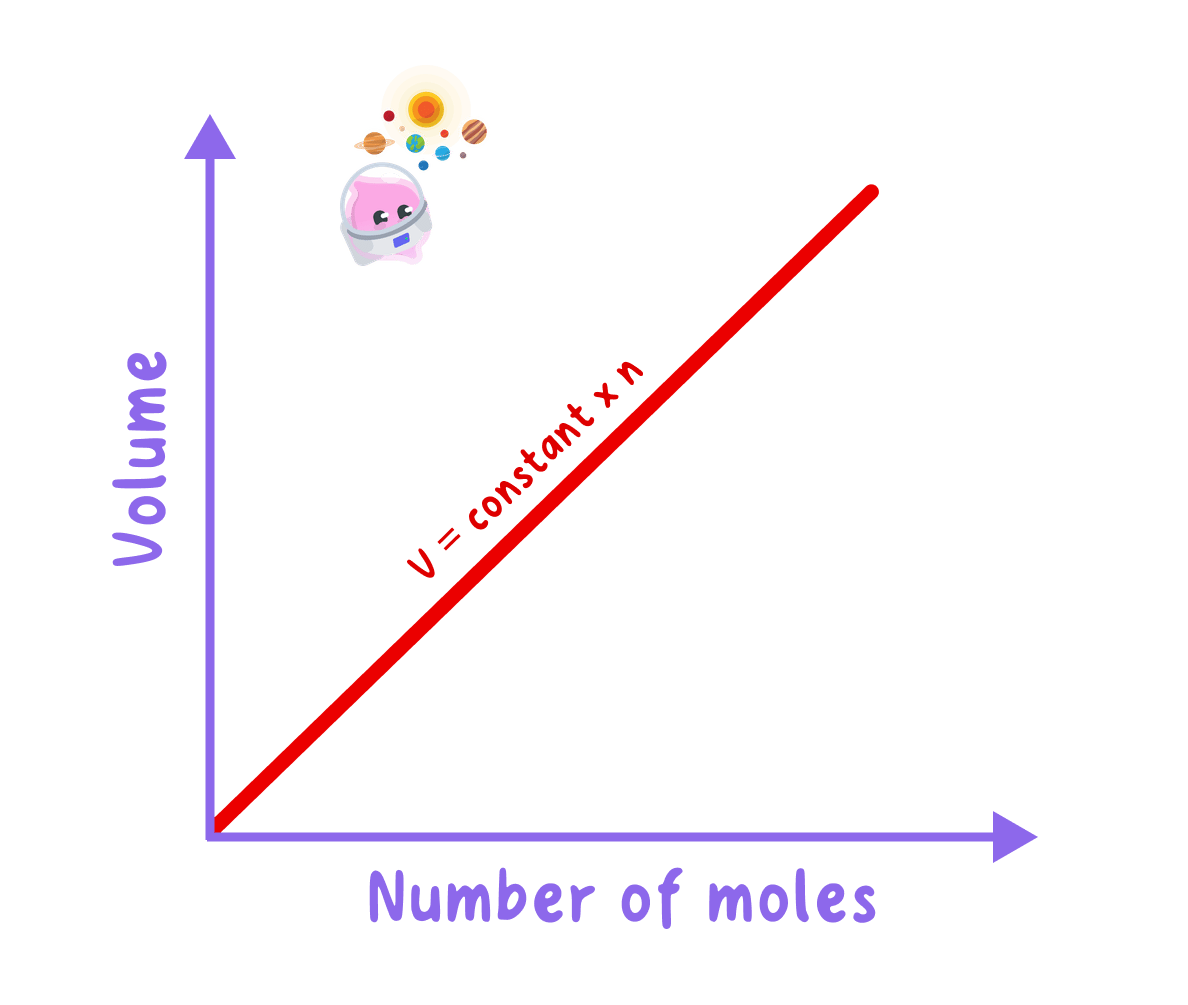
One mole of hydrogen weighs 2.0 g2.0\,\text{g}2.0g and one mole of carbon dioxide weighs 44.0 g44.0\,\text{g}44.0g, yet at room temperature and pressure each fills the same 24 dm324\,\text{dm}^324dm3.
Converting gas volume and moles using 24 dm³
- To find a gas volume, multiply the amount in moles by 242424: volume (dm3)=amount (mol)×24\text{volume (dm}^3\text{)} = \text{amount (mol)} \times 24volume (dm3)=amount (mol)×24
- To find an amount in moles, divide the gas volume in dm3\text{dm}^3dm3 by 242424.
- For a volume in cm3\text{cm}^3cm3, divide by 24 00024\,00024000 instead, or convert it into dm3\text{dm}^3dm3 first.
- So 0.25 mol0.25\,\text{mol}0.25mol of carbon dioxide occupies 0.25×24=6.0 dm30.25 \times 24 = 6.0\,\text{dm}^30.25×24=6.0dm3 at room temperature and pressure.
- The value of 24 dm324\,\text{dm}^324dm3 applies only at room temperature and pressure, so a different temperature or pressure gives a different volume.
- Calculate the amount in moles of oxygen in 480 cm3480\,\text{cm}^3480cm3 of the gas at room temperature and pressure.
- Convert the volume: 480 cm3÷1000=0.480 dm3480\,\text{cm}^3 \div 1000 = 0.480\,\text{dm}^3480cm3÷1000=0.480dm3.
- Amount =0.48024=0.0200 mol= \dfrac{0.480}{24} = 0.0200\,\text{mol}=240.480=0.0200mol.
Balancing numbers give the ratio of gas volumes
Mole ratio
The ratio of the amounts in moles of substances that react or form, given by the balancing numbers in the equation.
- The balancing numbers give the mole ratio, and equal amounts of gases have equal volumes, so for gases they also give the volume ratio.
- In CH4(g)+2O2(g)→CO2(g)+2H2O(l)\text{CH}_4\text{(g)} + 2\text{O}_2\text{(g)} \rightarrow \text{CO}_2\text{(g)} + 2\text{H}_2\text{O(l)}CH4(g)+2O2(g)→CO2(g)+2H2O(l), the volumes of methane, oxygen and carbon dioxide are in the ratio 1:2:11 : 2 : 11:2:1.
- So 50 cm350\,\text{cm}^350cm3 of methane reacts with 100 cm3100\,\text{cm}^3100cm3 of oxygen and makes 50 cm350\,\text{cm}^350cm3 of carbon dioxide.
- Water is a liquid at room temperature, so it is left out of the gas volume ratio.
- In 2H2(g)+O2(g)→2H2O(l)2\text{H}_2\text{(g)} + \text{O}_2\text{(g)} \rightarrow 2\text{H}_2\text{O(l)}2H2(g)+O2(g)→2H2O(l), 40 cm340\,\text{cm}^340cm3 of hydrogen needs half its volume, 20 cm320\,\text{cm}^320cm3, of oxygen.
Do not use the balancing numbers as a volume ratio for solids, liquids or solutions, because the rule applies only to gases measured at the same temperature and pressure.
Finding gas volume from reactant mass via moles
- First convert the mass of reactant into moles by dividing by its MrM_rMr.
- Next use the mole ratio from the balanced equation to find the amount in moles of gas formed.
- Then multiply the amount of gas by 242424 to find its volume in dm3\text{dm}^3dm3 at room temperature and pressure.
- Give the answer to a sensible number of significant figures, usually matching the data in the question.
- Calculate the volume of carbon dioxide at room temperature and pressure when 5.00 g5.00\,\text{g}5.00g of calcium carbonate is heated: CaCO3(s)→CaO(s)+CO2(g)\text{CaCO}_3\text{(s)} \rightarrow \text{CaO(s)} + \text{CO}_2\text{(g)}CaCO3(s)→CaO(s)+CO2(g) (ArA_rAr: Ca = 40.1, C = 12.0, O = 16.0).
- Mr(CaCO3)=40.1+12.0+(3×16.0)=100.1M_r(\text{CaCO}_3) = 40.1 + 12.0 + (3 \times 16.0) = 100.1Mr(CaCO3)=40.1+12.0+(3×16.0)=100.1, so the amount =5.00100.1=0.04995 mol= \dfrac{5.00}{100.1} = 0.04995\,\text{mol}=100.15.00=0.04995mol.
- The ratio CaCO3:CO2\text{CaCO}_3 : \text{CO}_2CaCO3:CO2 is 1:11 : 11:1, so 0.04995 mol0.04995\,\text{mol}0.04995mol of carbon dioxide forms.
- Volume =0.04995×24=1.20 dm3= 0.04995 \times 24 = 1.20\,\text{dm}^3=0.04995×24=1.20dm3.
Working back from gas volume to reactant mass
- Divide the gas volume in dm3\text{dm}^3dm3 by 242424 to find the amount of gas in moles.
- Use the mole ratio to find the amount in moles of the reactant.
- Multiply by the reactant's ArA_rAr or MrM_rMr to find its mass in grams.
- In Mg(s)+2HCl(aq)→MgCl2(aq)+H2(g)\text{Mg(s)} + 2\text{HCl(aq)} \rightarrow \text{MgCl}_2\text{(aq)} + \text{H}_2\text{(g)}Mg(s)+2HCl(aq)→MgCl2(aq)+H2(g), 180 cm3180\,\text{cm}^3180cm3 of hydrogen is 0.18024=0.00750 mol\dfrac{0.180}{24} = 0.00750\,\text{mol}240.180=0.00750mol.
- The ratio Mg:H2\text{Mg} : \text{H}_2Mg:H2 is 1:11 : 11:1, so the mass of magnesium that reacted is 0.00750×24.3=0.182 g0.00750 \times 24.3 = 0.182\,\text{g}0.00750×24.3=0.182g.
When a question gives a gas volume in cm3\text{cm}^3cm3, convert it into dm3\text{dm}^3dm3 before dividing by 242424, and show that step, because it is the step most often missed.
- What volume does one mole of any gas occupy at room temperature and pressure?
- What is the volume of 0.150 mol0.150\,\text{mol}0.150mol of nitrogen at room temperature and pressure?
- How many moles of gas are in 1200 cm31200\,\text{cm}^31200cm3 at room temperature and pressure?
- In CH4(g)+2O2(g)→CO2(g)+2H2O(l)\text{CH}_4\text{(g)} + 2\text{O}_2\text{(g)} \rightarrow \text{CO}_2\text{(g)} + 2\text{H}_2\text{O(l)}CH4(g)+2O2(g)→CO2(g)+2H2O(l), what volume of oxygen reacts with 30 cm330\,\text{cm}^330cm3 of methane?
- Why is water left out of the volume ratio in this equation?
5.1.6 Choosing a reaction pathway
One product can be made by different pathways
Reaction pathway
The route of one or more reactions, with its starting materials and conditions, used to make a particular product.
- Ethanol can be made by fermentation of sugars with yeast, or by reacting ethene with steam, which is called hydration.
- Each pathway uses different starting materials, conditions and numbers of steps.
- Chemists compare the pathways using data rather than choosing the one that seems simplest.
- The data usually cover yield and atom economy, rate, conditions and energy use, raw materials, by-products and how pure the product is.
The best pathway is the one that gives the most suitable overall balance of these factors for the product and its use, even if it is not the best on every one.
Yield and atom economy measure how much becomes product
By-product
A substance formed in a reaction alongside the desired product.
- A high percentage yield means that less of the reactant is lost or left unreacted.
- A high atom economy means that less of the reactant mass turns into by-products.
- A pathway with fewer steps usually loses less product overall, because some product is lost at every step.
- A low atom economy matters less if the by-product is useful or saleable, and more if it is harmful and must be treated.
- Unreacted starting materials can sometimes be recycled through the reactor, which improves the overall yield.
- Compare the atom economies of the two pathways to ethanol: C6H12O6→2C2H5OH+2CO2\text{C}_6\text{H}_{12}\text{O}_6 \rightarrow 2\text{C}_2\text{H}_5\text{OH} + 2\text{CO}_2C6H12O6→2C2H5OH+2CO2 and C2H4+H2O→C2H5OH\text{C}_2\text{H}_4 + \text{H}_2\text{O} \rightarrow \text{C}_2\text{H}_5\text{OH}C2H4+H2O→C2H5OH (MrM_rMr: glucose = 180.0, ethanol = 46.0).
- For fermentation, atom economy =2×46.0180.0×100=51.1%= \dfrac{2 \times 46.0}{180.0} \times 100 = 51.1\%=180.02×46.0×100=51.1%.
- For hydration, ethanol is the only product, so the atom economy is 100%100\%100%.
- Hydration wastes far less of the reactant mass, while almost half the mass in fermentation leaves as carbon dioxide.
Rate, conditions and energy decide a pathway's cost
- A fast reaction makes more product in a given time, so less equipment is needed for the same output.
- High temperatures and pressures need more energy and stronger, more expensive equipment.
- A catalyst can let a pathway run fast enough at a lower temperature, which saves energy.
- A continuous process, fed with reactants all the time, makes product faster than a batch that is started and stopped.
- Hydration of ethene runs continuously and quickly, while fermentation is a slow batch process that takes several days.
Hydration of ethene needs about 300 ∘C300\ ^{\circ}\text{C}300 ∘C, a pressure about 60 times atmospheric pressure and a phosphoric acid catalyst, whereas fermentation runs at about 30 ∘C30\ ^{\circ}\text{C}30 ∘C and normal pressure with enzymes in yeast.
Raw materials, purification and safety can outweigh yield
- A pathway is more sustainable if its raw materials are renewable, cheap and easy to obtain.
- Sugar for fermentation comes from crops such as sugar cane, which can be regrown, while ethene comes from crude oil, which is finite.
- A pathway that gives a purer product needs less separation afterwards.
- Fermentation gives a dilute solution of ethanol that must be separated by fractional distillation, while hydration gives almost pure ethanol.
- Hazardous substances, flammable gases and harmful waste add safety and disposal costs to a pathway.
Countries with large areas of farmland and little oil, such as Brazil, make much of their fuel ethanol by fermentation, while countries with a large petrochemical industry have used the hydration of ethene.
Justifying a pathway choice with data
- State which pathway you would choose for the specified product.
- Quote at least two pieces of data that support the choice.
- Explain what each value means in practice, such as less waste, lower energy costs or more product per hour.
- Say why the other pathway is less suitable, even if it has one advantage.
- Finish with a judgement linked to the stated priority, such as low cost, speed or sustainability.
When a question asks you to choose a pathway from data, compare the pathways factor by factor using the numbers given, then say which factor matters most for this product and why it decides your choice.
- What is meant by a reaction pathway?
- Why does fermentation have a lower atom economy than the hydration of ethene?
- Why can a pathway with fewer steps give a greater overall yield?
- Give one advantage of fermentation over the hydration of ethene.
- Why might a pathway with a lower percentage yield still be chosen?
