

GCSE Chemistry Revision When You’re Stuck on a Pass
GCSE chemistry revision tips if you’re stuck at a pass grade. Use mark schemes, maths methods, and targeted practice to climb to grade 5+.
You know the feeling: you revise for GCSE Chemistry, you do “a bit of everything”, and the result stubbornly comes back as a pass grade. Not a disaster. But not the grade you know you could get if the paper just asked the questions the way your notes explain them.
The quiet truth is that most students stuck at a pass grade aren’t missing effort; they’re missing leverage. In GCSE Chemistry, leverage comes from two places: exam patterns (what gets asked and how it’s marked) and maths (because so many marks are method marks in disguise). That’s good news. Patterns can be learned. Methods can be practised. And a pass grade can move.
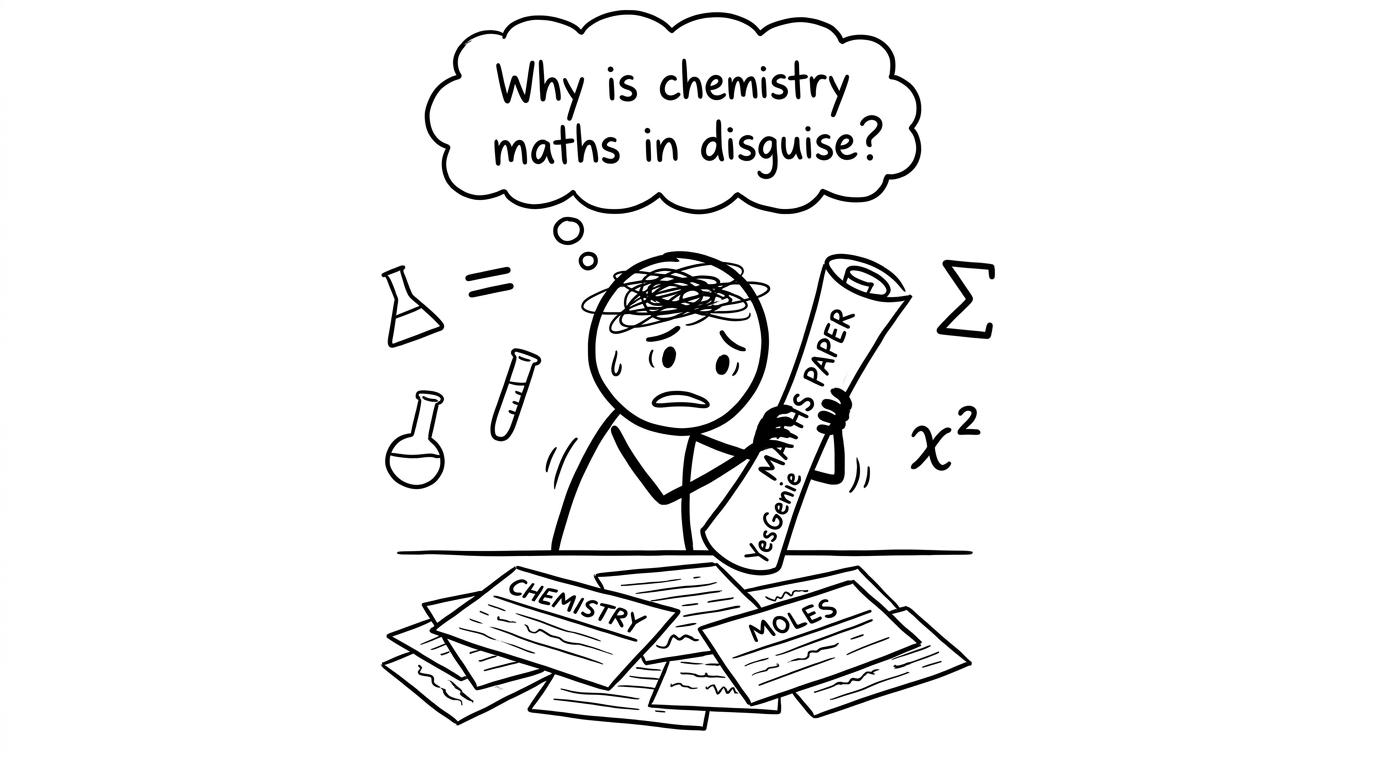 A GCSE student clings to a maths paper like a lifebuoy
A quick GCSE Chemistry rescue checklist (when you feel stuck)
If you want the shortest route from “stuck” to “moving”, use this checklist for the next 14 days:
- Choose your exam board style (AQA, Edexcel, OCR, Eduqas) and work in that language.
- Split your revision time: 60%60\%60% exam questions, 30%30\%30% fixing mistakes, 10%10\%10% content recap.
- Build a “chemistry maths” list: units, rearranging, ratio, standard form, graphs.
- Do one timed section every other day and mark it like an examiner.
- Keep a mistake log with the exact mark scheme phrase you missed.
- Practise the maths skills on YesGenie so the calculation marks stop leaking.
For the maths side of Chemistry, YesGenie is built for this: start with GCSE Maths Revision and then use your exam board pages like Edexcel GCSE Maths Revision or AQA GCSE Maths Revision Guides.
Why a pass-grade GCSE Chemistry student feels “stuck”
Most pass-grade plateaus come from predictable habits:
You revise topics, not marks
Reading a topic feels productive because it’s calm. Exam questions aren’t calm. They force decisions: which formula, which unit, which process, which keyword. In GCSE Chemistry, marks are attached to decisions, not to familiarity.
You lose “easy” maths marks
Chemistry maths is rarely advanced, but it is easy to do slightly wrong under pressure: unit conversions, standard form, rearranging, substituting, rounding. Those are exactly the skills that often separate grade 4 from grade 5/6.
You don’t use mark schemes as training
A mark scheme is not just an answer key. It’s a map of what the examiner is willing to reward. If you train with it, your writing starts to sound like the paper wants.
When you’re revising GCSE Chemistry, your goal isn’t to become a walking textbook. It’s to become someone who can reliably collect marks.
The pass-to-strong-pass strategy: practise like an examiner
Here’s the shift that changes outcomes: stop asking, “Do I understand this topic?” and start asking, “Could I earn the marks for this topic in the way this exam board awards them?”
On YesGenie, you can simulate this style of practice using:
- GCSE Past papers to get used to real wording and mark allocation.
- Your board’s paper collections such as Edexcel GCSE Maths Past Papers (useful for the maths that appears inside science questions).
- Edexcel GCSE Maths Predicted Papers when you want focused, exam-style rehearsal.
- The wider Resources hub for mini tests and timed practice formats.
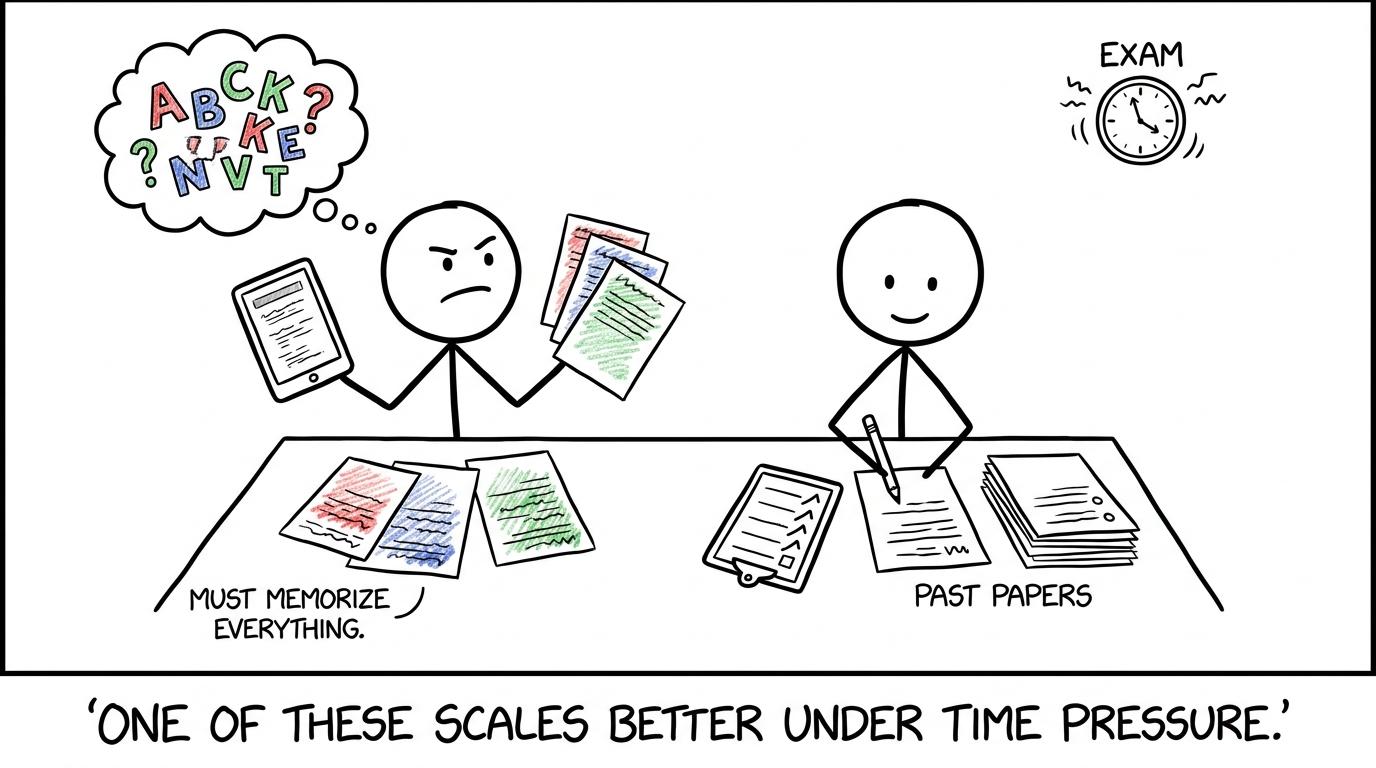 Two students revise differently under time pressure
The hidden advantage: GCSE Chemistry is a maths paper in a lab coat
If you’re a maths student reading this, you already have a tool that many Chemistry students underuse: method.
Chemistry calculations often reward:
- selecting the right relationship
- substituting correctly
- keeping units consistent
- rounding appropriately
That’s basically GCSE maths exam technique.
Worked example: percentage yield (clean method, clean marks)
A student makes 7.2 g7.2\text{ g}7.2 g of a product. The maximum possible (theoretical yield) is 9.0 g9.0\text{ g}9.0 g. Find the percentage yield.
Use:
percentage yield=actual yieldtheoretical yield×100 \text{percentage yield} = \frac{\text{actual yield}}{\text{theoretical yield}}\times 100 percentage yield=theoretical yieldactual yield×100Substitute:
percentage yield=7.29.0×100 \text{percentage yield} = \frac{7.2}{9.0}\times 100 percentage yield=9.07.2×100Calculate:
7.29.0=0.8⇒0.8×100=80 \frac{7.2}{9.0}=0.8 \quad\Rightarrow\quad 0.8\times 100=80 9.07.2=0.8⇒0.8×100=80So the percentage yield is 80%80\%80%.
This is the kind of calculation where students drop marks by forgetting the ×100\times 100×100 or rounding too early. If you write the structure first, you protect the marks.
To get sharper at calculations like this, practise the supporting maths: Percentages (question bank pages vary by board, but the skill is consistent).
Worked example: standard form in chemistry-style data
Suppose a particle has a mass of 0.00000045 g0.00000045\text{ g}0.00000045 g. Write this in standard form.
Move the decimal 777 places to make a number between 111 and 101010:
0.00000045=4.5×10⁻⁷ 0.00000045 = 4.5\times 10^{-7} 0.00000045=4.5×10⁻⁷Now you can use that same skill in Chemistry when values come in scientific notation.
If standard form is a weak point, build fluency through focused practice such as Standard Form questions (again, the question bank list is long, but you’re aiming for speed and accuracy).
Worked example: rearranging for concentration
A common relationship is:
concentration=amount of solutevolume of solution \text{concentration} = \frac{\text{amount of solute}}{\text{volume of solution}} concentration=volume of solutionamount of soluteIf c=nVc=\frac{n}{V}c=Vn, then:
n=cV n=cV n=cVFor example, if c=0.20 mol dm−3c=0.20\text{ mol dm}^{-3}c=0.20 mol dm−3 and V=0.50 dm3V=0.50\text{ dm}^3V=0.50 dm3:
n=0.20×0.50=0.10 mol n = 0.20\times 0.50 = 0.10\text{ mol} n=0.20×0.50=0.10 molThis is “changing the subject” in a Chemistry costume. If rearranging slows you down, train the pure maths skill on Changing the Subject of a Formula style questions.
How to revise GCSE Chemistry when you’re stuck: a 3-layer routine
When your grade is stuck, you don’t need more resources. You need a better loop.
Layer one: recall the minimum that earns marks
For each topic, write a tiny “mark-winning” page: key definitions, key tests, key trends, and the required practical method points your board loves. Not a chapter. A page.
Layer two: do exam questions in small batches
Choose 666 to 101010 questions on one micro-skill (for example, “electrolysis of molten compounds” or “rate of reaction graphs”). Mark immediately. Correct immediately.
Layer three: fix your error type, not the question
When you miss a question, classify the mistake:
- knowledge gap (didn’t know)
- application gap (knew but couldn’t use)
- exam-writing gap (wrong keywords)
- maths gap (calculation, units, rounding)
Then fix that gap.
YesGenie makes the “maths gap” part simple because you can go straight to topic practice and video solutions. If your working is messy, practise structured solutions using Edexcel GCSE Maths Revision Guides or the more general GCSE Maths Revision hub.
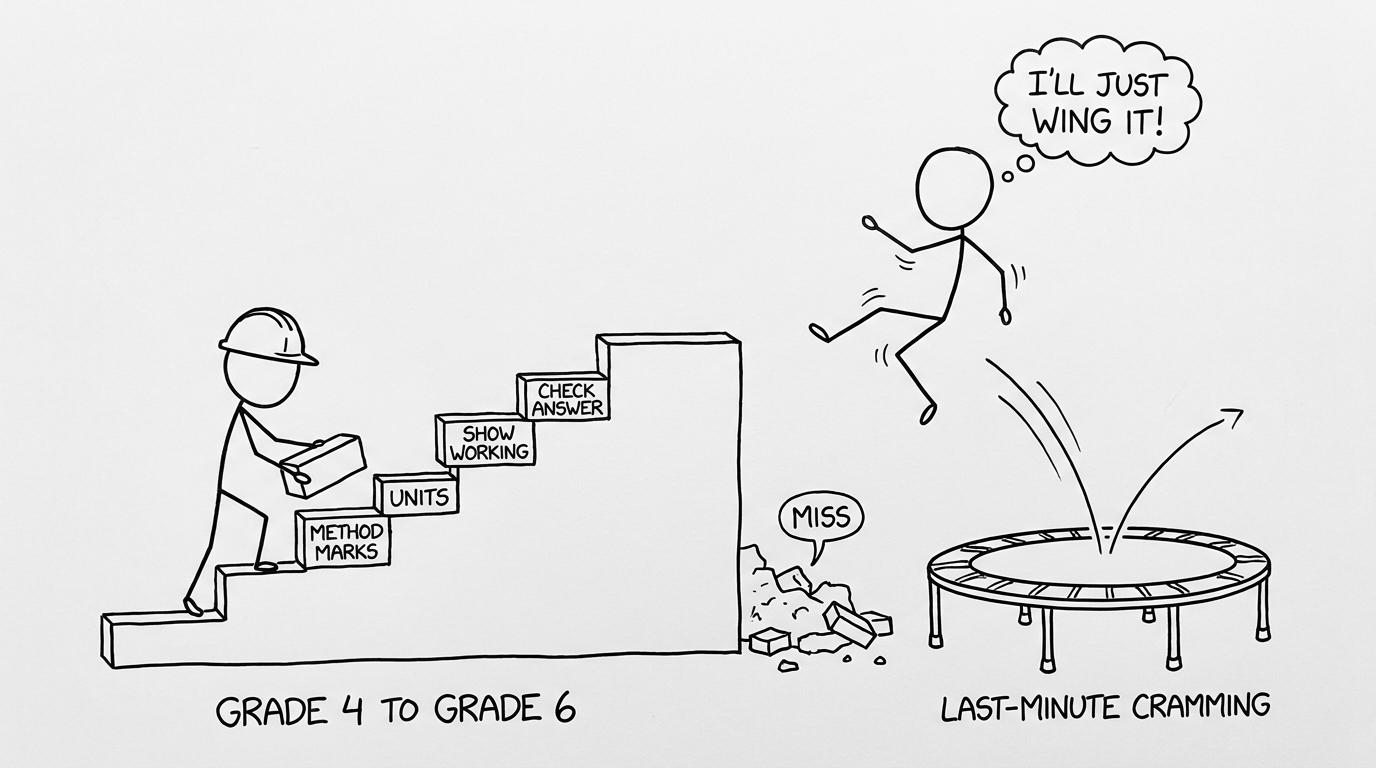 A staircase built from method marks beats last-minute cramming
Use your maths strength to unlock “written chemistry” marks
A pass-grade student often knows more than they can prove on paper. Here’s a practical bridge:
Turn explanations into cause-and-effect chains
Instead of writing broad paragraphs, write a chain that reads like logic:
- cause
- mechanism
- outcome
This mirrors how you show steps in maths. Examiners reward clarity.
Learn the “command words” like algebra instructions
In maths, “simplify” is different from “solve”. In GCSE Chemistry, “describe” is different from “explain”, and “evaluate” is different from “state”. Your marks depend on obeying the instruction.
Practise graph skills like a maths student
Chemistry graphs reward basics: gradient, intercept, proportionality, reading scales.
If gradients and straight-line graphs are shaky, revise them directly: Gradient of a Line style practice and a solid grasp of ratio/proportion.
Common mistakes that keep GCSE Chemistry at a pass grade
- Not showing working in calculations: you may lose method marks even if the final answer is close.
- Unit drift: mixing cm3\text{cm}^3cm3 and dm3\text{dm}^3dm3, or writing an answer without units.
- Rounding too early: keep full calculator values until the end, then round to what the question asks.
- Keyword-lite explanations: using vague phrases like “it reacts more” instead of “more frequent successful collisions”.
- Ignoring practical method marks: required practicals have predictable marking points, especially for controls and improvements.
- Not learning from mark schemes: doing questions without checking why your answer didn’t earn the mark.
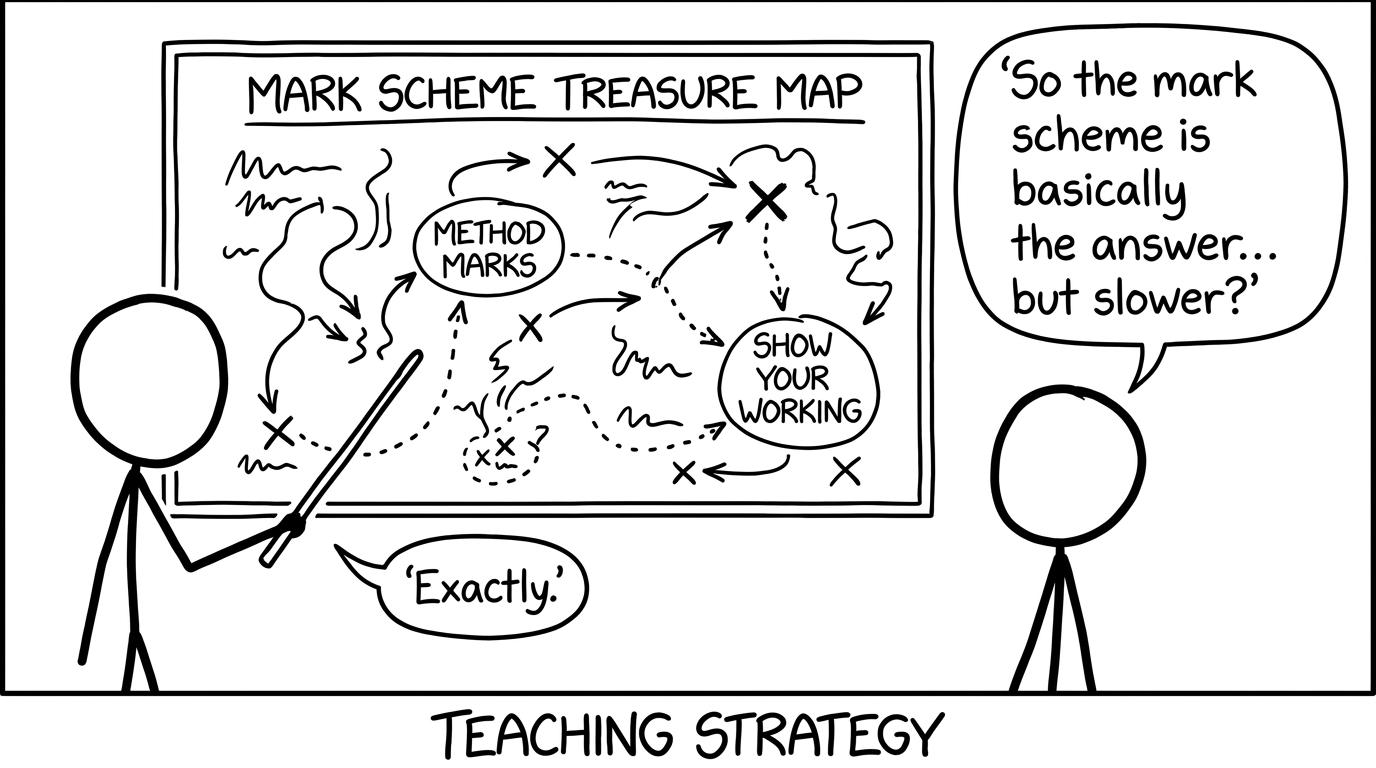 A mark scheme as a treasure map for method marks
Bringing it together: make your GCSE Chemistry revision measurable
If you’re stuck at a pass grade, you don’t need a personality transplant. You need a system that turns effort into marks. For GCSE Chemistry, that system is:
- tight recall notes (small enough to use)
- exam questions (often)
- mark schemes (honestly)
- maths method (consistently)
And because you’re a maths student too, you have a built-in advantage: you already understand that steps matter.
Your next step: use YesGenie to lock down the maths that repeatedly appears in science papers. Start at GCSE Maths Revision, practise the topics you keep missing, then pressure-test yourself with GCSE Past papers and (if you’re Edexcel) Edexcel GCSE Maths Predicted Papers. When your method becomes automatic, your confidence follows, and your GCSE Chemistry grade usually follows right behind it.










