

GCSE: Find Your Weakest Topics (Even in Chemistry)
GCSE revision: learn how to find your weakest topics fast using papers, mark schemes and maths-style tracking. Build a focused plan that works.
GCSE revision can feel oddly emotional: you open a paper, the first question looks friendly, and then one topic you thought you “sort of knew” quietly drains your confidence. That moment matters. Not because it proves you’re bad at the subject, but because it reveals something useful: your weakest topics are rarely the ones you dislike most; they’re the ones you’ve been rehearsing with the wrong feedback loop.
This guide is about how to find your weakest topics in GCSE Chemistry, written for UK GCSE and A Level maths students who already understand a hard truth: results improve when you measure the right thing. You’ll use the same disciplined approach you use in maths revision papers, mark schemes, error analysis, and small targeted practise to pinpoint what’s costing marks.
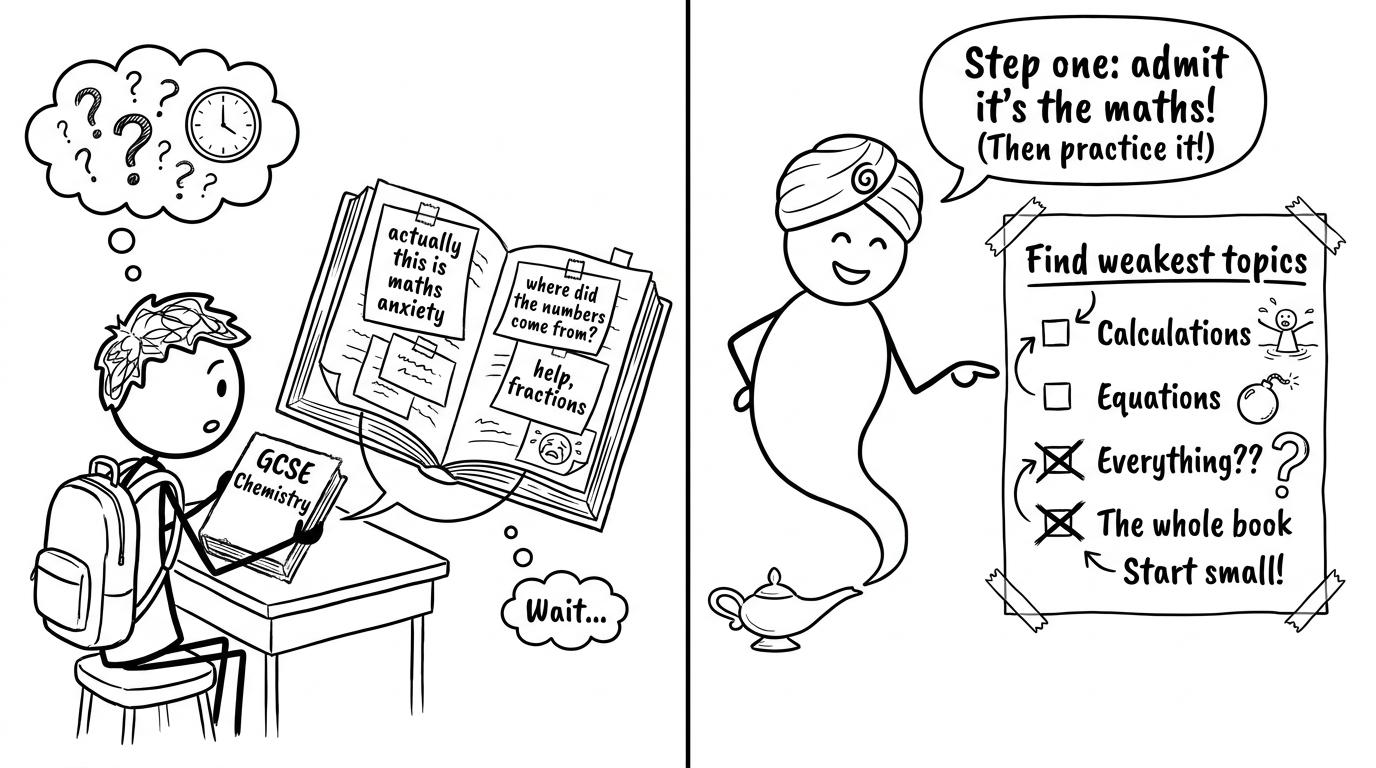 Student opens GCSE Chemistry and finds a weakness checklist
The quick checklist (the 20-minute diagnosis)
If you want a fast start, do this:
- Pick one recent GCSE Chemistry paper (AQA, Edexcel, OCR, Eduqas) and do 25 minutes under calm exam conditions.
- Mark it strictly with a mark scheme (don’t “be kind”).
- For every lost mark, write the reason as one of these:
- Recall gap (didn’t know the fact/definition)
- Method gap (knew the idea but couldn’t do the steps)
- Exam-language gap (command words, required phrasing)
- Careless error (units, rounding, sign, misread)
- Turn each reason into a topic label (e.g. “moles”, “bonding”, “electrolysis”, “required practicals”, “rates”).
- Count which labels appear most.
That list, not your feelings, is your starting point.
To make this systematic (and very “maths-student”), you’ll build a mini tracking model and use it across a week.
Why maths students are good at this (and why GCSE still surprises you)
In maths, you can often see the shape of your weakness. If you can’t solve ax2+bx+c=0ax^2+bx+c=0ax2+bx+c=0, you know it’s quadratics (or algebra fluency, or factorising). GCSE Chemistry is sneakier because marks hide inside language, required practical steps, and multi-step calculations.
But the fix is the same as in maths:
- Expose yourself to realistic questions.
- Mark with the same harshness the examiner will.
- Diagnose the cause of each dropped mark.
- Practise the smallest unit that fixes the cause.
When you do this, you stop “revising chemistry” and start revising your chemistry.
Build a weakness map using papers and mark schemes
Your weakest topics reveal themselves fastest in exam questions, not notes.
On YesGenie, the maths workflow is clean: you can choose exam boards and practise with mark schemes and worked solutions. Even if your target here is GCSE Chemistry, you can copy the process directly using the maths resources:
- Use the structure of real papers from GCSE Past papers.
- If you do Edexcel maths, the layout at Edexcel GCSE Maths Past Papers is a good model for organising by series and tier.
- For short bursts (perfect for “diagnosis mode”), mimic the pacing of Edexcel GCSE Maths Mini Tests.
The 3-column error log (simple, ruthless, effective)
Create a table with:
- Question/topic
- What I did
- Why I lost marks (true reason)
Be honest in the third column. “I was rushing” is sometimes true, but often it’s a disguise for “I don’t know this well enough to do it quickly”.
A tiny scoring model (so you can rank weak topics)
To rank topics, you need a number. Use this:
Let each topic have:
- MMM = marks lost on that topic
- AAA = total marks available on that topic attempted
- RRR = risk factor (how often it appears), from 111 (rare) to 333 (common)
Define a weakness score:
W=MA×R W = \frac{M}{A} \times R W=AM×RWorked example:
- You attempted A=12A=12A=12 marks of “moles” style questions and lost M=5M=5M=5.
- It’s common, so R=3R=3R=3.
Compare that to, say, “polymers” where you lost M=2M=2M=2 out of A=8A=8A=8 and it’s less common R=2R=2R=2:
W=28×2=48=0.5 W = \frac{2}{8} \times 2 = \frac{4}{8} = 0.5 W=82×2=84=0.5Your weakest topic (right now) is the higher WWW. This is exactly how a maths student thinks: what gives the biggest return per minute?
Use “maths-style topic practice” to isolate the cause
A GCSE Chemistry weakness is rarely just “I’m bad at electrolysis”. It’s usually one of these:
Recall weaknesses (facts that won’t stick)
These show up as blank spaces or vague answers. Fix with tight active recall.
Maths analogy: forgetting circle theorem statements. You don’t fix that by doing a whole mixed paper; you fix it by rehearsing the statements and then applying them.
Method weaknesses (multi-step processes)
These show up when you start correctly, then drift. Chemistry calculations often behave like multi-step algebra.
Maths analogy: changing the subject or simultaneous equations. You know the goal but lose structure mid-way.
To practise this kind of weakness on YesGenie (for maths), students often use topic-by-topic practice from question banks, like the ones linked from Edexcel GCSE Maths Revision Guides or the broader question-bank layout you can see at Eduqas GCSE Maths Question Bank. That same “one topic, many exam-style questions, immediate marking” approach is what you want for Chemistry too.
Exam-language weaknesses (the marks are in the wording)
These show up when you write something scientifically correct, but not in the form the mark scheme rewards. Your job is not just to know Chemistry, but to speak mark scheme.
Maths analogy: you did the right calculation but didn’t write the final statement, or you didn’t show a required step and lost method marks.
Careless weaknesses (the annoying ones)
These are often pattern-based: units, sig figs, misreading “describe” vs “explain”. Careless errors are real, but the fix is rarely “try harder”; it’s usually “create a checking routine”.
A worked example: turning a messy week into a focused plan
Suppose you do three short sessions and collect this data (from any GCSE Chemistry papers you have access to):
- Moles/amount of substance: attempted A=20A=20A=20, lost M=8M=8M=8, R=3R=3R=3
- Required practicals: attempted A=15A=15A=15, lost M=6M=6M=6, R=3R=3R=3
- Bonding and structure: attempted A=18A=18A=18, lost M=5M=5M=5, R=2R=2R=2
- Rates: attempted A=10A=10A=10, lost M=2M=2M=2, R=2R=2R=2
Compute WWW for each:
Wmoles=820×3=1.2 W_{moles} = \frac{8}{20}\times 3 = 1.2 Wmoles=208×3=1.2 Wpracticals=615×3=1.2 W_{practicals} = \frac{6}{15}\times 3 = 1.2 Wpracticals=156×3=1.2 Wbonding=518×2≈0.56 W_{bonding} = \frac{5}{18}\times 2 \approx 0.56 Wbonding=185×2≈0.56 Wrates=210×2=0.4 W_{rates} = \frac{2}{10}\times 2 = 0.4 Wrates=102×2=0.4So your plan is not “revise everything”. It’s:
- Priority 1: moles + required practicals (highest WWW)
- Priority 2: bonding
- Maintenance: rates
Now give it time:
- Two focused sessions on moles.
- Two focused sessions on required practicals.
- One mixed paper section to check transfer.
If you’re a maths student, you’ll recognise the philosophy: master the bottlenecks, then reintroduce mixed questions.
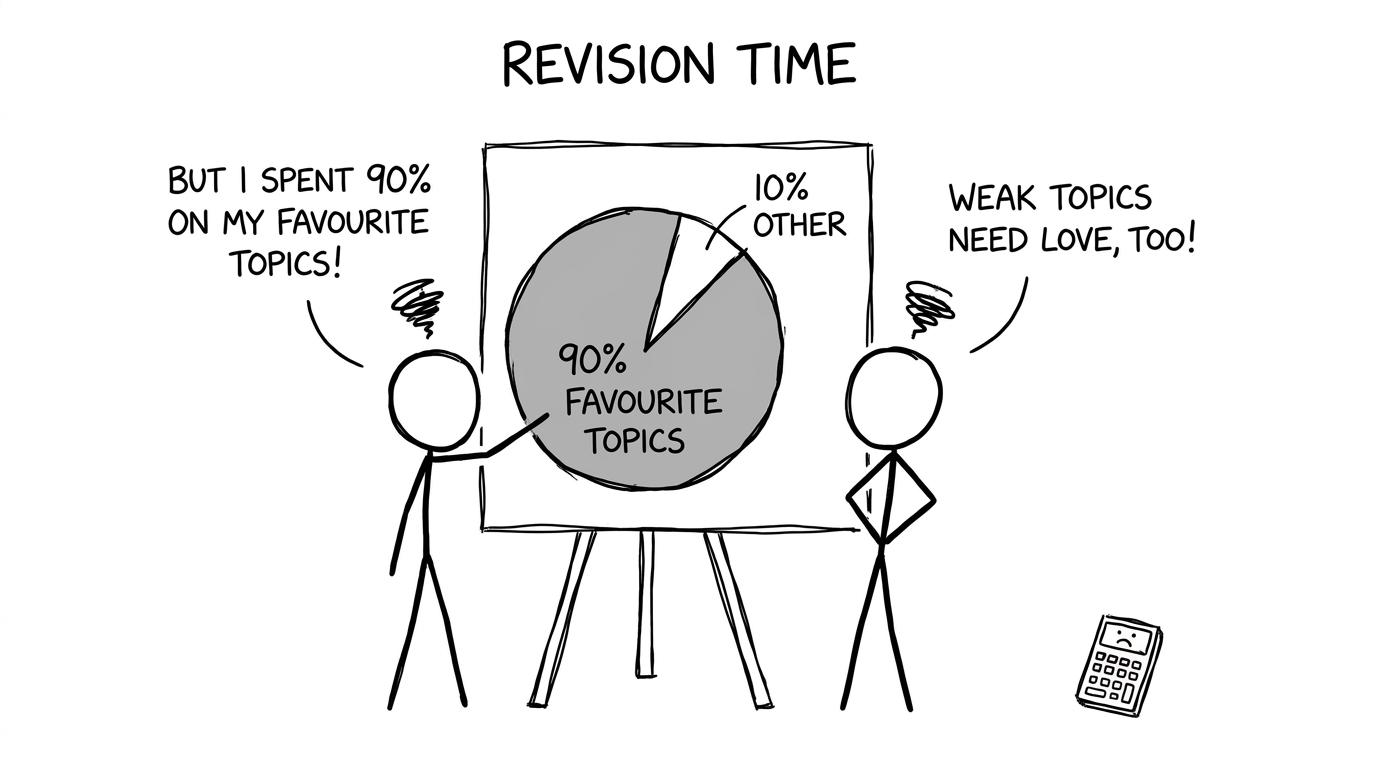 Two stick figures arguing over revision time pie chart
How to make the plan stick (especially when you also have GCSE maths)
Most students don’t fail because they can’t work hard. They fail because they work hard in ways that don’t change the score.
Use a two-layer plan:
- Layer 1 (diagnose): 2 short exam-style bursts per week.
- Layer 2 (repair): 3 topic sessions per week, chosen from your weakness scores.
Then protect your maths revision time by making it equally structured:
- Use topic lists like those found in Edexcel GCSE Maths Revision Guides to choose what to practise next.
- Use quick papers from the Resources hub when you’re tired and need a shorter win.
- If you’re also thinking ahead to Year 12/13, seeing how the paper structure scales up at Edexcel A Level Maths Past Papers can be strangely motivating: the habit you build now is the same habit you’ll need later.
Common mistakes when trying to find weakest topics
Marking kindly (and calling it confidence)
If you give yourself benefit-of-the-doubt marks, you stop the data from telling you the truth. GCSE mark schemes are specific. Your revision should be specific too.
Labelling a weakness too broadly
“Electrolysis” isn’t a topic label; it’s a chapter. A good label looks like: “half-equations”, “ion movement”, “link to reactivity series”, or “why aluminium extraction needs cryolite”. Small labels create fixable tasks.
Practising your favourite topics to feel productive
This is the revision equivalent of taking the easy questions first and running out of time. Comfort work is not the same as progress.
Confusing time spent with marks gained
If you spend 60 minutes rewriting notes and gain 0 marks, the hour didn’t disappear; it just didn’t convert. Your goal is conversion.
Not revisiting the weakness after repair
A weakness only counts as repaired when it survives a mixed set of questions under time pressure.
 A mock exam builder machine with levers for topics
Bringing it back to YesGenie (and to your GCSE results)
There’s a quiet shift that happens when you stop revising what feels familiar and start revising what costs marks. Your confidence becomes less about mood and more about evidence. That’s how high grades are built: not by doing more, but by doing what matters.
If you’re serious about improving your GCSE outcomes across subjects, keep your maths revision equally structured. Use YesGenie’s free revision lessons, practice questions, mini tests, past papers, mark schemes, and video solutions to keep exposing, marking, diagnosing, and repairing. Start with GCSE Past papers, add quick wins from Edexcel GCSE Maths Mini Tests, and use topic organisation from Edexcel GCSE Maths Revision Guides to keep your plan tight.
When you treat weakness-finding as a skill (not a scary moment), you don’t just prepare for GCSE exams; you build a method you can reuse at A Level and beyond.
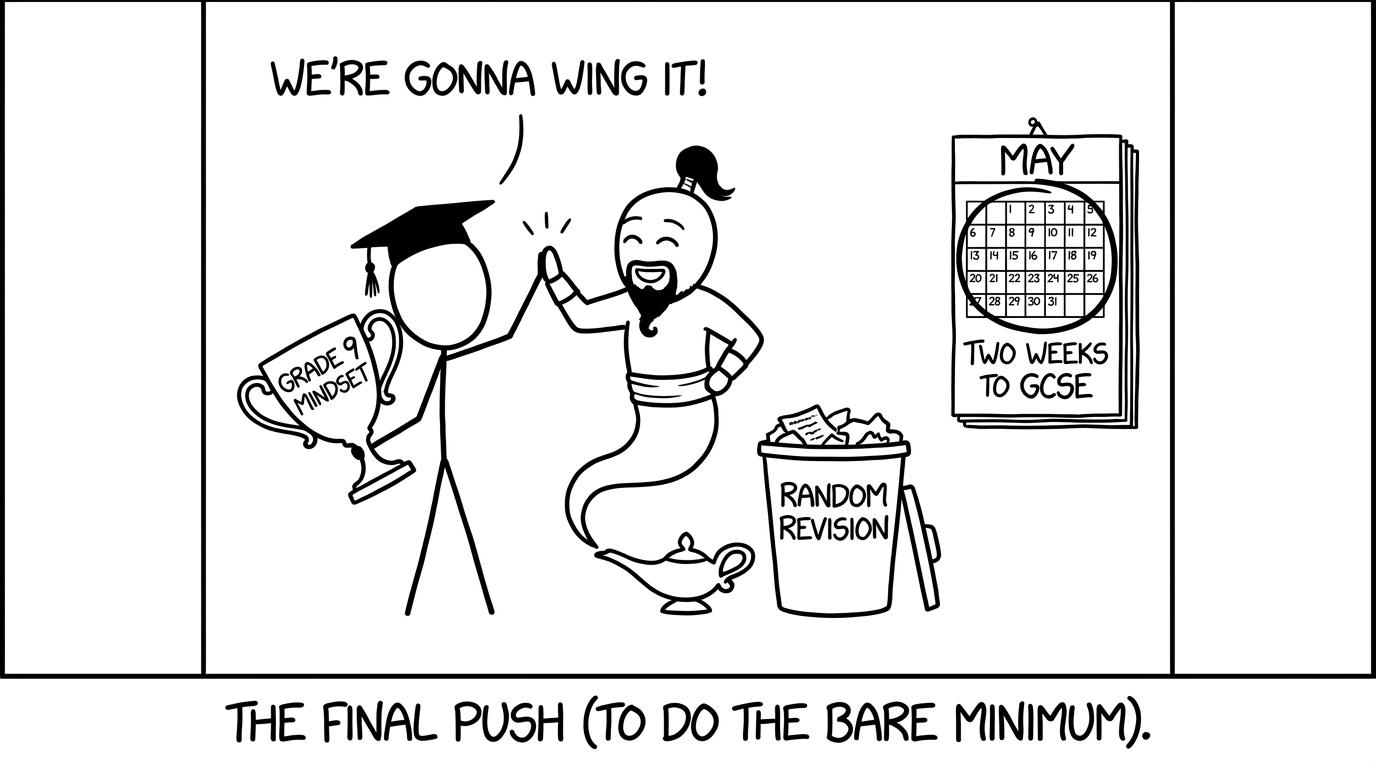 Student high-fives genie next to bin labelled random revision










