GCSE Subjects to Pair with Classical Civilisation
GCSE subjects to pair with Classical Civilisation: compare humanities, languages and creative options, balance workload, and choose with confidence.
Choosing GCSE options can feel strangely permanent. One form asks you to compress your interests, strengths and half-formed plans for the future into a few boxes. If Classical Civilisation already has your attention, the most useful question is not simply which subjects sound related. It is which GCSE subjects to pair with Classical Civilisation without creating an exhausting timetable.
The strongest combinations usually include one subject with natural overlap, such as History, Religious Studies or Latin, and one contrasting subject, such as Geography, Computer Science, Art or a practical option. Your best choice depends on how you prefer to learn, how each course is assessed and what your school actually offers.
Classical Civilisation itself already demands source analysis, accurate knowledge and extended writing. Pairing it with three more heavily written subjects may look coherent on paper, but balance often produces a more manageable two years.
A quick GCSE options checklist
Before comparing individual subjects, ask:
- Do I enjoy the actual course content, not just the subject name?
- Does the assessment involve written exams, coursework, performances or practical projects?
- How much overlap will there be with Classical Civilisation?
- Will the combination keep future A Level choices reasonably open?
- Am I choosing independently rather than following friends or a favourite teacher?
- Can I realistically revise these subjects alongside English, science and maths?
Government guidance describes the English Baccalaureate, or EBacc, as a combination of English language and literature, maths, science, History or Geography, and a language. It is a performance measure rather than a separate qualification. Your school may build some or all of these subjects into its options system, so check its rules before planning a combination.
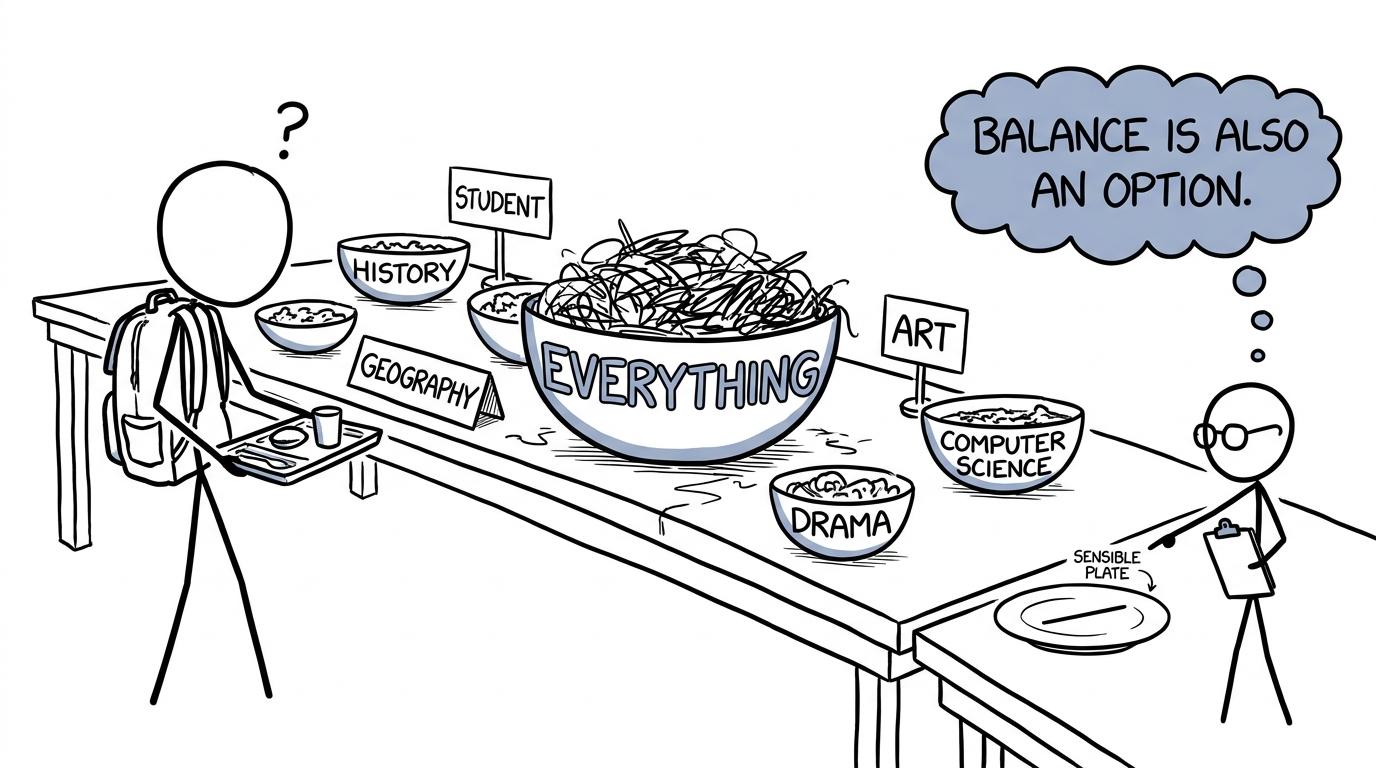 A student discovers that balance is also available at the GCSE options buffet
What studying Classical Civilisation involves
OCR currently offers GCSE Classical Civilisation under specification J199. Students study one thematic component, either Myth and Religion or Women in the Ancient World, alongside one Literature and Culture component: The Homeric World, Roman City Life, or War and Warfare.
The qualification draws on ancient Greek and Roman literature and visual or material culture. Assessment consists of two written papers, each lasting one hour and thirty minutes and contributing half of the qualification. Questions include shorter responses and extended answers, with students analysing both prescribed and, in parts of the course, unseen sources.
That structure matters when choosing companion subjects. Classical Civilisation is not simply a collection of myths. You must remember evidence, interpret sources, compare societies and build supported arguments. A sensible combination either strengthens these skills or gives you a welcome change of pace.
The best subjects with direct academic overlap
History
History is perhaps the most obvious partner. Both subjects involve evidence, context, causation and carefully supported judgements. Learning how to select precise evidence in History can improve the way you construct Classical Civilisation essays, while familiarity with ancient societies can make historical source work feel more natural.
The drawback is workload similarity. Both courses usually involve substantial factual recall and extended writing. This pairing makes sense if essays are among your strengths and you enjoy reading. It creates unnecessary pressure if you already find written answers slow or draining.
History also satisfies the humanities part of the EBacc. Classical Civilisation does not replace History or Geography for that measure, so this distinction may matter if your school expects an EBacc pathway.
Religious Studies
Religious Studies pairs particularly well with Myth and Religion. Ideas about ritual, morality, belief, death and the relationship between individuals and society can appear in both classrooms, although they are approached through different cultures and specifications.
The transferable skill is evaluation. In each subject, a convincing answer depends on explaining evidence rather than listing it. However, Religious Studies adds another set of beliefs, teachings and written arguments to revise. It is a good fit for students who enjoy discussion and precise reasoning, but less useful as a supposed “easy” option. No subject feels easy when its assessment style works against your strengths.
Latin or Classical Greek
Where offered, Latin or Classical Greek creates the closest connection to the ancient world. Language study can deepen your understanding of vocabulary, literature and cultural context. Ancient languages also count within the language pillar of the EBacc when the relevant approved qualification is taken.
This is an intellectually coherent combination, but it is not automatically the calmest one. Vocabulary, grammar and translation require frequent practice. Choose an ancient language because you enjoy working closely with words, not because the subject names look impressive together.
English Literature
English Literature supports analysis of character, theme, imagery and authorial choices. Those habits transfer naturally to ancient literature studied in translation. In most GCSE programmes, however, English is part of the core curriculum rather than an additional option.
Treat this as built-in support. If your timetable already contains English Literature and Classical Civilisation, you may not need every optional subject to involve more essays.
The best subjects for a balanced combination
Geography
Geography is one of the strongest all-round choices. It adds modern human and physical contexts, data interpretation, maps and fieldwork-related skills while still requiring explanation and evaluation. It also meets the humanities element of the EBacc.
Compared with History, Geography usually creates less direct content overlap with Classical Civilisation. That can be an advantage. Your revision week becomes more varied rather than becoming one long sequence of dates, sources and essays.
A modern foreign language
French, Spanish, German or another available language can create a broad academic combination and satisfy the EBacc language pillar. Language learning also develops memory, attention to grammar and confidence in communicating precisely.
The workload is cumulative. Short, regular vocabulary and listening practice matters more than occasional cramming. A language is therefore a sensible partner when you are willing to practise consistently. It becomes stressful when every vocabulary test is postponed until the night before.
Computer Science
Computer Science provides a marked contrast to Classical Civilisation. Algorithms, programming and computational thinking use a different style of reasoning from literary and cultural analysis. For students who enjoy both logic and the humanities, that contrast can keep the week interesting.
Do not choose it merely to “balance” your options if programming leaves you cold. Balance means combining subjects you can sustain, not forcing one essay subject and one technical subject into the same timetable.
Art, Drama or Music
Creative subjects can bring ancient stories, performance and visual culture to life from a different angle. Art may connect with material culture; Drama can sharpen your understanding of character and audience; Music offers a distinct creative discipline.
Their assessment patterns require close attention. Portfolios, rehearsals, performances and compositions can create intense deadlines even when there is less traditional revision. Ask current students and teachers when major pieces are completed. The right creative option can provide variety, but several project-heavy subjects together may produce avoidable clashes.
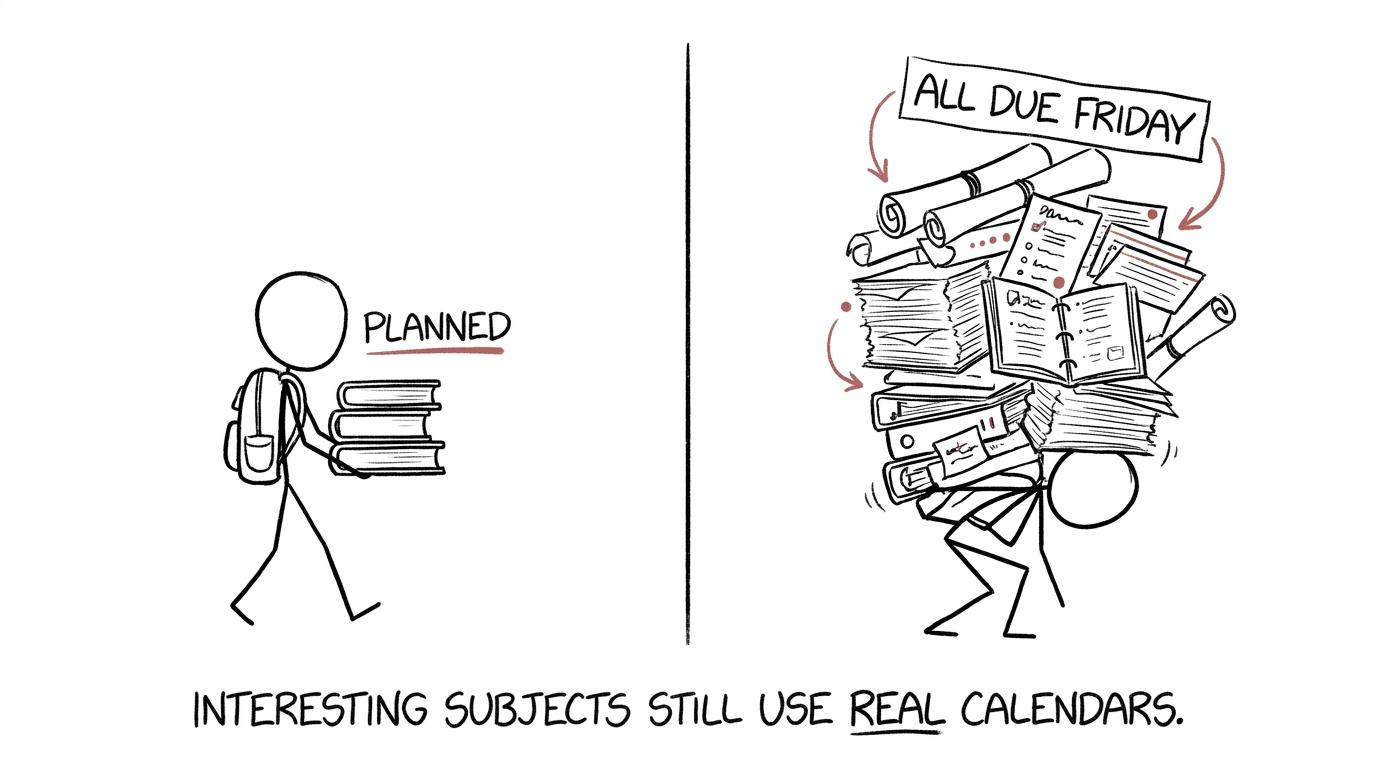 One student plans revision while another meets the legendary all-due-Friday deadline
Where GCSE maths fits into the combination
GCSE maths is normally part of your core programme, whether you take foundation or higher tier. It does not share much content with Classical Civilisation, but that is precisely why the combination can work. Maths replaces extended prose with calculation, diagrams, algebra and logical steps.
The challenge is that maths cannot be maintained through reading alone. It needs repeated question practice. When essay deadlines become busy, protect a few short maths sessions rather than abandoning the subject for several weeks.
The GCSE Maths revision hub lets you choose resources for boards including Edexcel, AQA, OCR and Eduqas. Start with a revision lesson, move directly into practice questions, and use the solutions to identify the exact step that cost you marks.
If your options already create a crowded week, the 20-minute GCSE maths revision routine is more sustainable than saving everything for a weekend. A short, repeatable routine leaves room for Classical Civilisation reading without allowing algebra or geometry to fade.
Combinations that can add unnecessary stress
No combination is universally wrong. Stress usually comes from assessment patterns and personal weaknesses rather than subject labels. Still, several combinations deserve careful thought.
Too many essay-heavy subjects
Classical Civilisation, History and Religious Studies can be an excellent humanities route. Add another writing-intensive option, however, and you may face several bodies of evidence plus repeated extended answers. This works for enthusiastic, efficient writers. It is less sensible if essays already take you much longer than expected.
Too many project and performance deadlines
Art, Drama, Music and Design and Technology can involve work that cannot be recreated through a final week of revision. Combining several may lead to portfolio, rehearsal or practical deadlines arriving together. Look at the full assessment calendar rather than assuming that fewer written exams mean less work.
Choosing maximum difficulty for appearance
Triple science, a language, Computer Science and Classical Civilisation may suit a student who genuinely enjoys all four areas. It should not be selected simply because it appears demanding. A broad combination with strong grades is usually more useful than an overloaded timetable chosen to impress an unknown future audience.
Choosing overlap instead of enjoyment
Latin and History may appear to be the “correct” partners, but a student who prefers Geography and Art may work more consistently in those subjects. Related content can reduce context-switching, yet interest is what makes sustained revision possible.
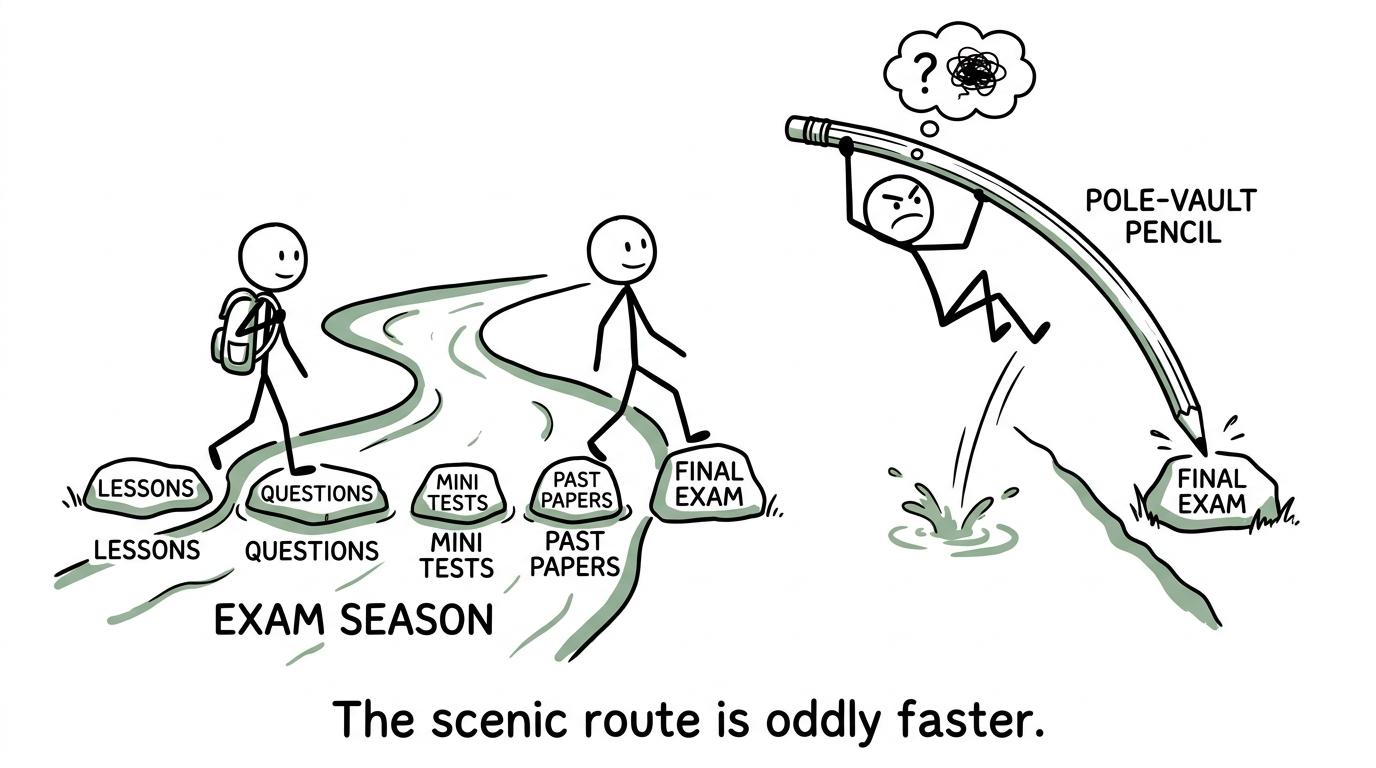 A sensible revision path crosses exam season while a pencil pole-vault attempt goes badly
How to test your proposed combination
Write down each potential subject and classify its main demands: factual recall, essays, calculations, vocabulary, coursework, practical work or performance. Then look for concentration. If almost every option sits in the same category, ask whether that reflects a genuine strength or an avoidable pressure point.
Next, check the course specification and assessment arrangements used by your school. Option titles do not reveal the exact topics, project deadlines or teaching structure. Ask what students study, how they are assessed and what successful weekly work looks like.
Finally, test the combination against a realistic revision timetable. The MathsGenie GCSE revision timetable shows how topic sessions, timed questions and review can coexist without filling every evening. The point is not to schedule Year 11 in advance. It is to see whether every chosen subject has somewhere to go.
Common mistakes when choosing GCSE options
- Following friends: timetables change, classes split and your strengths may differ.
- Choosing a teacher rather than a course: staffing can change, but the specification remains.
- Assuming related means easier: History and Classical Civilisation reinforce skills, yet both still require separate knowledge.
- Ignoring assessment style: a subject you enjoy in lessons may include coursework or performances you dislike.
- Treating predicted career plans as fixed: keep choices broad unless a future route has clear requirements.
- Forgetting the core workload: English, science and maths continue regardless of your options.
- Planning heroic revision: build around routines you can repeat on ordinary school days.
When GCSE courses begin, use evidence rather than anxiety to organise maths revision. The guide to finding your weakest GCSE topics helps turn lost marks into a short action list. For long-term recall, use the strategies in how to stop forgetting GCSE maths, then progress to timed work when you are ready. The guide on when to start GCSE past papers explains how to build up gradually.
Choose coherence, contrast and a workload you can repeat
The best GCSE subjects to pair with Classical Civilisation are not hidden in one perfect list. History, Religious Studies and ancient languages offer strong intellectual overlap. Geography, modern languages and Computer Science create breadth. Art, Drama and Music can add valuable creative contrast when their deadlines are manageable.
Aim for a combination with one clear connection, one source of variety and no obvious pile-up of assessments. Then confirm the details with your school, because its option blocks and course arrangements decide what is genuinely possible.
Once your subjects are chosen, make maths the predictable part of the week. Use MathsGenie’s free GCSE revision resources for revision lessons, practice questions, mini tests, past papers, predicted papers, mark schemes and video solutions. A good option choice reduces friction. A good revision system keeps it reduced.