GCSE Statistics Revision Timetable: Worth It?
GCSE statistics revision timetable worth it? Learn when a written plan helps, when flexible revision works, and how both can lead to more exam marks.
Revision timetables are easy to admire. Neat boxes, carefully chosen colours, every evening assigned a purpose. Yet a timetable can create the feeling of progress before any useful revision has happened.
So, is a GCSE statistics revision timetable worth it? Usually, yes, but only if it changes what you do. A simple plan can spread revision across several weeks, reduce daily decisions and ensure weaker topics return more than once. A beautiful timetable that is repeatedly ignored changes nothing. Flexible revision can work just as well, provided it still includes regular practice, honest marking and deliberate review.
The timetable is not the revision. It is the container.
The short answer: when a timetable is worth making
A written statistics revision timetable is useful when it helps you:
- decide in advance when revision will happen;
- revisit topics over several days or weeks;
- prioritise weaknesses rather than favourite questions;
- include practice questions, marking and corrections;
- balance statistics with algebra, geometry, number and ratio;
- adjust the plan when schoolwork or life interrupts it.
It is probably not useful when you spend longer designing it than following it, assign every available hour, or treat completed time as proof of improved understanding.
Before planning, confirm whether you mean the statistics content within GCSE Maths or the separate GCSE Statistics qualification. The standalone qualification covers a wider range of statistical ideas. Students taking Edexcel GCSE Statistics can begin with the GCSE Statistics revision hub, while GCSE Maths students should plan around the content and tier specified by their own exam board.
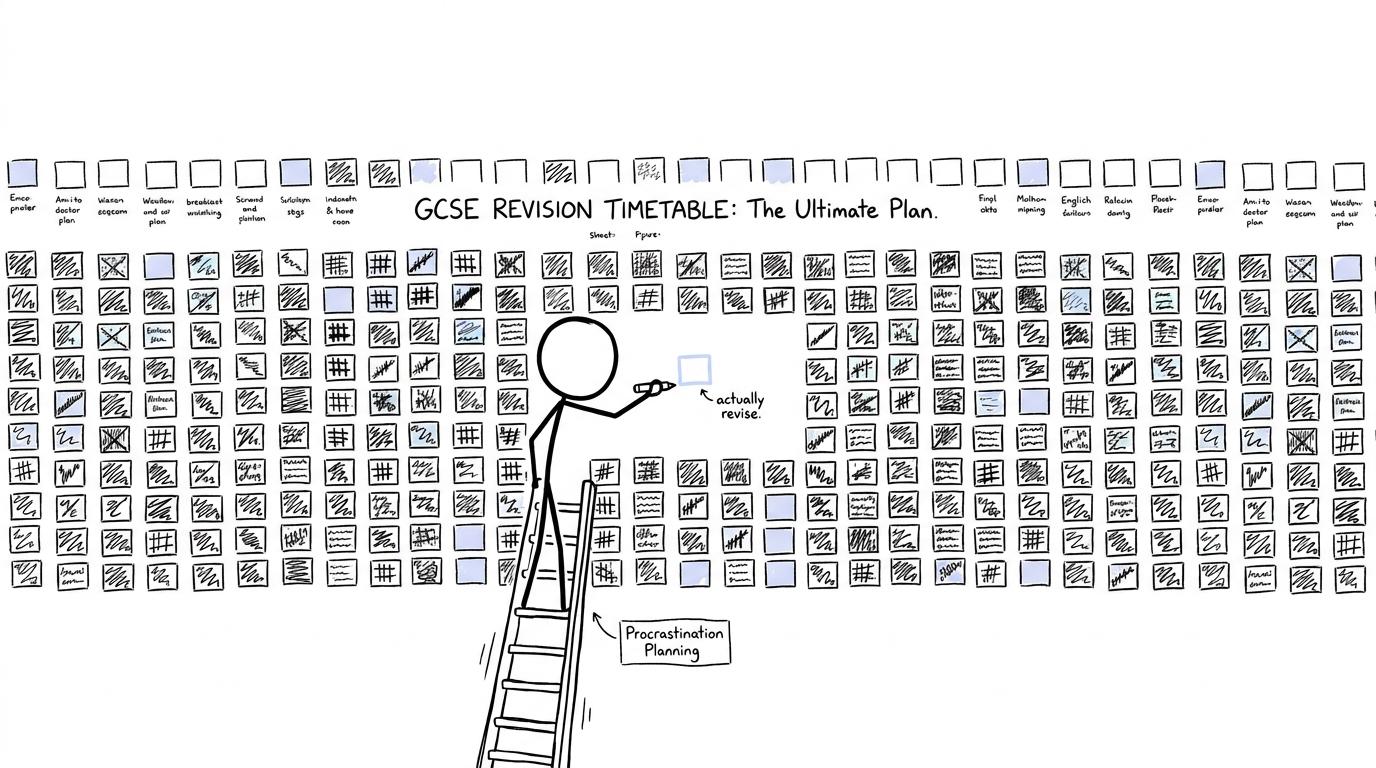 A student discovers that making a giant timetable is not the same as revising
What a written revision timetable can actually change
A timetable cannot guarantee a particular grade. Its value comes from the behaviours it encourages.
Learning research supports spacing practice across time rather than compressing the same work into one long session. Planning, monitoring and evaluating learning are also important parts of self-regulated revision. A timetable can support both ideas: it gives you somewhere to schedule a topic now, test it later and return again if it remains insecure.
That matters in statistics because recognising a method during a video is different from selecting it independently in an exam. You may understand a histogram lesson on Monday, yet still confuse frequency with frequency density on Friday. Returning to the topic exposes whether the method has lasted.
A useful plan therefore records actions, not vague intentions. Compare these two entries:
- “Revise statistics”
- “Complete histogram questions, mark them and reattempt errors on Thursday”
The second entry tells you what success looks like. MathsGenie’s histograms revision guide can refresh the method, but the learning becomes visible when you answer questions without support and check them carefully.
Could flexible revision work just as well?
Yes. A student does not need a detailed grid to revise effectively.
Flexible revision works when it has firm rules beneath it. You might choose the exact topic on the day while still committing to three sessions each week, marking every set and revisiting mistakes within a few days. That is flexible in content, but structured in behaviour.
This approach can be better if your week changes frequently or if recent practice should determine your next task. A past paper may reveal that scatter graphs are secure but averages from grouped data are not. It makes little sense to ignore that evidence merely because Tuesday’s box says “scatter graphs”.
Use MathsGenie’s averages from frequency tables revision guide when that weakness appears. If interpreting relationships is the problem instead, switch to scatter graphs revision. Check that each resource matches the content expected by your exam board and tier.
The real choice is not rigid timetable versus chaos. It is between two sensible systems:
- Fixed planning: decide the topic and time in advance.
- Flexible planning: reserve the time, then choose the topic using recent evidence.
Both can succeed. Neither works without doing and reviewing questions.
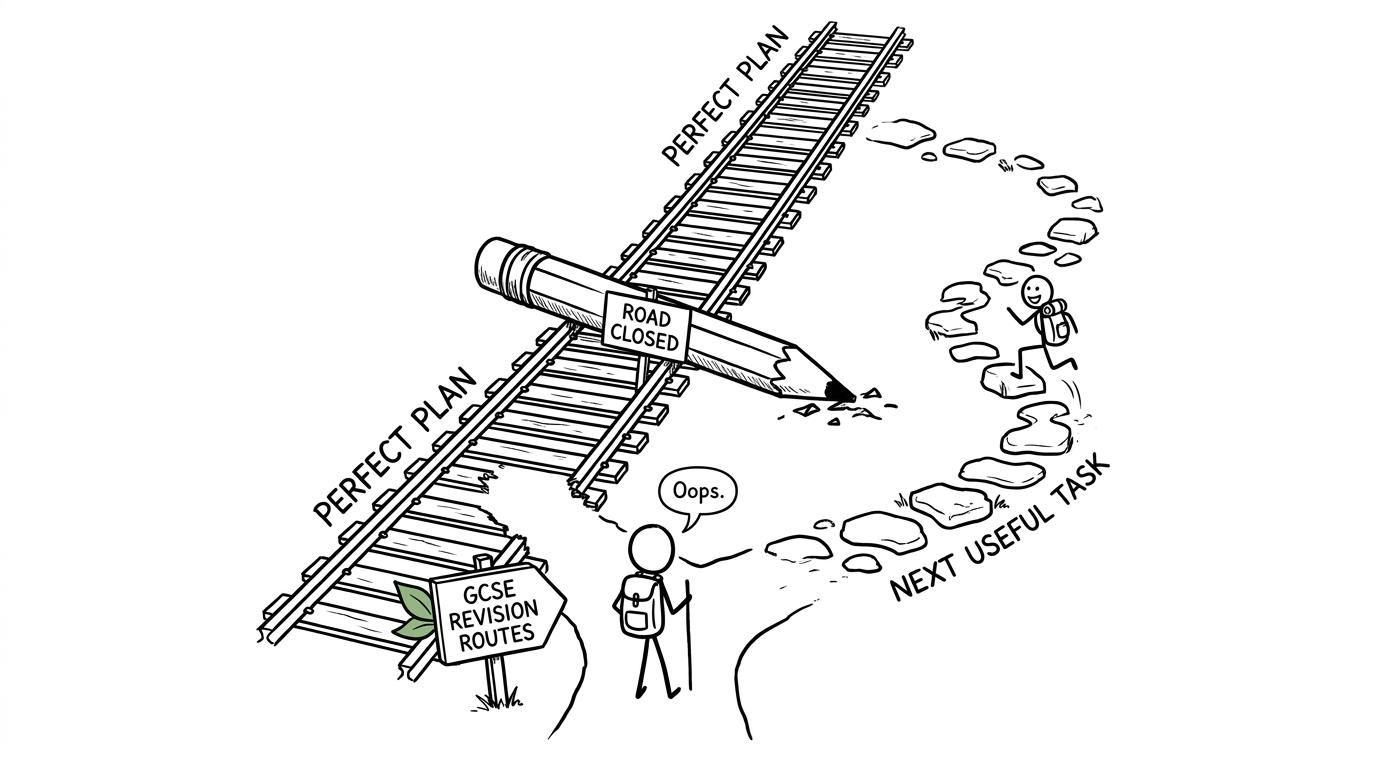 A flexible revision path continues when the perfect plan is blocked
Build a timetable around evidence, not equal time
Statistics topics should not automatically receive equal blocks. Your plan should reflect three things: what is examinable, what you currently understand and where mistakes are costing marks.
Start with a short diagnostic
Complete a mini test, a mixed set or part of a past paper without notes. Mark it immediately. For each lost mark, classify the cause:
- Knowledge gap: you did not know the method or definition.
- Selection error: you knew several methods but chose the wrong one.
- Execution error: the method was right, but calculation or graph work failed.
- Interpretation error: you did not answer in context or misread the data.
- Exam technique: working, units, scale or timing cost the mark.
A practice paper is valuable because it replaces assumptions with evidence. MathsGenie’s guide to starting GCSE past papers explains how paper practice can develop from short diagnostic work into timed papers.
Prioritise by need
A practical allocation is to spend roughly 60%60\%60% of your available statistics time on weak topics, 30%30\%30% on mixed exam practice and 10%10\%10% on secure material that needs maintaining. These proportions are a planning guide, not a scientific rule. Change them as your results change.
Your topic list might include:
- sampling, bias and populations;
- tables, charts and misleading representations;
- averages and measures of spread;
- scatter graphs, correlation and lines of best fit;
- cumulative frequency and box plots;
- histograms on Higher tier;
- probability and statistical interpretation where required by your specification.
For quartiles and comparisons of distributions, use the box plots revision guide. The cumulative frequency revision page provides another focused route for practising grouped-data diagrams.
Give every session a complete learning loop
A productive session should contain four stages:
- retrieve what you remember before opening notes;
- use a revision lesson or video to repair gaps;
- answer exam-style questions independently;
- mark, correct and schedule a later check.
A block of around 303030 to 454545 minutes is often easier to repeat than an ambitious evening-long session. The exact length matters less than concentration and follow-up. If you only have 202020 minutes, complete a small question set and mark it properly rather than rushing through an entire topic.
Use a hybrid plan if you dislike rigid timetables
For many students, the best answer is a hybrid timetable. Fix the sessions, but allow the diagnostic evidence to choose some of the content.
For example, your planner could contain:
- one fixed statistics topic session;
- one flexible “weakest current topic” session;
- one mixed mini test or paper section;
- one short return to errors from earlier in the week.
This protects revision time without pretending you can predict every future weakness. It also prevents the common problem of continuously changing plans because a different topic feels more appealing.
MathsGenie’s GCSE Maths revision timetable guide can help you place these sessions alongside the rest of GCSE Maths. Statistics deserves planned attention, but it should not crowd out major weaknesses elsewhere in the specification.
Let papers update the timetable
A timetable should become more accurate as you collect results. After each mini test or paper section, record:
- the topic that cost marks;
- the precise reason;
- the resource you will use;
- when you will reattempt a similar question.
This is more useful than writing “be more careful”. Carefulness is not a scheduled action. “Check class widths before calculating frequency density” is.
Later in revision, complete timed papers under suitable conditions. Use mark schemes and video solutions to understand how methods are rewarded, then move the relevant topics forward in your plan. Nearer the exam, MathsGenie’s Edexcel GCSE Maths predicted papers can provide fresh exam-style practice, but they should supplement broad specification coverage rather than encourage guesses about what will appear.
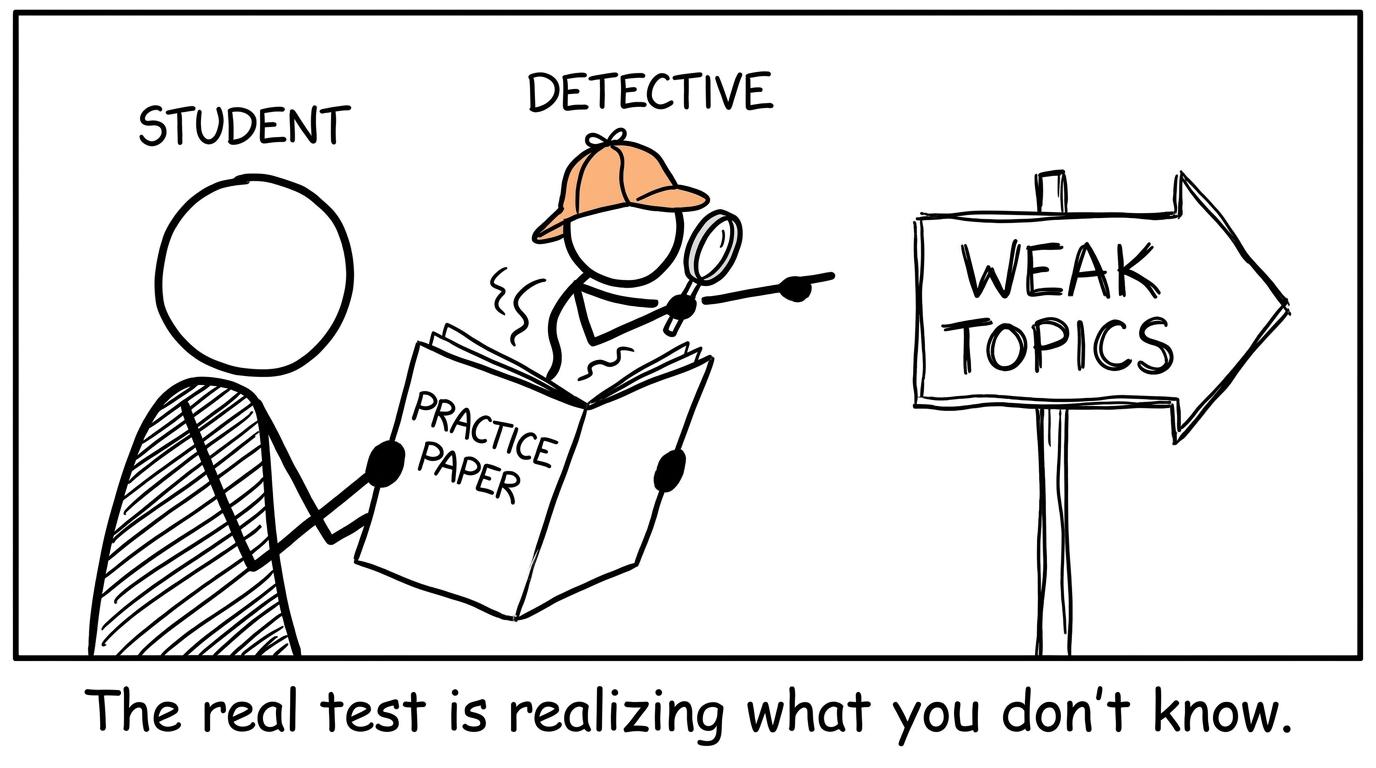 A practice paper detective points towards the student's weak topics
Common mistakes when planning statistics revision
Making the timetable too detailed
A plan that breaks every evening into tiny segments is fragile. One delayed bus or unexpected homework task can make the whole week feel ruined. Use broader blocks and leave spare capacity.
Measuring minutes instead of learning
Completing an hour does not prove that you can interpret a cumulative frequency graph. Measure performance through independent questions, marks and successful reattempts.
Revising only comfortable topics
Familiar questions feel fluent, which can be mistaken for readiness. Use marked work to decide what returns to the timetable.
Watching without practising
Videos and revision guides explain methods, but exam performance requires you to select and apply those methods yourself. Follow every lesson with questions.
Never changing the plan
A timetable is a forecast. New evidence should change it. Move secure topics into shorter maintenance slots and give repeated weaknesses more attention.
Ignoring the specification and tier
Edexcel, AQA, OCR and Eduqas organise and assess content through their own specifications. Foundation and Higher tier coverage also differs. Do not copy another student’s topic list without checking that it matches your course. Students taking the separate GCSE Statistics qualification must use its specification rather than assuming ordinary GCSE Maths statistics covers everything.
A timetable is useful when it leads to the next question
The best revision timetable is rarely the most impressive one. It is the one you can still follow after a difficult day. It reserves time, directs attention towards weaknesses and makes returning to mistakes normal.
If flexible revision gives you those same behaviours, it can work equally well. Keep fixed weekly commitments, choose tasks from marked evidence and avoid letting “flexible” become “whenever I feel like it”.
Start on MathsGenie with a revision lesson or topic guide, complete the practice questions, check the mark scheme and use video solutions where the method remains unclear. Then test your progress with mini tests, past papers and predicted papers. Put the next useful action into your revision planner, not the perfect action, just the one that moves your understanding forward.