GCSE Spanish Careers: Jobs That Value Your Grade
GCSE Spanish careers explained: discover which jobs and apprenticeships value language skills, and how Spanish can strengthen future applications.
The strange thing about choosing GCSE subjects is that you make the decision before you can see where it leads. Spanish may feel useful in a classroom, but when revision becomes difficult, a practical question appears: will anyone care about the grade?
The honest answer is that GCSE Spanish careers are rarely jobs for which one GCSE is the complete qualification. Instead, a good grade can strengthen an application for careers involving international customers, travel, trade, communication or public service. It becomes more valuable when paired with another useful strength, including maths, business, digital skills or science.
That distinction matters. GCSE Spanish is not usually the final destination. It is evidence that you have started building a skill an employer may need.
GCSE Spanish careers at a glance
Spanish can support progression towards:
- travel, aviation and hospitality roles;
- international business and customer service;
- logistics, imports, exports and supply chains;
- marketing, journalism and digital content;
- the Civil Service and other public-facing services;
- teaching, interpreting and translation after further training;
- apprenticeships involving customers, administration or international operations.
A grade alone does not guarantee entry. Employers and apprenticeship providers set their own requirements, and English and maths are often central to those requirements. Spanish is most likely to get noticed when you explain what the qualification demonstrates and why it is relevant to the role.
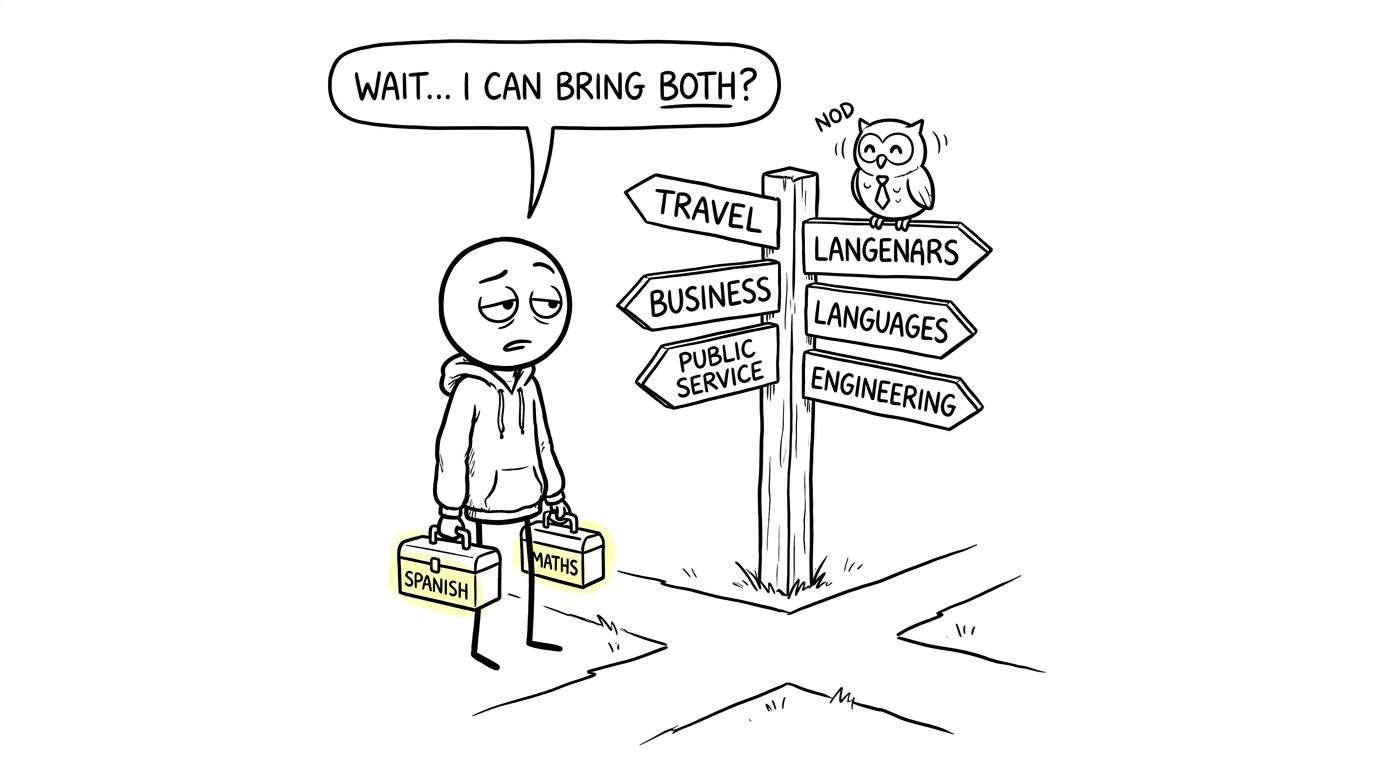 A GCSE student discovers that Spanish and maths can travel down the same career path
What does a good GCSE Spanish grade demonstrate?
An employer does not only see vocabulary and verb endings. A strong result can suggest that you can listen carefully, communicate under pressure, remember detailed information and keep working when understanding is incomplete.
Those are transferable skills. They matter when a hotel guest needs help, a customer email must be interpreted accurately or a logistics team is dealing with an overseas supplier.
The qualification can also show cultural awareness. Learning a language involves recognising that people do not always communicate, behave or organise ideas in the same way. That awareness is useful in customer service, management and international work.
However, it is important not to overstate the evidence. GCSE Spanish does not normally prove professional fluency. Translation and interpreting, for example, require much deeper language competence and usually further qualifications or specialist training. Think of the GCSE as a credible foundation rather than a certificate saying you can handle every workplace conversation.
Careers where Spanish may genuinely help
Travel, aviation and hospitality
Spanish can be relevant in airlines, airports, hotels, tour operations, visitor attractions and travel companies. These environments bring together customers from different countries, often when they are tired, confused or short of time.
Roles might include cabin crew, airport customer service, hotel reception, resort work, travel consultancy or tour operations. Language ability can help you stand out, although safety training, customer service, reliability and clear English remain essential.
The value is practical: even limited Spanish may help you welcome someone, understand a straightforward request or recognise when specialist language support is needed. Employers will still assess your overall suitability rather than hiring you because of one subject.
International business and customer service
Companies selling products or services overseas need people who can work with international customers. Spanish may support roles in sales administration, account support, purchasing, customer service and business development.
A GCSE is more persuasive here when combined with numeracy. International business involves prices, discounts, budgets, performance data and exchange rates as well as conversation. Revising through the GCSE Maths Revision Hub helps you build the quantitative side of that combination.
The strongest message to an employer is not simply, “I took Spanish.” It is, “I can communicate, work accurately with information and continue developing my language skills.”
Logistics, imports and exports
Supply chains cross borders. Logistics teams coordinate deliveries, documents, customers and suppliers, so language awareness can be useful even when English is the organisation’s main working language.
Possible areas include freight operations, shipping administration, procurement, warehouse coordination and import or export support. Accuracy matters enormously: a misunderstood address, quantity or deadline can create a real problem.
Maths therefore sits naturally beside Spanish. Percentages, measures, timetables and data interpretation all have workplace relevance. If accuracy is currently a weakness, the guide to finding your weakest GCSE topics provides a practical way to turn mistakes into a revision plan.
Marketing, media and digital content
Spanish may help in social media, publishing, advertising, market research and content localisation. But localisation is more than replacing each English word with a Spanish one. The message must make sense culturally and sound natural to its intended audience.
Professional language work normally requires ability beyond GCSE. Still, the qualification can be the first step towards combining languages with marketing, design, journalism, computing or data analysis at college, sixth form, university or through workplace training.
Public services and international organisations
Language skills can support some careers in central and local government, border and immigration work, policing, defence, aid organisations and diplomatic services. Requirements differ greatly between roles, and many recruitment routes assess judgement, written communication, teamwork and numerical reasoning rather than demanding a particular language GCSE.
Spanish can nevertheless become a useful additional skill. It shows an interest in communication beyond your immediate environment. For specialist overseas or diplomatic work, expect further selection, training and potentially higher-level language study.
Teaching, translation and interpreting
These are the careers most obviously associated with Spanish, but they are also the easiest to misunderstand.
GCSE Spanish can begin the journey towards becoming a language teacher, translator or interpreter. It is not normally enough to perform those jobs professionally. You would need to continue developing advanced speaking, listening, reading and writing skills, then follow the relevant education or professional route.
That should not make the GCSE seem unimportant. Foundations matter precisely because advanced skills have to begin somewhere.
Which apprenticeships could value GCSE Spanish?
There is no single “Spanish apprenticeship”. Instead, language ability may improve your application for an apprenticeship based in a sector where international communication occurs.
Relevant possibilities can include:
- cabin crew and passenger transport;
- business administration;
- customer service;
- travel and hospitality;
- marketing and communications;
- logistics and supply-chain operations;
- sales or account support.
Cabin crew is an established Level 333 apprenticeship route in England, while business administration can also provide a route into organisations working with international customers. Live vacancies change, however, and an apprenticeship title does not guarantee that Spanish will be used. Read the actual vacancy rather than relying on the sector name.
English and maths requirements often receive more attention than an optional language. Some providers ask for particular GCSE grades; others assess applicants differently or support eligible apprentices in meeting required English and maths standards. Always follow the conditions in the current vacancy.
This is why protecting your maths result matters. Use GCSE maths past-paper guidance to decide when to move from topic practice into timed exam work.
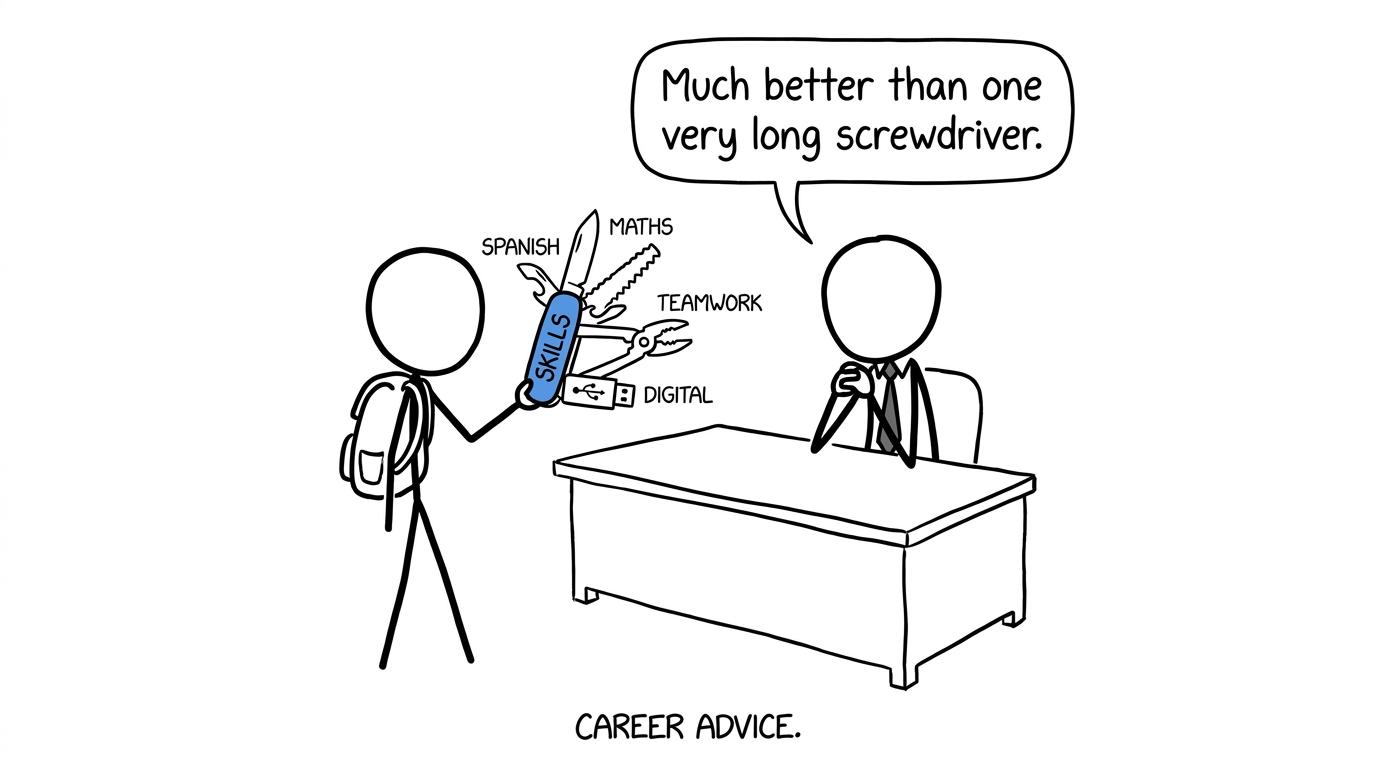 A student presents Spanish, maths and teamwork as one adaptable skills toolkit
When does the Spanish grade actually get noticed?
A language grade is most likely to attract attention in four situations.
The vacancy mentions languages or overseas customers
If an advert says that another language is desirable, list Spanish clearly in your qualifications and skills. Do not claim fluency unless you can support that claim.
Your application explains the relevance
A qualification list tells an employer what you took. A good application explains what you learnt. You might refer to listening carefully, preparing for a speaking assessment or communicating accurately within a limited time.
You continue using the language
Language knowledge fades without practice. Continuing to read, listen and speak makes your GCSE more credible and prepares you for A Level, college study or future workplace use.
Spanish complements another strong subject
Languages are often most powerful in combination. Spanish and maths can suit international business or logistics. Spanish and computing may support technology companies with global users. Spanish and science could contribute to work in healthcare, research or international manufacturing after further training.
This is a useful way to think about careers: employers rarely purchase one isolated school subject. They look for a bundle of abilities.
Balancing Spanish with GCSE maths revision
Students preparing for several exams often treat revision like a competition in which one subject must defeat another. A better approach is to give each session a clear purpose.
For maths, use evidence from questions rather than revising whatever feels familiar. The GCSE one-month maths revision plan shows how to diagnose weak areas, practise them and return to timed papers. If school days are crowded, follow a repeatable 20-minute maths revision routine.
For Spanish, alternate vocabulary recall with listening, reading, writing and speaking. A long evening of passive rereading is less useful than focused practice that forces you to retrieve language.
Your timetable should also reflect exam dates, current weaknesses and tier. The GCSE maths revision timetable guide can help you create that structure without turning every free hour into revision.
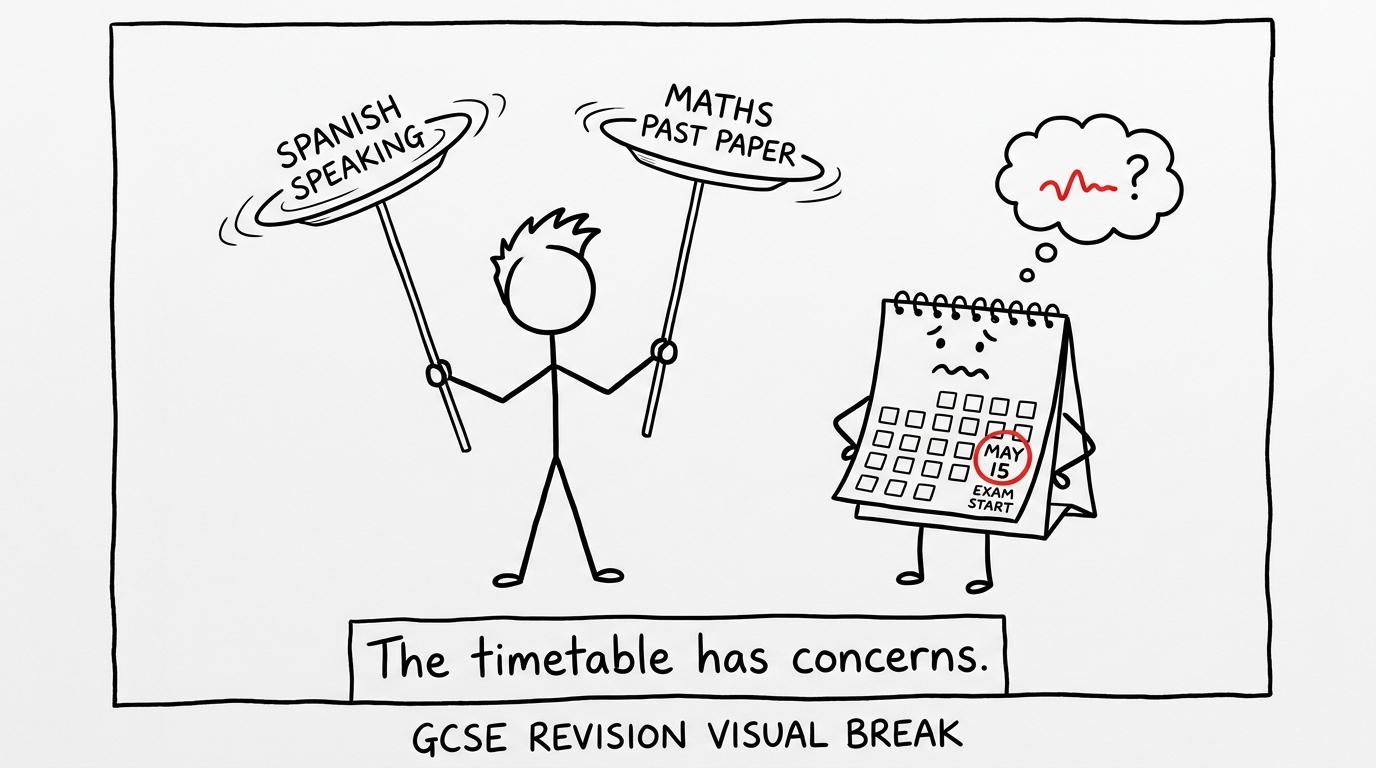 A revision timetable tries to remain calm while Spanish and maths compete for attention
Common mistakes when thinking about Spanish careers
Assuming GCSE Spanish proves fluency
It proves achievement at GCSE level. Describe your ability honestly and keep improving it. Professional translation, teaching and interpreting require further development.
Searching only for jobs with “Spanish” in the title
Language skills often sit inside broader roles such as customer service, administration, logistics, sales or travel. Search by sector and responsibilities as well as by language.
Ignoring English and maths requirements
Spanish may differentiate you, but English and maths can determine whether you meet an apprenticeship or course’s entry conditions. Match revision to your board and tier, then use MathsGenie’s free GCSE resources for lessons, questions and papers.
Treating a desirable skill as a guaranteed requirement
If Spanish is described as desirable, it may strengthen an application without being compulsory. If it is essential, an employer may test your ability rather than accepting the GCSE grade alone.
Letting the skill disappear after the exam
A qualification remains on your CV, but practical ability needs maintenance. Regular listening, reading and conversation make the grade more valuable over time.
Turn your subjects into a stronger combination
GCSE Spanish can help with careers in travel, business, logistics, customer service, media and public service. It can also open the door to advanced language careers after further education. Its real value is not that it guarantees a particular job. It is that it adds communication and cultural awareness to the rest of your skills.
Meanwhile, maths remains central to many sixth-form, college and apprenticeship applications. Start with a revision lesson, complete practice questions, check the mark scheme and retest the mistakes. Then build towards mini tests, timed past-paper practice and predicted papers.
Visit the MathsGenie GCSE Maths Revision Hub to choose your exam board and tier. Free revision lessons, past papers, predicted papers, practice questions, mark schemes and video solutions give you a clear next step, whichever career direction your subjects eventually take you.