GCSE Russian Careers: Jobs Where It Helps
GCSE Russian careers explained: discover jobs and apprenticeships where language skills stand out, and why strong maths keeps more routes open for you.
A GCSE option can feel like a small decision carrying an unreasonable amount of weight. You may enjoy Russian, earn a good grade and still wonder whether an employer will ever care.
The honest answer about GCSE Russian careers is encouraging but nuanced: the qualification can make you distinctive in language-related, international and analytical fields, but it rarely qualifies you for a job by itself. Employers are most likely to notice it when Russian is combined with stronger language proficiency, cultural understanding, experience and another useful skill such as maths, data analysis, logistics or technology.
That makes the GCSE a starting signal, not a finished career plan.
The short answer: where can GCSE Russian help?
A good GCSE Russian grade may strengthen your profile for:
- translation and interpreting pathways
- intelligence, security and defence roles
- the Civil Service, diplomacy and international policy
- freight forwarding, logistics and international trade
- journalism, research, publishing and broadcasting
- tourism, aviation and customer-facing international work
- language teaching and education
- technology, localisation, data and cyber security
Before choosing a route, remember three things:
- A GCSE demonstrates achievement, commitment and an assessed foundation in the language.
- Professional language roles normally require much greater fluency or further qualifications.
- Some apprenticeships make English and maths essential entry requirements even when an additional language helps your application stand out.
 A student carrying Russian and maths skills at a careers crossroads
What does GCSE Russian prove to an employer?
The current Pearson Edexcel GCSE Russian qualification assesses listening, speaking, reading and writing. It is available at Foundation and Higher tier, and candidates take the same tier across the four papers.
Your final grade therefore provides evidence that you have worked across several forms of communication. It can also suggest qualities that matter beyond languages:
- careful listening and attention to detail
- memory and vocabulary retrieval
- confidence communicating under pressure
- awareness that meaning depends on context
- persistence with an unfamiliar alphabet and grammar
- the ability to move between different systems of expression
However, employers recruit for what you can do now, not simply for the title of a qualification. If an advert asks for fluent or professional Russian, a GCSE alone will not usually meet that requirement. A strong grade is better viewed as evidence of potential and a foundation for A Level, university study, professional training or continued independent learning.
Careers where Russian can become a central skill
Translation and interpreting
Russian is among the languages identified by the National Careers Service as being used by translation services. Translators work with written material, while interpreters communicate spoken meaning in settings that can include conferences, businesses, courts and public services.
These are skilled professions. Translators need excellent written English as well as fluency in another language, and interpreters must process meaning accurately at speed. Degrees in modern languages, translation or interpreting are common routes, while professional qualifications are also available.
Your GCSE gets noticed here because it shows an early, assessed commitment. It does not establish professional fluency. If this path interests you, continuing Russian after GCSE and developing exceptionally strong English should be part of the plan.
Intelligence, security and defence
Russian can be directly relevant to language-specialist work in the UK intelligence services and defence. Official careers information from MI5 and SIS describes work involving translation, transcription, analysis and the interpretation of language within its cultural and political context.
Requirements vary substantially. Some language-specialist vacancies assess proficiency rather than demanding one particular qualification, while particular development programmes may require a relevant degree. Security roles can also involve nationality, residency, vetting or age conditions.
A GCSE Russian grade can be an early marker of interest, but these organisations need more than vocabulary. Judgement, analysis, discretion, accurate writing and cultural knowledge matter too. Strong numeracy can support analytical roles involving patterns, evidence and data.
Diplomacy, government and international policy
Languages can support careers in the Civil Service, diplomatic work, international relations and policy research. Russian may be relevant when a team works on Eastern Europe, Eurasia, security, migration, energy or international affairs.
Not every diplomatic or policy role requires Russian, and a GCSE is unlikely to be the decisive qualification. Its value lies in the story your wider profile tells: you have chosen a demanding language, developed an interest in another culture and perhaps continued that interest through reading, current affairs or further education.
A useful future combination might be Russian with economics, politics, history, law, computer science or maths. The language provides access and context; the second discipline gives you a professional lens through which to use it.
Careers where Russian is a valuable extra
Logistics, freight forwarding and international trade
International freight forwarding specialists organise the movement of goods across borders. The work can involve transport routes, customs documents, regulations, customer communication, costs and deadlines.
The Level 333 international freight forwarding specialist apprenticeship is equivalent in level to A Level. Its national standard leaves entry requirements to individual employers, while apprentices must meet the relevant English and maths requirements by the required stage of their programme.
Russian may attract attention when an employer serves Russian-speaking customers or markets, but demand depends on the organisation and the international trading environment. It is an advantage rather than a standard requirement. Accuracy, spreadsheet confidence, commercial awareness and numeracy are likely to matter every day.
Related apprenticeships in supply chains, business administration, customer service, procurement and transport may also value a language where it matches the employer's clients. Read each vacancy rather than assuming that every international company needs Russian.
Journalism, research and publishing
Language skills can help journalists and researchers read sources, follow regional developments and communicate with a wider range of people. Publishing and media organisations may also need researchers, editors, subtitlers or producers with specialist regional knowledge.
A GCSE can support your first application for relevant experience, but accuracy and source evaluation are crucial. Continue developing written English, learn how to check claims and consider pairing Russian with politics, history, economics or statistics.
Technology, localisation and data
Localisation adapts software, websites, games and digital services for different languages and cultures. Some roles focus on language quality; others require coding, project management, design or data skills.
Russian can be useful in these teams, although professional language work normally demands proficiency beyond GCSE. Combining it with computer science or maths creates a broader profile for technical organisations. The person who understands both the user and the system is often more useful than someone who understands only one side.
Education, travel and customer service
Russian can support longer-term routes into teaching, language tuition and educational publishing. In travel, hospitality and aviation, it may help when dealing with Russian-speaking customers, although demand varies by employer and destination.
These roles reward communication and calm problem-solving. A GCSE may distinguish two otherwise similar applications, particularly for early work experience, but employers will still look closely at customer service, reliability and safeguarding or teaching qualifications where relevant.
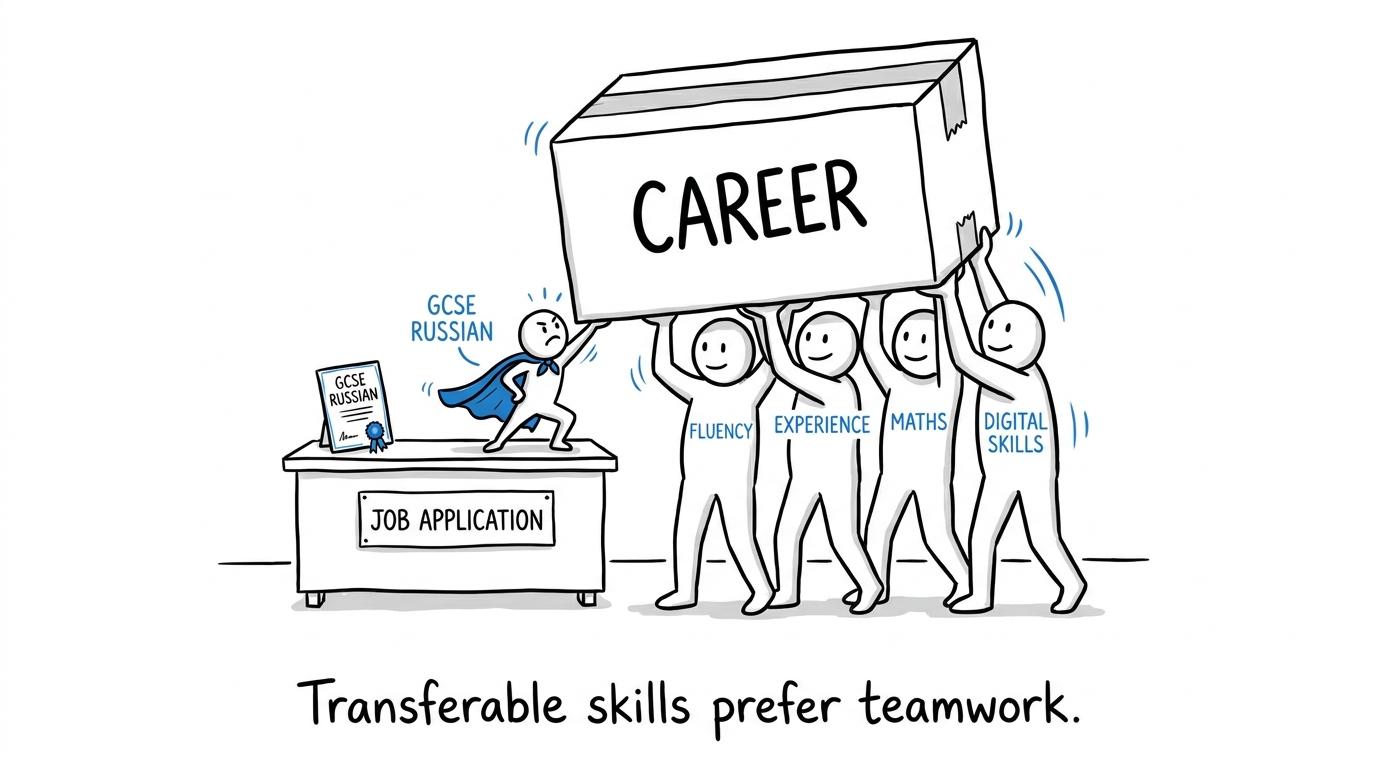 A Russian GCSE certificate discovering that career skills work as a team
Which apprenticeships might notice GCSE Russian?
There is no broad category of apprenticeships for which GCSE Russian is a standard entry requirement. That distinction matters. The language is more likely to be noticed by a particular employer than required by the apprenticeship standard itself.
Look especially at vacancies in:
- international freight forwarding and logistics
- supply chain operations and procurement
- business administration for international organisations
- travel, aviation and hospitality
- digital marketing and multilingual content
- customer service teams supporting overseas clients
- defence or government organisations offering structured training
Search the vacancy for phrases such as “additional languages desirable”, “international clients”, “regional knowledge” or “multilingual team”. If Russian is relevant, explain how you have used it rather than listing the grade without context.
Meanwhile, protect your core qualifications. Apprenticeship rules and employer criteria frequently place formal emphasis on English and maths. If maths is the subject currently limiting your options, begin with the GCSE Maths revision hub, where you can choose resources for Edexcel, AQA, OCR, Eduqas, WJEC or CCEA.
Why maths strengthens a language-based career
Languages and maths can look like opposite subjects. In practice, they often solve different halves of the same problem.
Maths supports budgeting, exchange rates, forecasting, data interpretation, logistics, technology and evidence-based analysis. Russian helps you understand language, people and context. Together, they can support international business, intelligence, economics, transport and technical work.
You do not need to abandon language revision to improve maths. Use a controlled routine. The MathsGenie guide to finding weak GCSE topics helps you diagnose where marks are disappearing, while the GCSE maths topics by board and tier keeps revision aligned with your specification.
For a manageable schedule, follow the one-month GCSE maths revision plan. Learn one method, complete practice questions, check the mark scheme and return to the weakness later. That loop is more valuable than repeatedly reading notes.
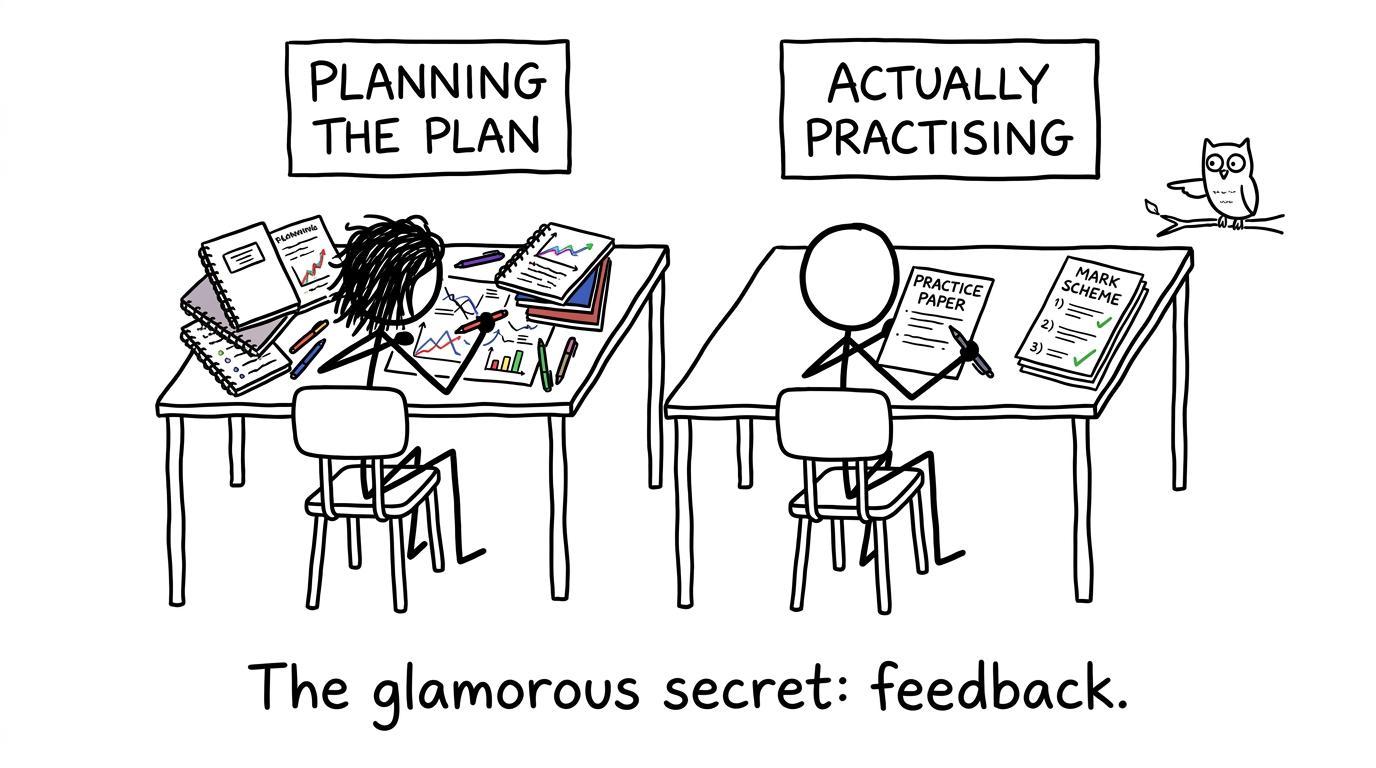 A revision planner learns that completing questions beats planning forever
How to make your Russian GCSE more valuable
A qualification becomes more persuasive when you continue using the skill behind it.
- Keep practising: maintain listening, reading, speaking and writing rather than letting the language disappear after the exam.
- Build cultural knowledge: understand that Russian is used by varied communities and that language ability is not the same as political expertise.
- Add a complementary subject: maths, computing, economics, politics, history or business can create a clearer professional direction.
- Seek appropriate experience: school projects, supervised volunteering and work experience can demonstrate reliability and communication.
- Describe evidence: on an application, explain the skills behind the grade, such as sustained revision, oral communication or accurate translation.
- Check current requirements: security, defence and apprenticeship conditions can change, so always use the employer's current vacancy information.
Common mistakes when planning GCSE Russian careers
Assuming the GCSE guarantees a language job
It does not. Professional translation, interpreting and specialist analytical work require advanced proficiency, and often further education or assessment.
Treating Russian as useful everywhere
A rare skill is only valuable when it meets a real need. Investigate the employer's markets, customers and work before presenting Russian as relevant.
Ignoring English and maths
An additional language can make an application memorable, but English and maths often determine whether you meet course or apprenticeship requirements. Use short GCSE maths revision routines when time is tight.
Listing a grade without explaining the skill
Employers cannot infer your full ability from one line. Describe what the course required and be honest about your current proficiency.
Letting revision become passive
Colourful notes feel productive because they are tidy. Exams reward retrieval and application. Use past papers at the right stage of revision, then mark them carefully and repair the specific topics that cost you marks.
Turn an unusual subject into a useful combination
GCSE Russian is not a golden ticket, but it is not decorative either. It can open a conversation, support further language study and become genuinely valuable in translation, intelligence, policy, logistics, media or technology. Its impact grows when you pair it with fluency, experience and another practical discipline.
Your immediate task is simpler than choosing an entire career. Keep developing the language, research real entry requirements and secure the core qualifications that preserve your options.
For maths, start with MathsGenie's free revision lessons and practice questions. Move into mini tests, then build exam confidence with past papers, mark schemes and video solutions. Nearer the examination, use Edexcel GCSE Maths predicted papers alongside official past papers, not instead of them.
A career is rarely built from one subject. It is built from combinations. Russian can make yours more distinctive; MathsGenie can help ensure maths does not hold it back.