

GCSE Religious Studies 5 to 7: A Practical Guide
GCSE Religious Studies 5 to 7: build stronger knowledge, evaluation, evidence and focused exam technique to raise your marks securely.
A grade 5 answer often knows the topic. A grade 7 answer does something more demanding: it selects precise knowledge, explains why it matters and uses it to build a convincing judgement.
That is the central lesson for any student searching for a GCSE Religious Studies 5 to 7 plan. You do not usually need twice as many notes. You need to turn what you know into developed arguments, accurate references to religious teaching and conclusions that follow from your analysis.
Grade boundaries change between exam boards and exam series, so there is no permanent number of marks that guarantees a grade 7. The practical target is to produce stronger responses consistently across the whole paper.
The grade 5 to grade 7 checklist
Focus on these changes first:
- Know exactly which specification, religions and themes you study.
- Replace broad statements with precise religious beliefs and teachings.
- Explain the connection between evidence and the question.
- Show diversity within and between religious traditions where relevant.
- Develop logical chains of reasoning rather than listing points.
- Evaluate the strength of arguments instead of merely presenting two sides.
- Reach justified conclusions that answer the precise statement.
- Practise under time pressure and learn from mark schemes.
- Keep an error log and revisit recurring weaknesses.
The jump is not mainly about writing more. It is about making each paragraph work harder.
What separates a grade 5 from a grade 7 in Religious Studies?
A student working around grade 5 often demonstrates reasonable knowledge but applies it inconsistently. They may identify an appropriate teaching without explaining its relevance, offer several undeveloped points or finish an evaluation with a conclusion based mainly on personal opinion.
A grade 7 response tends to show greater control. Knowledge is selected rather than emptied onto the page. Religious teachings are applied to the specific issue. Different viewpoints are developed accurately, and the final judgement grows out of the preceding argument.
The difference can be summarised through four habits.
Precision instead of generalisation
Statements such as “Christians believe life is important” are too broad on their own. Which Christians? What belief supports that view? How might it affect a believer’s response to the issue?
Stronger answers use accurate vocabulary and distinguish between common and divergent views where the specification requires it. They avoid suggesting that every member of a religion thinks identically.
Precision also means answering the exact question. A detailed paragraph about forgiveness will earn little if the question is specifically about whether punishment should protect society.
Explanation instead of description
Description tells the examiner what a belief is. Explanation shows its influence or significance.
A useful internal test is to ask:
- Why does this teaching support the argument?
- How might it influence a believer?
- What consequence follows from it?
- Why is this evidence relevant to the statement?
Words such as “because”, “therefore” and “this means” can help, but they are not magic phrases. The reasoning after them must genuinely extend the point.
Evaluation instead of two separate lists
Many middle-grade essays contain one paragraph supporting the statement, one paragraph opposing it and a short conclusion. That provides balance, but balance alone is not sophisticated evaluation.
Higher-level evaluation considers the quality of each argument. Ask whether a teaching is directly relevant, whether a viewpoint deals with the whole issue and whether one argument is more convincing under particular circumstances.
Pearson Edexcel’s current guidance for top-level evaluation refers to sustained, coherent analysis, logical chains of reasoning and a justified conclusion. AQA’s higher level descriptors similarly reward well-argued responses, different points of view and judgements supported by relevant religious knowledge. OCR examiner feedback has also warned against blocks of knowledge without critical analysis, sources of authority or a conclusion.
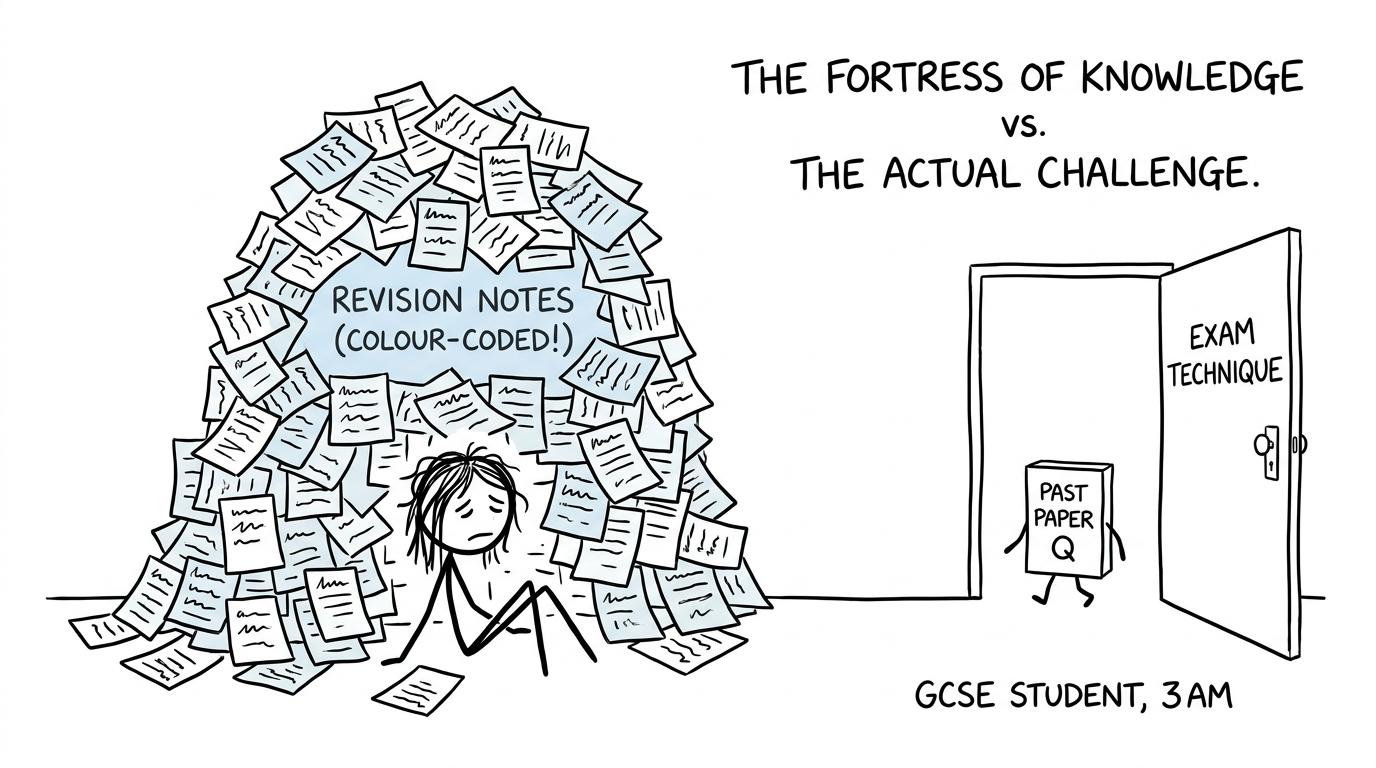 A revision-note fortress fails to stop an exam-technique question
Judgement instead of unsupported opinion
Your own view can be relevant when a question invites evaluation, but “I agree because it seems fair” is not enough. A strong judgement identifies the decisive argument and explains why it carries more weight.
A conclusion should:
- answer the statement directly;
- compare the strongest competing arguments;
- explain the criterion used to judge them;
- remain consistent with the essay.
Do not introduce an entirely new argument in the final lines. The conclusion should resolve the discussion already on the page.
Understand what your exam board rewards
GCSE Religious Studies is untiered, unlike GCSE Maths, so there is no foundation or higher paper to choose between. Every student sits the relevant papers for their specification and can access the full grade range.
However, paper structures and assessment weightings are not identical across AQA, Edexcel, OCR and Eduqas. Confirm your board, specification code, religions and themes with your teacher before building a revision plan.
Across the subject, AO1 concerns knowledge and understanding of religion and belief. This includes beliefs, practices, sources of authority, influence, and similarities or differences. AO2 concerns analysis and evaluation, including significance and influence.
AQA and Pearson Edexcel allocate approximately 50%50\%50% to each objective in their current GCSE specifications. OCR’s current full-course specification uses an overall weighting of 60%60\%60% for AO1 and 40%40\%40% for AO2. This is why generic advice should never replace your board’s current specification and sample materials.
AQA students taking Specification A from summer 2026 should also note the updated section structure of one, one, four, six and twelve marks. The former five-mark question has become a six-mark question, with greater reward for applying a source of authority. Do not use an old timing plan without checking whether it matches your examination year.
Build knowledge that can be used in an answer
The amount of content can make rereading feel productive. It is reassuring because everything looks familiar. Unfortunately, recognition is not the same as recall.
Instead, create compact topic sheets containing:
- essential beliefs and practices;
- accurate subject vocabulary;
- short references to scripture or other sources of authority;
- contrasting or different views where required;
- likely influences on individuals and communities;
- links to ethical themes.
Then close the sheet and retrieve the information from memory. MathsGenie’s guide to stopping forgotten GCSE content explains a useful cycle of active recall, spaced practice and exam-style questions. Although its resources are designed for maths, the learning principle transfers directly to Religious Studies.
Avoid memorising isolated quotations with no idea how to use them. A shorter source accurately connected to an argument is more valuable than a long quotation inserted without explanation. Follow the wording permitted by your board’s mark scheme, and remember that relevant paraphrased teaching may sometimes be more useful than an inaccurate quotation.
Turn revision into exam performance
Knowing content and producing a timed answer are different skills. The bridge between them is deliberate practice.
Diagnose your actual weaknesses
Complete a suitable past-paper section without notes. When you mark it, classify each lost mark:
- Knowledge: a belief, teaching or term was missing or inaccurate.
- Application: the knowledge was not connected to the question.
- Development: a point was stated but not explained.
- Evaluation: arguments were presented without being assessed.
- Technique: the command word, timing or required viewpoint was missed.
This is more useful than writing “revise theme two”. The process mirrors the MathsGenie weakest-topic diagnostic, where broad uncertainty is converted into a small, fixable list.
Practise one response skill at a time
Do not write full papers every evening. If evidence is weak, practise selecting sources for several questions. If conclusions are vague, plan several judgements. If timing is the problem, complete one extended response under the recommended conditions for your paper.
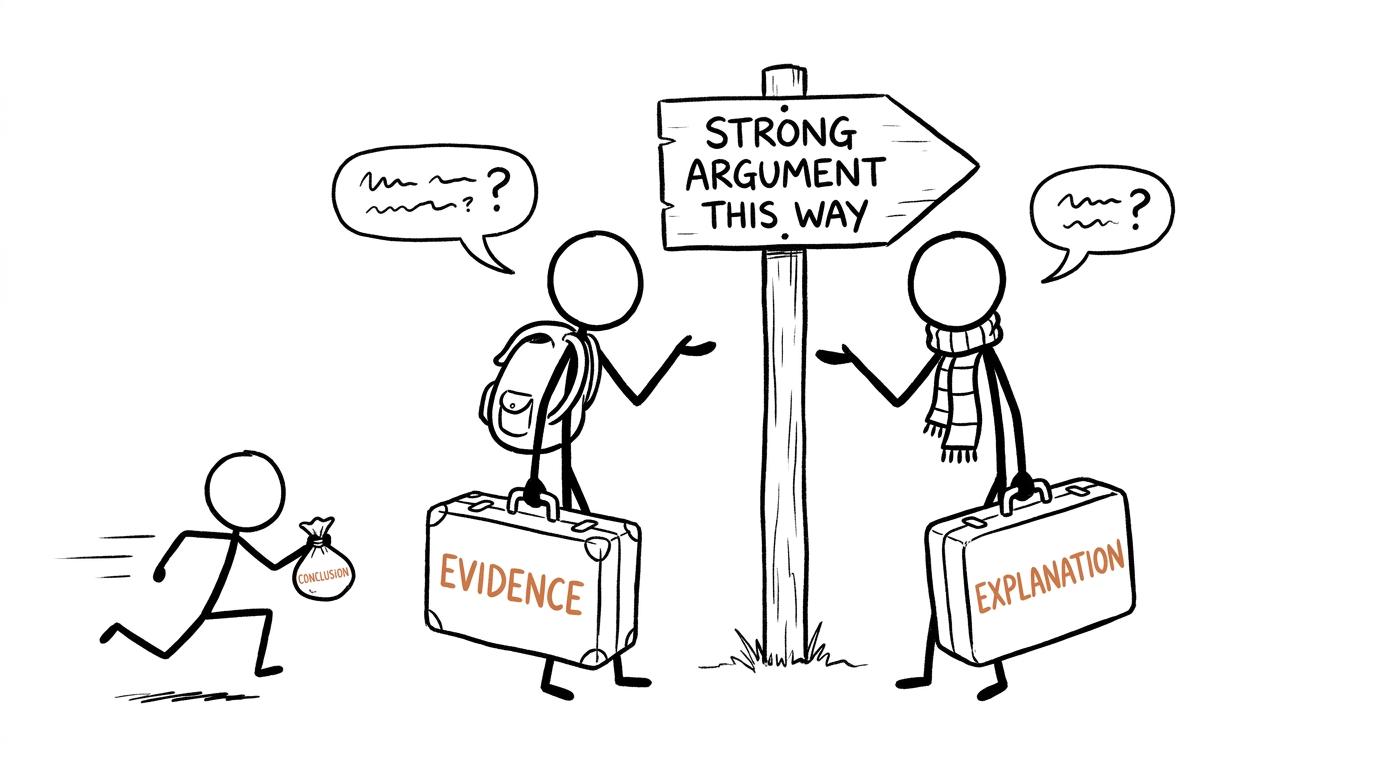 Evidence and explanation hurry towards a strong argument
Your practice should gradually become more realistic:
- begin with untimed plans and short responses;
- move to timed individual questions;
- combine questions into full sections;
- complete full papers under examination conditions.
The same progression is discussed in when to start GCSE past papers. Past papers diagnose problems; they do not fix those problems unless you review and reattempt the weak skills.
Use mark schemes as feedback
A mark scheme is not merely a document that announces your score. It shows the qualities your response must demonstrate.
After marking an answer, write one specific correction such as:
- apply the teaching to the issue;
- include a genuine different viewpoint;
- explain why the argument is stronger;
- answer the command word directly;
- justify the final judgement.
Then rewrite the weakest paragraph without copying a model response. The MathsGenie guide to using GCSE mark schemes offers a transferable method: identify what earns credit, record the error and change the next attempt.
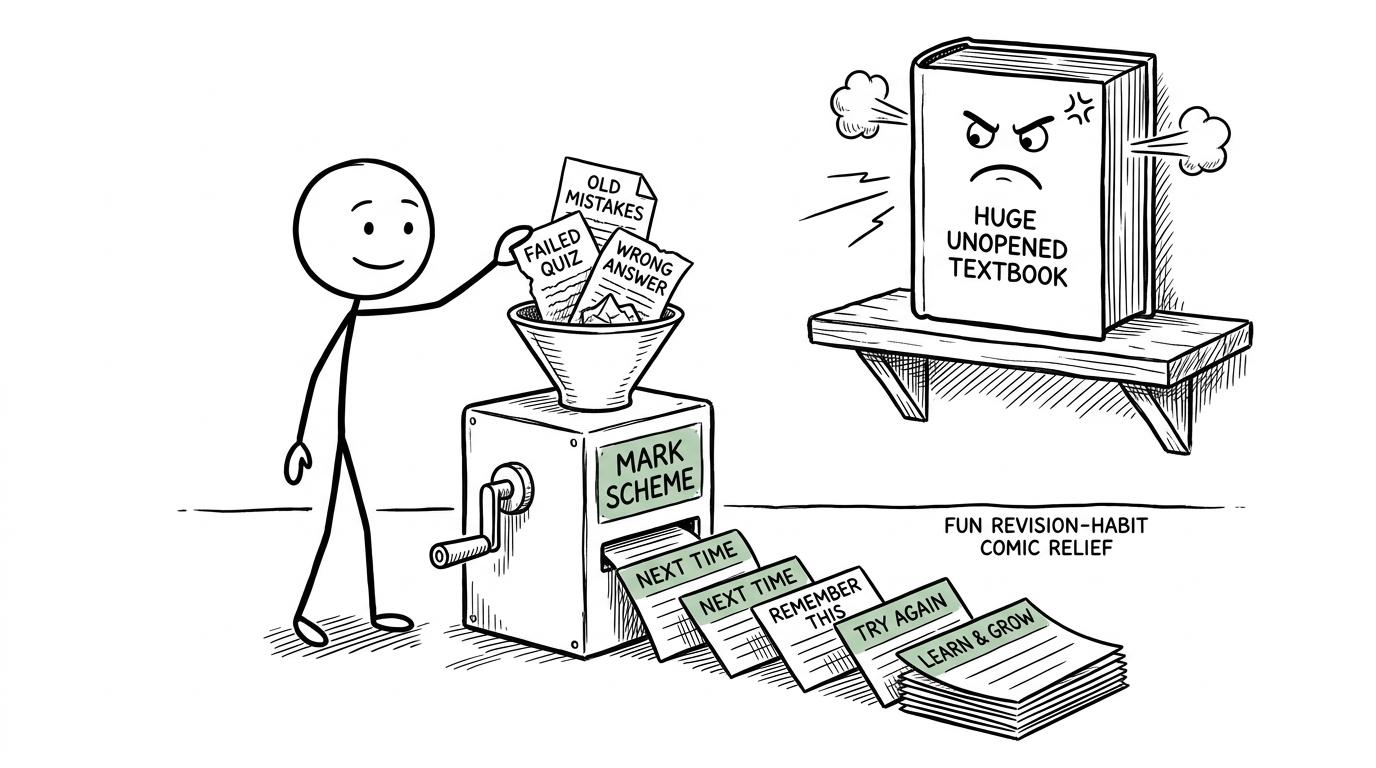 A mark-scheme machine turns mistakes into useful next-time cards
A weekly revision routine for moving up a grade band
A sustainable week might include three short sessions and one longer session.
During the short sessions, retrieve one topic, check the gaps and answer one exam-style question. During the longer session, complete a timed section, mark it and improve the weakest answer.
Use a simple rotation:
- Session one: beliefs, teachings and key vocabulary;
- Session two: sources of authority and their application;
- Session three: evaluation planning and conclusions;
- Longer session: timed questions, marking and corrections.
Revisit weak material after a few days rather than waiting until it feels forgotten. If you are balancing Religious Studies with maths and other subjects, adapt the structure in the GCSE revision timetable guide or the one-month GCSE revision plan. Keep the subjects separate, but preserve the same rhythm: retrieve, practise, mark, correct and retest.
Common mistakes that keep students around grade 5
Writing everything you know
Relevance is more valuable than volume. Select the belief or teaching that advances the answer rather than adding memorised material because it belongs to the general topic.
Treating religions as a single viewpoint
Avoid phrases such as “all Muslims believe” or “Christians always think”. Use accurate qualification where beliefs differ between traditions, denominations or interpretations.
Dropping in a quotation
A quotation does not explain itself. Connect the source to the argument and show how it could influence the believer or community in question.
Confusing balance with evaluation
Two sides can still be superficial. Compare their force, limitations and relevance before reaching a judgement.
Ignoring the command word
“Describe”, “explain”, “analyse” and “evaluate” require different responses. Learn the command-word guidance for your own exam board.
Using outdated paper structures
Specifications and assessment arrangements can change. This is especially important for AQA candidates sitting the revised format from summer 2026. Check current materials supplied by your board and school.
Practising without correcting
Completing another paper may feel industrious, but repeated errors become habits. Spend at least as much attention on why marks were lost as on the score itself.
Make the next answer better than the last
Moving from grade 5 to grade 7 in GCSE Religious Studies is less about producing enormous essays and more about gaining control. Know the exact course. Recall precise content. Apply evidence. Develop reasoning. Evaluate arguments. Finish with a judgement that has been earned.
The most useful revision loop is simple: attempt, mark, diagnose, correct and retest. It works in Religious Studies, and it is the same disciplined approach that powers the free MathsGenie GCSE Maths revision hub.
Use your board’s current Religious Studies specification and official papers for subject-specific practice. Then bring the same routine to maths with MathsGenie’s revision lessons, practice questions, mini tests, past papers, predicted papers, mark schemes and video solutions. Better grades rarely come from one heroic evening. They come from making the next response more precise than the previous one.











