

GCSE Psychology Paper 1 Exam Date 2026
GCSE Psychology Paper 1 exam date 2026: check the morning session, board timings, paper content, equipment and a calm final revision plan.
The date is often the smallest detail on an exam timetable, yet it can create the largest amount of uncertainty. Once it is confirmed, revision becomes easier to organise.
The GCSE Psychology Paper 1 exam date 2026 was Thursday 7 May 2026 in the morning for AQA, Pearson Edexcel and OCR. The final timetables published by all three exam boards placed their first GCSE Psychology paper in that session.
AQA and Edexcel allowed 1 hour 45 minutes. OCR allowed 1 hour 30 minutes. Your school or exam centre determined the precise arrival and start time, so its individual timetable was the document to follow.
If you are checking the date retrospectively, perhaps to understand an absence or plan your next qualification, speak directly to your exams officer. Summer GCSE Psychology is not normally available as a November resit.
The essential exam checklist
Before worrying about individual studies, theories or evaluation paragraphs, confirm the practical details:
- Date: Thursday 7 May 2026
- Session: morning
- Exam board: AQA, Pearson Edexcel or OCR
- Paper code: check the board-specific table below
- Room and arrival time: use your centre timetable
- Equipment: at least two black ink pens, a pencil, an eraser, a ruler and an approved calculator
- Candidate information: know your legal name, candidate number and centre number where required
- Restrictions: do not take a phone, watch, notes or smart device into the examination room
- Contingency availability: candidates were expected to remain available for the designated contingency sessions on Wednesday 24 June 2026
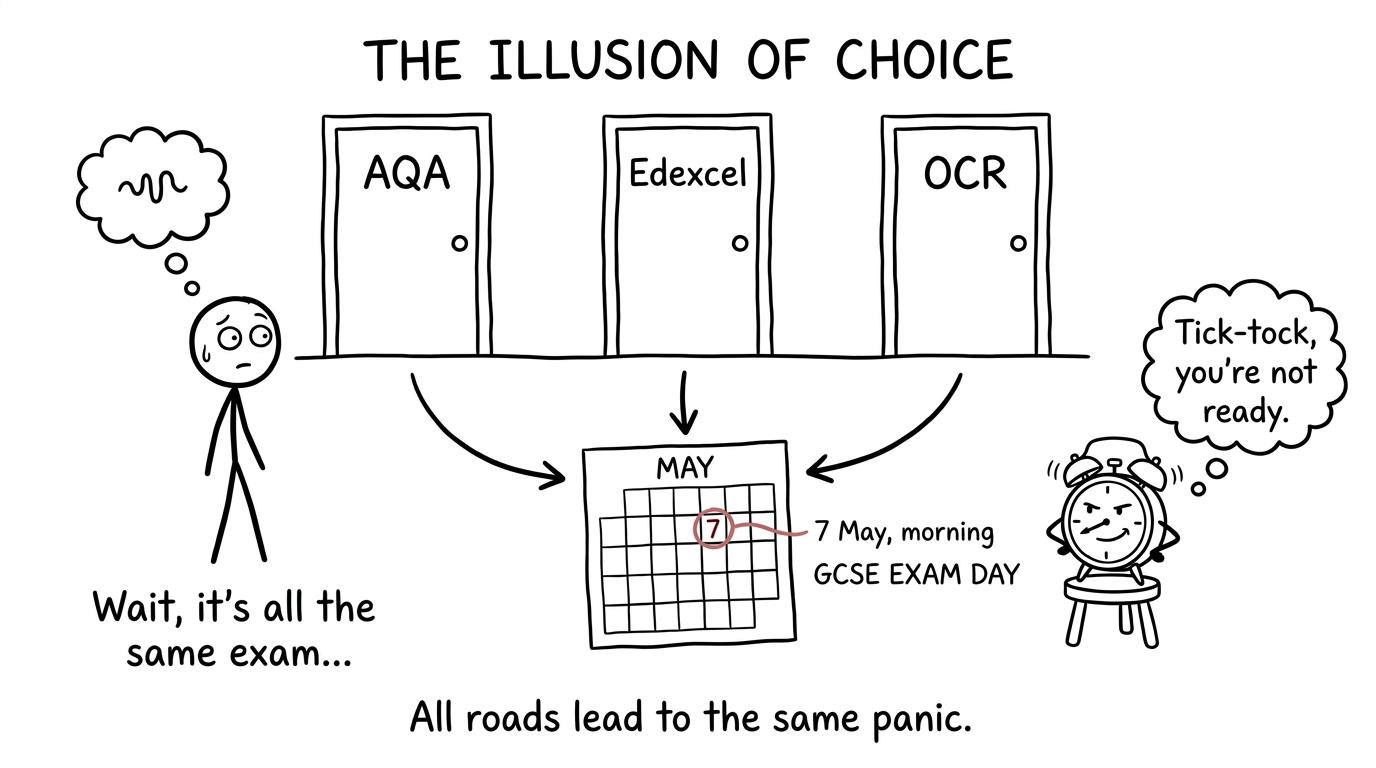 A student discovers that the three exam-board doors lead to the same calendar date
GCSE Psychology Paper 1 dates by exam board
The shared date does not mean the papers were identical. Each specification used different content, marks and timings.
| Exam board | Paper and code | Date and session | Duration | Weighting |
|---|---|---|---|---|
| AQA | Paper 1: Cognition and behaviour, 8182/1 | Thursday 7 May 2026, morning | 1 hour 45 minutes | 50%50\%50% |
| Pearson Edexcel | Paper 1, 1PS0/01 | Thursday 7 May 2026, morning | 1 hour 45 minutes | 55%55\%55% |
| OCR | Studies and applications in psychology 1, J203/01 | Thursday 7 May 2026, morning | 1 hour 30 minutes | 50%50\%50% |
The awarding bodies’ published start time for a morning session is normally 9.00am. However, JCQ rules permit centres to begin within an authorised window, and schools may ask candidates to arrive considerably earlier for registration and seating. Never rely on the national session alone. Follow the start time printed on your personal timetable.
GCSE Psychology is not divided into foundation and higher tiers. That distinction matters in GCSE maths, but Psychology candidates following the same board sit the same paper.
What was assessed on each Paper 1
Knowing the date gives revision a deadline. Knowing the specification gives it direction.
AQA Paper 1: Cognition and behaviour
AQA Paper 1 was a 100-mark examination covering:
- memory;
- perception;
- development; and
- research methods.
Each topic formed a 25-mark section containing a mixture of multiple-choice questions, short answers and extended writing. The complete paper represented 50%50\%50% of the GCSE.
Research methods should not be treated as a small topic left until the end. It requires candidates to understand how psychological investigations are designed, how evidence is interpreted and whether conclusions are justified.
Pearson Edexcel Paper 1
Edexcel Paper 1 was worth 98 marks and represented 55%55\%55% of the qualification. It assessed five compulsory topics:
- development;
- memory;
- psychological problems;
- the brain and neuropsychology; and
- social influence.
The paper had six sections. The first five focused on the compulsory topics, while the final section contained extended open-response questions about debates and relationships between areas of psychology. Knowledge of investigations could also be drawn into the assessment.
OCR Studies and applications in psychology 1
OCR Component 01 was a 90-mark paper worth 50%50\%50% of the GCSE. Its content included:
- criminal psychology;
- development;
- psychological problems; and
- research methods.
The paper contained short and medium-tariff questions alongside an extended 13-mark response. OCR also includes synoptic assessment, so candidates need to connect ideas rather than remember each study as an isolated collection of names and findings.
What to have ready before the exam
Good preparation removes decisions from exam morning. The objective is not to predict every question. It is to make sure avoidable problems cannot compete for your attention.
Confirm the correct paper
Write down your board, component code, room, seat number if supplied, arrival time and finish time. Psychology Paper 1 content varies substantially between boards, so revising a topic list found online without checking the specification can waste valuable time.
Also check whether another examination falls on the same day. If there is a timetable clash, your exams officer will arrange the appropriate supervision. Do not try to solve a clash informally yourself.
Pack permitted equipment
JCQ guidance says candidates should write clearly in black ink. A sensible kit includes:
- two or more working black ink pens;
- a sharpened pencil;
- an eraser;
- a ruler;
- an approved calculator in working order;
- a transparent pencil case; and
- a clear, label-free water bottle if your centre permits one.
AQA, Edexcel and OCR permit calculators in their GCSE Psychology assessments. Check the calculator before the exam, clear prohibited stored information and remove any cover containing instructions. Your school may provide some equipment, but that is something to confirm rather than assume.
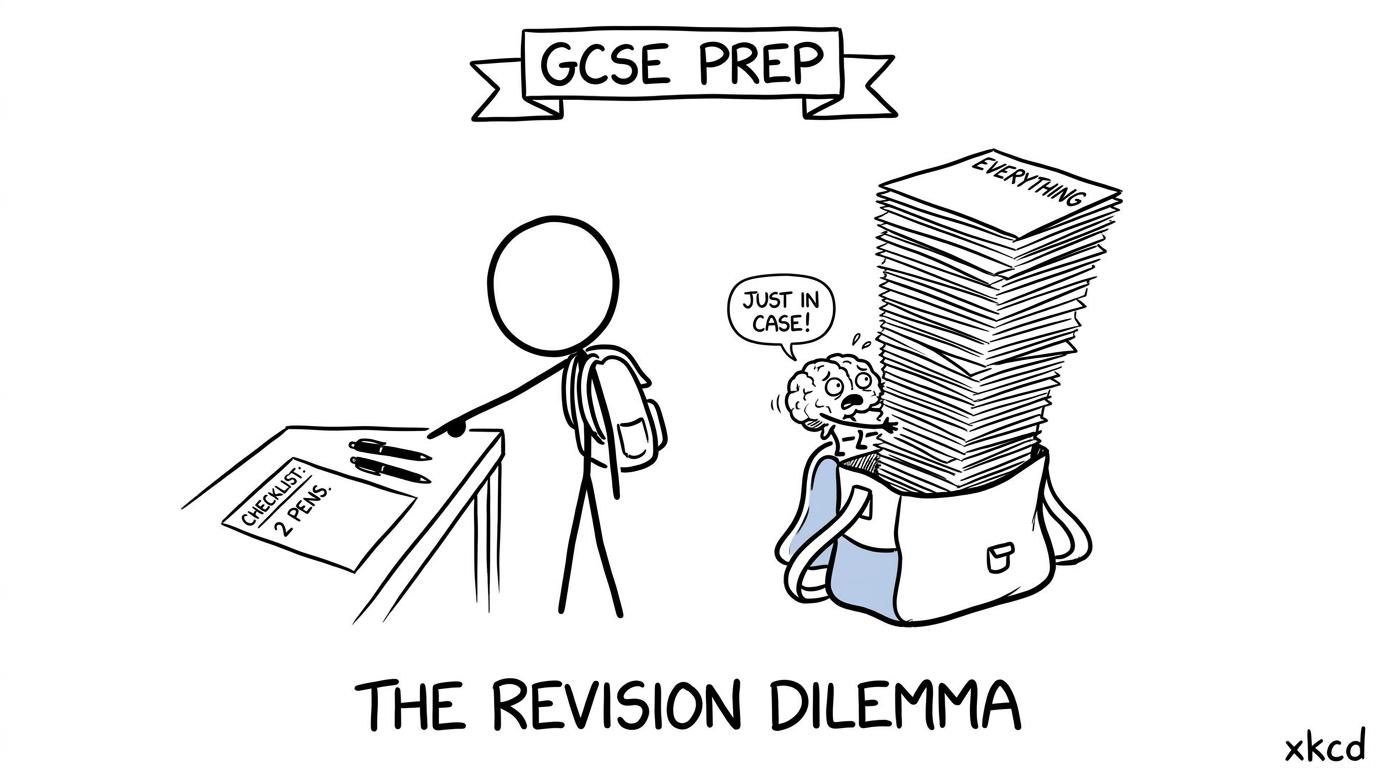 A cartoon brain attempts to add an enormous pile of notes to a neatly packed exam bag
Leave unauthorised items outside
Phones, all types of watches, earbuds, notes and other smart devices must not be on your person in the examination room. Switching a phone to silent does not make it permitted. Follow your centre’s process for storing belongings and check your pockets before entering.
This is one of those rules that seems obvious until a rushed morning makes it less obvious. Pack once, check once and remove the uncertainty.
Do not overlook the maths in Psychology
Psychology examines behaviour, but its evidence is often numerical. Depending on the specification and question, students may need to interpret tables and graphs, compare data, work with averages, understand range or complete calculations linked to research methods.
That makes a short maths refresher worthwhile. MathsGenie’s free GCSE Maths revision hub lets you select the appropriate exam board and revisit statistical or numerical skills without beginning an unfocused tour of the entire maths specification.
If a graph, percentage or average has caused problems in practice, use the guide to finding your weakest GCSE topics to diagnose the exact issue. Then complete a small set of questions and check the solution immediately.
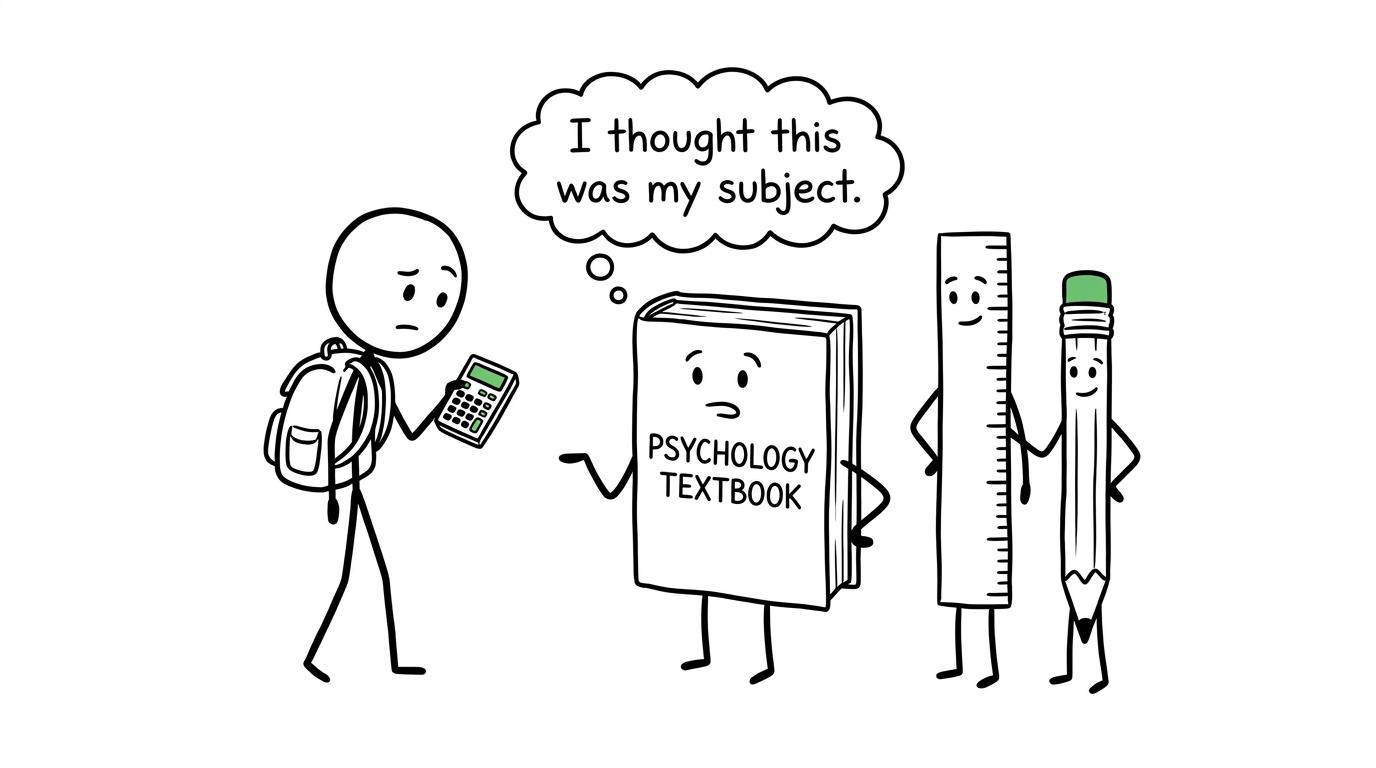 A psychology textbook is surprised to discover a calculator joining the revision session
The calculator is not a substitute for interpretation. A numerical answer must still make sense in context, and working should be shown when requested. A ruler and pencil are also useful when the paper requires a graph or diagram.
A calm final revision plan
The final stage of revision should become narrower, not louder. Start with your board’s Paper 1 topic list and classify each area as secure, uncertain or weak. Spend the most time on material that is both examinable and currently unreliable.
A practical final cycle is:
- retrieve a theory, study or research-method concept without notes;
- check the specification or class materials;
- answer an exam-style question;
- mark it using the official mark scheme;
- write one precise correction; and
- return to that correction on another day.
Do not merely count completed questions. Identify whether a lost mark came from missing knowledge, weak application, unsupported evaluation, an inaccurate calculation or misunderstanding the command word.
You can organise this alongside your other subjects with the free MathsGenie revision planner. If maths is competing for time, the GCSE maths revision timetable guide explains how to build repeatable sessions rather than relying on last-minute bursts.
The night before, avoid attempting to relearn the whole Psychology course. Review a short error list, retrieve key studies and definitions, pack your equipment and stop at a sensible time. The same restrained approach is explored in the GCSE maths night-before plan.
Common mistakes before and during Paper 1
Revising the wrong board’s topics
AQA, Edexcel and OCR all used the same date, but they did not assess the same Paper 1 content. Check the board and component code before using any revision list.
Assuming morning means the same start time everywhere
The nationally published session was morning, but your centre controlled its operational timetable within the rules. Use the arrival time given by your school.
Memorising studies without preparing to apply them
A familiar name does not guarantee marks. Practise explaining how evidence relates to the scenario, question or claim being assessed.
Ignoring research methods and numerical skills
Research methods can involve calculations, data interpretation and graphs. Prepare your calculator and revisit weak numerical skills before the examination.
Completing practice without marking it
An unmarked paper records effort but provides little direction. The guide to using GCSE past papers properly explains the more useful cycle: complete, mark, repair and retest.
Cramming instead of preparing
Packing equipment, confirming the room and protecting sleep may feel less ambitious than another hour of notes. Yet these actions protect the knowledge you have already built. The GCSE exam-week checklist provides a calm routine that can be adapted across subjects.
Turn the date into a practical plan
The answer is clear: GCSE Psychology Paper 1 for AQA, Pearson Edexcel and OCR was scheduled for the morning of Thursday 7 May 2026. The next step is equally clear: match your revision to the correct specification, prepare permitted equipment and practise responding under the relevant time limit.
MathsGenie remains your free home for the mathematical side of GCSE preparation. Use its revision lessons and practice questions to repair individual skills, then build accuracy through mini tests, Edexcel GCSE Maths past papers, mark schemes and video solutions. Closer to a maths examination, GCSE predicted papers can provide fresh timed practice.
An exam date is not a source of confidence by itself. It is simply a fixed point. Confidence comes from using the time around it deliberately.











