GCSE Maths Revision: Silence or Noise?
GCSE maths revision silence or noise? Explore the evidence on music, lyrics and focus, then build a practical routine for effective exam practice.
A difficult maths question can make every sound feel louder. A conversation downstairs, a notification across the room, even the chorus of a song you have heard a hundred times can suddenly compete with the numbers on the page.
So, for GCSE maths revision, silence or noise, which is better? The most useful answer is this: silence is the safest default for demanding maths and timed papers, while quiet, predictable background sound may help some students begin or sustain less demanding practice. Music with lyrics and changing, attention-grabbing noise are generally the riskiest choices.
This is not a contest between people who love playlists and people who demand library silence. The real question is whether your sound environment helps you produce accurate mathematical work, not merely whether revision feels more pleasant.
The quick revision checklist
Use this as your starting point:
- Choose silence for unfamiliar topics, multi-step problems and timed papers.
- Avoid music with lyrics when reading questions or holding several steps in mind.
- If silence feels uncomfortable, try quiet instrumental music or a steady neutral sound.
- Keep the volume low enough that you stop actively noticing it.
- Remove unpredictable sounds, especially conversations and notifications.
- Practise some full papers in conditions resembling the exam hall.
- Compare accuracy, time and recall rather than trusting preference alone.
The MathsGenie GCSE maths revision hub gives you topic lessons, exam questions and papers suitable for testing these different conditions.
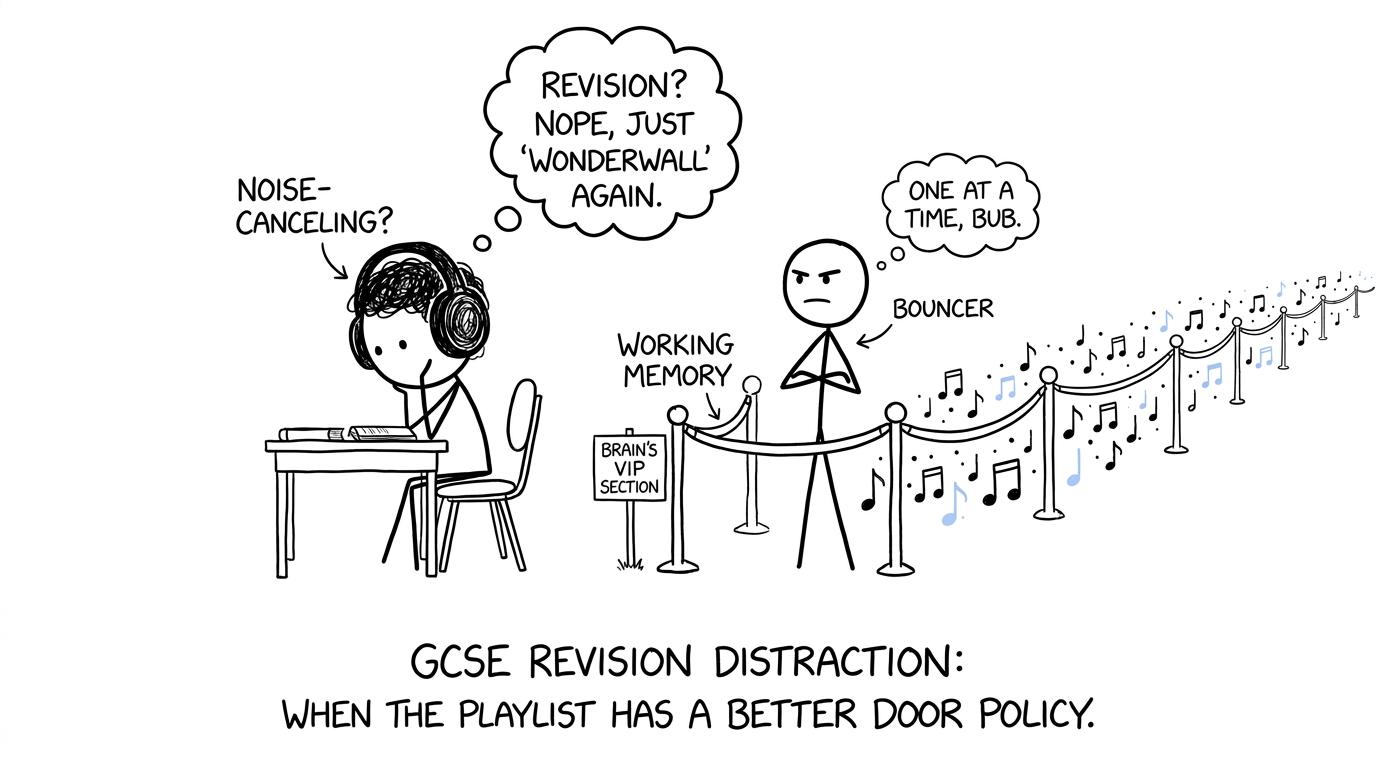 A student discovers that songs and algebra are competing for space in working memory
What the evidence says about silence and background noise
Research on background sound does not support one dramatic rule for every learner and every task. Results vary according to the type of sound, the difficulty of the activity and differences between individuals.
There is, however, a fairly consistent practical pattern. Speech, lyrics and changing sound are more likely to disrupt tasks involving reading, memory and concentrated reasoning. Quiet or steady sound is usually less disruptive, although it does not reliably improve performance for everyone.
Silence removes a source of competition
Maths frequently depends on working memory, the limited mental space used to hold information while doing something with it. When rearranging a formula, interpreting a graph or planning a geometrical argument, you may need to remember several connected details at once.
Background speech can enter that same competition. Your brain processes meaningful language even when you are not deliberately listening. That is why a nearby conversation can be more distracting than the steady hum of a fan.
Silence does not automatically teach you mathematics or guarantee concentration. It simply removes one possible demand on attention. For difficult work, that is a valuable advantage.
Music can improve mood without improving marks
A playlist may make revision feel less tiring. It can create a routine, reduce boredom or help you settle at your desk. Those benefits matter because revision that never begins cannot be effective.
But enjoyment and performance are different measurements. Experimental research on background music has produced mixed findings, with outcomes affected by volume, lyrics, familiarity, task difficulty and the learner. A student can genuinely prefer music while still completing fewer questions accurately.
This distinction is easy to miss. The song improves the experience, so it feels as though it improved the maths. Only your completed work can tell you whether that is true.
Lyrics are particularly likely to interfere
Songs with lyrics contain language. GCSE questions also contain language, including crucial commands such as “show that”, “estimate”, “prove” and “give a reason”. If your attention follows the song for even a moment, you can miss a condition or lose the thread of a calculation.
Familiar lyrics are not necessarily harmless. Knowing a song well may make it easier to ignore, but it can also make your mind anticipate the next line. Instrumental music removes this verbal competition, though dramatic changes in tempo or volume may still capture attention.
White noise is not a universal concentration tool
Claims that white, pink or brown noise will automatically improve concentration are stronger than the evidence justifies. Steady sound can mask unpredictable household or traffic noise, and some students find that useful. For others, it becomes another irritation.
Treat neutral noise as an environmental tool, not a cognitive shortcut. If it hides disruptive sounds and your performance remains strong, it may be helpful. There is no reason to force it into a quiet room simply because a revision video recommends it.
Why the best choice changes with the maths task
“Revising maths” covers several very different activities. Watching a familiar revision lesson is not mentally identical to attempting an unseen higher-tier problem.
Learning an unfamiliar method
Use silence, especially when the lesson contains several linked steps. Pause the explanation, reproduce the method without looking, then attempt practice questions.
The goal is not to let a video wash over you. It is to build a method that can later be retrieved independently. If you are unsure where to begin, use the structured approach in the guide to finding your weakest GCSE topics.
Completing routine practice
Quiet instrumental music may be workable when you are practising a familiar skill and trying to build fluency. Examples include straightforward arithmetic, basic substitution or repeating a method you already understand.
Stop the music if you begin rereading questions, making avoidable errors or losing track of written steps. Greater difficulty should usually mean fewer competing sounds.
Marking and reviewing errors
Marking needs more attention than students often give it. You must compare your work with a mark scheme, identify the exact point of failure and decide what to change next time.
Silence is valuable here because the purpose is diagnosis, not administration. A cross on the page tells you very little. A specific note such as “used the diameter instead of the radius” gives you something to repair.
The twenty-minute GCSE maths revision routine shows how short practice, marking and error review can fit into one focused session.
Sitting past and predicted papers
Do full timed papers in silence wherever possible. Joint Council for Qualifications rules require appropriate exam-room conditions and attention to internal and external noise. Candidates cannot use ordinary earbuds to create a personal soundtrack in the exam hall, except where an authorised access arrangement applies.
This makes quiet paper practice valuable for two reasons: it tests your mathematics and rehearses the environment in which you must eventually use it.
Use Edexcel GCSE maths predicted papers for unseen practice, alongside official past papers appropriate to your exam board and tier. Predicted papers should complement past papers, not replace them.
 A quiet mock paper competes with an unnecessarily ambitious home marching band
How to find your best revision environment
Preference is useful information, but it is not proof. Run a small, fair comparison instead.
Choose two sets of questions that are similar in topic and difficulty. Complete one in silence and the other with your normal background sound. Keep the session length, time of day and access to notes as similar as practical.
Record:
- the number of marks earned;
- the time taken;
- avoidable errors;
- how often you reread a question;
- how much you remember the following day.
Repeat the comparison on more than one occasion. A single session can be distorted by tiredness, question difficulty or mood. You are looking for a pattern.
Do not reduce the decision to total marks alone. If both conditions produce the same mark but one takes noticeably longer, the slower environment may still be interfering. Equally, sound that helps you begin routine practice could remain useful even if you switch it off for demanding questions.
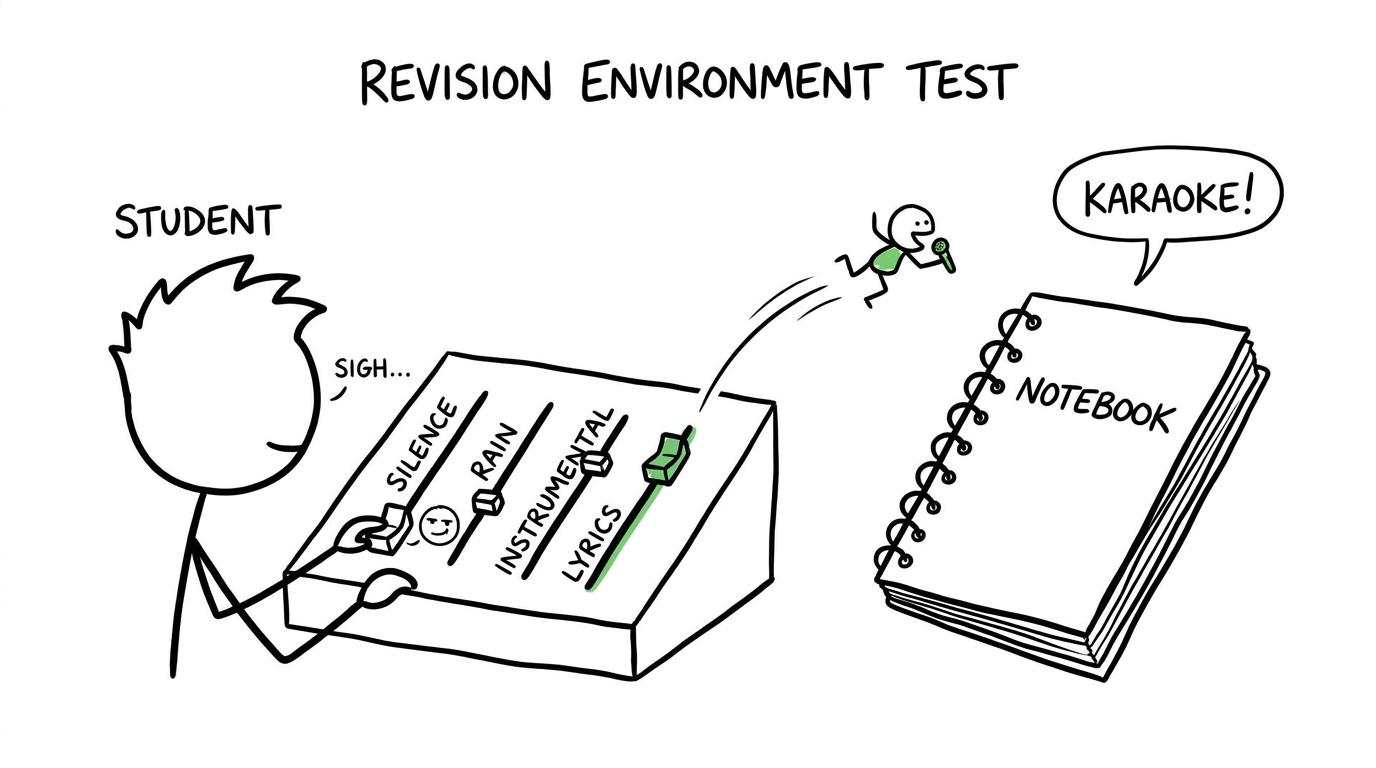 A student conducts a highly scientific investigation into silence, rain sounds and unexpected karaoke
Build a sound strategy rather than one rigid rule
A sensible revision session can change conditions as the work changes:
- Settle: use a quiet instrumental track for a few minutes if it helps you begin.
- Learn: switch to silence for a new revision lesson or difficult explanation.
- Practise: keep silence for demanding questions; use low, neutral sound only for secure skills.
- Test: complete mini tests and papers in quiet exam-style conditions.
- Review: mark carefully in silence and write specific corrections.
This flexible approach is more realistic than declaring that music is always good or always bad. It also fits naturally into a GCSE maths revision timetable, where topic learning, retrieval and paper practice have distinct purposes.
If your revision time is limited, the one-month GCSE maths revision plan can help organise those tasks without turning every evening into an exhausting full paper.
When silence itself feels distracting
Some students find silence uncomfortable because it makes ordinary sounds more noticeable or leaves room for anxious thoughts. The answer is not necessarily a loud playlist.
Try reducing stimulation gradually. Move from lyrical music to instrumental music, then to a steady neutral sound, and finally to short periods of silence. Noise-cancelling headphones can also reduce sound without playing audio, provided you use them safely and only during home revision.
Use a visible timer and decide the task before starting. A vague instruction such as “revise algebra” gives the mind room to wander. A defined task: one lesson followed by a short question set: gives attention somewhere to go.
For a repeatable structure, the GCSE past-paper timing guide explains how targeted practice can develop into timed full papers as exams approach.
Common mistakes when choosing revision sound
Assuming preference equals performance
Enjoying music does not prove that it helps accuracy or recall. Compare completed work under controlled conditions.
Choosing songs before choosing the task
Start with the mathematical purpose. A familiar worksheet and an unseen problem-solving paper do not place the same demands on attention.
Letting a phone control the playlist
Changing tracks, reading notifications and searching for the perfect sound can cost more focus than the music itself. Prepare audio before starting and keep the phone out of reach.
Never practising in exam conditions
If every question is completed with music, snacks and frequent pauses, silence can feel strangely uncomfortable on exam day. Build quiet timed practice into your routine well before the first paper.
Focusing on sound while ignoring bigger problems
Background noise matters, but it cannot rescue passive revision, unsuitable questions or weak marking. The largest gains usually come from attempting mathematics, checking it and repairing specific errors. The MathsGenie guide for students stuck at a pass grade explains how to build that learn-practise-mark-retest cycle.
Make the environment serve the work
There is no prize for revising in perfect silence, and no special virtue in surviving a noisy room. The aim is simpler: create conditions in which you can think clearly, write complete methods and remember what you have practised.
Begin with silence for challenging maths. If a low, predictable background sound helps you settle or complete routine work without reducing accuracy, use it deliberately. Keep lyrics away from language-heavy questions, and make quiet timed papers a regular part of your preparation.
Then let the work provide the evidence. Open the free MathsGenie GCSE maths resources, choose a revision lesson or practice set, and test your environment honestly. Progress from practice questions and mini tests to past papers and predicted papers, using mark schemes and video solutions to turn each lost mark into a clear next step.