

GCSE Maths Numeracy: A Calm 3-Day Revision Plan
GCSE maths numeracy last minute revision plan: a calm three-day schedule using targeted practice, honest marking and exam-ready habits for better marks.
The exam is three days away. Your notes seem to have multiplied overnight, every forgotten topic feels urgent, and opening a full paper only makes the clock sound louder.
Here is the useful answer first: a GCSE maths numeracy last minute revision plan should not attempt to cover everything. Spend day one diagnosing and repairing core number skills, day two practising mixed questions under time pressure, and day three consolidating mistakes while protecting your sleep. The aim is not to become a different student in three days. It is to collect more of the marks already within reach.
MathsGenie gives you the structure: free GCSE maths revision resources, topic lessons, practice questions, mini tests, past papers, mark schemes and video solutions. Your job is to use fewer resources more deliberately.
Your three-day revision checklist
Keep this checklist visible throughout the plan:
- Confirm your exam board, tier, paper and calculator rules.
- Diagnose weaknesses using questions rather than feelings.
- Prioritise fractions, percentages, ratio, measures, estimation and data.
- Learn briefly, then spend longer answering questions.
- Mark every set immediately and record why marks were lost.
- Revisit mistakes the following day without looking at the solution.
- Pack your equipment and stop heavy revision early on the final evening.
If you are unsure what belongs on your paper, use the GCSE maths topics by exam board and tier guide before starting. Edexcel, AQA, OCR and Eduqas specifications cover broadly shared mathematical content, but their paper structures and presentation differ.
In Wales, “Numeracy” may also refer to a specific WJEC qualification. Students beginning the new made-for-Wales course from September 2025 take GCSE Mathematics and Numeracy as a Double Award, with units organised differently from GCSE maths in England. Check your timetable, unit and school guidance rather than assuming every paper has the same format.
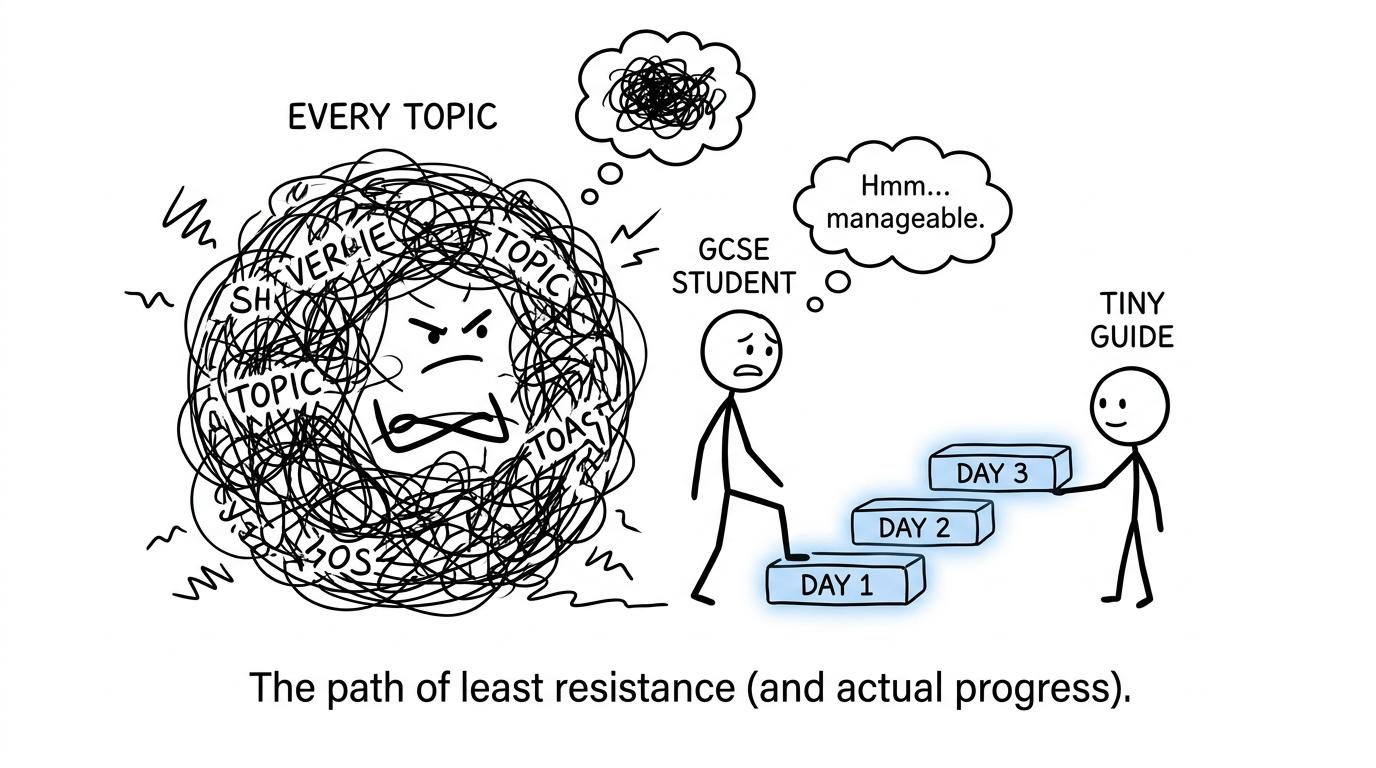 A student chooses three calm revision steps instead of tackling every topic at once
Day one: find the marks that are leaking
Panic usually says, “I know nothing.” A marked set of questions gives a more precise answer: perhaps you can calculate percentages but misread percentage change, or understand averages but forget to use the frequency column. Precision makes the problem smaller.
Begin with a short diagnostic
Choose a mini test, a mixed section from a paper, or around 404040 minutes of exam-style questions. Match the resource to your board and foundation or higher tier. The Edexcel GCSE maths mini tests are useful for short, focused practice; students on other boards should choose equivalent material from their board area.
Work without notes. Use a calculator only if it will be permitted on that paper. If a question stops you for more than a couple of minutes, circle it and continue. You are gathering evidence, not trying to create a perfect score.
Mark the set immediately. For every lost mark, label the cause:
- Knowledge: you did not know the method.
- Selection: you knew several methods but chose the wrong one.
- Accuracy: arithmetic, signs or calculator input caused the error.
- Communication: working, units or interpretation were missing.
- Timing: you rushed or stayed too long on one question.
The guide to finding your weakest GCSE topics explains how to turn paper evidence into a short repair list.
Repair the numeracy foundations
Choose no more than three weaknesses. For a numeracy-heavy paper, the strongest priorities are usually:
- fractions, decimals and percentages;
- ratio, proportion and scale;
- rounding, estimation and bounds where required;
- money, rates and compound measures;
- units and conversions;
- averages, tables, charts and interpreting data.
Refresh each method using one short revision lesson or video. Then close the explanation and answer practice questions. Revision becomes useful when you retrieve and apply a method, not when you recognise it on a screen.
Keep a small recall sheet containing relationships you repeatedly need, such as:
percentage change=changeoriginal amount×100%\text{percentage change}=\frac{\text{change}}{\text{original amount}}\times 100\%percentage change=original amountchange×100% mean=totalnumber of values\text{mean}=\frac{\text{total}}{\text{number of values}}mean=number of valuestotal speed=distancetime\text{speed}=\frac{\text{distance}}{\text{time}}speed=timedistanceDo not build a decorative formula poster. Write only the facts that your diagnostic showed you were failing to recall or use correctly.
Day two: turn methods into exam decisions
Knowing a method in isolation is different from recognising it inside a worded problem. Day two is about that gap.
Re-test yesterday’s repairs
Begin with a few fresh questions on the three topics repaired on day one. Do not look at your notes first. If the method now works, keep moving. If it fails again, compare your attempt with the mark scheme or watch a video solution, then write a one-sentence instruction for next time.
For example, an instruction might say: “Use the original amount in the denominator” or “Convert both measurements to the same unit before calculating.” These are not pages of notes. They are decisions you can carry into the exam.
Complete a timed mixed section
Use a suitable section from the past-paper collection available through the MathsGenie GCSE revision hub. A full paper is worthwhile only if you have the energy and enough time to mark it properly. A carefully reviewed half-paper is better than a complete paper abandoned without feedback.
Use these exam conditions:
- Keep to the correct calculator rule.
- Put notes and solutions away.
- Show working in the answer space.
- Leave difficult questions and return later.
- Check units, rounding instructions and the required form of the answer.
Mark the work while your reasoning is still fresh. A mark scheme is not merely a score counter. It shows which stages can earn method marks and where precision matters. If you are uncertain about when longer paper practice is useful, read when to start using GCSE past papers.
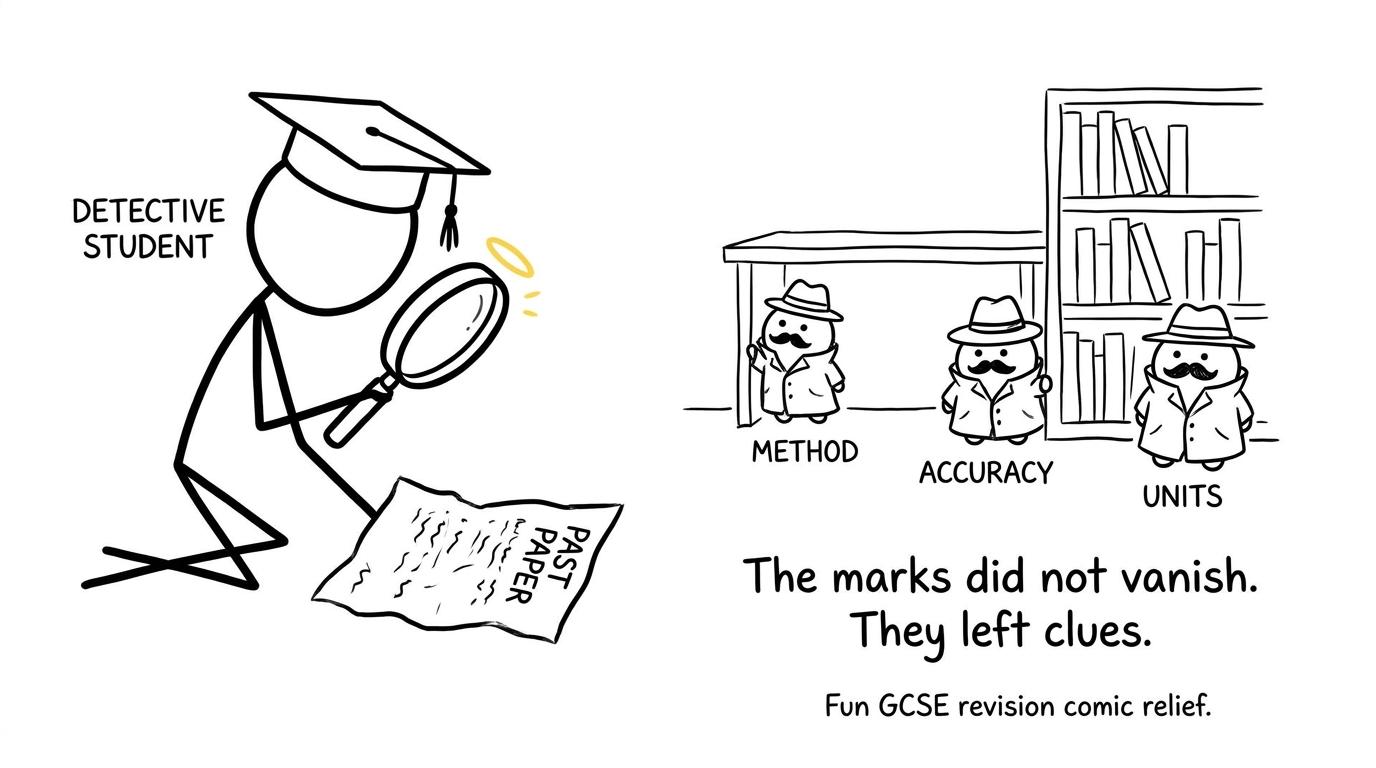 A revision detective follows clues left by method, accuracy and unit mistakes
Practise the three-pass paper strategy
Use three passes when working through a mixed set:
First pass: answer questions you recognise and can begin confidently. Secure accessible marks without racing.
Second pass: return to questions that need several stages, a diagram or more careful interpretation.
Third pass: attempt the hardest remaining questions and check completed work. Look particularly for omitted units, premature rounding, incorrect calculator mode and answers that are unreasonable in context.
Numeracy provides natural checks. A probability should normally lie between 000 and 111. A percentage decrease greater than 100%100\%100% is unlikely in an ordinary loss-of-value context. An estimated answer can expose a mistyped calculator entry before it costs the mark.
Day three: consolidate rather than cram
The final day should feel lighter. That is not laziness. It is a deliberate shift from discovering weaknesses to making reliable methods easier to retrieve.
Review your error log
Cover the corrections and try each troublesome method again. Your final list should contain a few specific reminders, not every topic in the specification.
Then complete one short mixed mini test. Mark it, repair only the most important remaining errors, and stop opening new chapters. A last-minute attempt to learn several difficult higher-tier topics can displace attention from straightforward marks in number, ratio and measures.
Predicted papers can provide useful exam-style practice near the examination, but they are not forecasts of exact questions. Use them to practise unfamiliar combinations and timing, never to decide that an omitted topic cannot appear.
Check your paper and equipment
Confirm the start time, location, exam board, tier and whether the paper permits a calculator. Pack black pens, pencils, an eraser, ruler, protractor and compasses, plus an approved calculator when required. Check that the calculator works and that you know how to clear previous entries and use brackets correctly.
For GCSE Mathematics in England, formula sheets are provided with papers in the 2026 and 2027 examination series. However, you still need to recognise when and how to use a formula. Arrangements can differ for WJEC qualifications and future series, so follow the information supplied by your school and exam board.
Use the GCSE maths exam week checklist to reduce avoidable uncertainty before the morning.
Protect the final evening
Finish heavy revision at least an hour before bed. Pack your bag, set an alarm and do something quiet. Sleep supports attention and memory; another exhausted paper is unlikely to repair what two focused days have already clarified.
If anxiety rises, reduce the task. Do not ask, “Can I master GCSE maths tonight?” Ask, “What is the next useful action?” It may be checking one formula, packing your ruler or going to bed.
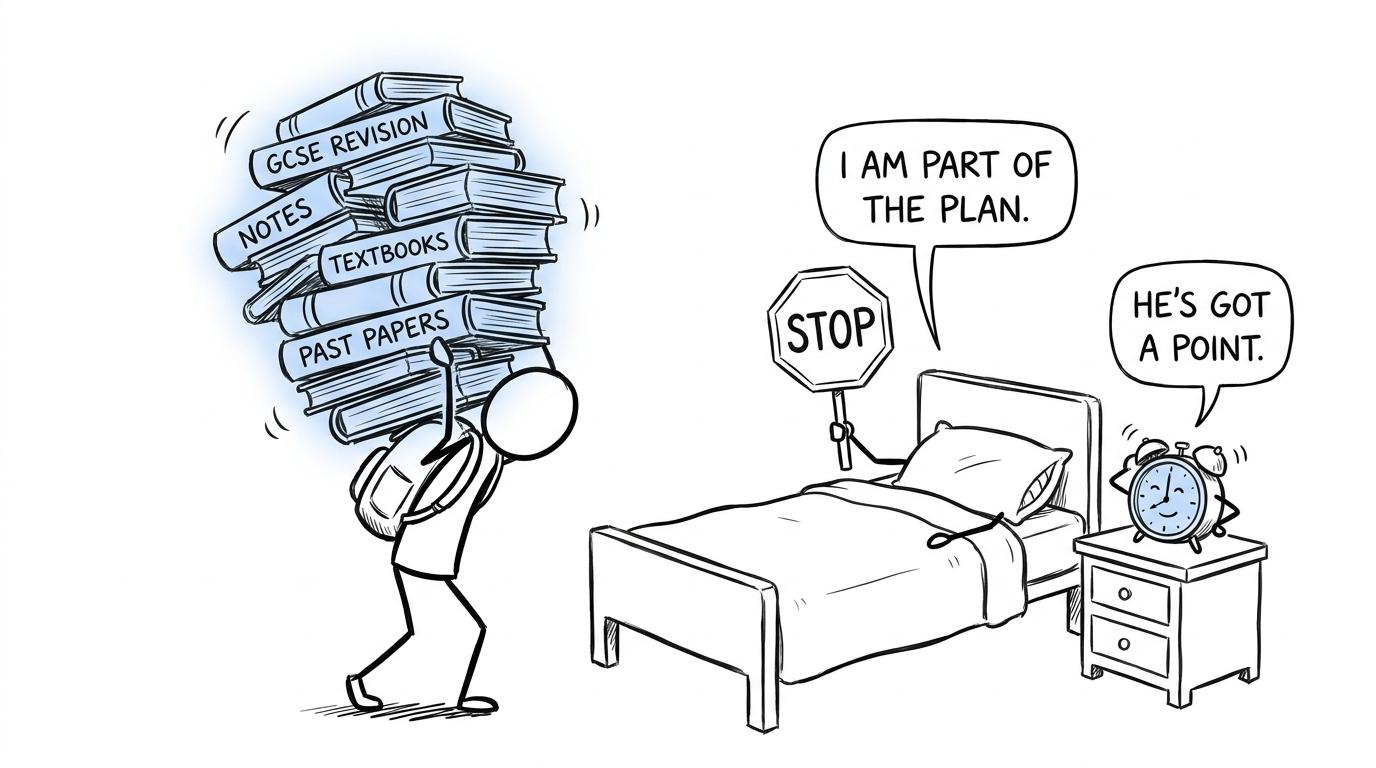 A revision book pile discovers that sleep is part of the plan
Common last-minute revision mistakes
Revising only by watching videos
A clear explanation can create the feeling of fluency. Follow every lesson with questions completed from memory. If you cannot reproduce the method independently, it is not secure yet.
Attempting every topic
Three days reward selection. Prioritise recurring foundations and weaknesses revealed by marked work. The best order for learning GCSE maths topics can help you identify which skills support several others.
Marking generously
Do not award yourself a mark because you “basically knew it”. Compare each step with the mark scheme. Honest marking now prevents surprising losses in the exam.
Repeating questions you already find easy
Confidence matters, but comfortable practice alone does not close gaps. Keep some familiar questions for momentum, then spend most of the session on repairable weaknesses.
Ignoring context and units
Numeracy questions often wrap familiar calculations inside money, measurement, timetables, graphs or rates. Underline what the answer represents, convert units before calculating and interpret the final value in context.
Sacrificing sleep for one more paper
A final paper without careful marking adds fatigue more reliably than knowledge. On the last night, consolidation and preparation are the better bargain.
Three days can still change the paper
You cannot compress months of revision into one weekend. You can make better decisions for three days: diagnose honestly, repair selectively, practise under pressure and arrive rested.
Start now at the MathsGenie GCSE maths revision centre. Choose your board and tier, use a revision lesson to repair one method, answer the practice questions, and check your work with the mark scheme or video solution. Then move to mini tests, past papers and predicted papers when you are ready to test the method under exam conditions.
The panic wants you to do everything. The plan asks you to do the next useful thing, calmly, carefully and for marks.











