GCSE Maths With No Background Knowledge: A Guide
GCSE maths no background knowledge? Learn if starting is realistic, what schools decide and how to rebuild essential skills quickly with free revision tools.
It is easy to mistake missing knowledge for missing ability. A page of fractions, algebra and unfamiliar symbols can feel like evidence that you do not belong on the course. It is not. If you are considering GCSE maths with no background knowledge, the direct answer is: yes, starting can be realistic if your school, college or exam centre will enter you, but you will need to rebuild the earlier foundations alongside the GCSE content.
There is no shortcut that makes those foundations unnecessary. There is, however, a much shorter route than trying to relearn every maths lesson you have ever missed. Diagnose the gaps, repair the skills that unlock other topics, and move gradually from guided practice to exam questions.
Your starting checklist
Before planning revision, confirm five things:
- Your exam board: usually Edexcel, AQA, OCR or Eduqas.
- Your tier: foundation or higher.
- Your exam series and entry arrangements: ask your school, college or approved exam centre.
- Your present level: identify what you can do without notes.
- Your available time: count realistic weekly sessions, not imaginary perfect days.
The GCSE Maths revision hub lets you choose your exam board and access free revision lessons, practice questions, papers and solutions. If you are unsure how the specifications compare, the GCSE Maths topics by exam board and tier guide provides a useful map.
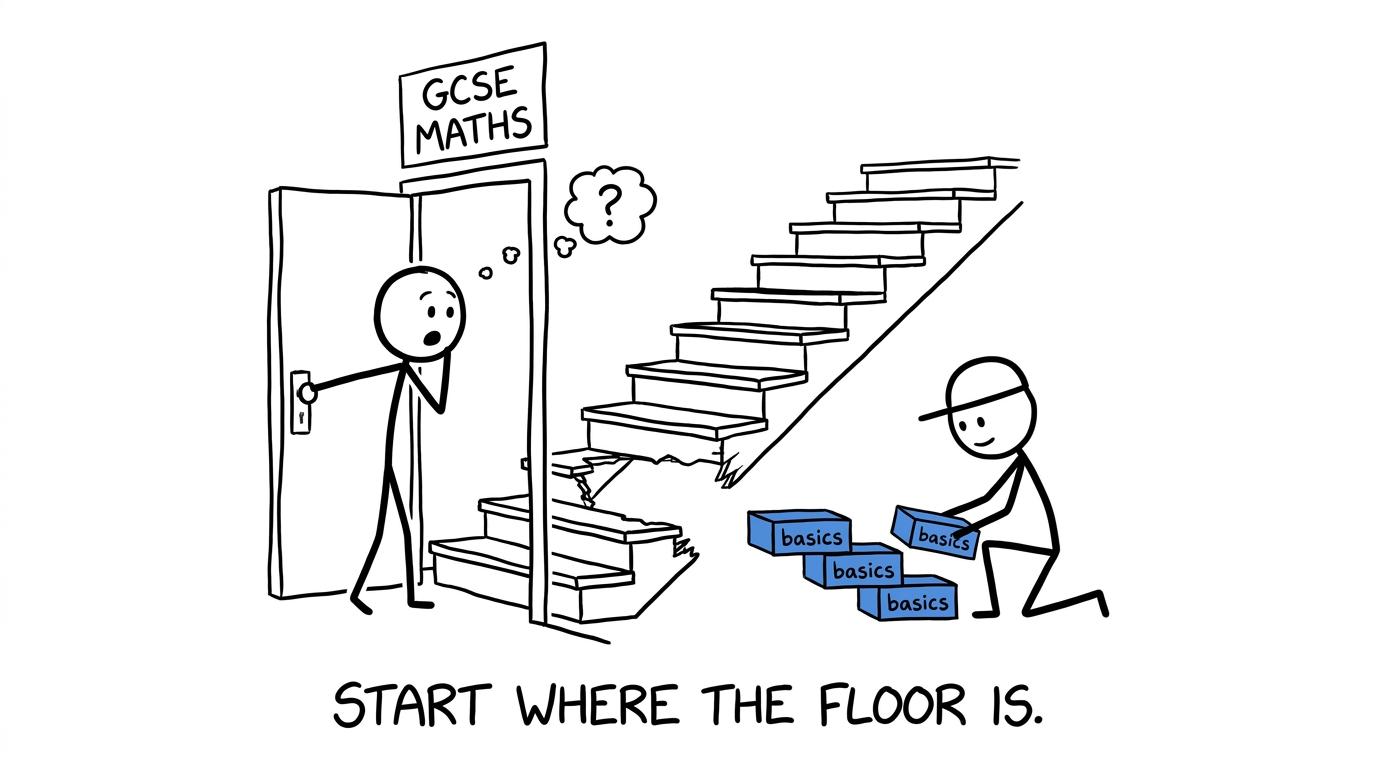 A student calmly rebuilding the missing first steps towards GCSE Maths
Can you actually take GCSE Maths without the usual foundations?
GCSE Maths does not normally require you to hold an earlier formal maths qualification before being entered. Private candidates may also prepare independently and sit the examinations through an approved centre. However, that does not mean every school or centre must accept every proposed entry.
If you attend school, the school decides whether to enter you and which tier is appropriate. It may consider your present attainment, preparation time and ability to access the course. If you are entering privately, the centre may set its own administrative conditions, deadlines and fees. Confirm these arrangements directly rather than assuming that online revision automatically creates an examination entry.
Academically, GCSE Maths builds upon knowledge normally developed through primary school and Key Stage 333. The specification expects you to work with number, algebra, ratio and proportion, geometry and measures, probability, and statistics. Those areas are connected. Weak multiplication skills can obstruct fractions; insecure fractions can obstruct ratio, probability and algebra.
So the honest answer has two parts:
- You can begin without the usual background. Your previous route does not define your ceiling.
- You cannot permanently skip the background. The essential parts must become the first stage of your GCSE preparation.
Foundation or higher tier matters
In GCSE Maths in England, foundation tier offers grades 111 to 555. Higher tier normally offers grades 444 to 999, with a narrow grade 333 safety net for candidates who fall just below grade 444. A grade 444 or 555 has the same value whether it is achieved on foundation or higher tier.
Higher is not automatically the more ambitious choice. It includes more content, places greater weight on algebra, and expects more reasoning and problem solving. Foundation gives greater space to number, ratio and standard techniques. For someone rebuilding substantial gaps, foundation may provide the clearest route to a secure result, although the correct decision depends on your target grade and progress.
Do not choose a tier from pride or fear. Ask your teacher or centre, complete diagnostic work, and use evidence. Tier decisions should reflect the paper on which you can earn the most marks reliably.
What background knowledge should you rebuild first?
Trying to cover the specification alphabetically is inefficient. Some skills act like hinges: once they move freely, several other doors open.
Number fluency
Begin with place value, the four operations, negative numbers, multiplication facts, factors, multiples and order of operations. You should be able to estimate before calculating and recognise when an answer is unreasonable.
Calculator use does not remove the need for number sense. One paper may be non-calculator, depending on the board, and calculator papers still require you to enter calculations correctly, interpret the display and round appropriately.
Fractions, decimals and percentages
These ideas appear throughout GCSE Maths. You need to compare and convert them, calculate with fractions, find percentages of quantities, and understand percentage change. They support ratio, probability, compound measures and many financial contexts.
If these skills are fragile, give them time. Repeatedly failing later topics because of an unresolved fraction gap is slower than repairing the gap once.
Ratio, proportion and units
Practise simplifying ratios, sharing in a ratio, direct proportion, scale and unit conversion. Learn to notice whether quantities should grow together, shrink together or change at different rates.
Units deserve deliberate attention. Length, area and volume conversions are not interchangeable, and many avoidable marks disappear when a correct calculation is paired with the wrong unit.
Essential algebra
Start with notation, substitution, collecting like terms, expanding brackets, solving linear equations and using formulae. Algebra can look like a separate language, but its basic grammar is small. The challenge is applying it accurately enough that it becomes familiar.
Do not rush into advanced higher-tier material merely because it looks like “real GCSE maths”. A secure linear equation is more useful than a half-remembered difficult technique.
Basic geometry and data
Rebuild angle facts, perimeter, area, coordinates, symmetry and standard metric measures. Then cover averages, charts, probability and interpreting data. Drawings and tables can reduce the reading load, but they still require careful labels and units.
How to catch up quickly without rushing
Fast progress is not the same as covering pages quickly. It means spending each session on the next skill that will make other questions easier.
Use this four-stage cycle:
| Stage | What to do |
|---|---|
| Diagnose | Attempt a short mixed test and record questions you cannot start confidently. |
| Learn | Use one revision lesson to understand the missing method. |
| Practise | Complete a focused set without copying the solution. |
| Mark and retest | Check every answer, record the error and attempt fresh questions later. |
Begin with a low-pressure diagnostic
A full paper may be too blunt when you are starting from very little. Use a mini test, half-paper or selected foundation questions instead. Your first score is not a predicted grade. It is a list of what to learn next.
Separate mistakes into four groups:
- missing knowledge;
- difficulty recognising the method;
- arithmetic or notation errors;
- exam technique, including omitted working or units.
This distinction matters. Watching another lesson will not necessarily fix a careless sign error, while doing more timed papers will not teach a method you have never met.
Use short daily sessions
A repeatable 202020-minute session can be more valuable than an occasional exhausting evening. Spend a few minutes recalling yesterday's rule, most of the session answering questions, and the final minutes marking and choosing the next action. The MathsGenie twenty-minute revision routine gives this approach a practical structure.
If an examination is close, the one-week GCSE Maths revision plan can help you prioritise. It cannot replace a full course from scratch, but it can stop limited time being wasted.
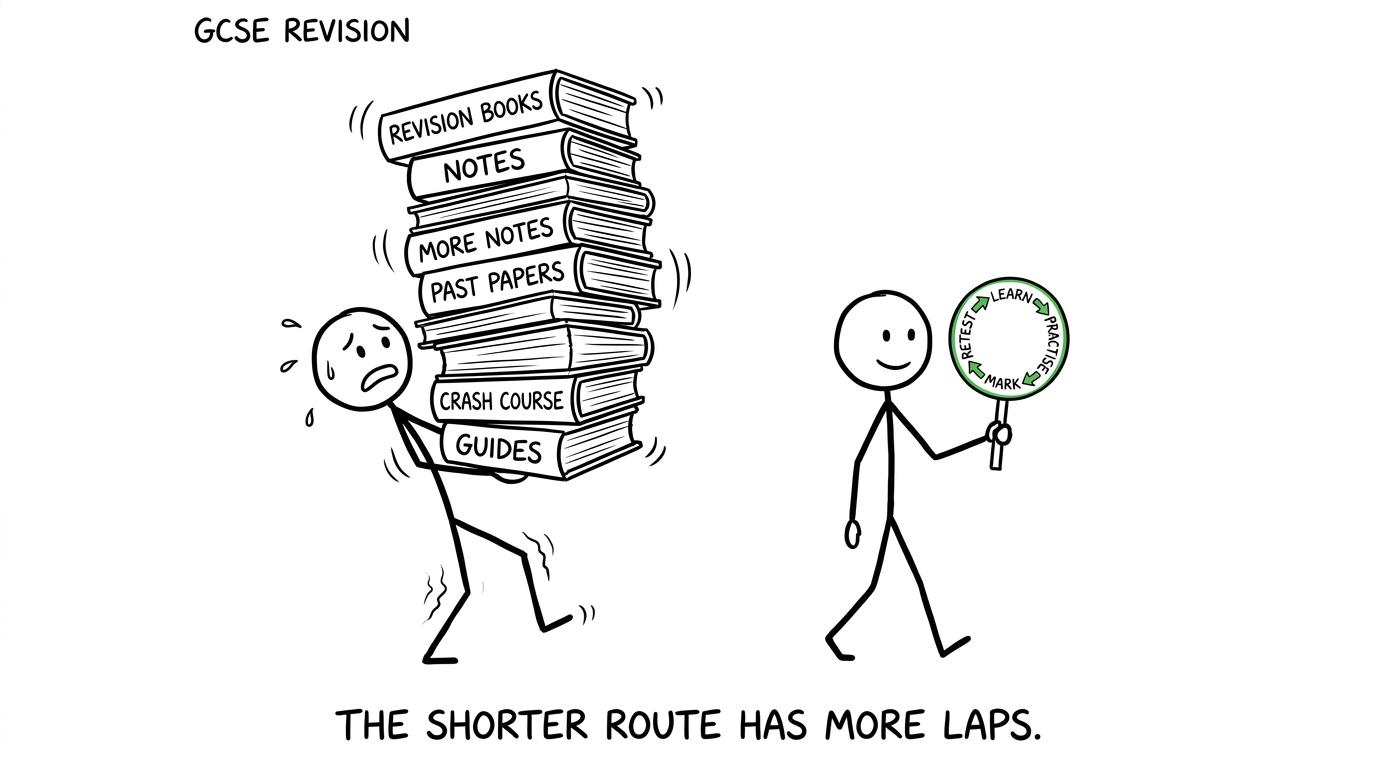 One student carries too many books while another follows a small repeatable revision loop
Build in dependency order
A sensible early sequence is:
- arithmetic and negative numbers;
- fractions, decimals and percentages;
- ratio, proportion and units;
- basic algebra and equations;
- geometry, probability and statistics;
- mixed problem solving.
This is not a rigid specification order. If your diagnostic shows that coordinates are already secure but division is not, repair division first. Your plan should respond to evidence.
Move to papers in phases
Do not wait until you feel completely ready, because that feeling may never arrive. Equally, do not spend every day completing papers that mostly contain unfamiliar material.
Begin with questions by topic. Progress to mini tests and timed sections. Once most foundation topics are recognisable, introduce full papers and use the mark scheme to identify the next gaps. The guide to when to start GCSE Maths past papers explains this phased approach.
For example, students taking Pearson Edexcel can find board-specific papers, mark schemes and available solutions in the Edexcel GCSE Maths past-paper collection. Students following another board should select that board through the main revision hub.
How to know whether you are catching up
Progress is not simply finishing more topics. Look for changes in what you can do independently:
- You can begin familiar questions without reopening the lesson.
- Your working is arranged clearly enough to check.
- The same error appears less often.
- You retain a method several days later.
- Mixed questions are becoming recognisable.
- Your timed accuracy improves without frantic rushing.
Keep a short error log. Record the topic, the exact mistake and the action required. “Bad at algebra” is not useful. “I change a sign incorrectly when rearranging equations” gives you something specific to practise.
If you are rebuilding after an earlier attempt, the GCSE Maths resit revision plan explains how to turn lost marks into a focused sequence of topics. The advice in GCSE Maths revision when stuck at a pass grade is also useful once the basics are present but progress has slowed.
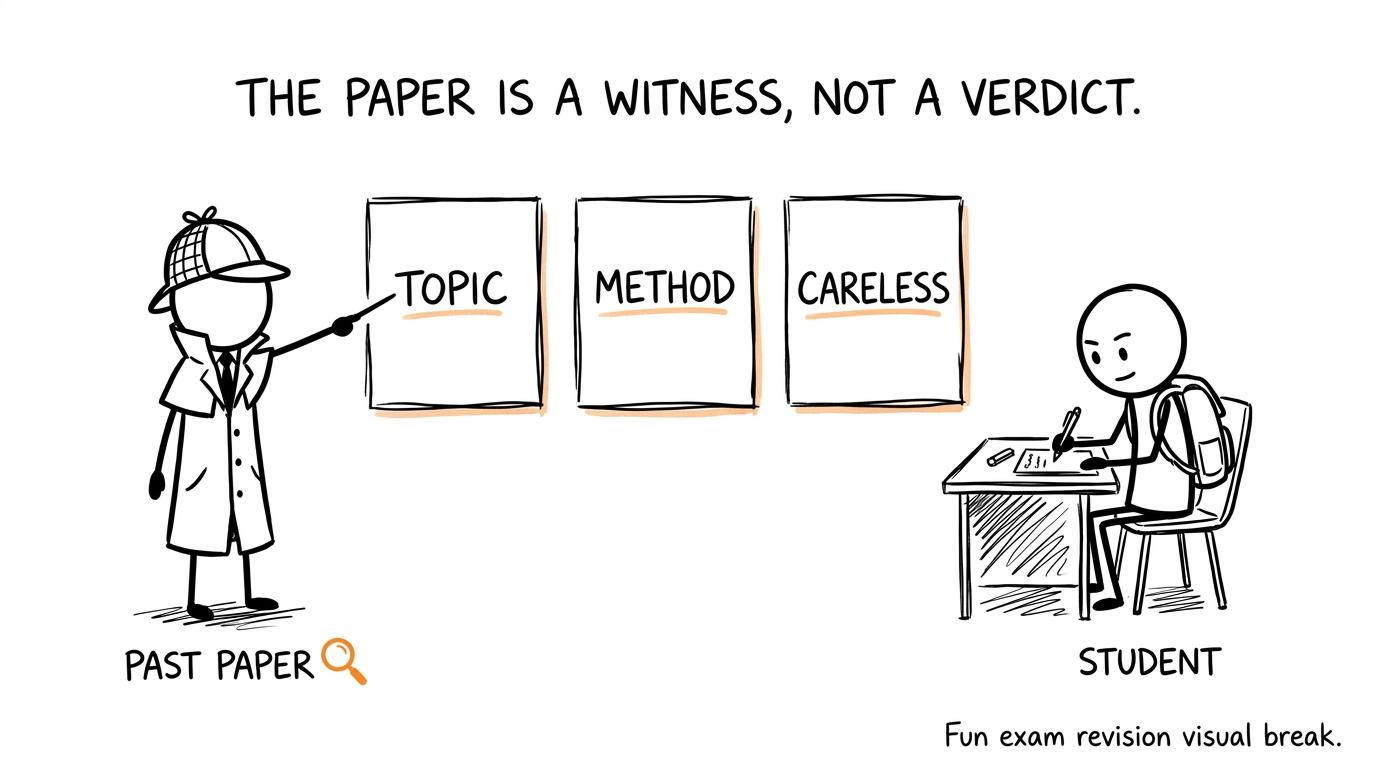 A past paper acts as a detective identifying different types of revision mistake
Common mistakes when starting GCSE Maths from scratch
Beginning with the hardest topics
Advanced topics can feel more urgent because they appear impressive. In reality, difficult questions often combine simpler skills. Build the components before attempting the combination.
Watching without practising
A clear video can create recognition, but recognition is not independent recall. Close the explanation and answer questions yourself. The struggle to retrieve a method is part of learning it.
Taking full papers too early
An early paper is useful as a diagnostic. Repeating full papers before repairing the gaps usually repeats the same blank answers. Alternate assessment with focused teaching.
Ignoring the mark scheme
A total mark tells you how the attempt ended. A mark scheme shows where credit was available. Compare your working, not only your final answer, and use video solutions when you cannot see why a method works.
Revising without checking the board or tier
Edexcel, AQA, OCR and Eduqas cover the required GCSE subject content, but their paper structures and presentation differ. Use resources suited to the specification and tier for which you are entered.
Expecting speed to replace consistency
Catching up fast still requires repetition. A method encountered once is easy to lose. Retest it after a gap, then meet it inside mixed questions.
Start from where you are, then make it visible
Taking GCSE Maths without the usual background is demanding, but it is not absurd. The decisive question is not whether your learning route looks normal. It is whether you can obtain an entry, choose an appropriate tier and build the missing foundations in a deliberate order.
Start with the MathsGenie GCSE Maths revision hub. Choose your board and tier, use revision lessons to learn one method, answer practice questions without copying, and mark every attempt. As your knowledge becomes steadier, add mini tests, past papers and predicted papers. Use mark schemes and video solutions to turn each mistake into a precise next step.
You do not need to repair your entire mathematical past in one weekend. You need to identify the next missing step and build it securely. Then build the next one.