GCSE Arabic Exam-Day Kit: Night-Before List
GCSE Arabic exam day kit checklist: pack black pens, a clear pencil case and water, while leaving dictionaries, watches and phones safely outside.
The night before an exam has a habit of making ordinary objects feel unusually important. Is one pen enough? Can you take a dictionary? Do you need the calculator already packed for tomorrow’s maths paper?
A GCSE Arabic exam day kit is refreshingly simple: take at least two working black ink pens in a transparent pencil case, a clear unlabelled water bottle if your centre permits one, and any candidate card or identification requested by your school. Keep your timetable and emergency contact details in your bag. Leave dictionaries, watches, notes and electronic devices outside the exam room.
That is the practical answer. The rest of this guide helps you avoid the small uncertainties that create unnecessary stress.
Your GCSE Arabic exam day kit checklist
Pack these items the night before:
- At least two reliable black ink or black ballpoint pens
- A transparent pencil case
- A clear water bottle with its label removed, if permitted by your centre
- Your candidate card or photo identification, if your school requires it
- Your printed timetable or a written note of the exam time, room and paper
- Any medication or approved equipment arranged through your school
- Your school’s emergency contact details
- Suitable clothing or uniform, according to your school’s rules
Before going to bed, check that you know:
- whether you are sitting listening, speaking, reading or writing
- whether your entry is Foundation or Higher tier
- the date, arrival time and room
- how you will travel to school
- who to contact if you are delayed or unwell
Your school’s instructions and the directions printed on the examination paper always take priority. Exam regulations can change, so read the current candidate information supplied by your exams officer rather than relying on an old checklist.
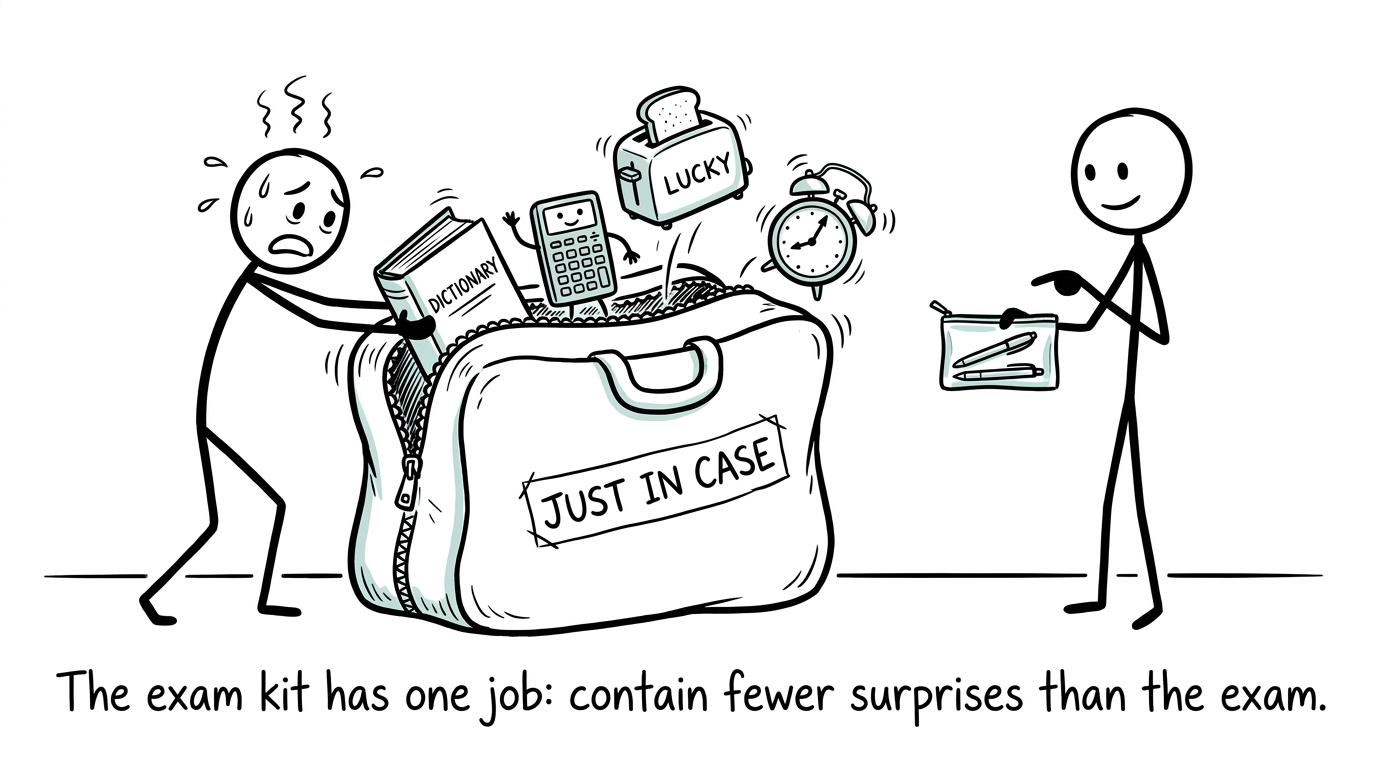 A student choosing between an enormous exam suitcase and a simple transparent pencil case
What you actually need in the examination room
Two black pens, not one heroic pen
Current JCQ candidate guidance says that written answers must be clear and completed in black ink. Pearson’s current GCSE Arabic assessment guidance also instructs candidates to use a black ink or black ballpoint pen and not to use pencil for the written papers.
Take at least two pens. Test both on scrap paper the night before and check that they write smoothly. A spare pen is not excessive preparation; it removes a predictable problem at almost no cost.
Do not plan to use erasable pens, gel pens, correcting fluid, correcting tape or highlighters in your answers. JCQ rules prohibit these. Although a highlighter may sometimes be used on wording in a question paper, it cannot be used in the answer itself. For a simple Arabic kit, leaving it out avoids confusion.
A transparent pencil case
Any pencil case taken into the examination room must be see-through. Pack only the stationery needed for that paper. A large collection of coloured pens, revision cards and miscellaneous equipment gives you more things to check and more opportunities to carry something inappropriate by accident.
GCSE Arabic is not GCSE maths. You do not normally need a ruler, protractor, pair of compasses or calculator for an Arabic paper. Keep the GCSE maths equipment and night-before routine separate so that one subject’s kit does not quietly migrate into another subject’s exam.
Water, if your centre permits it
A clear water bottle may be taken into many examination rooms, subject to your centre’s instructions. The safest choice is a transparent bottle with the label removed and a secure cap. Avoid bringing a coloured or opaque bottle.
Food is normally kept outside unless your centre has approved it for a medical reason. If you require food, medication or another adjustment, speak to the exams officer beforehand rather than trying to resolve it at the examination-room door.
Candidate information requested by your school
Your centre may ask you to bring a candidate card or identification. This is a centre procedure rather than a universal promise that every student needs the same document, so follow the instructions issued by your school.
Keep a separate note of your candidate number if your centre recommends it. You should also know the exact paper, tier and room, but wait for the invigilator’s instruction before completing the front of the question paper or opening it.
What not to put in your Arabic exam kit
A good kit is partly defined by what it excludes.
No dictionary
Dictionaries are not permitted in Pearson Edexcel GCSE Arabic assessments. That includes the preparation period for the speaking assessment. A bilingual dictionary, vocabulary book or electronic translation device must therefore remain outside.
This is one of the most important checks because bringing unauthorised material into the examination room can create a serious problem even if you did not intend to use it.
No phone, watch or smart device
Do not enter the examination room carrying a mobile phone, smartwatch, analogue watch, earbuds, smart glasses, tablet or another unauthorised device. Current JCQ instructions ban watches of every kind, not only smartwatches.
Follow your school’s process for handing in devices or storing them safely. Simply switching off a phone does not make it authorised. The least stressful option, where practical, is to leave unnecessary technology at home.
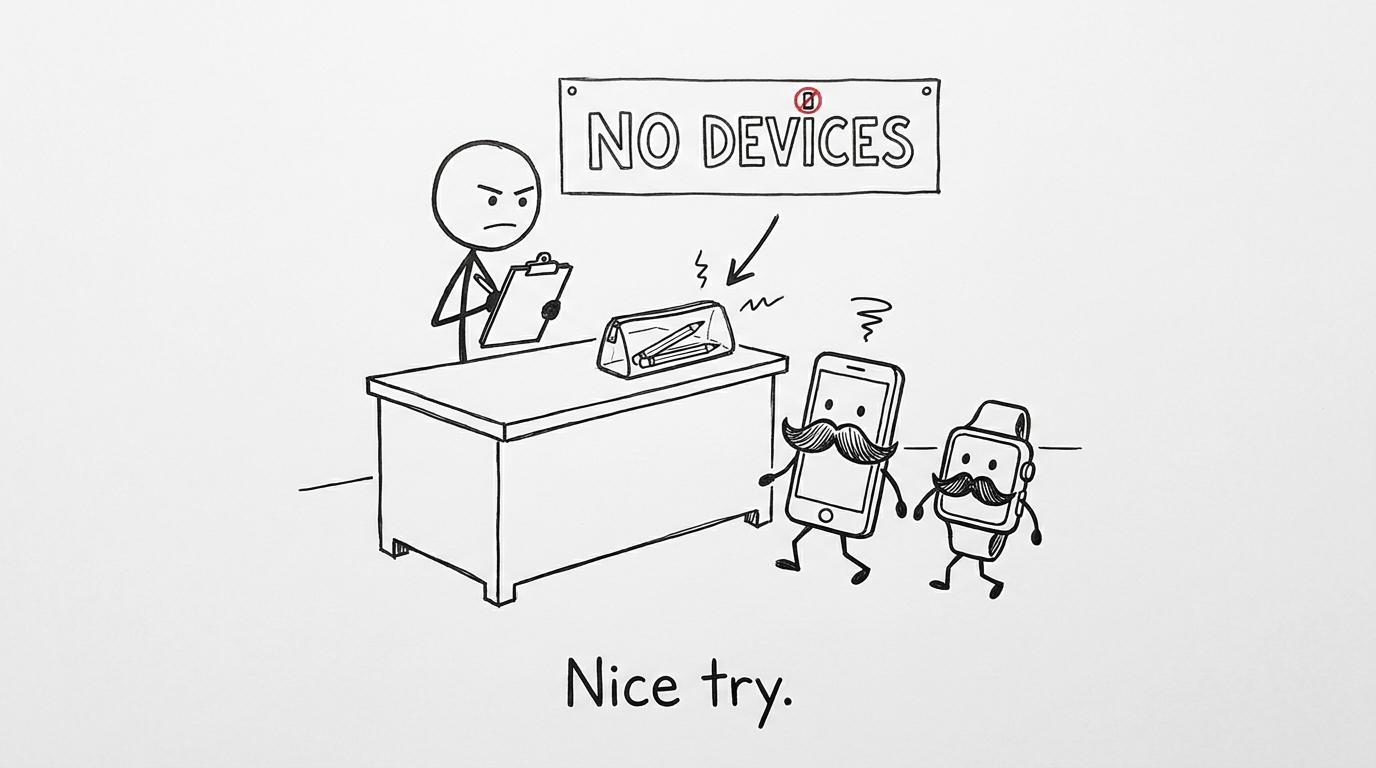 A phone and smartwatch in fake moustaches attempting to enter an examination room
No notes or homemade rough paper
Revision notes, vocabulary lists, prepared phrases and books must stay outside. Do not bring your own paper for rough work. The centre provides the official examination stationery you are allowed to use.
A useful boundary is to stop revising before you enter the formal examination area. Put your materials away properly rather than holding a final vocabulary sheet and hoping to find somewhere to leave it.
No calculator
A calculator serves no purpose in a standard GCSE Arabic paper. Leaving it out makes your desk clearer and prevents confusion over stored material, lids or instructions.
When your next examination is maths, rebuild the kit for that specific paper. The MathsGenie GCSE maths revision hub helps you choose your exam board and tier, while the wider MathsGenie resources collection includes practice papers, predicted papers and shorter revision activities.
Adjust the kit for each Arabic paper
Pearson Edexcel GCSE Arabic is assessed through four components: listening, speaking, reading and writing. Foundation and Higher tier students sit the same four broad assessment types, but the timing and demand vary. Your physical kit remains small, yet your preparation should reflect the paper in front of you.
Listening
Bring the standard black pens and listen carefully to the invigilator’s instructions. The centre provides and controls the listening equipment. Personal headphones or earbuds are not part of your kit unless your centre has made a specific approved arrangement.
If you cannot hear the recording properly or believe there is a technical problem, raise your hand promptly. Do not wait until the assessment has moved on and do not try to solve the issue yourself.
Speaking
Your centre organises the speaking assessment, recording equipment, preparation materials and supervision. Dictionaries and personal resources are not allowed. Use only the notes and materials permitted under the assessment instructions, and do not take stimulus materials away.
Because speaking assessments are arranged within a window rather than always appearing like a conventional whole-cohort written paper, check your personal appointment carefully. Confirm the time, location and arrival instructions directly with your teacher.
Reading and writing
For these papers, working black pens are the main equipment you need. Do not use a dictionary or write your answers in pencil. Follow the instructions about which language to use, because some reading responses may require English while speaking and writing assessment work is completed in Arabic.
Write clearly and keep within the answer spaces. If you need additional paper, raise your hand. The invigilator will supply the correct official sheet, which must include your candidate details.
A calm night-before routine
Packing should take minutes, not become a new revision project.
First, lay out your transparent pencil case and test both black pens. Prepare your water bottle. Place any candidate card beside your bag. Then check the timetable against your school’s latest information, including the paper, tier, room and required arrival time.
Set an alarm and plan your journey. Save the school or exams office contact number somewhere accessible outside the exam room. If you depend on public transport, allow sensible extra time.
After that, stop packing. The purpose of the routine is to close decisions, not create new ones.
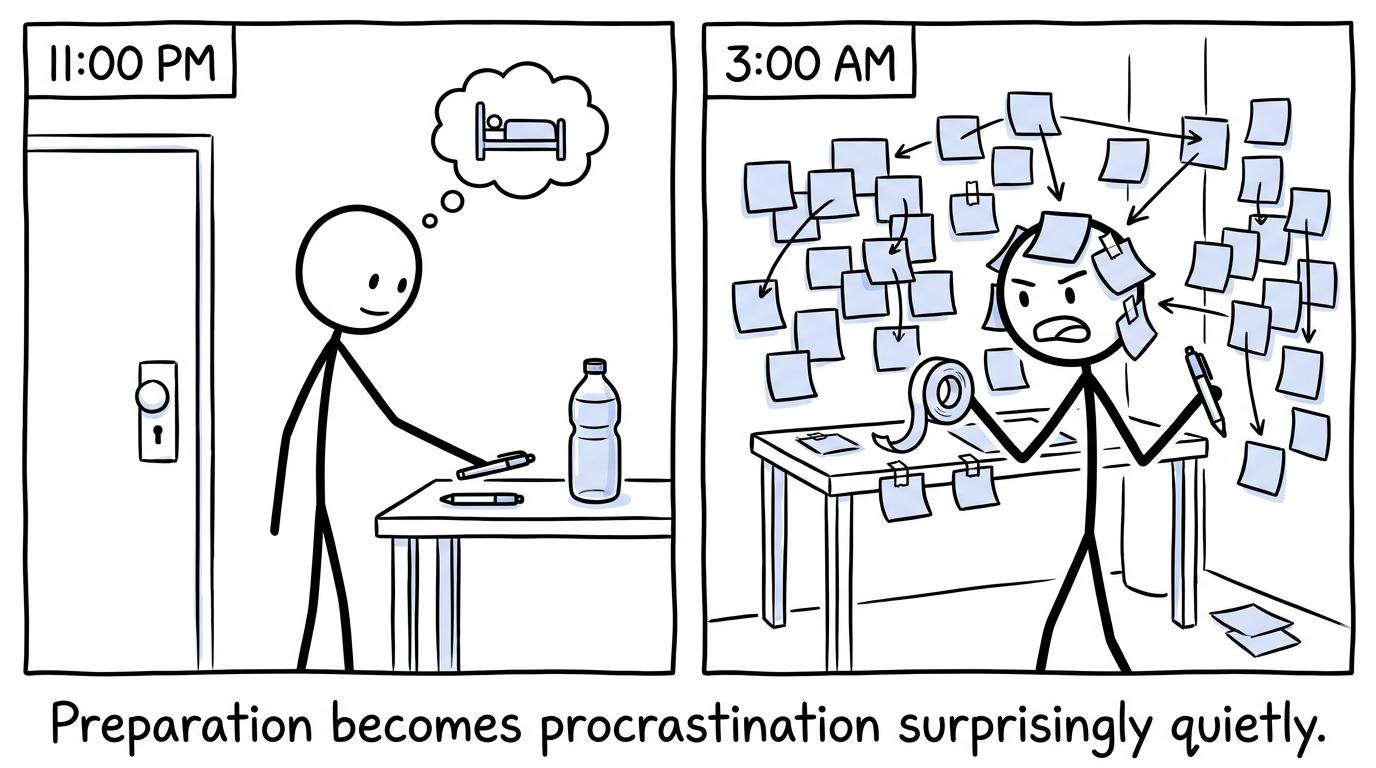 One student calmly packs two pens while another builds an elaborate revision command centre
If Arabic sits between your GCSE maths papers, use the same principle for revision: choose one useful task and finish it. A short Edexcel GCSE Maths mini test is more manageable than starting a full paper late at night. Earlier in the examination season, use the GCSE one-week revision plan to organise lessons, questions and paper practice without allowing one subject to consume every evening.
Common GCSE Arabic exam-kit mistakes
Packing a dictionary automatically
A dictionary may feel like standard language equipment, but it is not allowed in Pearson Edexcel GCSE Arabic. Remove it from your bag the night before so there is no possibility of carrying it into the room.
Bringing only one pen
Pens run out and occasionally stop working. Two tested black pens are the simplest form of insurance available to you.
Wearing a watch out of habit
All watches are prohibited under current JCQ examination guidance. Take yours off before leaving home or store it according to your centre’s procedure.
Treating a switched-off phone as acceptable
A phone remains an unauthorised device when switched off. Follow your school’s storage arrangements and never keep it in a pocket during the examination.
Confusing the maths kit with the Arabic kit
A calculator and geometry equipment belong in the appropriate GCSE maths examination, not Arabic. Keep separate checklists for each subject. When planning maths preparation, use MathsGenie’s guide to starting GCSE past papers and diagnose gaps with the weakest-topics revision method.
Trusting an old timetable screenshot
Rooms, speaking appointments and centre instructions can be updated. Check the latest information supplied by your school and ask your exams officer if anything is unclear.
Pack once, then let the kit become boring
The best GCSE Arabic exam day kit is not impressive. It is transparent, permitted and ready: two black pens, a clear pencil case, approved water and any identification requested by your centre. Everything else stays outside.
That small act of organisation matters because attention is limited. Every decision settled the night before is one less decision competing with the Arabic in front of you.
Once your Arabic kit is packed, turn to the rest of your examination timetable with the same calm structure. MathsGenie is the free place to prepare for GCSE maths through revision lessons, practice questions, mini tests, past papers, predicted papers, mark schemes and video solutions. Open the GCSE maths revision area, choose your board and tier, and make your next revision task specific. Pack what you need. Practise what you need. Then give yourself permission to stop.