

Is GCSE English Literature Hard? An Honest Answer
Is GCSE English Literature hard? Get a student-informed answer, discover what makes it difficult and learn how to revise it alongside GCSE maths.
A blank page can feel more intimidating than a difficult equation. In maths, you can often see whether the next step is substitution, factorisation or rearranging. In English Literature, the route from question to answer can feel less certain.
So, is GCSE English Literature hard? The straight answer is yes, many students find it demanding. The difficulty usually comes from remembering several texts, selecting useful evidence, building an interpretation and writing quickly under closed-book exam conditions. Yet it is not impossibly hard, and it is not a mysterious test of whether you are naturally “good at English”. Its skills can be practised.
That distinction matters. A hard subject may require consistent preparation. An unpredictable subject would leave you powerless. GCSE English Literature is demanding, but it is far more trainable than it first appears.
The short answer: how hard is GCSE English Literature?
GCSE English Literature is likely to feel hard if you:
- leave quotation and text recall until the final weeks;
- know the plot but struggle to analyse the writer’s choices;
- write slowly under timed conditions;
- try to memorise complete model essays;
- find older language, poetry or unseen texts difficult;
- revise by rereading rather than retrieving information.
It often becomes more manageable when you:
- learn a small bank of short, flexible quotations;
- organise each text by character, theme and turning point;
- practise planning answers to unfamiliar questions;
- write timed paragraphs and essays;
- use teacher feedback and official mark schemes;
- spread revision across the year.
The same principle applies to maths. Confidence rarely arrives before practice; it usually arrives because of practice. MathsGenie’s guide to stopping yourself from forgetting GCSE content explains how active recall and spaced practice can make revision stick.
What students really say about the difficulty
Student opinion is not completely one-sided. Some students enjoy having room to form an argument and find Literature more rewarding than subjects built around fixed answers. Others describe the combination of memory, interpretation and time pressure as one of the most uncomfortable parts of GCSE assessment.
Recent student-voice research gives useful context. In one survey, around 47.8%47.8\%47.8% of respondents favoured open-book English examinations, while only 15.6%15.6\%15.6% wanted English assessment to remain unchanged. Students commonly connected closed-book examinations with the burden of recalling quotations and the concern that memory could restrict the quality of their analysis.
That does not prove that every student finds Literature hard. The researchers themselves emphasised that student experiences were complex rather than uniform. Public student discussions show the same split: one student may feel overwhelmed by the poetry anthology, while another argues that a secure understanding and a selective quotation bank make it manageable.
The most honest conclusion is therefore not “everyone hates it” or “it is easy if you listen in class”. It is this: students tend to find the format difficult when recall, analysis and timed writing have to happen simultaneously.
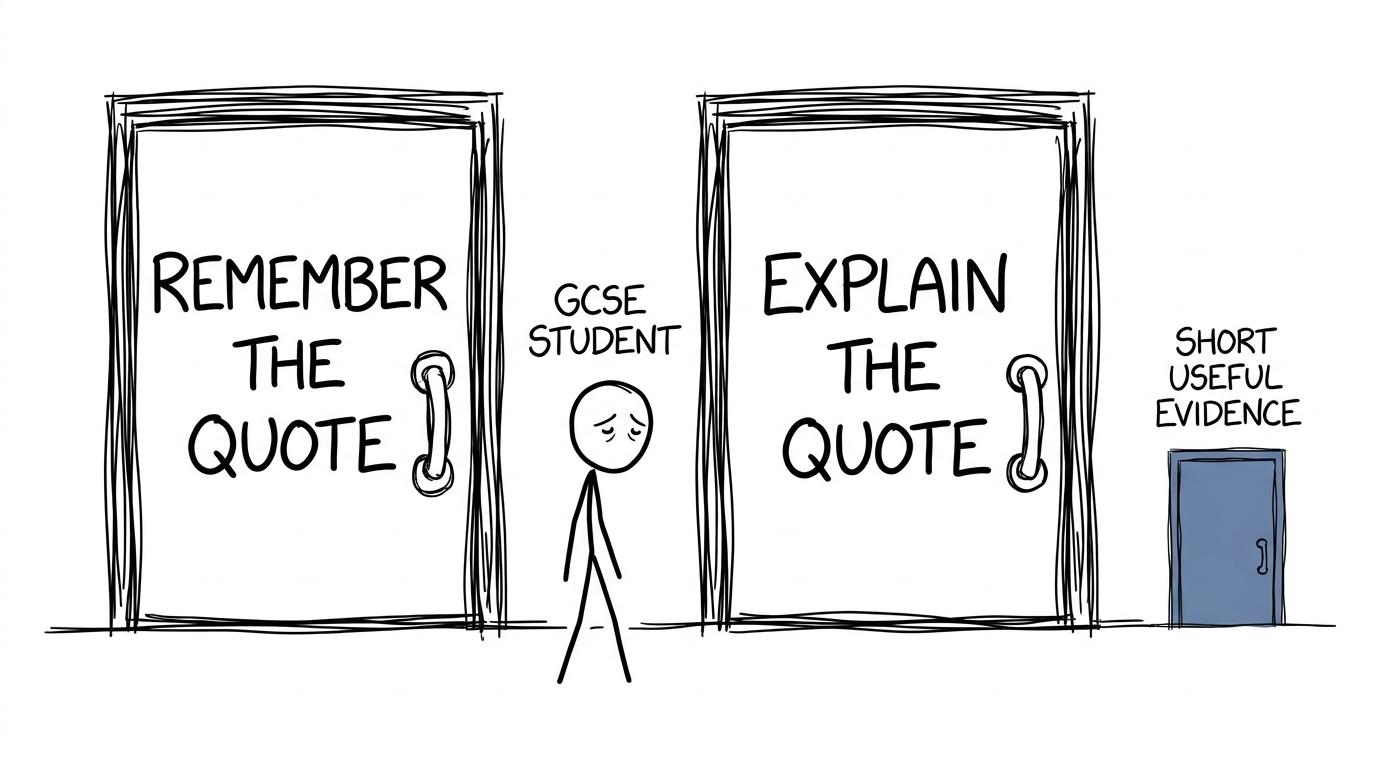 A student choosing between memorising everything and using short evidence
Why GCSE English Literature feels difficult
It is closed book
GCSE English Literature examinations are normally closed book across the main English exam boards, including AQA, Edexcel, OCR and Eduqas. Required extracts or stimulus material may be printed in the paper, but students cannot take their studied texts into the examination.
That creates a genuine memory demand. However, Ofqual has previously clarified that students are not expected to reproduce long passages or entire poems from memory. The assessment is about knowledge and understanding of whole texts, supported by relevant textual references.
Short evidence can be more useful than a memorised paragraph. A brief phrase may support several ideas about a character, theme or relationship. What matters is what you do with it.
There is a large body of content
Depending on the exam board and specification, students study combinations of Shakespeare, a nineteenth-century novel, modern prose or drama, anthology poetry and unseen poetry. The precise texts and paper structure vary, so check your own specification rather than relying on another school’s revision list.
The difficult part is not simply reading several works. You need to retain plot development, characters, themes, methods and relevant context, then decide which material fits a question you have not seen before.
This resembles mixed maths practice. Knowing a method when the worksheet heading names the topic is easier than recognising it inside an unfamiliar exam question. The MathsGenie GCSE maths revision hub builds that recognition through lessons, exam questions, worksheets and mixed paper practice.
Analysis is less predictable than recall
Knowing that an event happened is not the same as explaining why a writer presented it in a particular way. GCSE assessment objectives reward critical response, textual support and analysis of language, form and structure. Context also matters where it is relevant to the text and question.
For example, AQA gives approximately 37.5%37.5\%37.5% of its qualification weighting to AO1 and 42.5%42.5\%42.5% to AO2. Together, those objectives place substantial emphasis on responding to texts and analysing how writers create meaning. Exact weightings and question structures should always be checked for your exam board.
This explains why plot summaries alone reach a limit. Examiners need an argument about the text, not a retelling of it.
The clock changes the task
A thoughtful classroom discussion can develop slowly. An examination cannot. Students must interpret a question, retrieve evidence, organise an argument and write accurately within a fixed period.
On AQA, for instance, Paper 1 lasts 111 hour 454545 minutes and Paper 2 lasts 222 hours 151515 minutes. OCR currently uses two closed-text examinations of 222 hours each. These examples show why students must use timings that match their own board rather than copying a universal essay schedule.
Timing becomes easier only when it is practised. Maths students face the same issue: understanding a topic at home is different from using it efficiently in an examination. The MathsGenie guide to using GCSE past papers properly shows how timed attempts, marking and targeted repair can turn paper practice into progress.
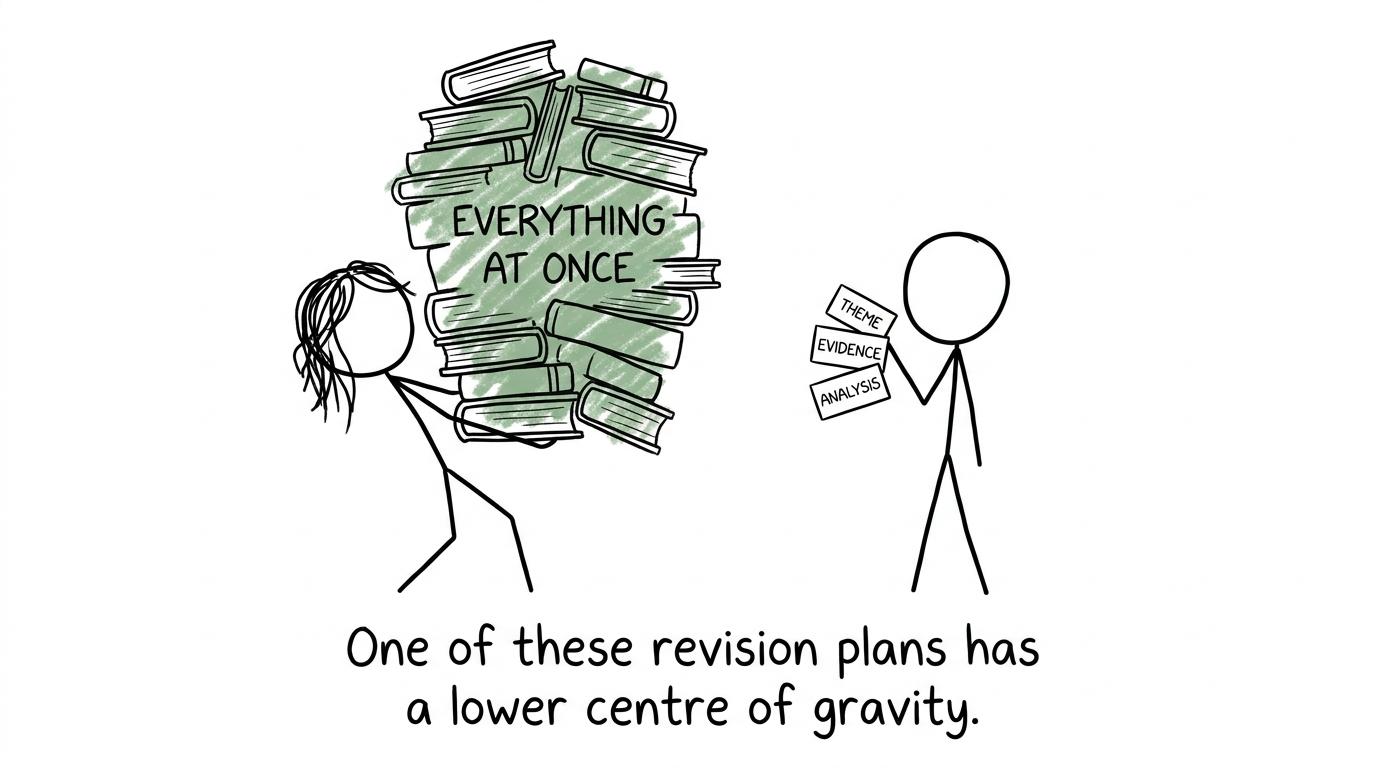 Two different approaches to carrying a GCSE revision workload
What makes the subject more manageable?
Build a small, connected quotation bank
Do not begin by trying to memorise every impressive line in every text. Choose short quotations that connect with several themes or characters. For each one, know:
- who says or describes it;
- where it appears;
- what it suggests;
- which language or structural choice is significant;
- which questions it might help answer.
Retrieve the quotation before checking it. Repeated retrieval is more useful than repeatedly reading a highlighted page.
Revise ideas, not prepared essays
A memorised essay is fragile because the real question may focus on a different character, moment or angle. Instead, create flexible clusters around themes, relationships and changes across the text.
A useful English revision cycle is:
- recall one theme without notes;
- list relevant moments and evidence;
- plan an answer to a fresh question;
- write one timed section;
- compare it with the assessment objectives and feedback;
- improve the weakest part.
That is close to the diagnose, practise and retest process in MathsGenie’s guide to finding your weakest GCSE topics.
Practise decisions as well as writing
Students sometimes complete many essays without examining the decisions underneath them. Before writing, ask:
- What is the exact focus of the question?
- What is my overall interpretation?
- Which moments show development or contrast?
- Which evidence gives me something meaningful to analyse?
- How will each paragraph advance my argument?
Planning should not consume the examination, but a brief, purposeful plan can prevent repetition and plot summary.
Balance English with maths revision
If maths is your main concern, English Literature can easily expand until it occupies every revision session. Avoid that by giving each subject a defined task rather than a vague instruction to “revise”.
One evening might contain a short quotation-retrieval session followed by an Edexcel GCSE maths mini test. Another might pair an English essay plan with selected questions from Edexcel GCSE maths past papers.
A realistic GCSE maths revision timetable can help protect time for both subjects without turning every evening into an exhausting marathon.
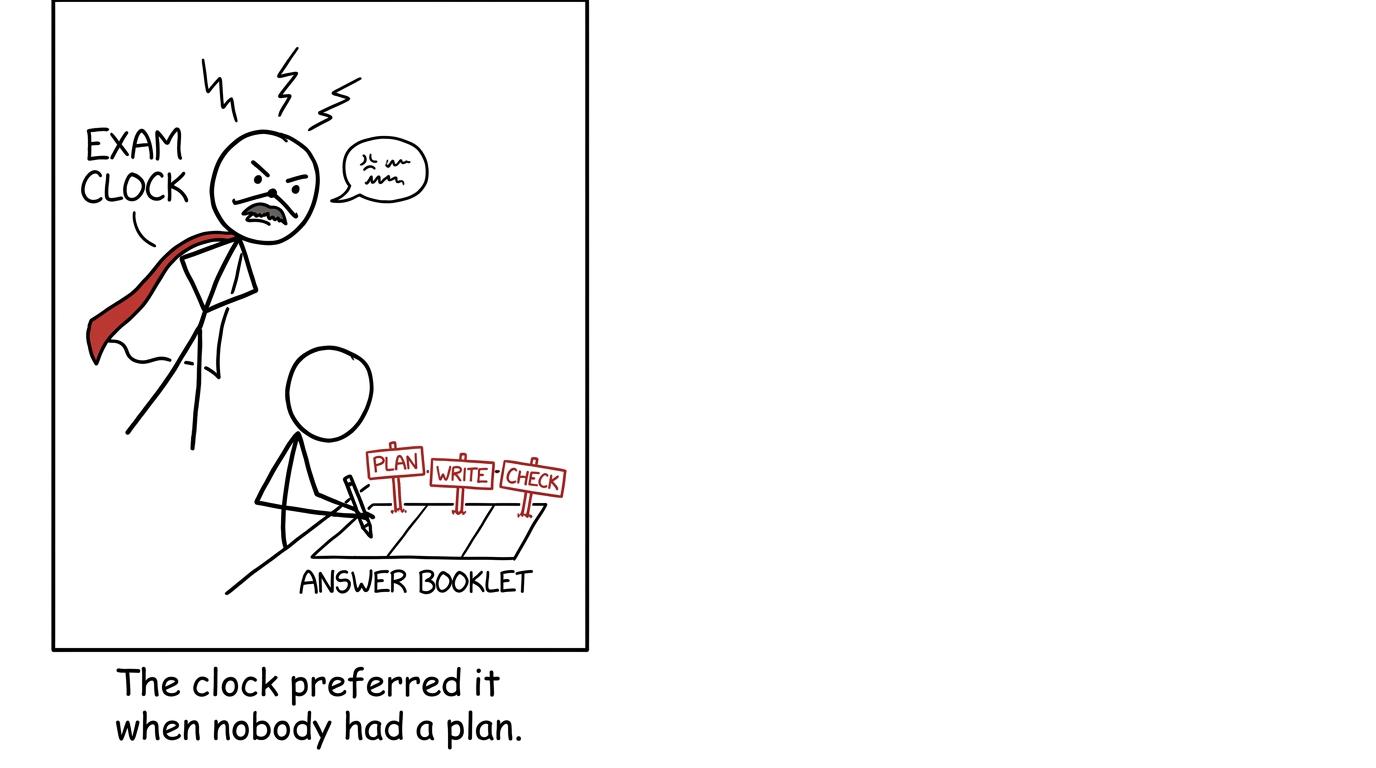 A calm student takes control of a dramatic examination clock
Common GCSE English Literature mistakes
Treating quotation quantity as the goal
A page filled with quotations is not automatically analytical. Select evidence that directly supports your interpretation, then explore its effect.
Retelling the plot
Plot knowledge is necessary, but narration does not replace analysis. Keep returning to the question and the writer’s choices.
Adding context without a textual connection
Historical facts do not earn marks simply because they are accurate. Context should illuminate the text, interpretation or writer’s purpose rather than becoming a separate history paragraph.
Ignoring form and structure
Students often focus only on individual words. Depending on the question, development across a text, contrasts, narrative perspective, dramatic staging, poetic form or structural shifts may be equally valuable.
Avoiding timed practice
Untimed writing can improve your ideas, but it cannot fully prepare you for examination pace. Build gradually from timed plans to paragraphs and complete responses.
Sacrificing every other subject
Panic can make Literature feel as though it needs unlimited revision time. It does not. A consistent plan is better than a last-minute takeover. If maths examinations are approaching, use GCSE predicted papers alongside official past papers to maintain exam practice without abandoning English.
So, is GCSE English Literature hard or manageable?
It is both. The qualification asks students to hold a substantial amount of material in mind and turn it into a clear argument under time pressure. Students are right to describe that combination as difficult, particularly in a closed-book examination.
But difficulty is not the same as randomness. You can improve quotation recall. You can learn to recognise what a question is asking. You can practise analysis, planning and timing. Progress often comes from making these separate skills more reliable rather than searching for one perfect model essay.
Use the same disciplined approach for maths. Start with free MathsGenie GCSE revision resources, learn weak topics through revision lessons and practice questions, then test them with mini tests, past papers, mark schemes, predicted papers and video solutions. One subject asks you to build an argument; the other asks you to build a method. Both become less frightening when you practise the next step.











