

GCSE Economics: Memory or Understanding?
GCSE economics memory vs understanding: discover what exams reward, how to balance recall with reasoning, and how maths practice can improve your revision.
You can memorise a perfect definition of inflation and still struggle when an exam question asks how rising prices might affect a particular household. That uncomfortable gap explains the debate around GCSE economics memory vs understanding.
The short answer is that you need both, but understanding carries your knowledge further. Memory gives you accurate terminology, formulae and chains of cause and effect. Understanding lets you apply them to unfamiliar contexts, interpret data, analyse consequences and reach a supported judgement. GCSE Economics examinations reward that complete process rather than recall alone.
This matters for maths revision too. Economics includes percentages, averages, graphs and quantitative evidence. Knowing a formula is useful; recognising which values belong in it, interpreting the result and using it within an argument requires understanding.
The quick revision checklist
A balanced GCSE Economics revision plan should help you:
- recall precise definitions, concepts and formulae;
- explain why one economic change may cause another;
- apply knowledge to the business, market or country in the question;
- interpret tables, graphs and numerical evidence;
- analyse consequences for consumers, producers, workers and government;
- evaluate competing arguments before reaching a justified conclusion;
- practise under timed conditions and learn from mark schemes.
If your revision only prepares you to answer “What does this term mean?”, it is incomplete. The examination will also ask, in different forms, “What happens next?”, “Who is affected?”, “Does the context change the outcome?” and “Which argument is strongest?”
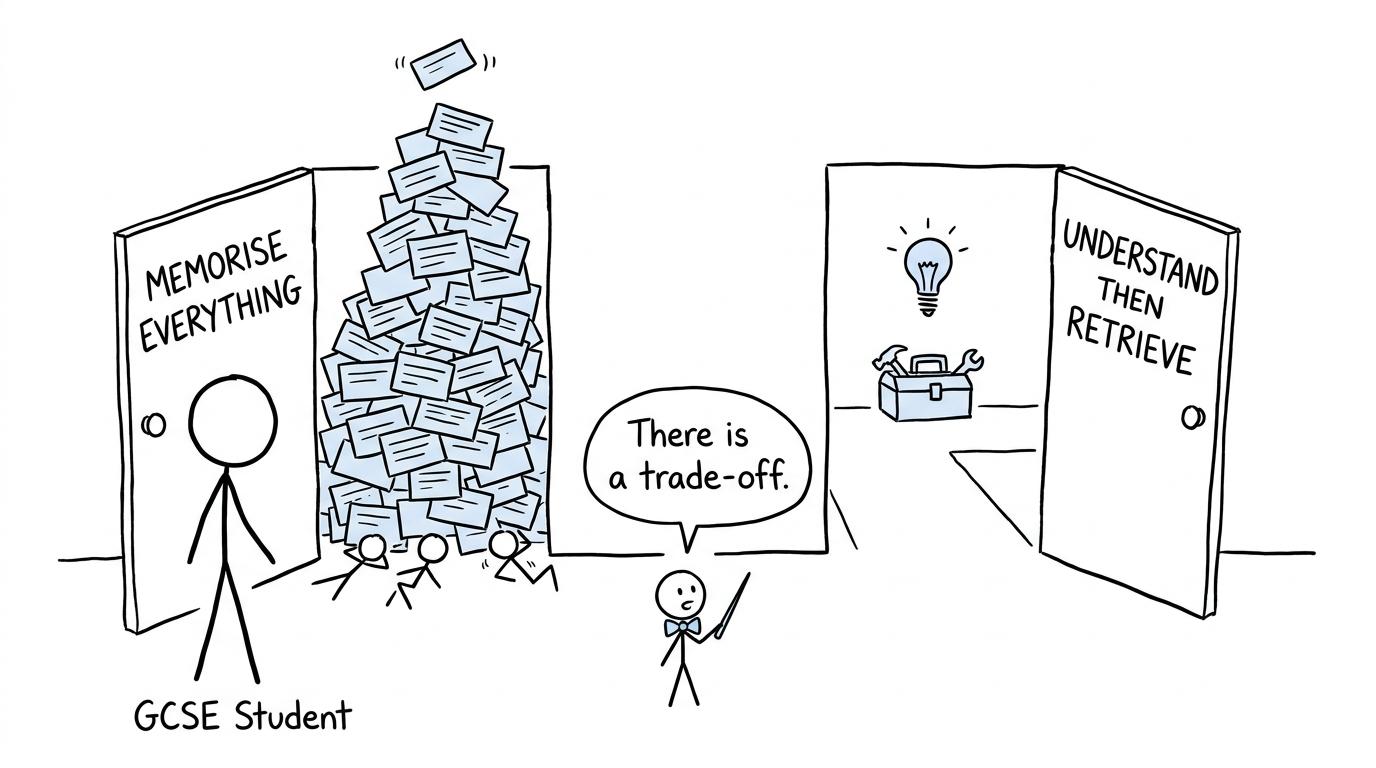 A student chooses between a mountain of flashcards and a path combining understanding with retrieval
What GCSE Economics examinations actually reward
Official GCSE Economics subject content requires students to develop knowledge and understanding, apply economic concepts to contemporary and historical situations, analyse evidence and make informed judgements. Current AQA and OCR specifications organise these demands through three assessment objectives:
- AO1: knowledge and understanding of economic concepts and issues;
- AO2: application of that knowledge and understanding to contexts;
- AO3: analysis and evaluation of evidence and issues, including judgements and conclusions.
In both the current AQA and OCR specifications, the overall weighting is approximately 35%35\%35% for AO1, 35%35\%35% for AO2 and 30%30\%30% for AO3. The precise wording and paper structure should always be checked against your own current specification.
Those weightings reveal something important. Even AO1 is not labelled “memory”; it combines knowledge with understanding. Meanwhile, approximately 65%65\%65% of the weighting concerns application, analysis and evaluation. You cannot secure those marks by reproducing isolated flashcards.
This does not make memorisation unimportant. You cannot apply a concept you do not know. But knowledge is the starting material, not the finished answer.
What should be memorised?
Some Economics content must become quick and reliable enough to retrieve under pressure.
Definitions and economic vocabulary
Terms such as scarcity, opportunity cost, demand, supply, productivity, inflation, unemployment and fiscal policy need precise meanings. Loose everyday language can weaken an otherwise sensible argument.
Do not memorise definitions as meaningless strings of words. Attach each one to:
- its central idea;
- a suitable context;
- a commonly confused term;
- one likely consequence.
That structure makes recall more durable and prepares the definition for use.
Core relationships and chains
You should remember the direction of important relationships. For instance, a change in interest rates may influence borrowing, saving and spending. However, a memorised chain should not become an automatic claim that ignores the question.
A useful chain has the form:
change→immediate effect→behavioural response→economic consequence\text{change} \rightarrow \text{immediate effect} \rightarrow \text{behavioural response} \rightarrow \text{economic consequence}change→immediate effect→behavioural response→economic consequenceThe arrows are not proof. At each stage, ask why the link might occur and what could weaken it.
Formulae and calculation methods
The official GCSE subject content includes quantitative skills such as percentages, percentage changes, averages, revenue, costs, profit, income and the interpretation of economic data.
Relevant relationships include:
percentage change=new value−original valueoriginal value×100\text{percentage change}=\frac{\text{new value}-\text{original value}}{\text{original value}}\times 100percentage change=original valuenew value−original value×100 profit=total revenue−total cost\text{profit}=\text{total revenue}-\text{total cost}profit=total revenue−total cost average cost=total costquantity produced\text{average cost}=\frac{\text{total cost}}{\text{quantity produced}}average cost=quantity producedtotal costMemorising these is sensible. Yet the harder skill is deciding which formula fits the information, using the correct original value and explaining what the result means economically. MathsGenie’s GCSE Economics calculations revision guide connects those numerical methods directly to OCR Economics contexts.
Where genuine understanding earns marks
Understanding becomes visible when the question changes slightly and you can still think your way through it.
Application means using the given context
A generic statement about “businesses” may not fully answer a question about a small exporter facing a currency movement. Application means selecting details from the stimulus and allowing them to shape your reasoning.
Before writing, identify:
- the economic agent involved;
- the market or country described;
- the direction and size of any change;
- the relevant data;
- the time period;
- any condition that makes the situation unusual.
A remembered paragraph should be treated as raw material. It must be rebuilt around the question.
Analysis means explaining the links
Analysis is not simply adding more consequences. It is showing a connected sequence in which each step follows logically from the previous one.
Ask “why?” after every claim. If demand rises, why might a producer respond? If costs increase, which costs have changed? Can the business pass those costs to consumers? The depth comes from explaining mechanisms, not from writing the longest possible chain.
Evaluation means weighing arguments
Evaluation is more than placing “however” at the start of the final paragraph. A strong judgement considers why the outcome may depend on factors such as:
- the size of the change;
- the time period;
- consumer or producer responsiveness;
- the state of the wider economy;
- differences between stakeholder groups;
- the reliability or limitations of the evidence.
Your conclusion should follow from the argument you have made. It should not be a memorised sentence that could fit any question.
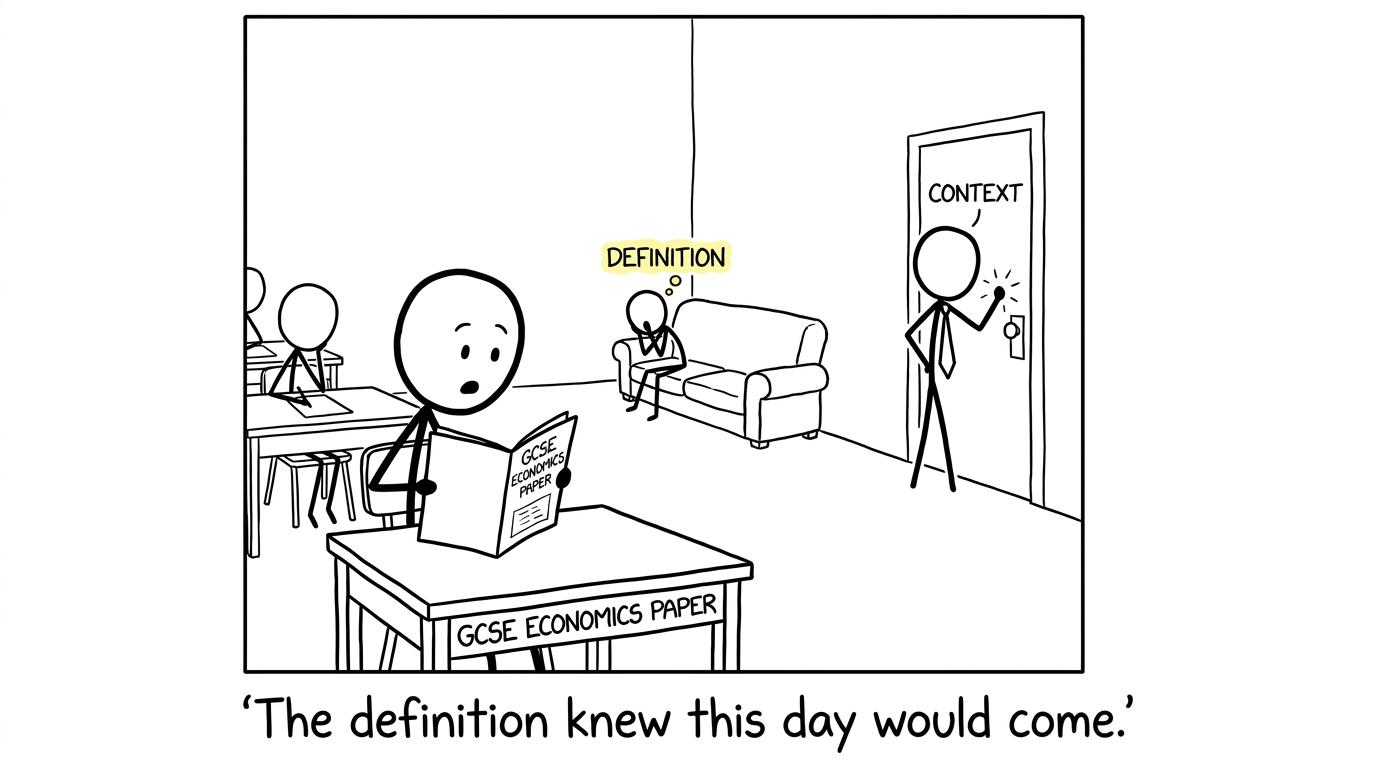 A memorised definition hides while the unfamiliar exam context arrives
Why maths understanding matters in Economics
Economics does not use GCSE Maths merely as a calculation test. Numbers often provide evidence for a decision or argument.
You may need to compare changes, interpret a trend, distinguish an absolute change from a percentage change, or decide whether data supports a claim. These skills are easier when your mathematical methods are understood rather than copied.
Useful MathsGenie resources include:
- percentage change revision and practice, which supports comparisons involving prices, output and income;
- averages revision, useful when interpreting average costs, wages or other data;
- scatter graphs revision, which helps separate a visible relationship from proof of causation;
- the wider GCSE Maths revision hub, where you can select your exam board and tier.
One warning is especially valuable: correlation does not by itself establish causation. Two variables may move together because one affects the other, because the direction runs the opposite way, or because another factor influences both. That habit of caution is mathematical and economic at the same time.
How to revise memory and understanding together
The best approach is not to spend one week memorising and another week understanding. Train both within the same session.
Retrieve, explain, apply and check
Use this four-part cycle:
- Retrieve: close your notes and write the definition, formula or diagram from memory.
- Explain: state why the relationship works in your own words.
- Apply: use the idea in an unfamiliar context or source of data.
- Check: compare your response with the mark scheme and improve one specific weakness.
A flashcard might begin with a definition. On the reverse, add a prompt asking when the effect may be stronger, weaker or uncertain. That small change turns a recall tool into a reasoning tool.
Organise revision around questions, not pages
Rereading notes can create familiarity without proving that you can retrieve or use anything. Examination questions expose the difference.
Practise a mixture of short knowledge questions, calculations, contextual explanations and extended responses. Mark them carefully. Record whether each lost mark resulted from:
- missing knowledge;
- weak application;
- a broken analytical link;
- unsupported evaluation;
- inaccurate calculation;
- misreading the command word.
This diagnosis tells you what to do next. “Revise inflation” is vague. “Practise applying the effects of inflation to different households” is actionable.
Maths students can use the same process with GCSE Maths past-paper practice: attempt, mark, diagnose, repair and retest. If content keeps disappearing between sessions, the guide to stopping GCSE content from being forgotten offers a practical retrieval and spacing routine.
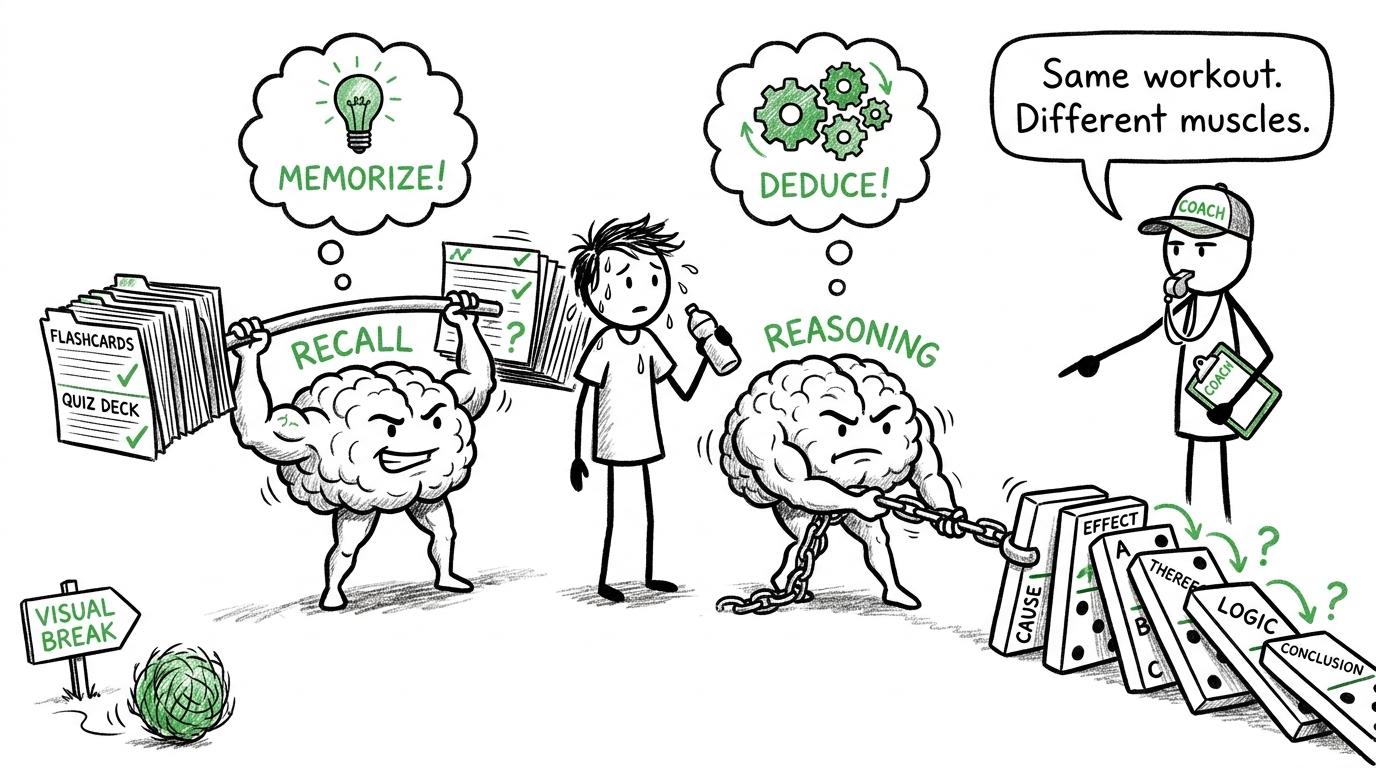 Recall and reasoning train together in a cartoon brain gym
Common mistakes in GCSE Economics revision
Memorising model answers word for word
A model answer can show structure and depth, but reproducing it in a different context often produces generic application and irrelevant analysis. Learn what makes it effective rather than treating it as a script.
Treating definitions as the whole topic
A correct definition may secure knowledge marks. It does not automatically explain effects, use the stimulus or evaluate an argument. Follow every definition with questions about mechanism and context.
Making unsupported chains
Long arrows do not guarantee sound analysis. If one link is doubtful, everything after it becomes weaker. Explain each stage and acknowledge relevant conditions.
Ignoring numerical evidence
Do not calculate a percentage and then abandon it. Use the result to support, challenge or qualify the argument. Include units and check whether the answer is reasonable.
Confusing length with evaluation
A long conclusion is not necessarily a strong one. A concise judgement based on the most important contextual factor can be more effective than several generic caveats.
Revising comfortably rather than diagnostically
Highlighting familiar material feels productive because recognition is easy. Closed-book retrieval and timed questions feel harder because they reveal gaps. That discomfort is useful information.
The real answer: memory supports understanding
The choice between memory and understanding is slightly misleading. Strong Economics revision creates a sequence:
accurate recall→contextual application→analysis→judgement\text{accurate recall} \rightarrow \text{contextual application} \rightarrow \text{analysis} \rightarrow \text{judgement}accurate recall→contextual application→analysis→judgementMemory gives you something to think with. Understanding tells you when, why and how to use it. Practice makes both available under examination pressure.
Start by checking your Economics specification and assessment objectives, then build a routine of retrieval, contextual questions and honest marking. For the quantitative side, make MathsGenie your free revision base. Use its revision lessons and practice questions to repair weak methods, then test yourself with mini tests, GCSE revision resources and predicted papers, past papers, mark schemes and video solutions.
The goal is not to remember every sentence you have ever read. It is to know the essential ideas well enough that you can think when the question is new.











