

GCSE Japanese Resit Entry: Late Entry Guide
GCSE Japanese resit entry explained: what to do if you miss the usual sitting, how late fees work, and how to arrange your next exam through a centre.
Missing an entry deadline can feel strangely final. The examination still exists, you are still willing to take it, yet the date on a calendar has passed. Fortunately, a GCSE Japanese resit entry may still be possible through a late entry or a later examination series. The important step is to contact your school, college or private examination centre immediately.
A late entry is not guaranteed. It depends on the awarding body's window, whether a centre can accommodate the four Japanese assessments and whether arrangements can still be completed safely. If you missed the examination itself rather than the entry deadline, that is different: you cannot simply sit the paper on another day, so you must contact the centre and discuss special consideration or a fresh entry.
This guide relates to Pearson Edexcel GCSE Japanese, specification code 1JA0, which is the qualification covered by the current official entry information researched for this article. Always ask your centre to confirm the latest series, dates and entry options before paying.
Your immediate checklist
If the usual Japanese sitting or registration date has passed, work through these actions:
- Decide whether you missed the entry deadline, the speaking assessment window or an actual examination.
- Contact your school's examinations officer before approaching another centre.
- Confirm the awarding body, specification code and examination series.
- Ask whether the centre accepts late entries or private candidates for Japanese.
- Check whether it can conduct the speaking assessment.
- Confirm your foundation or higher tier across every paper.
- Request a written breakdown of entry fees, late fees and centre administration charges.
- Ask whether a previous speaking result may be transferred, if relevant.
- Put every Japanese and maths examination commitment into one revision calendar.
Speed matters here. A normal deadline becoming a late deadline does not mean places remain available indefinitely.
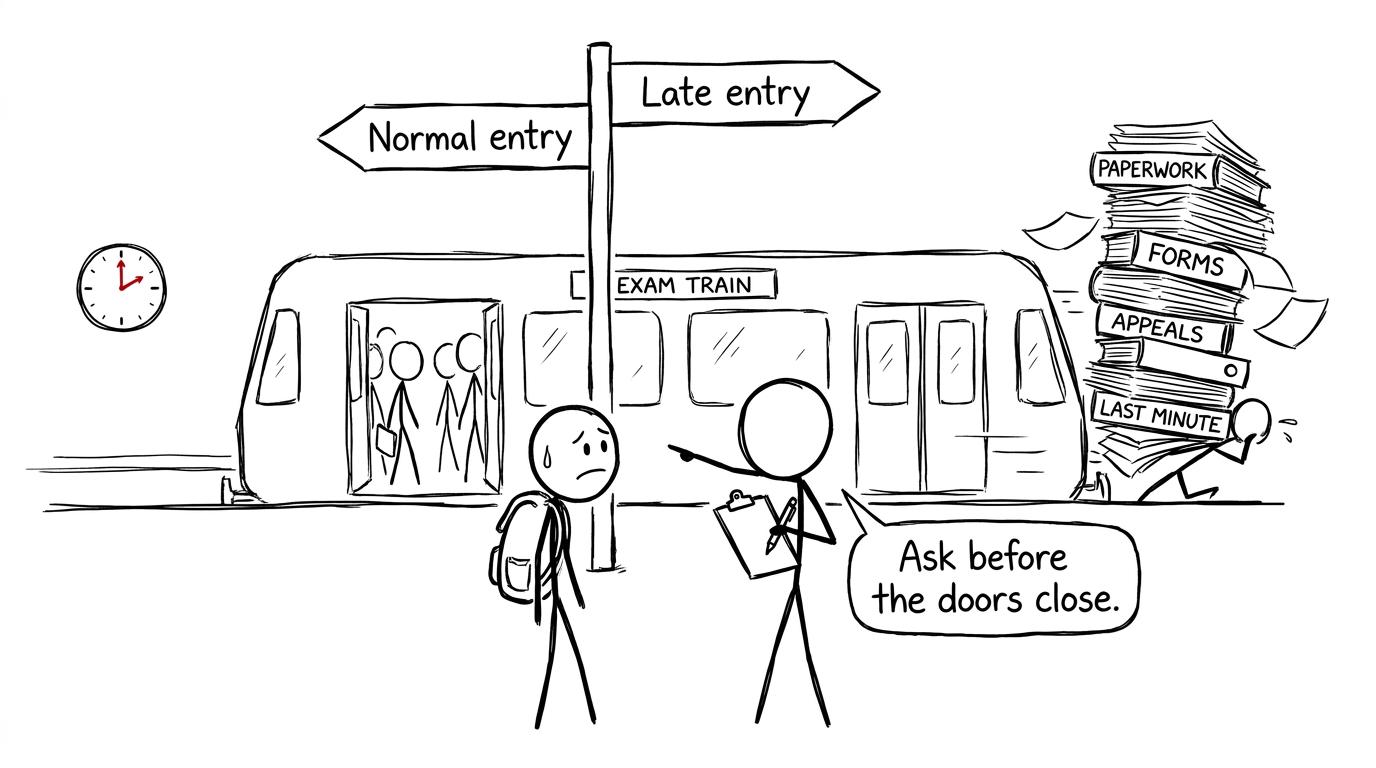 A student choosing between normal and late exam entry trains
What a GCSE Japanese resit entry actually means
A resit is normally a new entry for the qualification in an available examination series. It is not a special easier paper, and the awarding body does not label the assessment as a second attempt on the question paper.
Pearson Edexcel GCSE Japanese has four assessed components:
- Paper 1: listening and understanding in Japanese
- Paper 2: speaking in Japanese
- Paper 3: reading and understanding in Japanese
- Paper 4: writing in Japanese
The qualification has foundation and higher tiers. Pearson's entry information says that a candidate must be entered for the same tier across all four papers, with the tier decided before the speaking assessment. Do not assume that the tier used in an earlier attempt will automatically be selected again.
Current Pearson information also lists entry options in which a speaking assessment is transferred from a previous series. That does not mean every candidate can automatically carry a speaking result forward. Your centre must check the applicable rules, entry code and eligibility for your chosen series.
Late entry and resit entry are different
The two terms are often used together, but they answer different questions.
A resit entry describes why you are entering: you previously took, missed or intended to take the qualification and now want another opportunity.
A late entry describes when the centre submits your entry: after the awarding body's normal deadline.
You could therefore make a resit entry before the normal deadline, which is usually the simplest and least expensive route. Alternatively, a first attempt could become a late entry if the registration was not submitted in time.
How the late-entry window works
Awarding bodies set a normal entry deadline and later points at which extra charges apply. For the Pearson June 2026 UK series, the published GCSE entry deadline was 21 February 2026. Late fees applied from 22 February, with high late fees applying from 22 April.
Those dates are useful for understanding the process, but they should not be reused for another year. Deadlines change by series. Centres may also impose earlier internal cut-offs so they have time to collect identification, organise speaking assessments and correct entry errors.
Pearson's published 2025/26 fee guidance stated that an entry fee was doubled from the late-fee date and trebled from the high-late-fee date. What you pay to a private centre can be higher because its total may also cover invigilation, rooms, administration and the speaking assessment. Ask for the total cost rather than only the awarding-body fee.
What to do if you missed the usual sitting
The right response depends on what, precisely, was missed.
If you missed the normal entry deadline
Contact the examinations officer or private centre immediately. Ask whether the awarding body is still accepting entries and whether the centre can deliver GCSE Japanese.
Japanese is more complicated to arrange than a written-only subject because the centre must manage the speaking component as well as the listening, reading and writing papers. A centre that accepts private maths candidates does not necessarily accept Japanese candidates.
Do not send payment until the centre confirms all of the following in writing:
- the exact qualification and specification code
- the examination series
- your tier and entry option
- speaking-assessment arrangements
- the complete price
- the refund or withdrawal policy
- the documents and identification required
If you missed one of the examinations
Tell the centre immediately and explain the reason accurately. A national contingency day is not a personal make-up session. Official 2026 student guidance states that the contingency date is for examinations moved because of significant national or local disruption, not for rescheduling an examination missed by one candidate.
The centre can decide whether an application for special consideration is appropriate under the relevant rules. Special consideration is not automatic and cannot recreate evidence that was never assessed. If it is unavailable or does not produce a result, you may need a fresh entry in a later eligible series.
If your school will not enter you
Ask whether this is because the deadline has passed, the centre does not offer Japanese, or it cannot accommodate an external candidate. The distinction matters.
You can look for an approved centre accepting private candidates, but the entry must still be made through that centre. Private candidates do not submit GCSE entries directly to the awarding body. Start early because a suitable centre needs the facilities and staff to administer the speaking assessment correctly.
Can GCSE Japanese be taken in November?
Do not apply the familiar GCSE maths rule to Japanese without checking the current Pearson documentation.
Most students know that GCSE English Language and GCSE maths have established November resit arrangements for eligible candidates. Subject availability outside those qualifications is more restricted. However, Pearson's GCSE information manual for 2025/26 specifically states that GCSE Japanese is available in summer and November and provides Japanese entry information.
Availability on an awarding-body system does not guarantee that your school or local private centre will offer the series. Before making plans, ask the centre to verify:
- that Japanese 1JA0 is available in the intended November or summer series
- whether any age or previous-entry conditions apply
- which components must be taken again
- whether a speaking result can be transferred
- the centre's own booking deadline
Treat verbal reassurance as a starting point, not the final confirmation. Your statement of entry should show the correct subject, series and tier.
Protecting your maths revision while arranging Japanese
Administrative uncertainty has a habit of occupying more attention than the task deserves. One unanswered email can follow you through an entire evening of algebra.
Give the entry problem a fixed place in your week. Keep a short list of calls, documents and deadlines, then return to your examination preparation. If maths is also part of your resit or summer programme, use the GCSE maths resit revision plan to turn an uncertain result into specific topic actions.
A manageable weekly structure could include separate Japanese speaking, vocabulary and writing sessions alongside maths topic practice. MathsGenie's one-month GCSE maths revision plan offers a clear model for scheduling retrieval, practice and paper review without allowing one subject to consume every available hour.
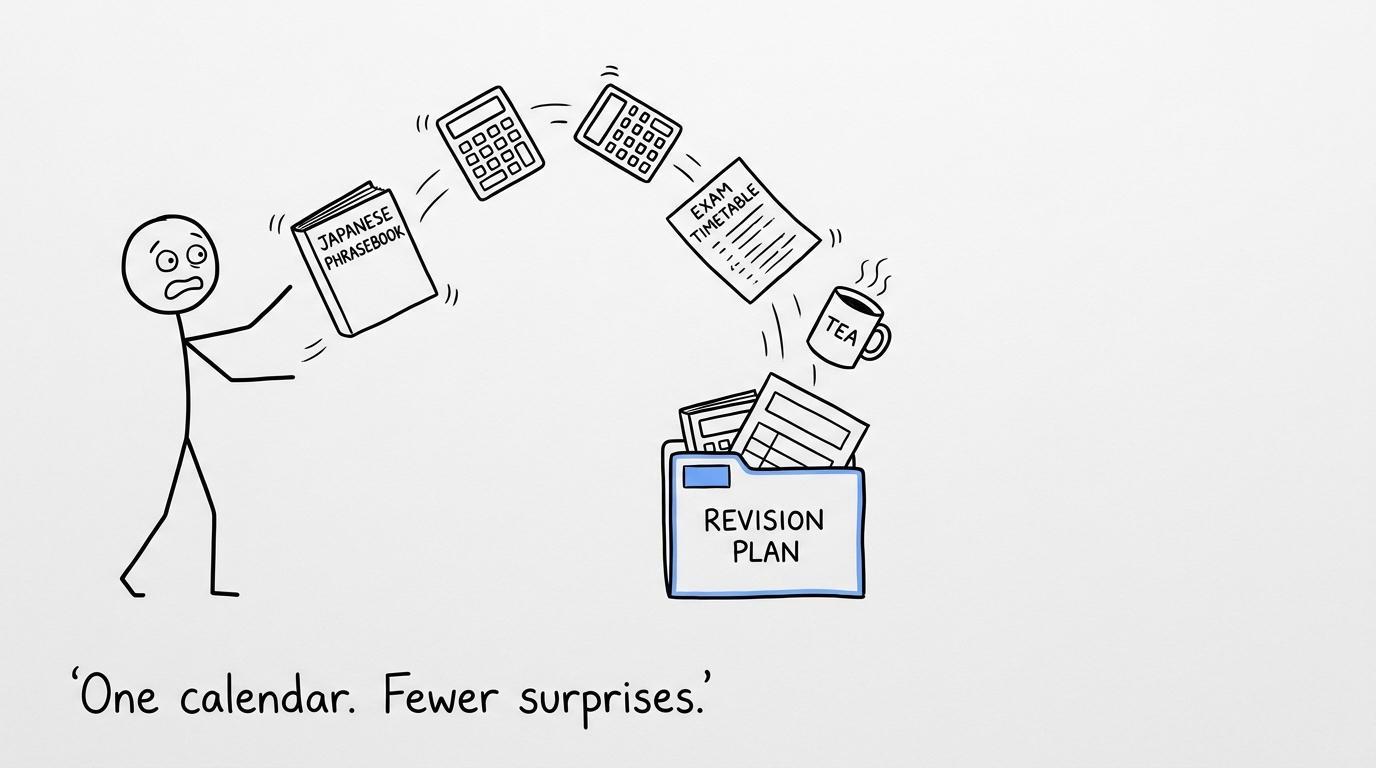 A student juggling Japanese and maths revision materials
For maths, begin with a diagnostic paper rather than revising everything equally. The guide to using GCSE past papers properly explains how to mark, classify and repair mistakes. AQA candidates can use the AQA GCSE Maths revision hub, while Edexcel students can add Edexcel GCSE Maths predicted papers after securing their weaker topics.
The principle is the same in both subjects: practise the form of performance the examination requires. Japanese needs active listening, speaking, reading and writing. Maths needs written methods, accurate decisions and timed problem-solving.
Common mistakes with late and resit entries
Assuming the school has entered you
A conversation with a teacher is not the same as a confirmed examination entry. Ask for written confirmation or a statement of entry and check every detail.
Confusing GCSE with International GCSE
These are different qualifications with different codes, assessment structures, dates and fees. Saying only “Japanese GCSE” is not precise enough when contacting a centre.
Looking only at the awarding-body deadline
A school or private centre can close bookings before the official deadline. Its internal date is often the one that determines whether it will accept you.
Forgetting the speaking assessment
A centre may be able to host written papers but not the speaking component. Confirm the speaking arrangements before paying any fee.
Assuming a previous component will transfer
Pearson lists transferred-speaking entry options, but the centre must confirm whether they apply to your previous assessment and intended series.
Waiting for a late window because it exists
Late entry is a fallback, not a strategy. Charges rise, centres fill and there is less time to correct errors.
Letting administration replace revision
Sending emails can feel productive, but it does not improve examination performance. Once the next action is with the centre, return to planned practice. MathsGenie's guide to when to start GCSE past papers can help you choose the right balance between topic work and timed papers.
Build certainty one confirmation at a time
A missed deadline is serious, but it is not the same as having no options. Establish what was missed, contact an approved centre quickly and confirm the series, specification, tier, speaking arrangements and total fee in writing. If you missed an examination rather than an entry date, speak to the original centre immediately about the official next steps.
Then let the administration become smaller than the preparation. Use the GCSE maths revision timetable guide to protect regular revision time, and make MathsGenie your free home for maths revision lessons, practice questions, mini tests, past papers, predicted papers, mark schemes and video solutions.
The calendar matters. But once your entry is secure, what you do with the remaining days matters more.











