GCSE Italian Part-Time Job Balance: A Real Plan
GCSE Italian part time job balance made realistic: plan shifts, protect sleep, revise four language skills and keep your GCSE maths preparation on track.

A part-time job does not only take the hours printed on the rota. It takes travel time, recovery time and sometimes the quiet part of the evening when you meant to revise. That is why gcse italian part time job balance is less about finding a perfect timetable and more about protecting a few reliable revision windows.
The practical answer is simple: schedule demanding revision before work where possible, use short periods for vocabulary and listening, keep one shift-free block for speaking or writing, and reduce work early if your sleep, attendance or schoolwork begin to suffer. Your Italian preparation should cover listening, speaking, reading and writing, while your wider timetable must still protect core subjects such as GCSE maths.
Your quick balance checklist
Start with these decisions:
- Put every shift, journey and school commitment into one weekly calendar.
- Keep sleep, meals and school attendance fixed before allocating revision.
- Give Italian several short sessions rather than one enormous weekly session.
- Match each session to your energy: difficult writing when fresh, vocabulary when tired.
- Reserve separate time for maths questions and paper practice.
- Tell your manager about assessments and exams before rotas are issued.
- Review the plan every Sunday and adjust it using completed work, not good intentions.
A workable plan is rarely symmetrical. A shift day might contain only 151515 minutes of Italian. A free day might contain 454545 minutes. What matters is whether the week covers the right skills without depending on exhausted late-night revision.
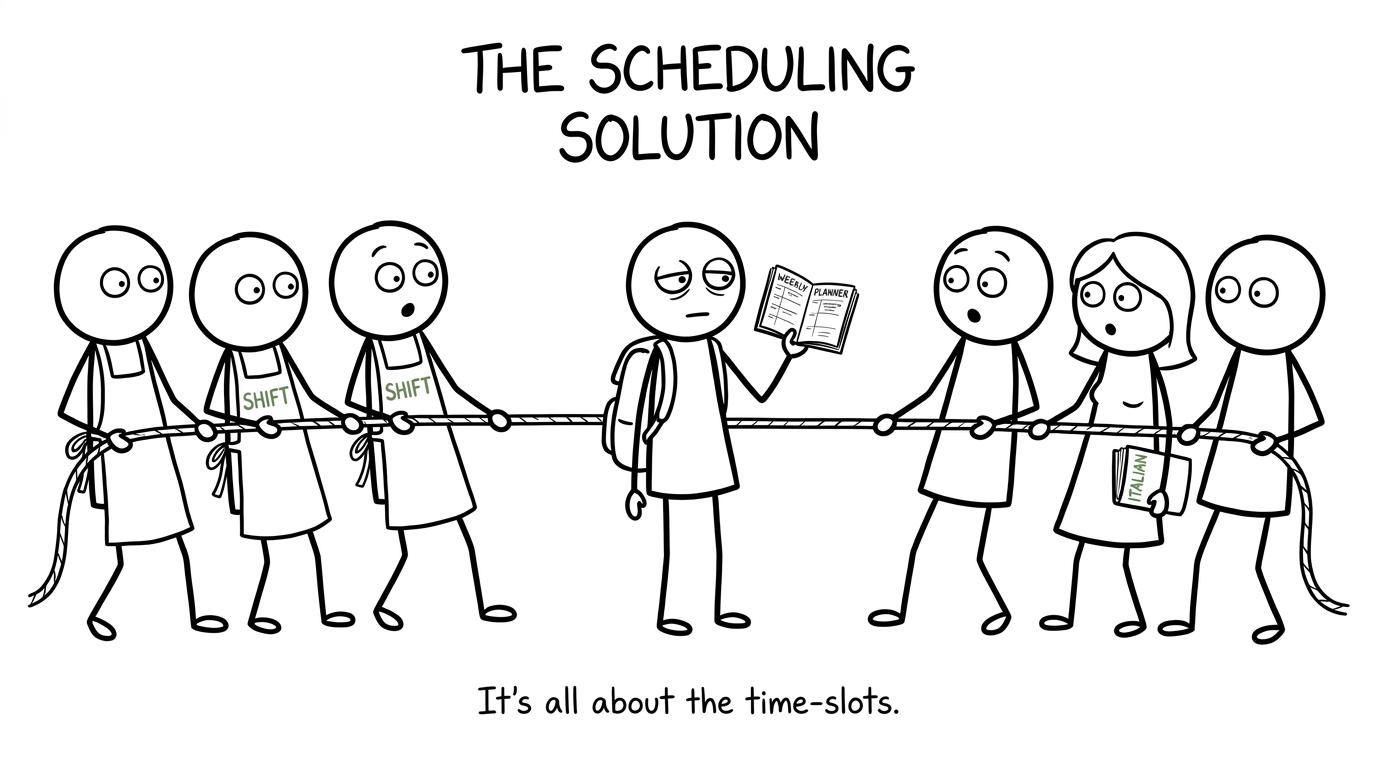 A student calmly ends a tug of war between work and Italian using a weekly planner
Build your timetable around fixed commitments
Begin with what cannot move: lessons, shifts, travel, meals and a realistic bedtime. Only then should you add revision. This prevents the common mistake of creating a beautiful schedule that quietly assumes you have more hours than you do.
Teenagers generally need substantial sleep, with NHS guidance commonly placing the recommended range for ages 141414-171717 at around 888-101010 hours each night. Cutting sleep to create revision time may make the timetable look productive while making concentration, recall and emotional regulation harder the next day.
If you are below school leaving age, employment rules also matter. In England, government guidance says children may work no more than 121212 hours during a term-time week, cannot work during school hours and may require a local authority employment permit. Age limits, permitted jobs and local bylaws can vary, while rules elsewhere in the UK differ. Check current government and council guidance with a parent, carer or employer rather than assuming a rota is lawful because someone offered it.
Find your true available time
For each shift, include:
- travel in both directions;
- changing or preparing for work;
- eating before or afterwards;
- enough time to settle before sleep;
- any homework due the next morning.
A four-hour shift may occupy much more than four hours of usable evening time. Accepting that is not pessimism. It is accurate planning.
If your wider GCSE timetable is becoming crowded, the GCSE maths revision timetable guide offers a useful principle: prioritise the topics that actually cost marks, include space for rest and build towards timed papers gradually.
Use different revision on shift days and free days
Not every revision task needs the same concentration. The useful question is not simply, “Do I have time?” It is, “What kind of attention do I have?”
Before a shift
If you are reasonably fresh, use 202020-303030 minutes for work that requires active production:
- planning or completing a writing response;
- practising answers for a speaking topic;
- translating short sentences into Italian;
- correcting errors from teacher feedback;
- recalling verbs and structures without notes.
Keep the target narrow. “Revise Italian” is too vague. “Practise five speaking answers about school and future plans” tells you when the session is finished.
During travel or a break
Use short, interruptible activities only where it is safe and permitted:
- retrieve vocabulary from flashcards;
- listen to a short Italian audio clip;
- mentally rehearse speaking answers;
- read a small passage and identify its main message;
- review a personal list of recurring errors.
Do not rely on a work break for essential revision. Break lengths can change, and you may genuinely need to eat and rest.
After a shift
Late evening is usually better for light review than difficult new learning. Try 101010-151515 minutes of vocabulary retrieval, listening or correcting work completed earlier. If you are too tired to concentrate, stop and sleep. A tired hour of rereading may achieve less than a focused quarter-hour the following day.
This same principle works for busy maths days. MathsGenie’s 20-minute GCSE maths revision routine reduces decision-making by using a repeatable sequence of recall, questions, marking and error logging.
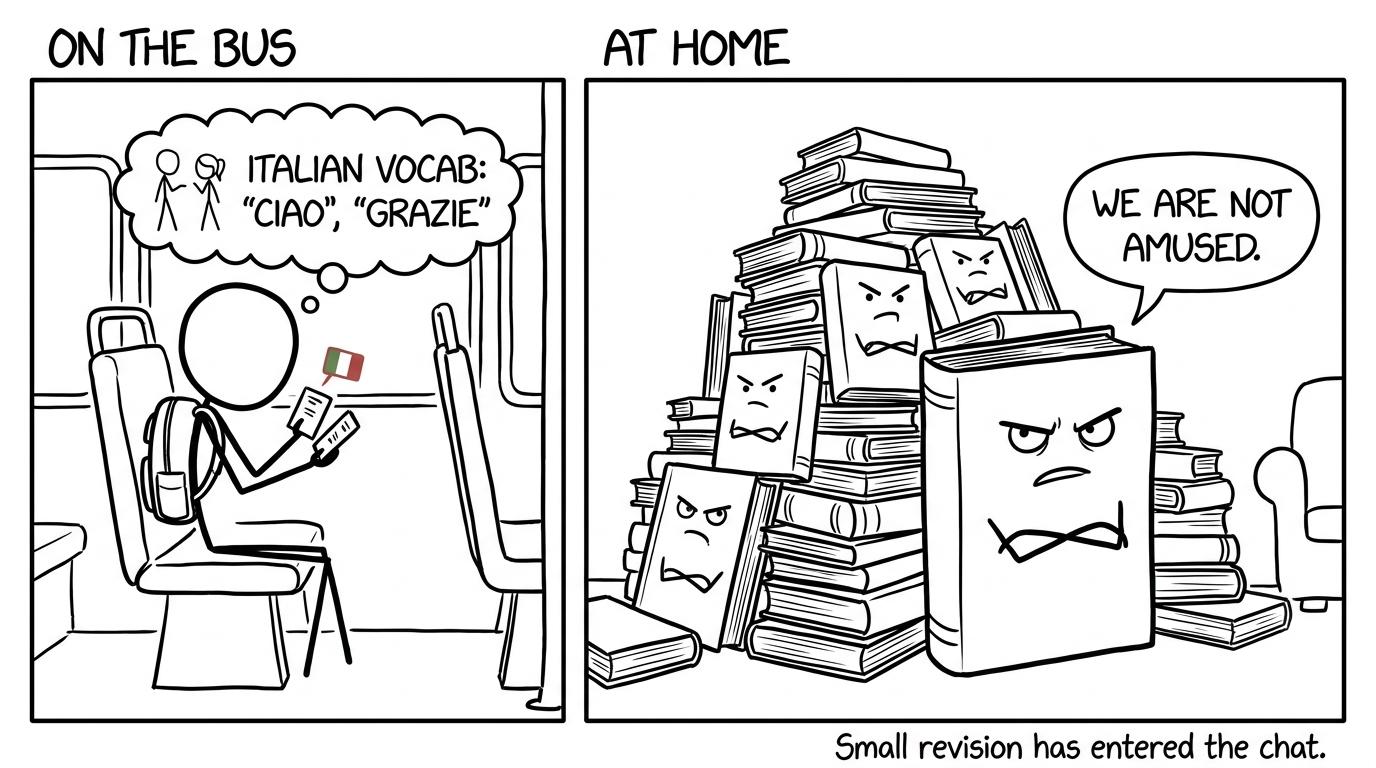 A student uses a bus journey for a small piece of Italian revision
Cover all four GCSE Italian skills
Current GCSE Italian assessment covers listening, speaking, reading and writing, with each skill contributing approximately 25%25\%25% of the qualification. The exact paper format, timings and speaking arrangements depend on your specification and tier, so check the current information for your exam board and ask your teacher if anything is unclear.
A busy student cannot afford to revise only the easiest skill. Use a simple weekly record with four boxes:
- Listening: understand spoken Italian without relying on a transcript.
- Speaking: answer aloud, extend ideas and respond without reading a script.
- Reading: identify key information, opinions, time frames and unfamiliar language in context.
- Writing: produce accurate language, cover every task requirement and check verbs carefully.
Aim to touch each skill every week. Listening and vocabulary fit naturally into short sessions. Speaking needs privacy and active rehearsal. Writing usually deserves your freshest block because it combines recall, grammar, planning and checking.
Keep a small error log rather than copying pages of notes. Record specific problems such as a missed agreement, an incorrect tense or a misunderstood question word. Your next Italian session should begin with one of those errors.
Protect maths alongside Italian and work
Italian cannot occupy every free evening, especially when GCSE maths is another major examination subject. The safest approach is to allocate separate blocks rather than deciding each day which subject feels most urgent.
Use the GCSE maths revision hub to choose your exam board and find free revision lessons, exam questions, worksheets and papers. Resources are available for boards including Edexcel, AQA, OCR and Eduqas, with work suitable for foundation and higher tier.
On a working week, your maths plan might contain:
- one short topic lesson and focused question set;
- one mini test or timed paper section;
- one correction session using solutions or a mark scheme.
That structure is more useful than repeatedly reading notes. The GCSE maths topics by exam board and tier guide can help you choose work that matches your specification and grades 999-111 target.
When time is especially tight, alternate the main subject focus. One free evening can hold an Italian writing task; another can hold a maths mini test. Short maintenance sessions keep the other subject active between deeper blocks.
Plan backwards from assessments and exams
Work rotas often appear weekly. School deadlines do not. Put speaking assessments, mock exams, coursework deadlines and final papers into your calendar as soon as dates are confirmed.
Then work backwards:
- Normal weeks: maintain all four Italian skills and repair maths topic gaps.
- Before an Italian speaking assessment: protect regular aloud practice rather than relying on one long rehearsal.
- Before maths mocks: add timed sections and careful mark-scheme review.
- During the final exam period: request fewer or shorter shifts where possible.
Speak to your employer early and be specific. Instead of saying that exams are “soon”, explain the dates when your availability must change. A calm conversation several weeks ahead gives a manager more opportunity to arrange cover, although a requested change cannot always be guaranteed.
For structured preparation closer to exams, use the one-month GCSE maths revision plan. It combines diagnosis, focused topic work, retrieval and increasingly realistic paper practice.
Know when the balance is no longer working
A plan should be changed when the evidence changes. Warning signs include:
- repeatedly falling asleep in lessons or while revising;
- missing homework because of shifts;
- arriving late or missing school;
- losing all shift-free recovery time;
- avoiding speaking or writing because they require more effort;
- watching maths mistakes accumulate without correcting them;
- feeling persistently overwhelmed or unable to switch off.
Do not respond by making the timetable stricter. First speak to a parent, carer, teacher, pastoral lead or manager. The sensible solution may be fewer hours, different shifts, temporary exam leave or help prioritising schoolwork.
If you have a zero-hours or variable-hours arrangement, decide your maximum school-week availability in advance. Extra work can feel manageable when offered one shift at a time, while the combined effect only becomes visible later.
Common mistakes when balancing work and revision
Treating every evening as equally productive
An evening after school and a busy shift is not equivalent to a free Saturday morning. Put demanding Italian writing, speaking practice and timed maths work into periods when you can think clearly.
Revising only vocabulary
Vocabulary is convenient, which makes it easy to overuse. Knowing words does not automatically prepare you to understand speech, answer spontaneously or construct accurate written responses. Keep all four skills in rotation.
Sacrificing sleep first
Sleep should not be the spare space into which work and revision expand. If the plan requires late nights throughout the week, the plan is too full.
Waiting until exams to discuss shifts
Managers need notice. Share confirmed assessment dates early and follow the workplace’s normal process for changing availability or requesting leave.
Doing maths papers without reviewing them
The paper reveals the gap; the review closes it. When you begin timed practice, use the correct mark scheme, identify the topics behind lost marks and revisit them. The guide to starting GCSE maths past papers explains how to build from short sections to full papers.
If you study Edexcel, the Edexcel GCSE maths past papers page brings papers and official mark schemes together. Students following another board should select the matching collection through the main GCSE hub.
Building a plan with no recovery space
A timetable filled to its edges cannot absorb a late bus, an extra homework task or an exhausting shift. Keep at least one flexible block each week. It can become catch-up time when necessary and genuine rest when it is not.
Make the plan small enough to survive a hard week
Balance is not achieved when every day goes perfectly. It is achieved when one difficult shift does not destroy the rest of the week.
Set a minimum version of each routine. On a demanding day, that may be 101010 minutes of Italian retrieval or a few focused maths questions followed by marking. On a free day, complete the speaking, writing or timed paper work that needs sustained attention. Review the evidence each week and adjust before exhaustion makes the decision for you.
MathsGenie can remove much of the planning friction from the maths side. Start in the free GCSE revision hub, choose the correct exam board and tier, and move from revision lessons to practice questions. Then use mini tests, past papers and predicted papers to test your progress, with mark schemes and video solutions showing exactly what needs to change.
Your next action is modest: enter your shifts, protect sleep, choose one Italian skill and schedule one MathsGenie session. A realistic week is more valuable than a perfect timetable that never begins.