

GCSE Italian Exam Cost for a Private Candidate
GCSE Italian exam cost private candidate guide: compare entry, centre and speaking fees, late charges, and where to book your UK exam for 2026.
The GCSE Italian exam cost private candidate students pay is rarely just the exam board’s entry fee. For the 2025/26 academic year, Pearson Edexcel listed its GCSE Italian entry fee to centres as ext£54.20 ext{£}54.20ext£54.20. Yet private candidates may see an all-inclusive centre price of roughly ext£300 ext{£}300ext£300, because the centre must arrange administration, invigilation and a speaking assessment as well as the written papers.
The practical answer is therefore simple: budget around ext£300 ext{£}300ext£300, but request a complete written quotation before booking. Prices are set independently by exam centres, so they can be lower or considerably higher. Late entries, access arrangements and specialist speaking-test provision may increase the total.
You cannot enter directly with AQA or Pearson Edexcel. You must book through an approved UK school, college or independent exam centre that accepts private candidates and can conduct GCSE Italian speaking assessments.
GCSE Italian private candidate cost at a glance
Use this checklist before paying:
- Confirm whether the centre offers GCSE Italian, not only International GCSE Italian.
- Check the exam board and specification: commonly AQA
8633or Pearson Edexcel1IN0. - Ask for the full price, including the speaking assessment.
- Confirm whether administration, invigilation and certificate postage are included.
- Check whether the price covers all four components.
- Choose foundation or higher tier with advice from your tutor where possible.
- Ask for the centre’s own booking deadline and late-fee policy.
- Confirm the venue for both the speaking test and written papers.
- Request a statement of entry after registration.
The important distinction is between the awarding-body fee and the price charged to you. They are not the same number.
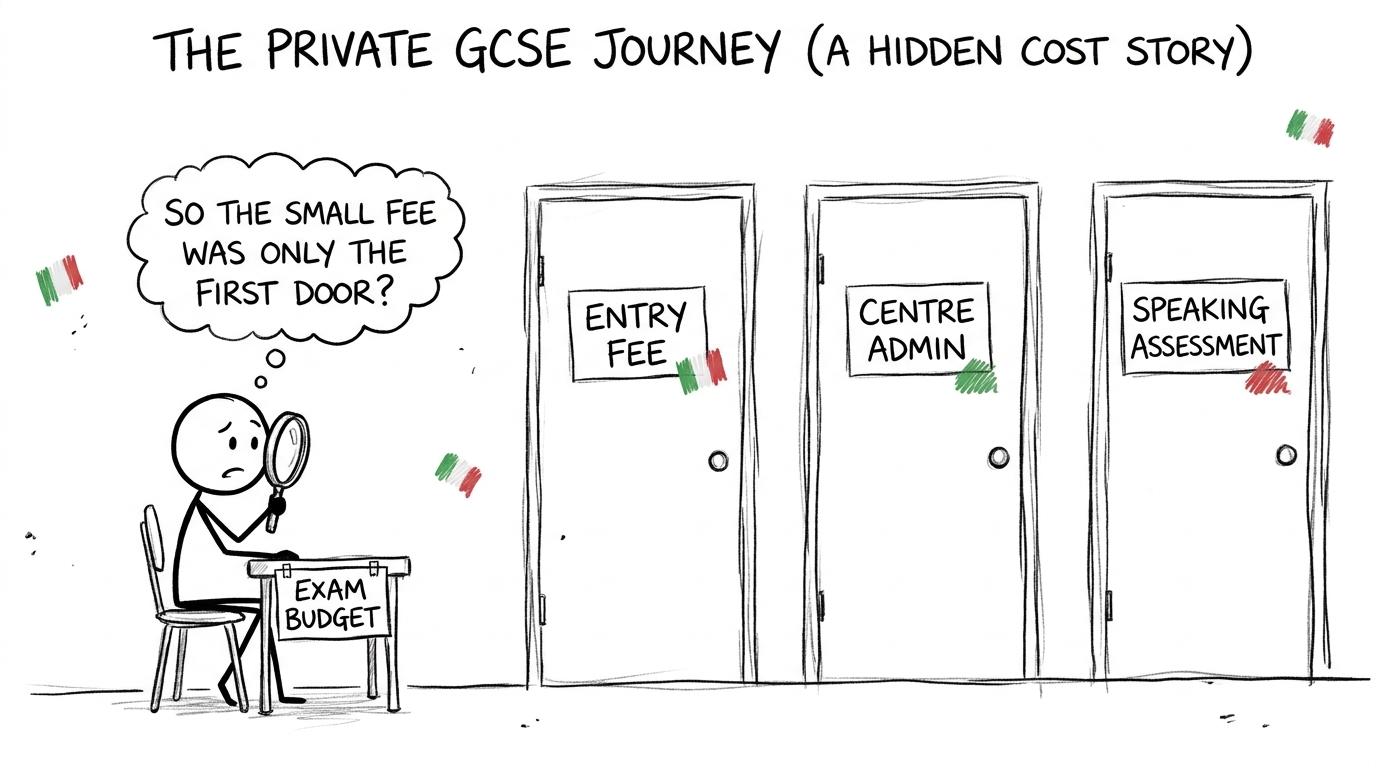 A private candidate discovers that the exam entry fee is only the first of several doors
What does sitting GCSE Italian actually cost?
There is no national fixed private-candidate price. Exam boards charge centres an entry fee, but each centre decides what it will charge for providing the examination service.
For context, Pearson’s published UK centre fees for 2025/26 set the GCSE Italian entry fee at ext£54.20 ext{£}54.20ext£54.20. A public 2026 school fee list rounded its Pearson Italian entry fee to ext£55 ext{£}55ext£55. However, commercial private-candidate centres reviewed for this guide advertised complete language examination prices around ext£300 ext{£}300ext£300 to ext£305 ext{£}305ext£305 before late fees.
Those figures explain why two apparently contradictory prices can both be correct. The lower amount is broadly the fee paid to the awarding organisation. The larger amount is what a private candidate may pay the centre for the complete service.
A sensible estimate can be expressed as:
Total cost=exam-board entry fee+centre charges+additional costs\text{Total cost}=\text{exam-board entry fee}+\text{centre charges}+\text{additional costs}Total cost=exam-board entry fee+centre charges+additional costsThe final quotation may include:
| Cost component | What it may cover |
|---|---|
| Exam-board entry | Registration for the complete GCSE qualification |
| Centre administration | Processing information, making the entry and communicating arrangements |
| Invigilation | Supervising the listening, reading and writing papers |
| Speaking assessment | An appropriate examiner, room, recording and submission procedures |
| Venue costs | Use of examination rooms and equipment |
| Access arrangements | Additional approved provision where this creates extra centre costs |
| Late charges | Fees applied when the centre or awarding-body deadline has passed |
| Results and certificate service | Results administration, collection or postage |
Never assume that a price described as an “entry fee” is the final amount. Ask whether it includes every required assessment and every centre charge.
Why the speaking exam affects the price
GCSE Italian assesses four skills: listening, speaking, reading and writing. Each contributes 25%25\%25% of the qualification under the AQA and Pearson Edexcel specifications researched for this guide.
The written components can be placed into an existing examination timetable. Speaking is different. The centre needs suitable staff, a supervised preparation area, recording equipment, secure materials and procedures for authenticating and submitting the assessment.
For Pearson Edexcel GCSE Italian, the speaking assessment is conducted by the centre and externally assessed. For AQA, the entering centre must accept responsibility for supervising and authenticating the speaking component. This is why a centre that accepts private candidates for GCSE Maths may not necessarily accept them for Italian.
Before booking, ask explicitly:
- Can you conduct and record the Italian speaking assessment?
- Is speaking included in the quoted price?
- Who conducts it?
- Will it take place at the same venue?
- When will the speaking date be confirmed?
Both AQA and Pearson specifications use foundation and higher tiers, and candidates take the same tier across all four skills. Foundation targets grades 1-5, while higher targets grades 4-9, with the usual grade 333 safety outcome possible under examination rules where applicable. Your tier must be settled before the assessments, not chosen separately paper by paper.
Where to book GCSE Italian as a private candidate
Start with the JCQ private-candidate centre search tool. JCQ is the Joint Council for Qualifications, and its postcode search lists approved centres that have indicated they may accept private candidates.
JCQ does not take your booking. The examination centre does.
The usual process is:
Choose the precise qualification
Decide whether you need AQA GCSE Italian or Pearson Edexcel GCSE Italian. Do not treat GCSE and International GCSE as interchangeable. Their specifications, assessment arrangements and availability may differ.
If a course provider or tutor has prepared you for a particular specification, use that board unless you have checked the differences carefully.
Search for possible centres
Use the JCQ search tool, then contact suitable centres directly. You can also ask local schools, colleges and established independent examination centres, although not every centre accepts external candidates.
Search results are only a starting point. A centre might accept private candidates generally but not offer Italian, or it may offer Italian only for one exam board.
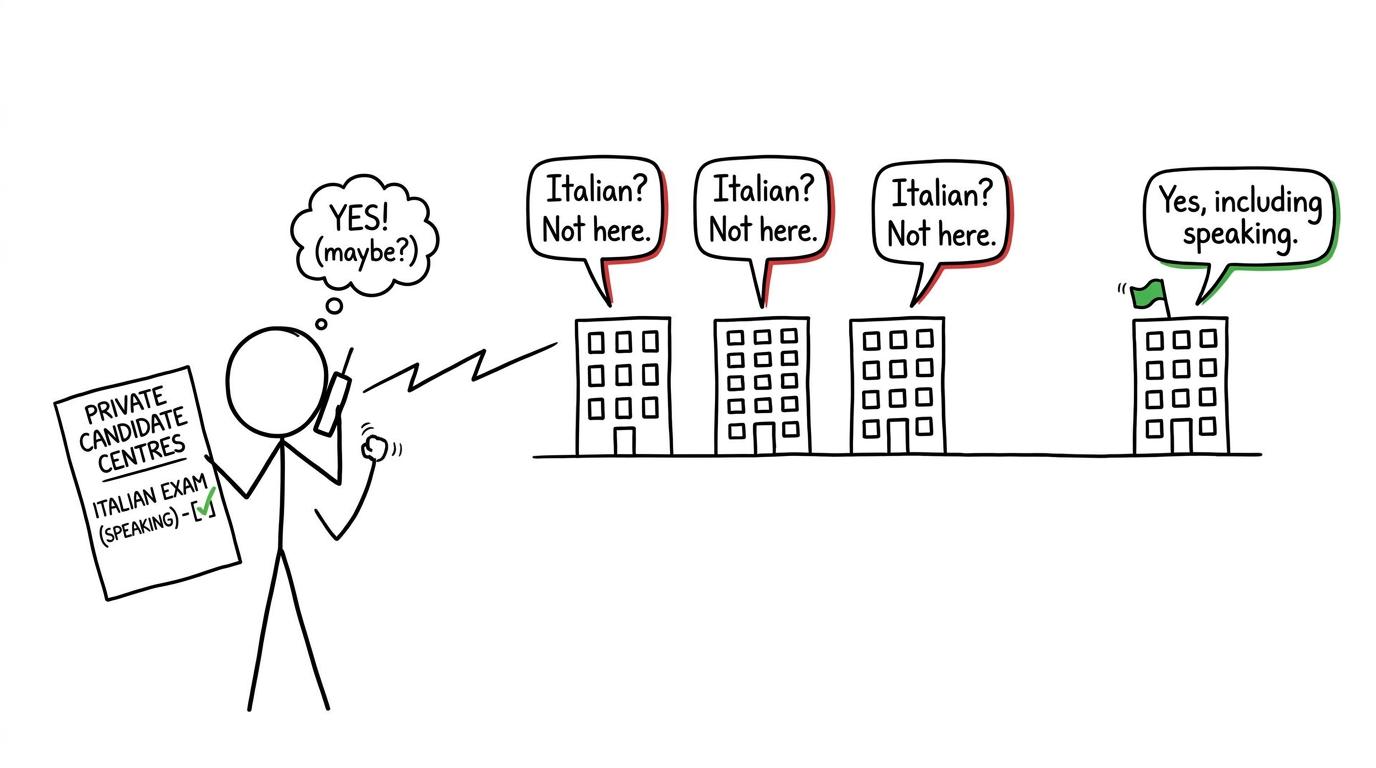 A student finally finds an exam centre that offers Italian and the speaking assessment
Request a written quotation
Ask for one figure showing the complete amount due. The quotation should identify the board, specification, tier and examination series, and confirm that speaking is included.
It is worth contacting several centres. The cheapest headline price is not automatically the best choice if travel is difficult, speaking arrangements are unclear or essential services cost extra.
Register and check your entry
The centre will normally request personal details, identification, contact information and details of previous examinations. If you already have a Unique Candidate Identifier, provide it when requested. If you need access arrangements, raise this at the first enquiry because evidence and approval procedures take time.
After entry, check your statement of entry carefully. Your name, board, subject, tier and component details must be correct.
Questions to ask an exam centre
A short, precise email usually produces a more useful answer than asking only, “How much is Italian?” Include these questions:
- Do you accept private candidates for GCSE Italian in the required examination series?
- Which board and specification do you offer?
- Can you provide both foundation and higher tier?
- What is the complete on-time fee?
- Does it include listening, speaking, reading and writing?
- Are examiner, recording, invigilation and administration charges included?
- What are your standard, late and final booking deadlines?
- What identification is required?
- Can you support my approved access arrangements?
- When and where will the speaking assessment take place?
- What is the refund policy if I withdraw?
Book early. Awarding organisations publish entry deadlines, but a centre may impose an earlier internal deadline so it has time to check documents, arrange staff and process entries. Published late fees can rise sharply, and a centre may stop accepting Italian candidates even while formal late entry remains possible.
Budgeting for the exam without disrupting maths revision
An extra subject creates two pressures: money and time. Both become easier when they are made visible.
Create a budget containing the centre fee, likely travel and a small contingency:
Budget=quoted fee+travel+contingency\text{Budget}=\text{quoted fee}+\text{travel}+\text{contingency}Budget=quoted fee+travel+contingencyDo not add costs that the centre has already included. Instead, obtain a detailed quotation and record what remains uncertain.
The same clarity helps with revision. GCSE Italian speaking preparation and GCSE Maths paper practice compete for the same evenings, especially in spring. A timetable should protect both rather than allowing the newest deadline to consume every session.
MathsGenie’s free GCSE Maths revision hub brings together board-specific lessons, practice questions, past papers and revision guides. On crowded school days, the 20-minute GCSE Maths revision routine provides a manageable way to keep practising while preparing for Italian.
Use GCSE Maths predicted papers nearer the examinations, but do not let them replace targeted learning. If you are unsure what deserves attention, follow the process for finding your weakest GCSE topics and repair the gaps first.
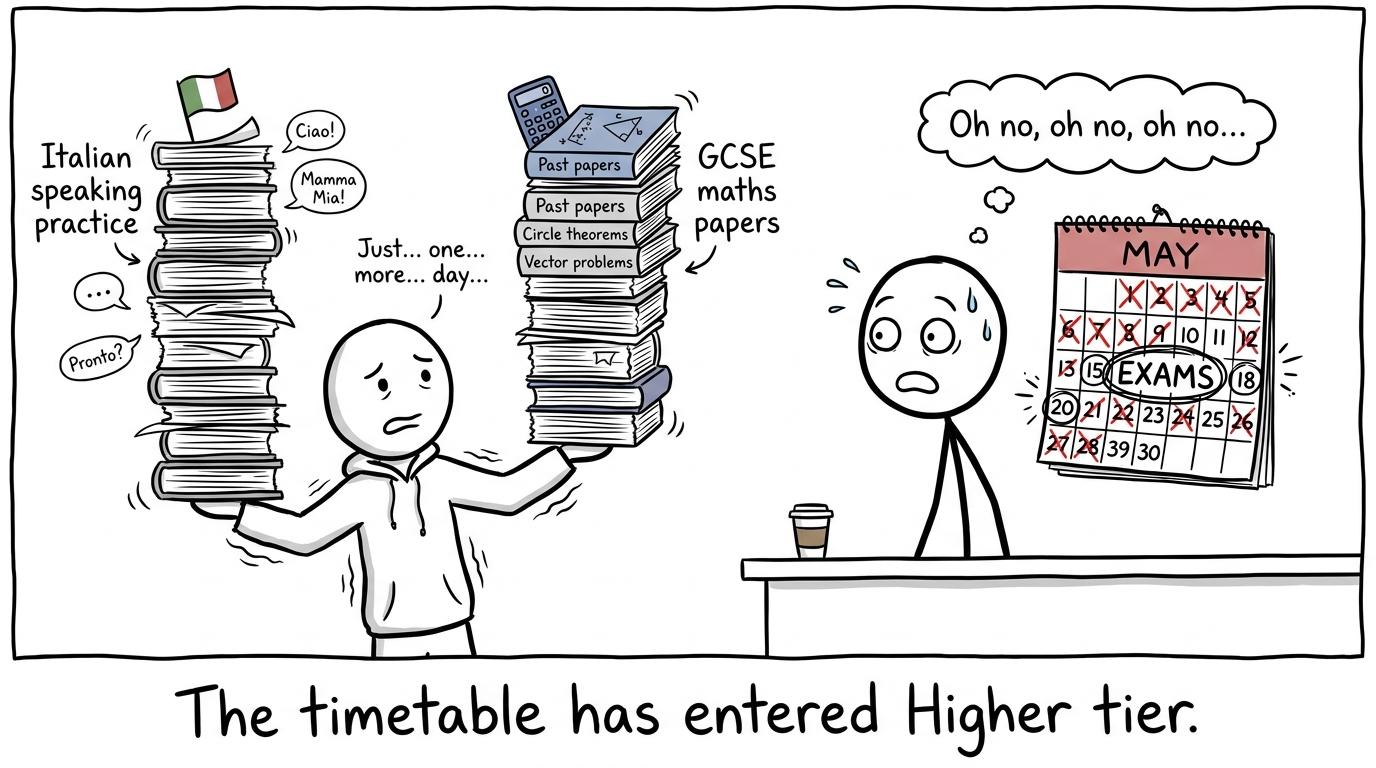 A student balances Italian speaking practice with GCSE maths papers while the calendar watches
Common mistakes private candidates should avoid
Comparing only the exam-board fee
The board’s fee is not normally the amount a private candidate pays. Compare complete centre quotations instead.
Booking a centre that cannot conduct speaking
Italian is not a written-only qualification. Obtain confirmation that the centre can administer the required speaking component for your chosen board.
Confusing GCSE with International GCSE
Check the full qualification title and specification code. Similar subject names do not guarantee identical papers or assessment arrangements.
Leaving the booking until the published deadline
Centres may close entries earlier, reach capacity or apply their own late charges. Begin contacting centres months in advance rather than relying on the final board deadline.
Choosing different tiers for different skills
You must be entered at one tier across the qualification. Confirm whether your entry is foundation or higher before approving it.
Forgetting travel and speaking dates
The speaking assessment is normally held before the main written papers. Include both journeys when comparing centres, particularly if the cheapest option is far from home.
Paying without checking the refund policy
Ask what happens if you withdraw, change tier or miss an assessment. Policies and recoverable fees vary between centres.
Book early, then return your attention to revision
The real GCSE Italian exam cost for a private candidate is not a single national tariff. Pearson’s 2025/26 awarding-body entry fee was ext£54.20 ext{£}54.20ext£54.20, but published private-centre prices around ext£300 ext{£}300ext£300 show why the final bill is higher. Your safest action is to find an approved centre through JCQ, confirm that it offers the correct specification and speaking assessment, and obtain an all-inclusive written quotation.
Once the booking is secure, the uncertainty disappears. You can return to the work that earns marks.
For maths, start with a focused GCSE revision strategy, learn through MathsGenie’s free revision lessons and practice questions, then build examination confidence with past papers, mark schemes and video solutions. The guide to using Edexcel past papers properly can help you turn each attempt into a clear list of improvements.
If the examinations are close, use the one-week GCSE Maths revision plan to organise mini tests, topic repair and predicted papers. Booking removes one worry. A calm, repeatable MathsGenie routine takes care of what comes next.











