GCSE History Tutoring Cost: UK Price Guide
GCSE history tutoring cost explained: compare typical UK hourly rates, calculate a realistic revision budget and decide whether a private tutor is worth it.
The difficult part of choosing a tutor is not finding someone who knows history. It is deciding whether an hour of their help will be worth an hour of your family's budget. A realistic GCSE history tutoring cost is usually around £25\pounds 25£25 to £50\pounds 50£50 per hour in the UK, although newer tutors may charge less and experienced teachers, examiners or agency specialists may charge £60\pounds 60£60 or more.
At the time of checking, Tutorful published an average History tutoring rate of £36.58\pounds 36.58£36.58 per hour and a GCSE-wide average of £35.86\pounds 35.86£35.86. Current marketplace listings elsewhere begin in the mid-£20\pounds 20£20s and rise well beyond £60\pounds 60£60. These are useful benchmarks, not a national tariff. Location, qualifications, lesson format and the tutor's familiarity with your exact exam specification all affect the final price.
For students balancing History with GCSE maths, the larger question is where paid support will make the greatest difference. Free resources can cover much of your independent maths revision, leaving your tutoring budget for a subject or skill where personalised feedback is genuinely needed.
GCSE history tutoring cost at a glance
Use this checklist before comparing tutors:
- Expect many one-to-one lessons to fall between £25\pounds 25£25 and £50\pounds 50£50 per hour.
- Online lessons often provide a wider choice of tutors and may cost less than comparable in-person support, although this is not guaranteed.
- Qualified teachers and tutors with extensive exam-board experience commonly charge more.
- Check whether marking, resources and support between lessons are included.
- Confirm the tutor knows your board and chosen topics, not simply “GCSE History”.
- Agree a review point so tutoring does not continue without evidence of progress.
- Ask about safeguarding, references, qualifications and cancellation terms.
 A student's revision budget survives an encounter with private tutoring
Typical UK prices for private History tuition
There is no compulsory price for private tutoring in the UK. Tutors and agencies set their own rates, so the advertised market is broad. The following bands are a practical guide rather than a promise about what every tutor will charge.
| Type of support | Indicative hourly cost | What you may find |
|---|---|---|
| Student or newer tutor | £20\pounds 20£20 to £30\pounds 30£30 | Subject knowledge, flexible support and lower prices, but potentially less classroom experience |
| Established online History tutor | £30\pounds 30£30 to £45\pounds 45£45 | Regular GCSE teaching, prepared resources and familiarity with exam questions |
| Experienced teacher or specialist | £40\pounds 40£40 to £60\pounds 60£60 | Detailed specification knowledge, structured feedback and stronger diagnostic teaching |
| Examiner or premium agency tutor | £60\pounds 60£60 to £90+\pounds 90+£90+ | Extensive assessment experience or a premium matching service, although the higher fee does not guarantee a better personal fit |
The middle band is where many families are likely to find an established tutor. Paying at the top of the range can make sense for a specific need, but price alone is weak evidence of teaching quality.
What does that mean for a revision budget?
A weekly lesson is a recurring commitment, not a one-off purchase. If a suitable tutor charges between £30\pounds 30£30 and £45\pounds 45£45, the likely totals are:
| Lesson pattern | Approximate total |
|---|---|
| Two lessons per month | £60\pounds 60£60 to £90\pounds 90£90 per month |
| Four lessons per month | £120\pounds 120£120 and £180\pounds 180£180 per month |
| Twelve weekly lessons | £360\pounds 360£360 and £540\pounds 540£540 in total |
A clear budget formula is:
total cost=price per lesson×number of lessons.\text{total cost}=\text{price per lesson}\times\text{number of lessons}.total cost=price per lesson×number of lessons.Also compare lessons of different lengths fairly. The effective hourly rate is:
hourly rate=lesson pricelesson length in minutes×60.\text{hourly rate}=\frac{\text{lesson price}}{\text{lesson length in minutes}}\times 60.hourly rate=lesson length in minuteslesson price×60.Ask about booking fees, subscriptions, travel charges, cancellation policies and minimum packages before committing. A low headline rate becomes less attractive if the platform adds costs or requires a long block of lessons.
Why prices vary so much
Qualifications and experience
A current teacher may charge more because they understand classroom expectations, common misconceptions and how to sequence improvement. A former examiner may bring particularly useful insight into assessment language. However, neither title automatically proves that the tutor communicates well with a particular student.
A university student with strong subject knowledge can still be an excellent choice for content recall, confidence and accountability. The right level of expertise depends on the problem being solved.
Online or face-to-face lessons
Face-to-face tuition may include travel time and local demand in the price. Online tuition removes geography from the search, potentially giving students access to a tutor who teaches their exact Edexcel, AQA, OCR or Eduqas option.
Online teaching still needs more than a video call. Ask how the tutor shares sources, annotates answers, checks understanding and returns written feedback.
Exam-board and topic knowledge
GCSE History is not divided into foundation and higher tiers as GCSE maths is. Instead, schools select particular studies from an exam board's specification. Two students taking “GCSE History” may be revising very different periods and question structures.
A useful tutor should ask for your exam board, specification and chosen units before the first proper lesson. They should also understand the four assessment objectives used across GCSE History: knowledge and understanding account for 35%35\%35%, analysis using second-order concepts accounts for 35%35\%35%, source evaluation accounts for 15%15\%15%, and interpretation evaluation accounts for 15%15\%15%.
That matters because memorising more dates will not repair every weakness. A student may know the content but struggle to analyse causation, use a source in context or reach a substantiated judgement.
How to judge whether a History tutor is worth it
The best tutor is not necessarily the person with the longest biography. It is the person who can identify why marks are being lost and turn that diagnosis into a manageable plan.
Start with a precise problem
“Get better at History” is too vague. A stronger goal might be:
- selecting evidence for an extended response;
- explaining cause and consequence rather than describing events;
- evaluating provenance without relying on stock phrases;
- comparing interpretations;
- completing answers within the available time; or
- rebuilding missing knowledge in one named unit.
Specific goals make it possible to review whether tuition is working.
Look for feedback, not performance
A polished explanation can feel impressive while leaving the student passive. Effective tuition should require the student to retrieve knowledge, plan answers, explain choices and respond to feedback.
Ask a prospective tutor how they diagnose gaps, what work happens between sessions and how they measure progress. Good answers should be concrete. Useful evidence might include improved timed responses, fewer repeated errors and better performance against the relevant mark scheme.
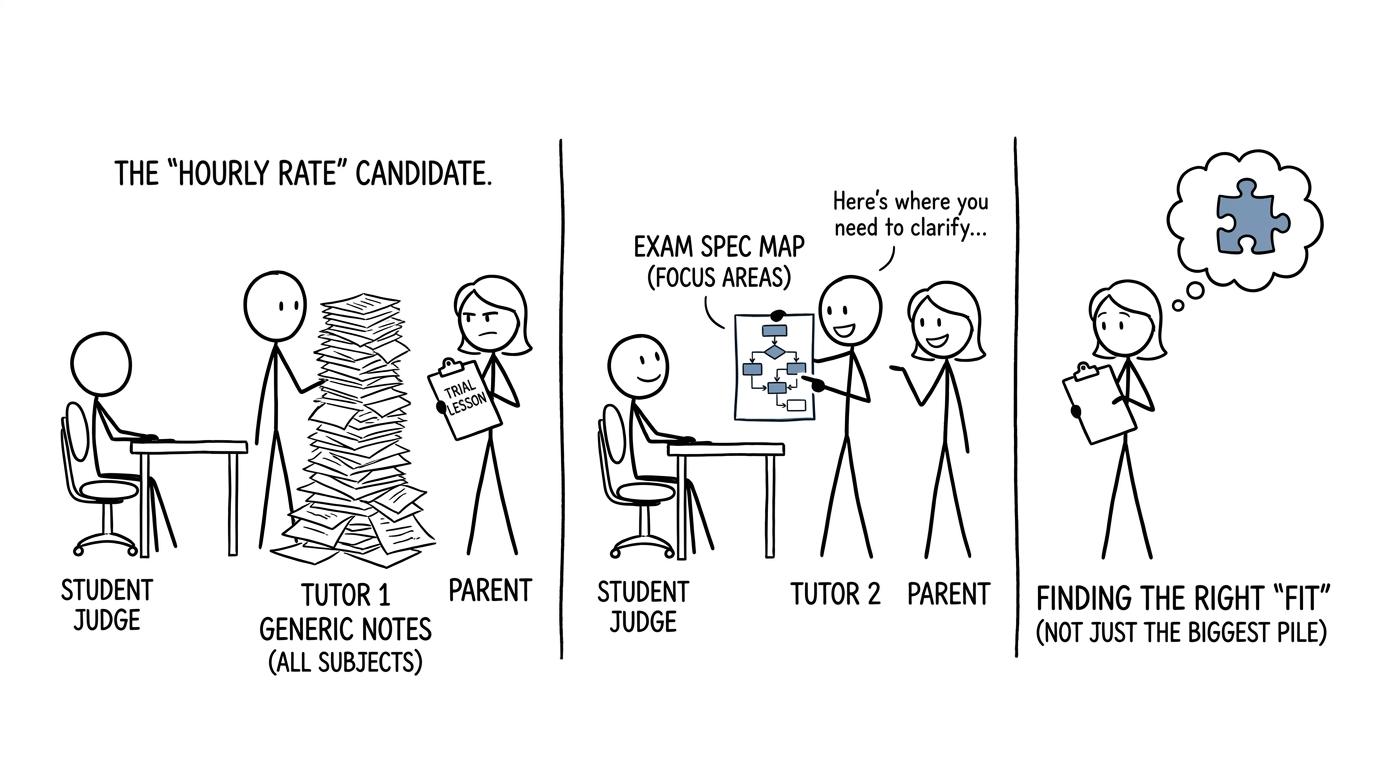 Choosing a tutor by fit rather than by the largest pile of notes
Use a trial lesson and a review point
A trial lesson should reveal whether the tutor listens, adapts and gives understandable feedback. Before booking a long package, agree to review progress after perhaps three or four sessions.
Ask three questions at that point:
- Can the student explain what has improved?
- Is independent work becoming more accurate or confident?
- Is the tutor still addressing a defined need?
If the answer is repeatedly no, a different tutor, format or revision method may offer better value.
Treat safeguarding as part of quality
Parents and carers should ask how sessions are managed safely, whether online or in person. Government guidance encourages families to consider safeguarding arrangements in private tuition and other out-of-school settings.
Check identity, relevant qualifications and references. Ask to see an appropriate, recent DBS certificate where available, but do not treat a certificate as a complete safeguarding system. Agree who communicates with the tutor, where lessons occur, who will be present and how concerns can be raised. Professional tutors should welcome clear boundaries and parental oversight.
Could free revision reduce the need for tutoring?
Tutoring is most valuable when it provides something that independent revision cannot easily supply: diagnosis, tailored explanation, accountability or detailed feedback. It is less valuable when the session simply repeats information already available in a textbook or free lesson.
This distinction matters for students preparing for several GCSEs. MathsGenie's free GCSE maths revision hub provides revision lessons, practice questions, papers and solutions across major boards. Using those resources independently may preserve paid tutoring for History essay feedback or another need that is harder to meet alone.
Start maths revision by identifying actual gaps rather than buying general support. The GCSE maths revision timetable guide explains how to combine topic learning with regular exam practice. Students who need a shorter plan can use the one-month GCSE maths revision plan.
Past papers also provide a free diagnostic. The guide to starting GCSE past papers at the right time helps students decide when to move from topic practice to timed work. Edexcel students can follow the method in how to use GCSE maths past papers properly, then add Edexcel predicted papers near the examination.
The principle works across subjects: use free resources for explanation and repetition, then pay for personalised intervention only where it changes what happens next.
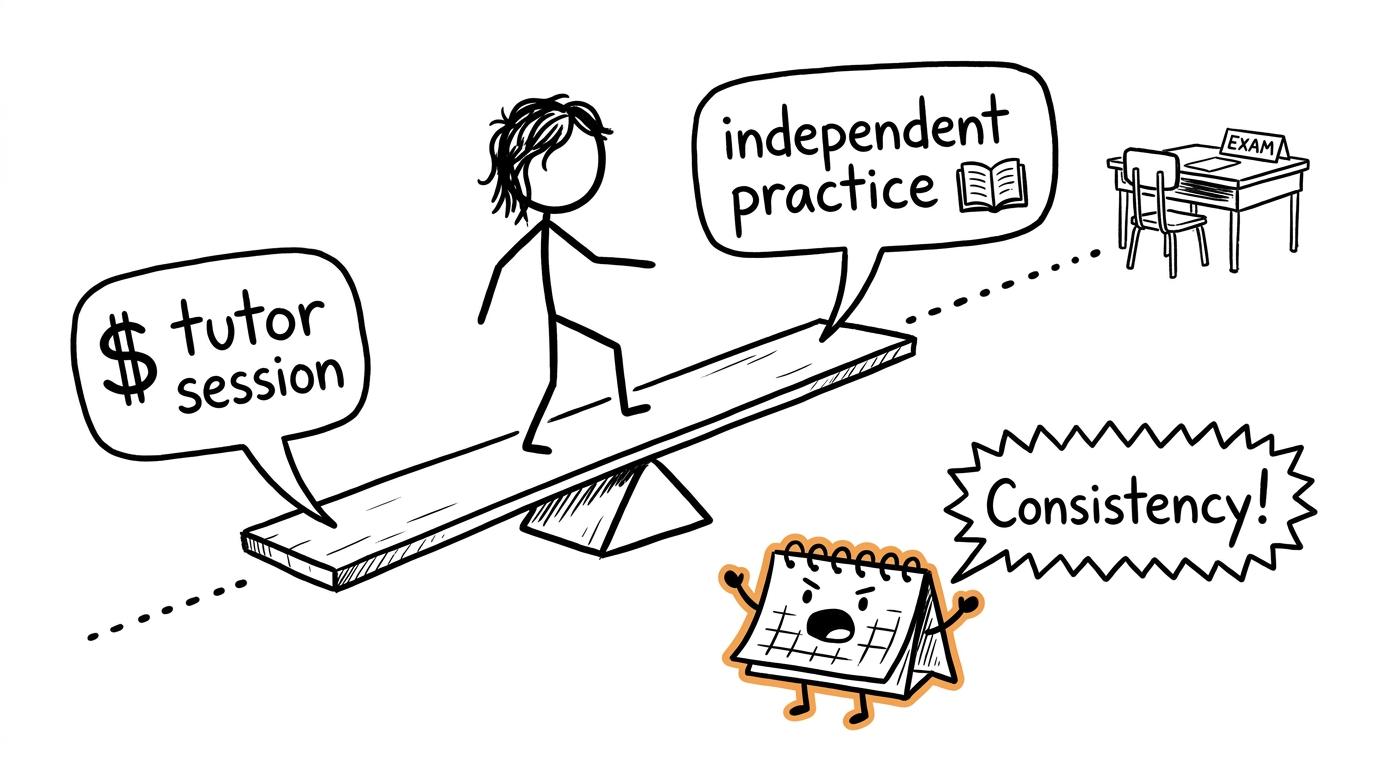 Paid guidance and independent practice balancing on the road to an exam
Common mistakes when choosing private tuition
Assuming the most expensive tutor must be best
Higher prices may reflect experience, location or agency fees. They do not guarantee rapport, clear explanations or familiarity with your chosen units. Compare the tutor's method with the student's need.
Booking a large package too early
A discounted package can reduce the hourly rate, but it also reduces flexibility. Begin with a trial and check the refund and cancellation conditions before paying in advance.
Failing to name the exam board
History content and paper structures vary. A tutor who knows a different board or topic may spend paid time learning what should have been confirmed beforehand.
Paying for explanations without practising
Listening is not the same as learning. Between lessons, the student should retrieve content and complete relevant questions. The same habit strengthens maths revision: turn notes into active practice using the MathsGenie active recall guide.
Continuing without measuring progress
Tutoring can become a comforting routine. Keep a simple record of the starting problem, feedback received and remaining weaknesses. If the original need has been resolved, reduce the frequency or stop.
Make the decision around the problem, not the price
For most families, a sensible starting expectation for private GCSE History tuition is approximately £25\pounds 25£25 to £50\pounds 50£50 per hour, with an established tutor often sitting near the middle of that range. The better question is not simply, “Is this rate reasonable?” It is, “What will this tutor do that the student cannot do effectively alone?”
Define the gap, check specification knowledge, take a trial lesson and review the evidence after a small number of sessions. Meanwhile, keep the rest of revision efficient. Use MathsGenie's free lessons and practice questions to repair maths topics, mini tests to check recall, and past papers, predicted papers, mark schemes and video solutions to build exam readiness. Paid support should sharpen a revision plan, not replace one.