

Is GCSE German Similar to GCSE French?
GCSE German similar to GCSE French? Compare exam skills, vocabulary, grammar and workload, then decide whether taking both subjects is right for you.
Enjoying GCSE German can create an interesting question: if one language clicked, might another do the same? The short answer is that GCSE German is similar to GCSE French in exam structure and learning skills, but not nearly as similar in vocabulary, grammar or pronunciation.
You would reuse valuable habits: learning vocabulary, recognising tense clues, listening for detail, answering role-plays and building accurate sentences. However, French is not simply German with different words. It belongs to a different language family and brings its own sound system, verb patterns and grammatical conventions.
So, should you try both? Probably yes if you genuinely enjoy language learning, have enough timetable space and can protect your maths and other core-subject revision. Enjoying German is encouraging evidence, not a guarantee.
The quick decision checklist
Before choosing GCSE French as well as German, ask:
- Do I enjoy understanding how languages work, rather than only enjoying my current class?
- Am I comfortable practising listening, speaking, reading and writing?
- Can I keep vocabulary from two languages separate?
- Does my school allow both subjects within its options system?
- Which exam board and specification would I follow?
- Can I fit two languages around English, science and GCSE maths revision?
- Have I tried a French lesson, vocabulary list or sample assessment before deciding?
If most answers are positive, French could be a sensible second language. If your enthusiasm depends mainly on one teacher, one topic or consistently easy homework, investigate further before committing.
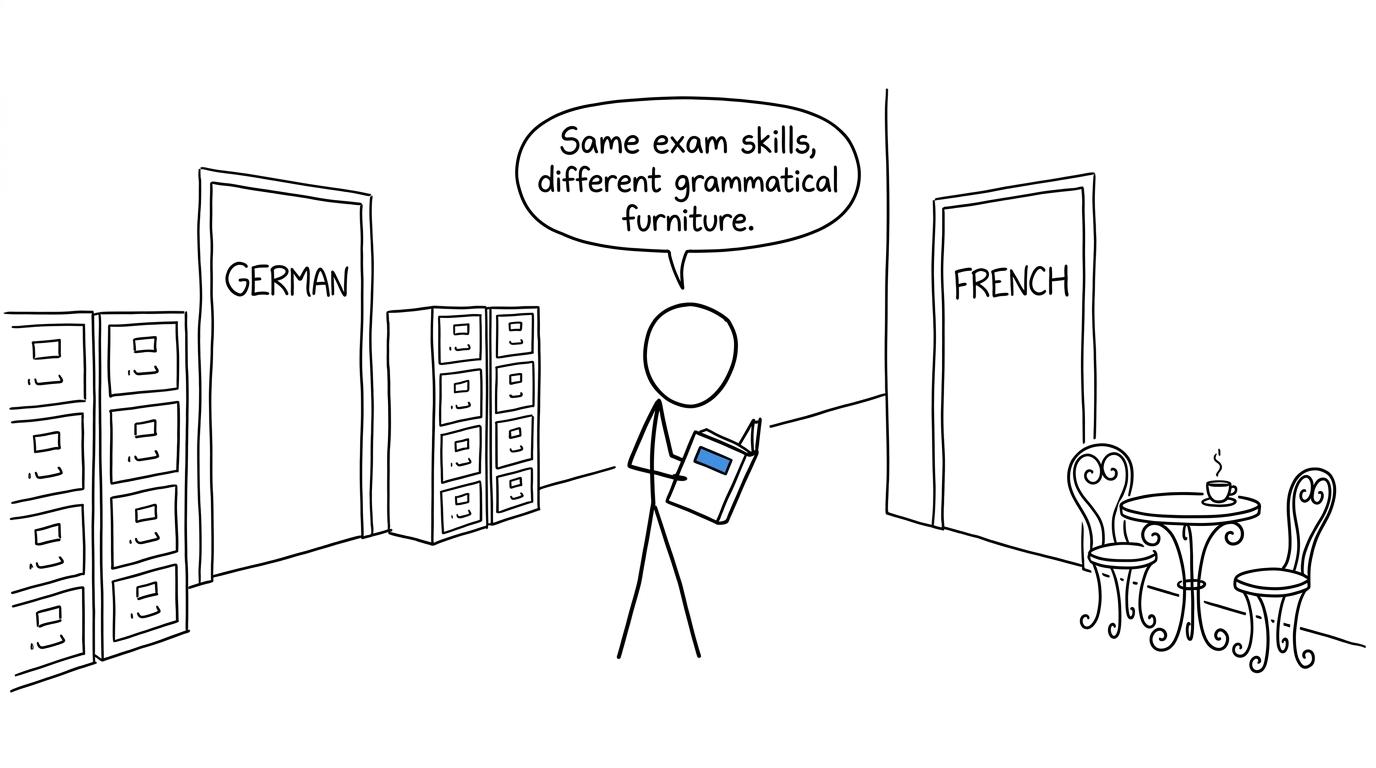 A student choosing between German and French doors while noticing that the exam skills match but the grammar does not
How much overlap is there between GCSE German and French?
The most useful distinction is between qualification overlap and language overlap.
The qualification overlap is substantial. In England, the reformed GCSE French and German specifications taught from September 2024, with first examinations in summer 2026, share national subject-content and assessment requirements. Both involve understanding and producing language through listening, speaking, reading and writing. Both are available at foundation and higher tier.
The language overlap is much smaller. German is a Germanic language, while French is a Romance language. English has connections with both, which can occasionally make words recognisable, but French and German are not mutually understandable.
| Area | Genuine overlap | Important difference |
|---|---|---|
| Exam skills | Listening, speaking, reading and writing are central to both | Exact paper timings and task arrangements depend on the exam board |
| Speaking | Role-play, reading aloud and interaction around visual material feature in the reformed qualifications | Pronunciation rules and natural sentence patterns differ |
| Vocabulary learning | Retrieval practice, flashcards and spaced review work for both | Similar meanings rarely mean identical spelling, gender or usage |
| Grammar | Both use grammatical gender, verb changes and word agreement | German has a more extensive case system; French relies heavily on conjugation and agreement |
| Translation | Meaning, tense and context matter in both | Word-for-word translation produces different errors in each language |
| Tiers | Both have foundation and higher routes | Your school may not enter you for the same tier in both subjects |
That means experience in German gives you a useful learning framework. It does not remove the need to learn French from the beginning.
The exam skills that transfer well
You already understand active vocabulary revision
A first language teaches you that recognising a word is not the same as being able to produce it. If you have learnt to retrieve German vocabulary without looking, check noun details and revisit forgotten words, the same system will help with French.
The lists themselves will be different, but the revision behaviour transfers almost perfectly. Short, repeated recall is more useful than copying a long vocabulary list once.
You know how to listen selectively
GCSE listening is not about understanding every sound. Strong candidates listen for the details that answer the question: who did something, when it happened, whether an opinion was positive or negative, and what changed.
Those habits transfer to French. Yet the listening experience may initially feel different because spoken French links and reduces sounds in ways that are unfamiliar to a German learner. Your strategy survives; your ear needs retraining.
You have experience building answers under pressure
The reformed French and German GCSEs share speaking features such as role-play, reading aloud and unprepared interaction. Exact formats vary between AQA, Edexcel and other awarding organisations, so always check the specification used by your school.
Knowing how to stay calm, respond directly and recover after a hesitation is genuinely useful. The transferable part is communication under pressure, not a memorised German script.
You recognise the value of accuracy
In both languages, small details can change the quality of an answer: a verb ending, an article, an adjective or a misplaced negative. German may have trained you to notice sentence structure and grammatical signals. French will reward the same attention, even though the rules are different.
This habit resembles successful maths revision. You learn a method, attempt questions, inspect the error and try again. MathsGenie’s guide to finding your weakest GCSE topics applies the same principle: useful practice identifies a precise weakness instead of producing a vague feeling of effort.
Where German and French feel genuinely different
Grammar is organised differently
German uses three grammatical genders and four cases. Articles and adjective endings can change according to a noun’s role in the sentence. Word order also becomes especially important when clauses grow more complex.
French uses two grammatical genders. It does not use a German-style four-case system, but it places considerable emphasis on verb conjugation, agreement and the relationship between written endings and spoken forms.
There are points of familiarity. Both distinguish between informal and formal ways of addressing someone. Both require learners to notice gender. But you should resist forcing a German rule onto a French sentence.
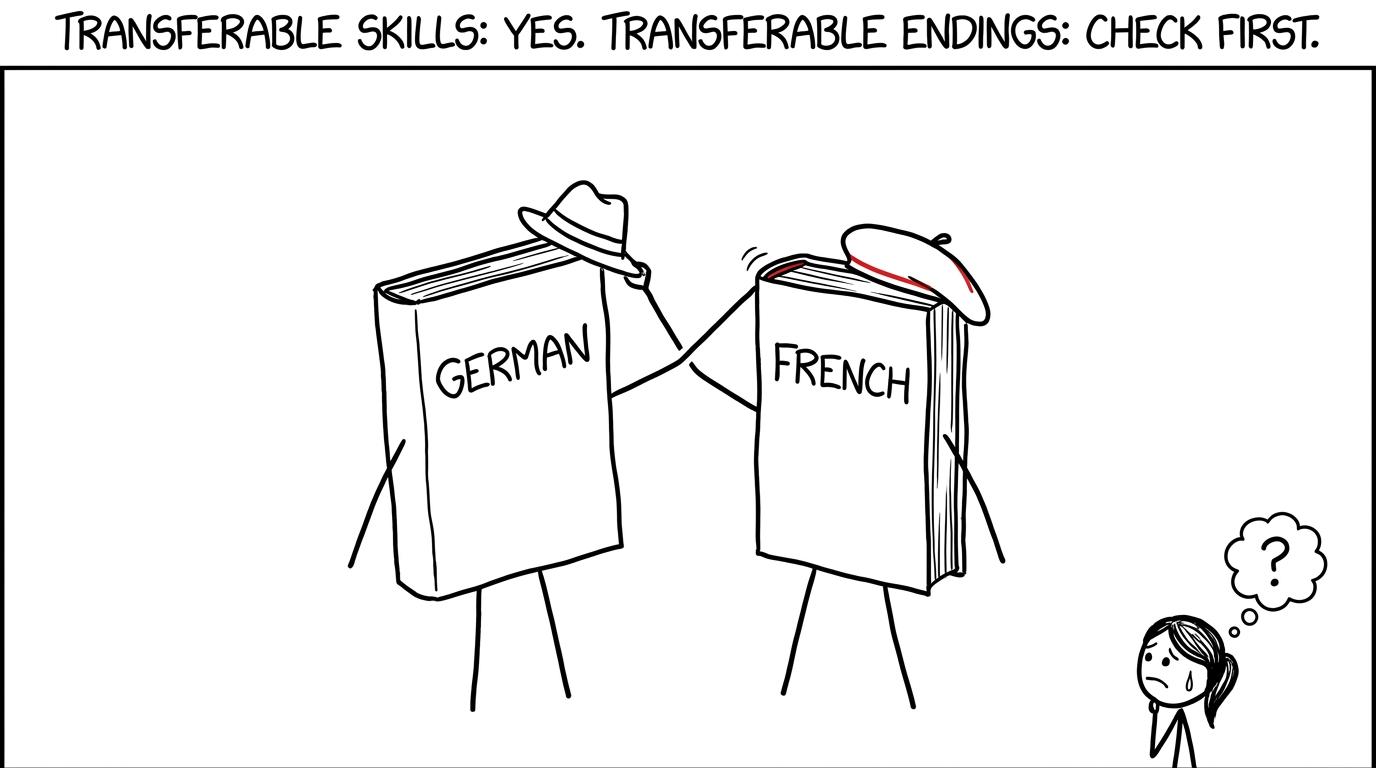 Two dictionaries discover that transferable skills do not make grammatical endings interchangeable
Pronunciation requires a fresh start
German spelling can often provide relatively direct clues to pronunciation once its sound patterns are known. French contains more silent letters, linked sounds and distinctions that may not be obvious from English spelling habits.
Neither system is automatically easier. Familiarity matters. A student who enjoyed the orderly patterns of German pronunciation may initially find French listening less transparent, while another may enjoy the rhythm and flow immediately.
The sensible test is practical: listen to beginner-level French and try reading a short passage aloud after learning the main sound-spelling relationships. Your reaction will tell you more than stereotypes about which language is supposedly difficult.
Vocabulary overlap is helpful but limited
English contains vocabulary influenced by both French and Germanic sources, so occasional words may look familiar. International terms and modern borrowed words can also create useful connections.
Still, cognates should be treated as clues, not proof. A familiar-looking word may have a narrower meaning, a different gender or an unexpected pronunciation. False friends can be especially persuasive because they feel too obvious to check.
German knowledge will not unlock French vocabulary directly. What transfers is your ability to classify words, notice patterns and verify meaning from context.
Will taking two languages harm your maths revision?
Not necessarily. The real issue is opportunity cost.
Two languages bring two vocabulary systems, speaking preparation and sets of assessments. During a busy GCSE term, that workload sits beside English, science and maths. A second language becomes a poor choice only when it makes the overall plan unrealistic.
Before committing, build a sample week. Include lessons, homework, travel, rest and focused revision. Maths should retain regular practice because procedural skills fade when they are left untouched for long periods.
A manageable routine could combine brief language retrieval with a focused maths session. The 20-minute GCSE maths revision routine is useful on crowded school days, while a longer weekly session can be reserved for GCSE predicted papers or past-paper practice.
The goal is not to squeeze work into every empty minute. It is to create a timetable you can still follow when school becomes busy. The MathsGenie GCSE revision timetable guide can help you test whether your plan leaves enough space for practice, marking and rest.
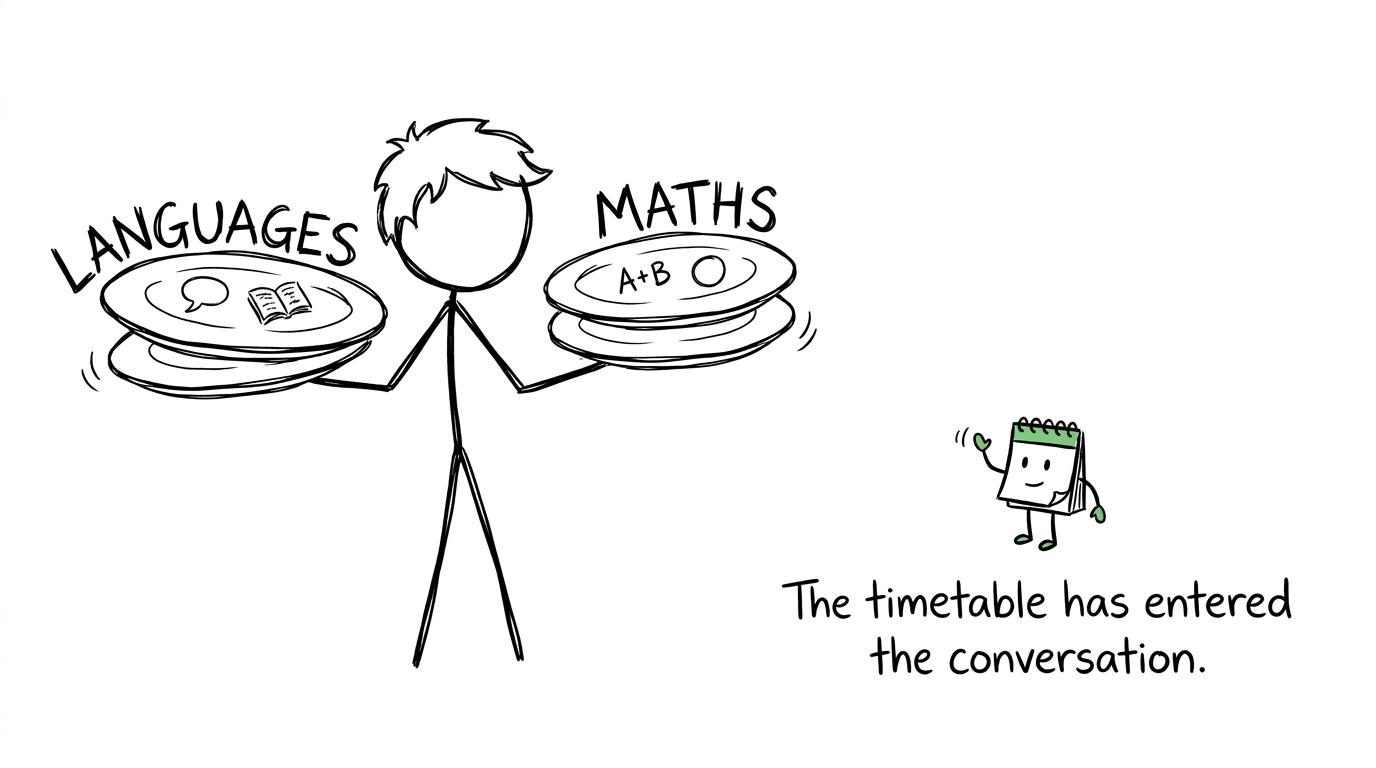 A student balances language and maths revision as the timetable politely demands attention
How to test French before choosing it
A small trial is better than an abstract debate. Over one or two weeks:
- learn a short set of high-frequency French words;
- listen to beginner speech and identify details;
- practise the key sound-spelling patterns;
- write a few original sentences without copying;
- look at sample material from your school’s exam board;
- ask the languages department about teaching time and expectations.
Judge the process, not just your first score. Did you enjoy noticing patterns? Were you willing to repeat difficult sounds? Did correcting mistakes feel satisfying or merely draining?
Then examine your wider workload. Use a maths mini test or paper section to see whether your current revision is already secure. If you need a clearer overview of what must be covered, the GCSE maths topics by exam board and tier guide provides a practical map for Edexcel, AQA, OCR and Eduqas students.
Common mistakes when deciding between French and German
Assuming similar exams mean similar languages
Shared assessment skills reduce the learning curve, but they do not make French vocabulary or grammar familiar. Expect transfer and new learning at the same time.
Choosing French only because German went well
Success in German is evidence that you can learn a language. It does not show that you will enjoy French pronunciation, classroom activities or cultural content. Try the subject first.
Believing one language is universally easier
Difficulty depends on prior experience, teaching, motivation and the aspects of language you find intuitive. General claims about French or German being easier are not a reliable basis for an option choice.
Ignoring the exact specification
AQA and Edexcel, for example, must follow common national requirements, but their paper structures, timings and resources are not identical. Confirm the board, tier and assessment format with your school.
Planning around your best week
A timetable that works only when there is no homework or exam pressure is not a plan. Build around an ordinary busy week and leave spare capacity. If exams are approaching, a structured one-month GCSE maths revision plan can help protect core practice.
Should you take GCSE French as well?
If you enjoyed analysing German, practising unfamiliar sounds and gradually turning fragments into real communication, French is worth exploring. The strongest overlap lies in the learning process and assessment skills. The weakest lies in the language itself.
Choose both when curiosity is matched by time, school support and a sustainable revision plan. Choose one when the second subject would stretch your timetable beyond what you can manage well. Neither decision reflects your ability; it reflects how carefully you are allocating attention.
Whatever you choose, keep maths revision steady. Start with the free MathsGenie GCSE hub, use revision lessons and practice questions to repair individual topics, then test your progress with mini tests, past papers, predicted papers, mark schemes and video solutions. A good option choice opens a door. A good revision system makes sure the rest of your subjects can walk through it too.











