GCSE Geography Year 10 Revision Head Start: Worth It?
GCSE geography Year 10 revision head start advice: discover whether early revision improves recall, how to avoid burnout and balance geography with maths.
There is a particular kind of worry that appears in Year 10. You have only just begun the GCSE course, yet Year 11 already seems to be approaching. Geography case studies are accumulating. Maths topics are becoming less forgiving. Someone mentions revision, and suddenly it feels as though you should be working every evening.
The short answer is that a GCSE geography Year 10 revision head start can help, but only if “revision” means short, spaced recall of material you have already been taught. It should not mean completing Year 11 papers too early, learning the whole specification alone or sacrificing rest. The advantage comes from reducing future forgetting, not extending exam pressure across two years.
The early-revision checklist
A sensible Year 10 approach looks like this:
- Check your geography exam board and specification.
- Review only content already covered in lessons.
- Use retrieval rather than repeatedly reading notes.
- Revisit topics across several weeks.
- Preserve your fieldwork records and case-study details.
- Keep sessions short enough to remain sustainable.
- Continue practising maths alongside knowledge-heavy subjects.
- Leave full-paper practice until you have covered enough content for it to be useful.
That is a head start. A permanent mock-exam season is not.
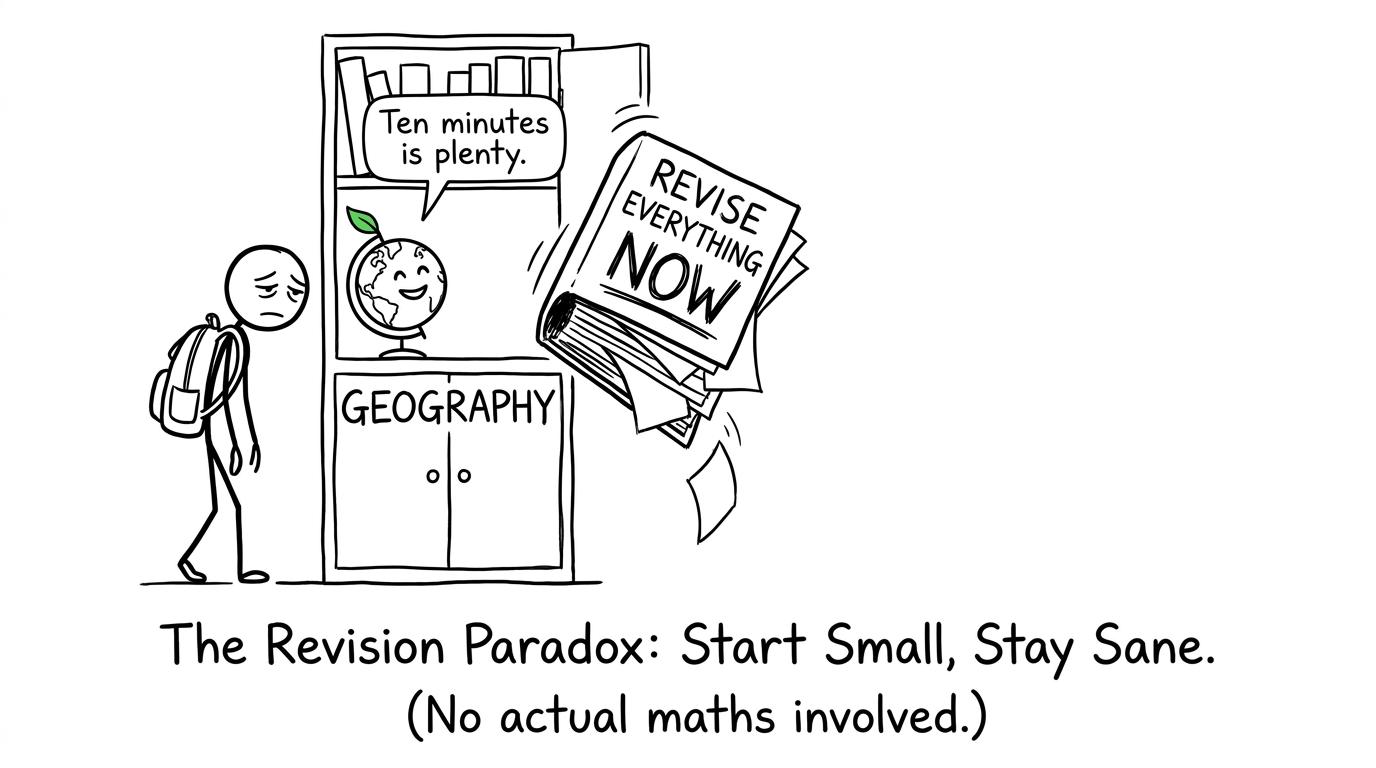 A student discovers that a tiny geography revision session is less intimidating than revising everything at once
Why starting geography revision in Year 10 can help
Early revision works best when it changes the shape of the task. Instead of meeting a topic once in class and trying to recover it months later, you return to it briefly while it is still recognisable.
Evidence reviewed by the Education Endowment Foundation supports active retrieval and spaced practice as useful approaches to learning. Retrieval means attempting to recall information before consulting your notes. Spacing means returning to that information after a delay rather than compressing the same amount of work into one long session.
This matters in geography because the course contains several kinds of learning at once: physical and human processes, place knowledge, examples and case studies, fieldwork, maps, data, numerical skills and extended responses. Official GCSE subject content also requires students to interpret geographical information and use quantitative and statistical techniques. You are not merely memorising a list of facts.
An early start gives each strand room to develop. You might retrieve a process one week, explain its consequences the next and later connect it to a named example. That is more useful than producing immaculate notes that are never tested.
What the GCSE geography course actually demands
The exact paper structure depends on whether your school follows AQA, Edexcel, OCR or Eduqas, so begin with the specification used by your centre. Do not assume that a friend at another school needs identical case studies or sits papers in the same format.
Across GCSE geography specifications in England, students develop knowledge of places, physical and human processes, people-environment relationships, maps, data and fieldwork. Fieldwork is undertaken in contrasting environments and is assessed through written examinations rather than a separate piece of coursework. Under the official subject framework, fieldwork contributes 15%15\%15% of the overall assessment weighting.
That makes Year 10 especially valuable if your school completes fieldwork during the year. Preserve the investigation question, location, sampling method, data-presentation choices, findings, limitations and possible improvements. Months later, a clear one-page fieldwork record is more useful than trying to reconstruct the day from memory.
Geography also includes graphical, numerical and statistical reasoning. That creates a useful bridge to GCSE maths: averages, range, percentages, proportional symbols, scale, coordinates, data interpretation and unfamiliar graphs all reward careful quantitative thinking. Maths revision is therefore not competing with every part of geography. Some skills reinforce both subjects.
For structured mathematical support, the GCSE maths revision hub provides free lessons, exam questions, worksheets and paper resources across the major exam boards.
The difference between a head start and burnout
Burnout is not caused simply by opening a revision book in Year 10. The greater risk is adopting a routine that is intense, vague and impossible to maintain.
“Revise geography” is vague. “Recall the stages of the fieldwork enquiry and check what I missed” is finite. The second task has an ending, which matters more than it sounds.
A sustainable routine could contain one or two short geography reviews each week. Start from memory, check against trusted class materials, correct errors and return to the topic later. Stop while you still have enough attention to learn properly.
The same principle can organise maths. MathsGenie’s GCSE maths revision timetable guide explains how to combine focused topic sessions with timed practice, while the short maths revision routine is designed for busy school days.
Early revision becomes harmful when it removes recovery time, disrupts sleep, causes persistent anxiety or displaces current homework and teaching. If that begins to happen, reduce the load and speak to a teacher, parent, carer or pastoral lead. A plan should make the course feel more manageable, not make every evening feel like an examination.
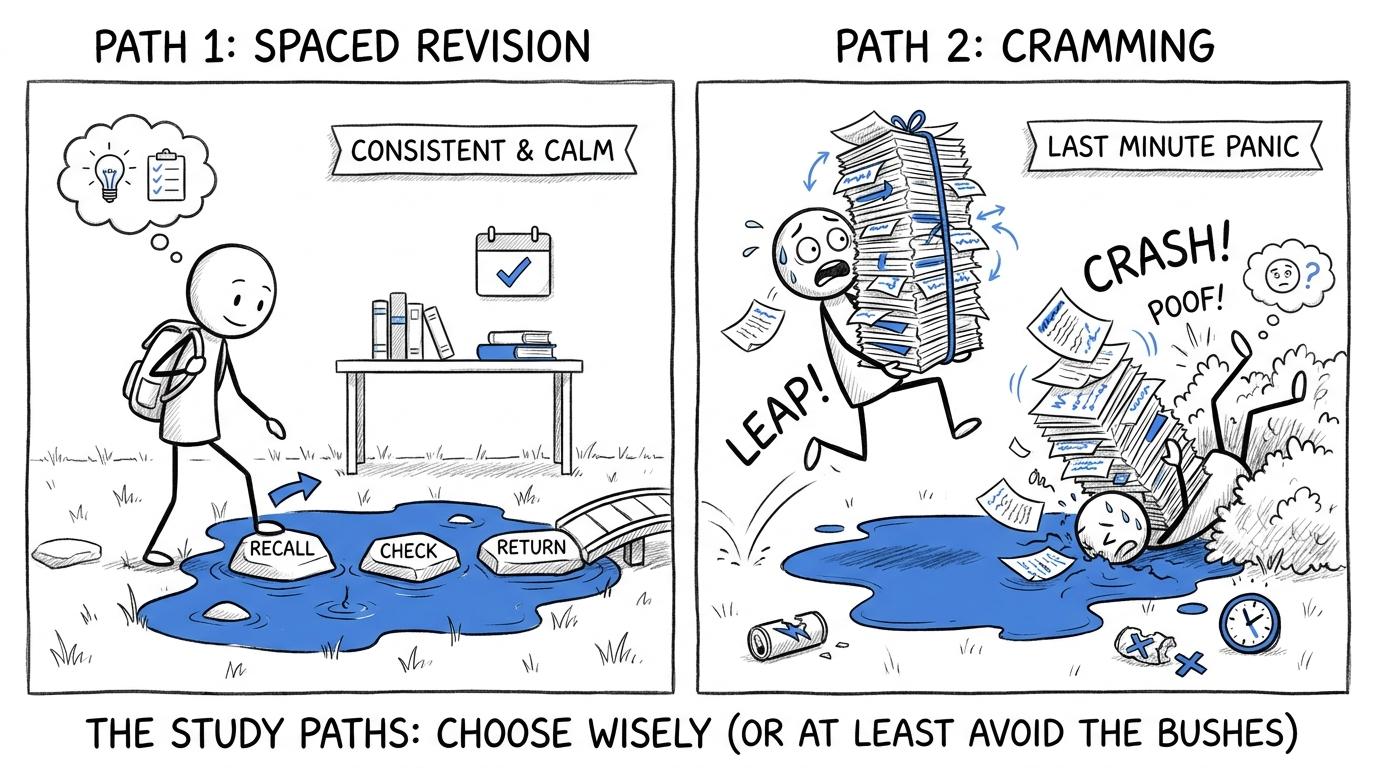 Two students discover the difference between spaced revision and carrying an enormous pile of highlighted notes
A practical Year 10 geography revision method
Build a specification map
List the units your class has completed and place each under one of four headings:
- secure;
- mostly understood;
- difficult to explain;
- not yet taught.
Do not revise the final category independently unless your teacher recommends it. A head start should consolidate classroom learning, not create misconceptions before a topic is taught.
Retrieve before looking
Close your book and write what you can remember about one focused question. You might sketch a process, list causes and consequences, identify evidence for a case study or recall the stages of your fieldwork enquiry.
Then check the answer. Corrections are essential because retrieval without feedback can preserve errors. This same diagnose-and-correct habit is central to MathsGenie’s guide to stopping forgotten GCSE content.
Compress case studies carefully
A case-study page should help you explain, not merely collect statistics. Organise it around location, context, causes, effects, responses and evaluation. Include precise evidence required by your course, but avoid gathering extra figures simply because they look impressive.
Facts change, particularly population and economic data. Use the examples and sources approved by your teacher, and label dates where they matter. Examiners reward relevant geographical knowledge used to answer the question, not an unsupported cloud of numbers.
Preserve fieldwork thinking
Keep a compact fieldwork summary containing:
- the enquiry question or hypothesis;
- the physical or human setting;
- primary and secondary data;
- sampling decisions;
- presentation methods;
- patterns, anomalies and conclusions;
- limitations and realistic improvements.
Do not memorise an evaluation such as “collect more data” without explaining how the change would improve reliability, accuracy or representativeness.
Practise data skills in both subjects
Geography questions may ask you to read scales, compare values, calculate percentages or interpret trends. Maths practice makes these operations more automatic, leaving more attention for geographical judgement.
Use Edexcel GCSE maths mini tests if that matches your course, or select the correct board through the main revision hub. Short tests are useful in Year 10 because they reveal specific weaknesses without turning every session into a full examination.
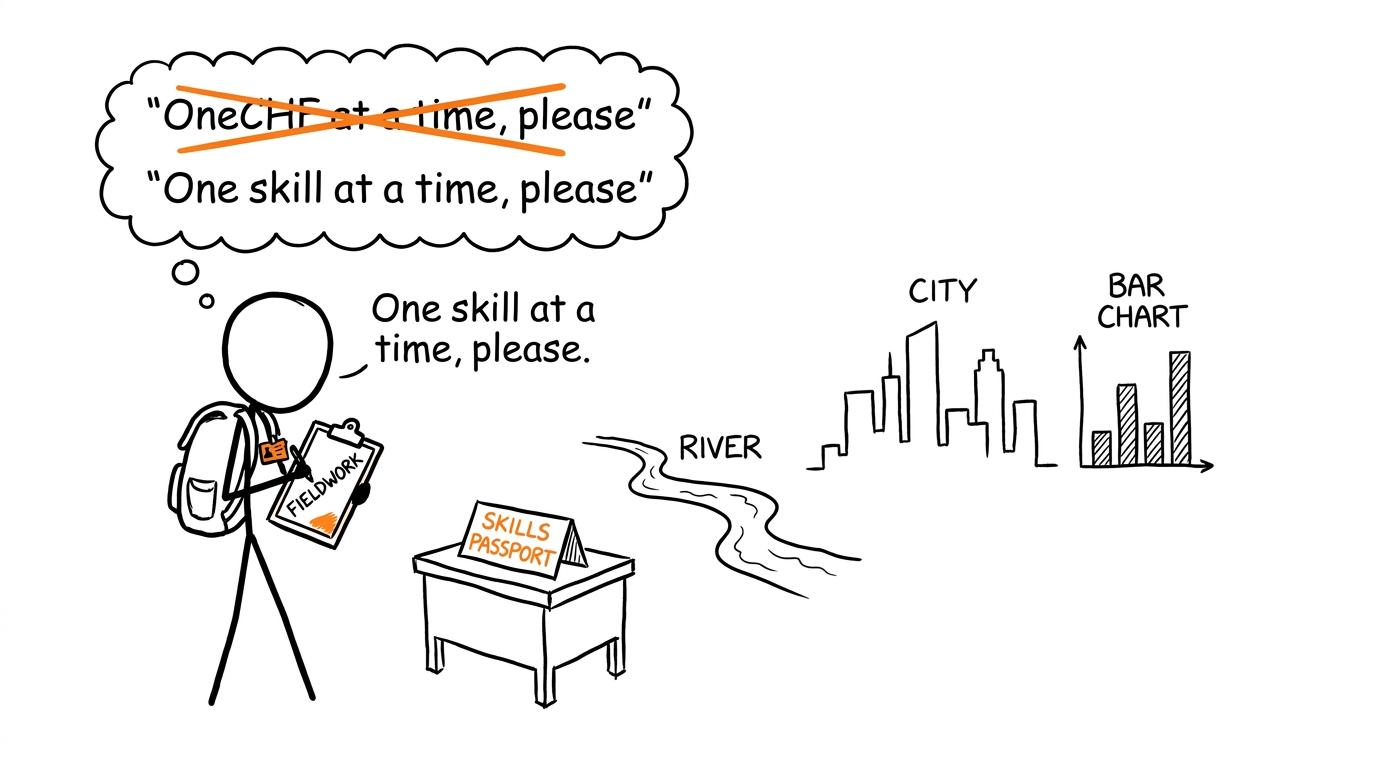 A river, city and chart wait politely while a student handles one geography skill at a time
When should you begin exam questions?
You do not need to wait until Year 11 to see exam-style questions. After completing a topic, short questions can teach you command words, interpretation and the level of detail expected.
Full papers are different. If much of the specification remains untaught, a full paper mainly confirms that you have not learnt content your class has not covered. That is neither surprising nor especially useful.
Use topic questions first. Add mixed sections when several units are secure. Save regular timed papers for later, when they can test knowledge, timing and stamina together. The MathsGenie guide to finding weak GCSE topics shows how assessment can generate a focused revision list rather than a discouraging mark.
When you do begin full maths papers, follow a proper feedback loop. The guide to using GCSE past papers effectively explains how to mark, diagnose, repair and retest weaknesses. Nearer the examination, Edexcel GCSE maths predicted papers can complement past papers, but they should never replace complete specification coverage.
Common mistakes with early GCSE revision
Turning every session into note-making
Rewriting feels productive because the page improves visibly. Your memory may not. Attempt recall, answer a question or reconstruct a diagram before checking notes.
Revising material that has not been taught
Teaching yourself whole units can waste time and introduce confusion. Consolidate completed content and ask your teacher what is coming next.
Ignoring the specification
Exam boards differ. Confirm whether you study AQA, Edexcel, OCR or Eduqas, then follow your school’s chosen content and examples.
Memorising case-study facts without arguments
A statistic has value only when it supports an explanation, comparison or judgement. Learn what the evidence demonstrates.
Forgetting fieldwork until Year 11
Record the enquiry while the decisions and limitations remain fresh. Fieldwork is not a decorative school trip; it forms part of the assessed geographical enquiry process.
Letting geography consume maths time
Geography rewards knowledge accumulation, while maths depends heavily on repeated problem-solving. Protect regular maths practice throughout Year 10, especially if you are uncertain about foundation or higher-tier skills.
Starting at an unsustainable pace
A heroic first week followed by silence is not a head start. Choose a routine you could still follow during a busy half-term.
Is the Year 10 head start genuinely worth it?
Yes, if it is modest, active and connected to what your class is learning. Starting early creates more opportunities to forget, retrieve, correct and remember. It also lets you preserve fieldwork details and discover weak skills before Year 11 becomes crowded.
But there is no credible basis for claiming that starting early automatically produces a particular grade. Quality matters. So do teaching, feedback, attendance, wellbeing and the consistency of practice. Two calm reviews each week can be more valuable than hours spent highlighting without testing yourself.
Begin with one completed geography topic and one maths weakness. Retrieve what you know, check it, correct it and schedule a return. Then let MathsGenie support the numerical side of your GCSE journey with free revision lessons, practice questions, mini tests, past papers, predicted papers, mark schemes and video solutions. The goal is not to make the exam season longer. It is to make the final months feel less like a rescue mission.