

GCSE Geography Study Planner: Work Backwards
GCSE geography study planner: build a realistic plan backwards from each exam date, balance maths revision and turn weak areas into weekly tasks.
The hardest part of revision is often not the work. It is deciding what to do next. When geography contains physical processes, human topics, case studies, fieldwork and geographical skills, while maths keeps demanding regular practice, a blank calendar can feel less helpful than it should.
A GCSE geography study planner solves that problem by starting at the destination. Write down each confirmed exam date, decide what must be ready before it, and work backwards to today. This turns revision from a weekly guess into a sequence of manageable deadlines. It also protects time for maths, English and science rather than allowing one subject to consume every evening.
Your backward-planning checklist
Before building the full plan, gather the information that determines it:
- your exam board and exact geography specification
- your school-issued examination timetable
- the topics assessed in each paper or component
- your required case studies and named examples
- your physical and human fieldwork enquiries
- your weakest knowledge and exam skills
- the evenings realistically available for revision
- dates for mocks, holidays and other GCSE papers
- at least one buffer session each week
Do not copy somebody else's geography timetable without checking these details. AQA, Edexcel, OCR and Eduqas do not organise every specification in the same way. Some boards also offer more than one geography route. Your paper codes and school timetable are safer anchors than a generic online calendar.
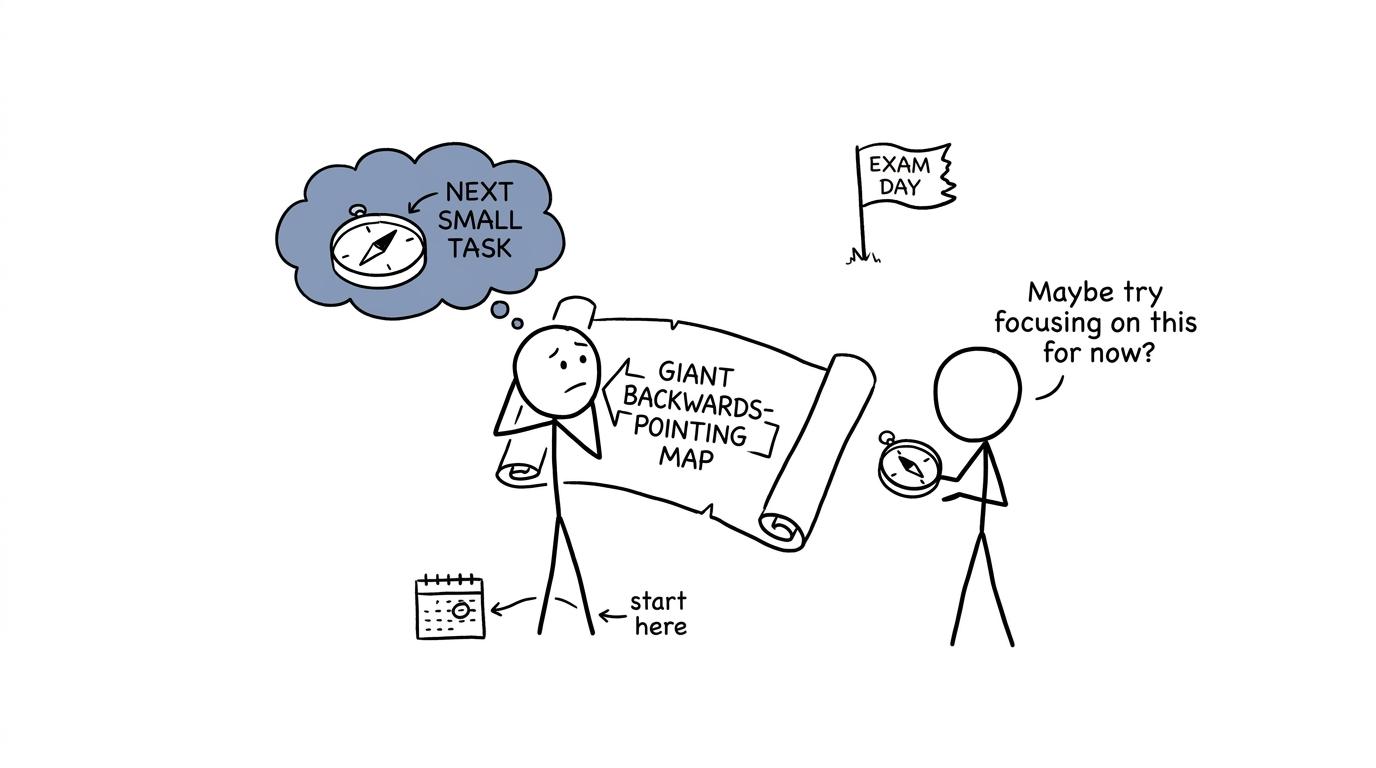 A student navigates backwards from exam day using a revision map
Why working backwards is better than guessing
Planning forwards usually begins with an optimistic thought: revise rivers on Monday, urban change on Tuesday, and perhaps finish everything by Easter. The difficulty appears later. Topics take different amounts of time, forgotten case studies need revisiting, and full-paper practice gets squeezed into the final week.
Backward planning begins with constraints instead. Exam day cannot move to suit your revision. Neither can the date of a mock or the fact that another subject may have a paper the following morning.
Once those fixed points are visible, you can reserve time for the activities that are easiest to postpone:
- completing timed questions
- marking answers carefully
- revisiting fieldwork
- learning precise case-study evidence
- practising maps, graphs and unfamiliar resources
- correcting recurring mistakes
This is the same principle that makes an effective GCSE maths revision timetable useful. A plan should not merely list content. It should create enough time to learn, practise, receive feedback and return to weaknesses.
Start with the official exam dates
Use the final timetable from your exam board and compare it with the personalised timetable issued by your school. Record the date, session and paper code for every geography component. If the two sources appear inconsistent, ask your exams officer rather than making an assumption.
Official specifications show what each component assesses, how long it lasts and how the marks are distributed. They also explain where geographical skills, fieldwork and any advance information or resource material fit into the qualification. Check the current specification for your cohort because arrangements can change between qualifications and exam series.
Create one line for each paper:
| Paper detail | What to record |
|---|---|
| Date and session | The confirmed day and whether it is morning or afternoon |
| Content | The specification topics assessed in that component |
| Skills | Maps, data, fieldwork, decision-making or extended responses |
| Resources | Any permitted or advance material relevant to your specification |
| Final checkpoint | The last date on which substantial revision will be completed |
Treat the final checkpoint as the true deadline. The evening before an exam is better used for light recall, checking equipment and sleeping properly than for learning an entire unit.
Audit the specification before filling the calendar
A planner built from chapter titles can hide important gaps. Instead, turn the official specification into a revision audit and label each item:
- Secure: you can recall it and answer an exam question without support.
- Developing: you know the main ideas but lack detail or accuracy.
- Priority: you cannot yet explain it confidently or apply it to a question.
Audit four separate areas.
Core geographical knowledge
Check each physical and human geography topic assigned to every paper. Break broad headings into small, testable tasks. “Revise coasts” is vague; reviewing processes, landforms, management approaches and the required located example creates distinct outcomes.
Case studies and examples
For each required case study, check that you can recall its location, relevant processes, impacts, responses and evaluative evidence. The exact requirements depend on your specification and what your school has taught, so use your class materials rather than collecting random examples from several courses.
Fieldwork
Record the enquiry question, location, methods, sampling decisions, results, conclusions and limitations for each fieldwork experience. You should also be prepared to apply the enquiry process to unfamiliar fieldwork material where your paper requires it.
Geographical and numerical skills
Geography can assess scale, percentages, averages, graphs, maps and the interpretation of data. These skills deserve scheduled practice rather than a quick read-through. If the calculations themselves feel uncertain, the free GCSE maths revision hub provides revision lessons, practice questions and solutions organised by exam board.
Convert the journey into revision phases
Now move backwards from each examination and create phases. Their length should reflect the time available, not an arbitrary template.
Final days: recall and accuracy
Keep this period light and specific. Review condensed case-study prompts, command words, fieldwork decisions and the mistakes already identified in your practice. Avoid beginning large untouched topics unless there is no alternative.
The GCSE maths night-before plan applies a useful principle across subjects: focused correction and proper rest are more valuable than an uncontrolled final marathon.
Final weeks: timed application
Reserve several checkpoints for complete papers, substantial paper sections or mixed exam questions. Mark them as soon as possible. Record why each mark was lost, then schedule a repair task.
Use specific labels such as “insufficient place detail”, “misread command word” or “conclusion not supported by data”. “Need more geography revision” does not tell tomorrow's version of you what to do.
Middle phase: close the priority gaps
Allocate most sessions to topics marked Priority or Developing. Pair knowledge retrieval with exam questions so that you learn how the content is assessed. Return to the same material after a gap rather than declaring it complete after one successful session.
Early phase: organise and diagnose
Complete the specification audit, collect fieldwork notes and attempt enough questions to expose weaknesses. This is also the right point to map your other subjects. Maths benefits from frequent contact, so keep regular sessions available instead of abandoning it until geography feels finished.
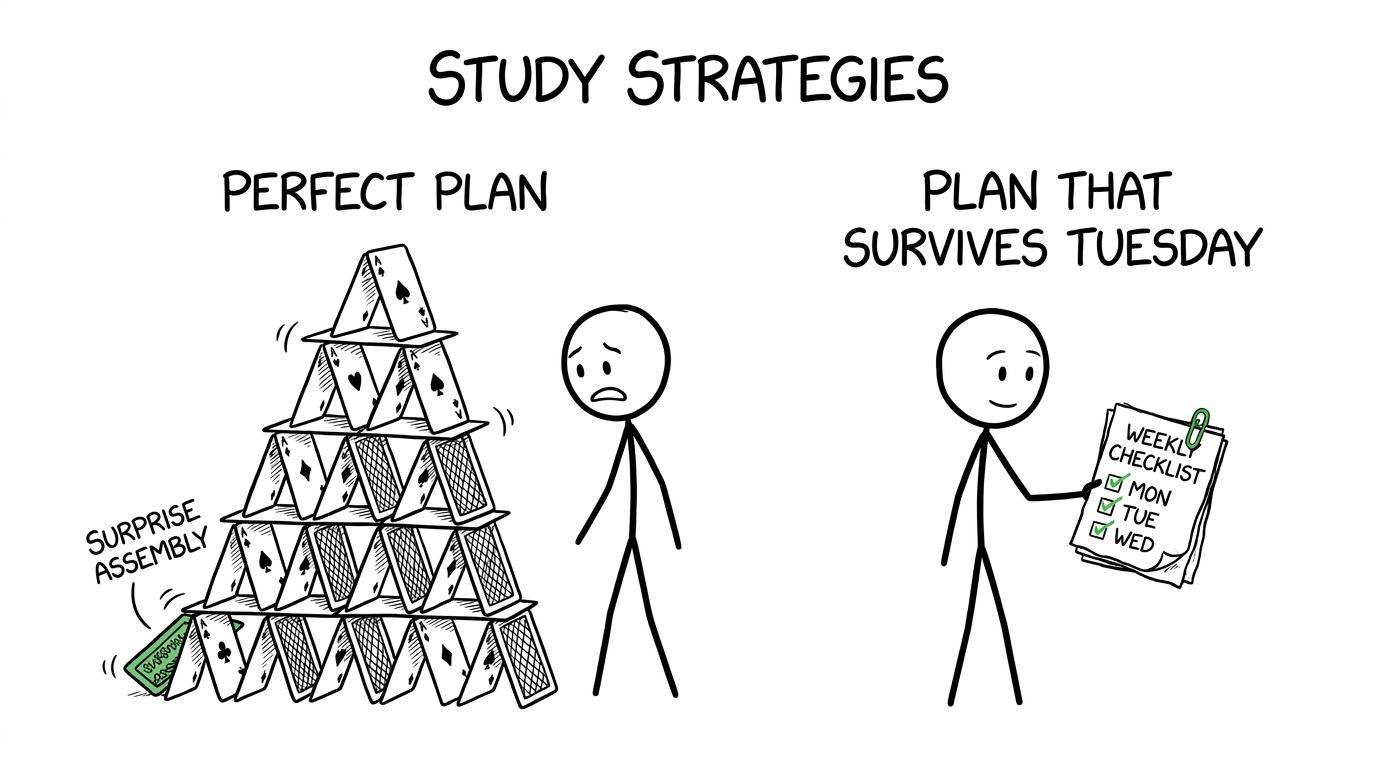 A perfect timetable wobbles beside a flexible plan that survives Tuesday
Calculate a realistic revision capacity
A backward planner must fit your real week. First estimate your usable sessions:
Usable sessions=(weeks available×sessions per week)−buffer sessions\text{Usable sessions} = (\text{weeks available} \times \text{sessions per week}) - \text{buffer sessions}Usable sessions=(weeks available×sessions per week)−buffer sessionsThe buffer matters. School events, illness, difficult homework and tired evenings are normal. A plan using every available slot has no way to recover when life interrupts it.
Next divide the usable sessions between:
- priority content
- developing content
- case studies
- fieldwork
- skills and data interpretation
- timed questions or papers
- corrections and retesting
Do not divide time equally merely because it looks tidy. A secure topic may need only occasional recall, while a weak topic requires teaching, practice and another attempt. The guide to finding your weakest GCSE topics explains how evidence from questions can replace guesswork.
Build weeks around outcomes, not hours
Each weekly entry should name a result you can verify. “Geography for one hour” measures attendance. “Recall the coastal case study, answer one extended question and correct it” measures progress.
A productive session can follow this sequence:
- retrieve key ideas without notes
- check and correct the missing knowledge
- answer an exam-style question
- compare the response with its mark scheme or teacher guidance
- record one precise improvement
- choose when the material will be retested
Shorter sessions can still be useful on crowded school days. MathsGenie's twenty-minute maths revision routine demonstrates how a small, repeatable structure can protect progress when time is limited. For geography, that might mean case-study recall followed by one short data question and immediate correction.
Balance geography with GCSE maths
The best geography plan does not quietly damage your maths preparation. Maths methods weaken when they are left untouched for long periods, so give the subject recurring places in the calendar.
Begin with the complete exam timetable. Where geography and maths papers sit close together, prepare both earlier. Do not assume that a large gap between geography papers is empty revision time; other GCSE exams will occupy much of it.
Keep maths sessions evidence-led:
- use revision lessons for methods you do not understand
- complete targeted practice questions
- use mini tests for quick checks
- complete timed papers as exams approach
- mark work and watch video solutions where available
Students following Edexcel can use the Edexcel GCSE maths past papers to place genuine timed practice into the same master calendar. The broader one-month GCSE maths revision plan can also help when several subjects are competing for the final weeks.
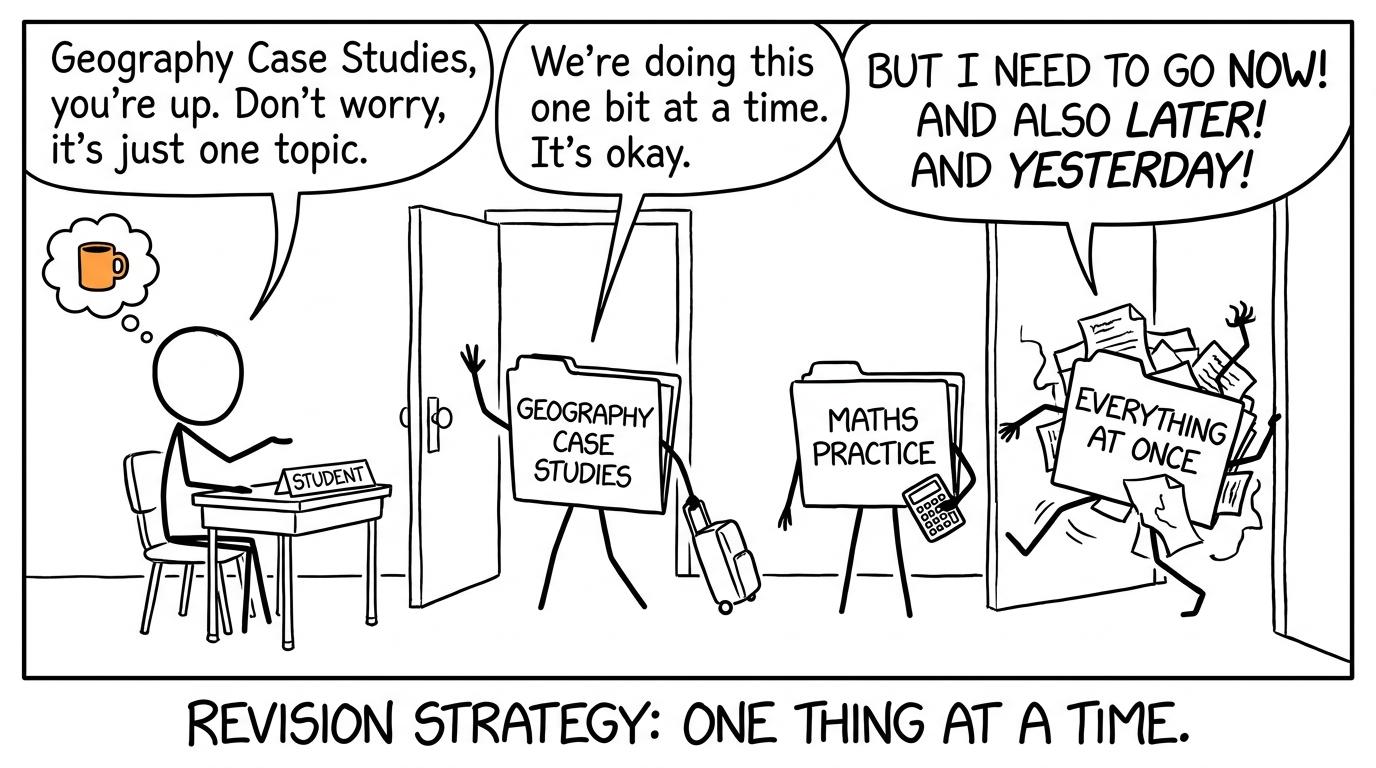 Geography and maths folders wait calmly while everything at once gets stuck
Review the planner every week
A revision plan is a forecast, not a promise carved into stone. At the end of each week, ask:
- Which tasks were completed?
- What evidence shows that the topics are now stronger?
- Which mistakes keep returning?
- Did the workload fit around school and other subjects?
- What should move into the buffer slot?
Only move a topic towards Secure when question performance supports that decision. Feeling familiar with a page is not the same as being able to construct an answer from memory.
Keep unfinished tasks visible, but do not copy everything blindly into the following week. Reprioritise according to the next exam and the marks still at risk.
Common GCSE geography study planner mistakes
Planning by subject instead of paper
“Revise geography” is too broad. Connect content and skills to the component in which they will be assessed.
Giving every topic equal time
Equal allocation feels fair but ignores evidence. Secure material needs maintenance; weak material needs repair and retesting.
Leaving papers until the end
Timed work exposes recall, interpretation and writing problems that notes cannot reveal. Schedule it before the final week so there is time to improve.
Treating the mark scheme as a final score
The total matters less than the cause of each lost mark. Convert errors into future planner entries.
Forgetting fieldwork and skills
Students often focus on memorable topic content while delaying maps, data and fieldwork. Give these areas named sessions from the beginning.
Creating a plan with no spare capacity
A timetable can look impressively full and still be unusable. Buffer sessions make the plan resilient rather than lazy.
Finish with a plan you can trust
Working backwards changes the emotional shape of revision. Exam day stops being a distant source of pressure and becomes a fixed point from which each sensible action can be traced. You know which paper comes next, which weakness deserves attention and when practice must become timed.
Build your geography plan from the correct specification and confirmed school timetable. Then place it beside your maths schedule, not on top of it. Use MathsGenie's free GCSE maths resources to fill those maths sessions with revision lessons, practice questions, mini tests, past papers, predicted papers, mark schemes and video solutions. Start with one confirmed exam date today, work backwards to one weekly milestone, and give your next revision session a clear purpose.










