GCSE Geography Exam Clash Same Week: Revision Plan
GCSE geography exam clash same week? Build a calm revision plan that balances Geography with Maths and other GCSE papers without neglecting either.
A crowded exam timetable creates a particular kind of panic. Geography needs case studies, fieldwork and extended answers. Maths needs repeated practice. Meanwhile, two other subjects may be waiting later in the week.
If you are searching for gcse geography exam clash same week advice, the short answer is this: prioritise the next exam without abandoning the subjects that follow it. Give Geography focused recall and question-planning sessions, keep Maths active through short exam-style practice, and change the balance after each paper.
The aim is not to divide every hour equally. It is to place each hour where it can protect the most marks.
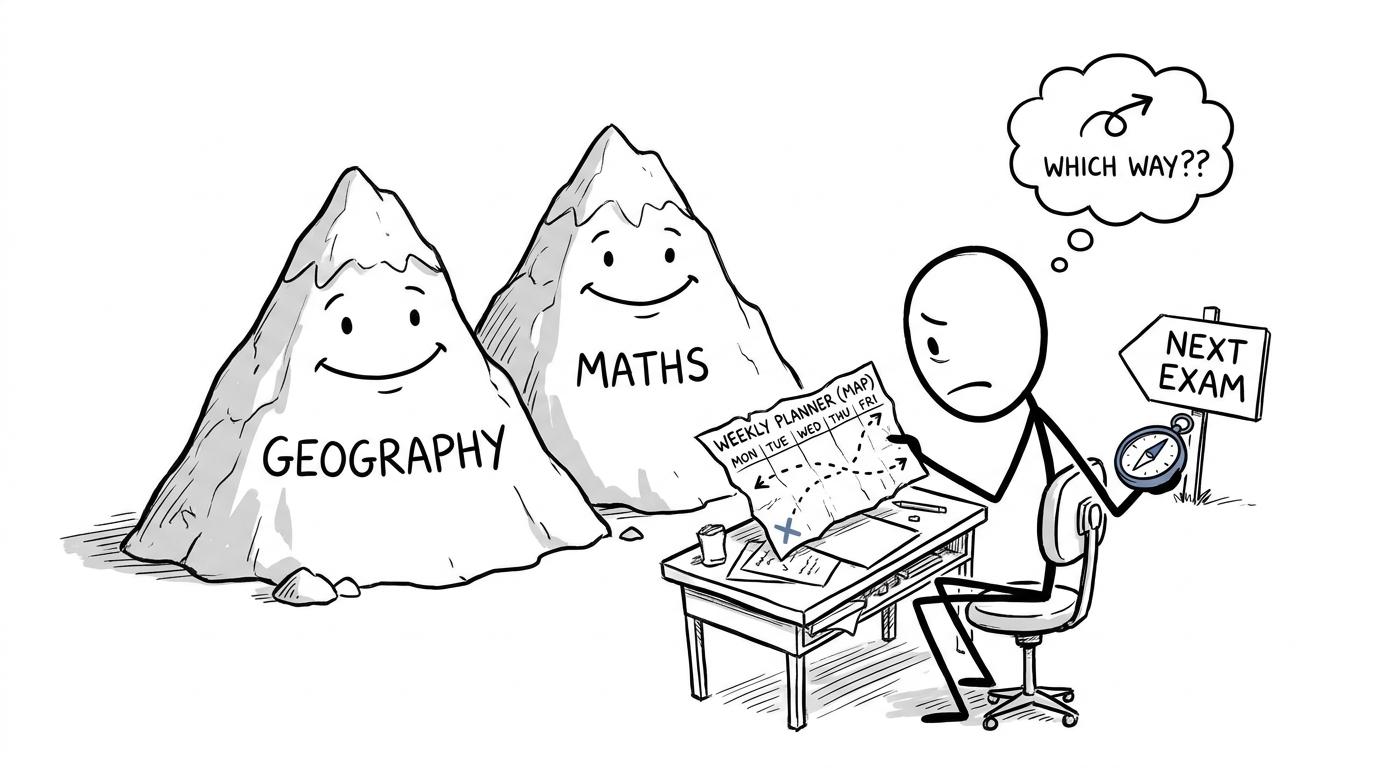 A GCSE student navigating the Geography and Maths mountains with a weekly planner
Your crowded exam-week checklist
Before deciding what to revise, make the week visible:
- Check the official timetable supplied by your school or college.
- Confirm your exam board, paper and tier where relevant.
- Identify the next exam and the one immediately after it.
- List no more than three weak areas for each subject.
- Use active tasks: retrieval, questions, plans and marking.
- Keep one short Maths session on most days before a Maths paper.
- Move the next subject into first place as soon as an exam finishes.
- Protect sleep, meals, travel time and breaks.
A same-week collision is mainly a prioritisation problem. If two papers are actually scheduled at the same time, that is a formal timetable clash rather than simply a busy week. Tell your exams officer immediately and follow the arrangements made by your centre. Do not try to solve it by choosing which examination to attend.
Build the plan around exam order, not anxiety
Students often give the most time to the subject that feels most frightening. That is understandable, but fear is a poor timetable.
Instead, sort subjects into three positions:
- Now: the examination within the next day or two
- Next: the paper following it
- Later: everything else that week
The subject in the Now position receives the largest share of serious revision. Next receives a shorter maintenance session. Later gets a brief retrieval task, or no session that day if time is genuinely limited.
Suppose Geography is tomorrow and Maths is two days later. Geography should lead today because its deadline is closer. Maths should still receive a compact set of questions so that methods remain familiar. After the Geography paper, Maths moves into the Now position.
This approach is deliberately unequal. Equal time can look organised while ignoring urgency, confidence and the size of your knowledge gaps.
Split Geography and Maths by the kind of thinking required
Geography and Maths create different revision demands. That difference can help you organise the day.
For Geography, useful active tasks include:
- recalling named case-study evidence without notes
- sketching fieldwork methods and evaluation points
- planning extended responses
- interpreting maps, photographs, graphs and unfamiliar resources
- checking the command words used by your exam board
The precise papers and assessment structure vary between AQA, Edexcel, OCR and Eduqas, so use your own specification and teacher guidance. For example, some Geography specifications include several externally assessed papers and may include fieldwork, geographical skills or issue-evaluation material. Never revise from another board's checklist simply because it appeared in a search result.
Maths improves through doing rather than rereading. Use the GCSE Maths revision area to select a lesson and then answer questions without copying the method. If you are unsure what belongs to your course, the GCSE Maths topics by exam board and tier guide separates the common content and explains the difference between foundation and higher tier.
A sensible mixed evening might contain:
- one Geography retrieval block
- one Geography exam-question or essay-planning block
- one short Maths question set
- one final recall check for whichever paper comes first
The blocks do not need to be identical in length. Their purpose is to produce evidence of learning, not to fill a timetable neatly.
Use short Maths maintenance sessions
Maths is unusually vulnerable to long gaps. You may recognise a method when reading it, yet struggle to begin when the page is blank. A short daily encounter helps preserve fluency while Geography holds the main share of attention.
Choose one of these maintenance tasks:
- complete a small set from GCSE Maths mini tests
- answer questions from one weak topic
- mark a previously completed paper section
- correct three errors without looking at the original solution
- recall essential formulae and then use them in questions
A session of roughly 202020 to 303030 minutes can be more useful than promising yourself a full paper and never starting. If the Maths exam is the following morning, increase the time and use a timed mixed section. The GCSE Maths night-before plan explains how to narrow revision without attempting to relearn the entire specification.
Marking is part of the session, not an optional extra. Separate lost marks into method gaps, factual slips, misread questions and timing problems. That turns a score into a revision decision.
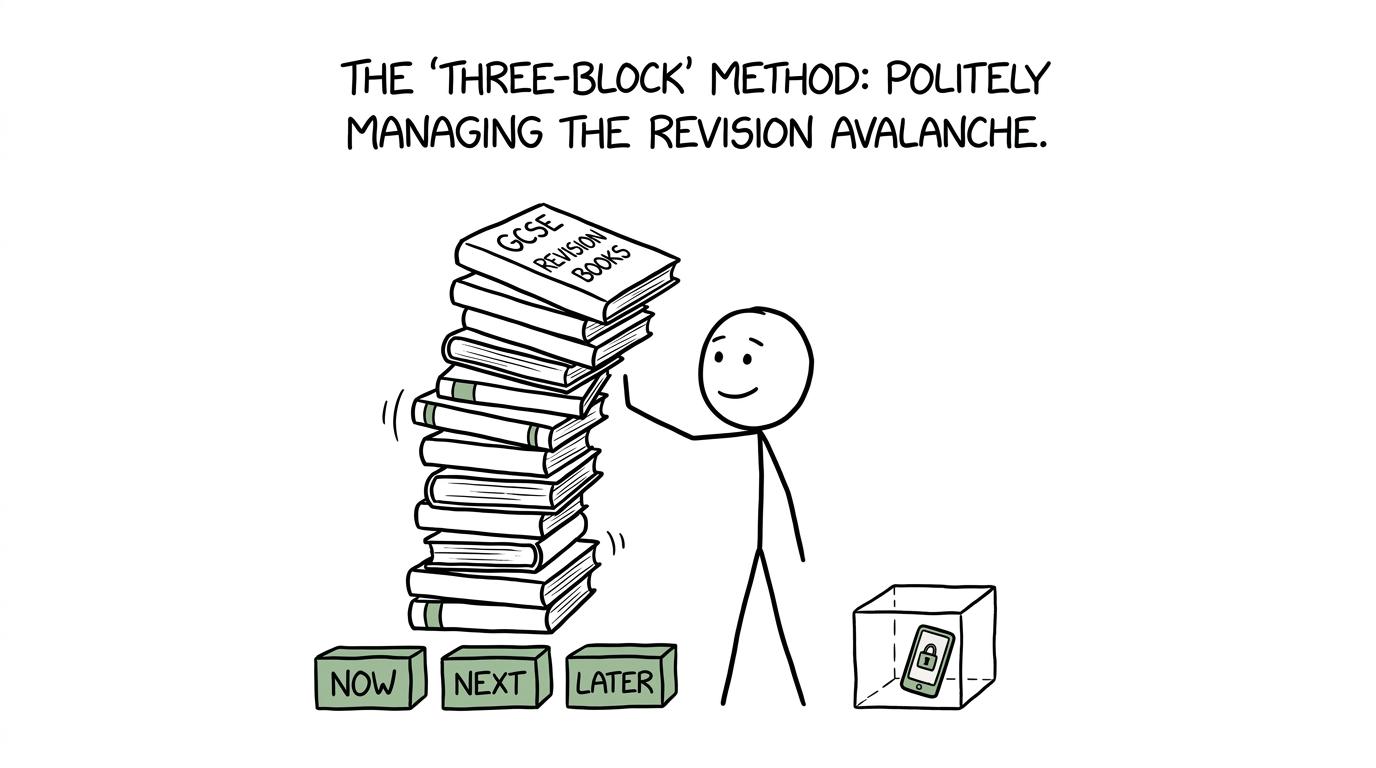 A stack of revision books controlled by Now, Next and Later planning blocks
Revise Geography efficiently when time is tight
When Geography shares a week with several examinations, avoid producing beautiful notes from scratch. Existing notes can support revision, but the main task should require you to retrieve or apply knowledge.
Compress case studies into usable evidence
For each required case study, check that you can recall:
- its location and relevant context
- the process, event or issue being illustrated
- specific effects or evidence
- responses, management or possible solutions
- one evaluative judgement where appropriate
Accuracy matters more than collecting a long list of uncertain figures. Use the examples taught by your school and verify details against your notes or approved course resources.
Plan extended answers before writing all of them
Writing complete responses is useful, but it consumes time. During a crowded week, alternate full answers with brief plans. A good plan identifies the question's command word, relevant knowledge, application to the context, and the judgement needed.
Then compare your response with the official mark scheme or teacher feedback. Geography mark schemes commonly reward more than isolated facts: questions may require interpretation, application, analysis or evaluation. The balance depends on the paper and command word.
Keep geographical skills active
Do not revise Geography as though it were only a memory subject. Practise interpreting unfamiliar sources, map information, fieldwork data and graphical material required by your specification. This is where your Maths habits can help: read scales carefully, show calculations where appropriate and check units.
Adjust the balance after every examination
A revision plan should change during the week. Once Geography is finished, continuing to revise it is rarely the best use of time unless another Geography paper is approaching.
Take a short break, eat and reset. Then move the next examination into the Now position. Avoid conducting a lengthy post-mortem with friends or searching for unofficial answers. You cannot recover marks from a completed paper, but you can protect the next one.
If Maths is next, begin with a manageable task rather than the hardest topic in the specification. A mini test or short mixed set reveals what has survived the week. Use your errors to choose targeted revision lessons and practice questions. The best order to learn GCSE Maths topics can help if your gaps cover several connected areas.
When you have enough time for broader preparation, follow a structure similar to the GCSE one-week Maths revision plan: diagnose, repair, test and review. In a crowded week, shorten the cycle rather than skipping it.
Protect energy as carefully as revision time
A plan that uses every waking minute is not an ambitious plan. It is a fragile one.
Stop times matter because tired revision becomes passive. Build in food, movement, school travel and preparation for the morning. Put your equipment, calculator and required identification together before bed. Check your school's instructions about permitted equipment rather than relying on what happened in a mock examination.
Subject switching can provide a useful mental reset, but switching every few minutes fragments attention. Finish a defined task before moving from Geography to Maths. Keep your phone out of reach during the block, then take an intentional break.
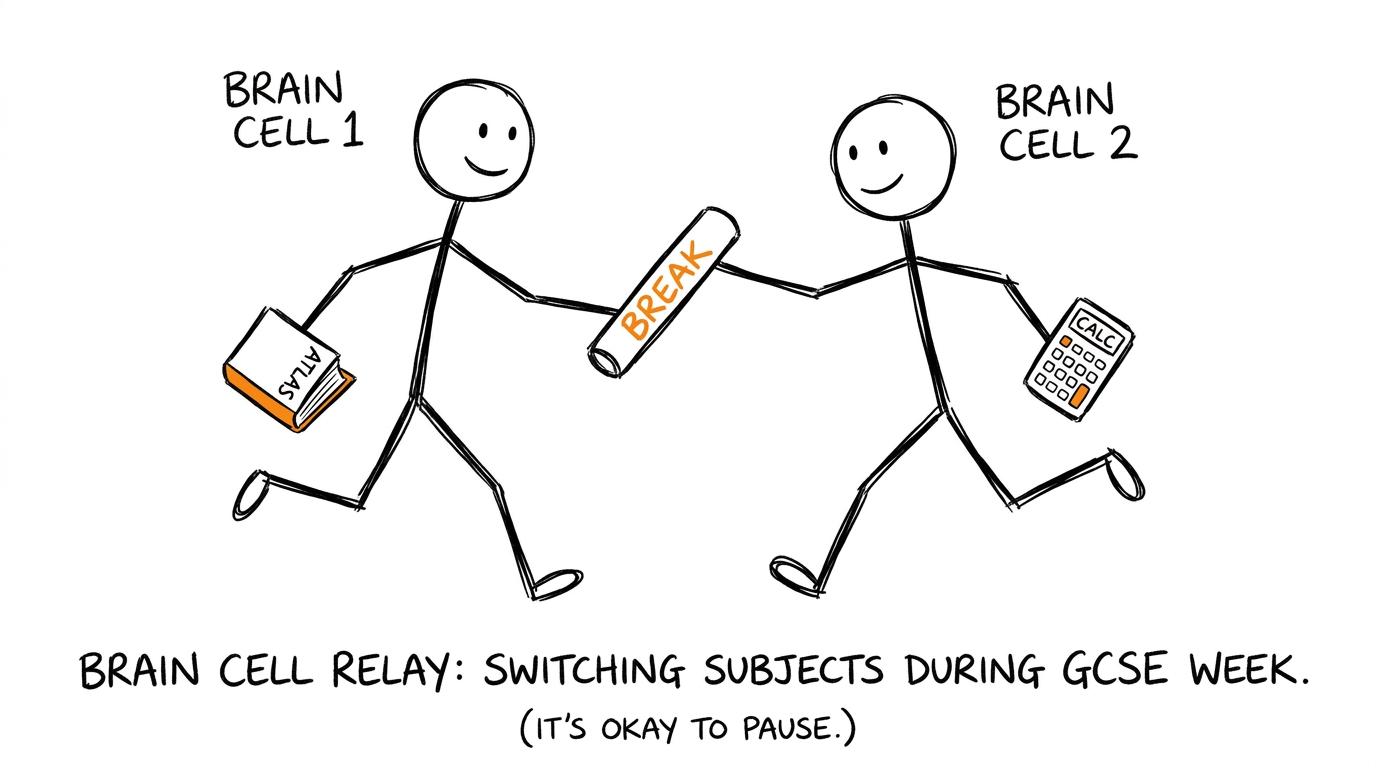 Two brain cells sharing a revision relay baton between Geography and Maths
Common mistakes during a same-week exam squeeze
Giving every subject equal time
Subjects do not have equal urgency on every day. Let exam order, current confidence and identifiable weaknesses determine the balance.
Revising only the nearest examination
Total focus on Geography may leave Maths untouched for several days. A short Maths maintenance session protects familiarity until Maths becomes the priority.
Completing papers without reviewing them
Practice exposes gaps; marking repairs them. Use mark schemes and video solutions, then redo the questions that cost you marks.
Confusing activity with progress
Highlighting, copying notes and reorganising folders can feel safe. Retrieval, question planning and exam practice provide clearer evidence of what you can do independently.
Attempting an exhausting late-night rescue
Extra hours are not automatically productive hours. Set a realistic stopping point, prepare for the morning and return with enough concentration to understand the paper.
Using resources for the wrong board or tier
Geography content and assessment structures differ by specification. In Maths, foundation and higher papers target different grade ranges and demands. Confirm the exact qualification before selecting practice.
Turn a crowded week into a sequence of small decisions
A busy timetable feels like one enormous problem, but you never have to revise every subject at once. You only need to choose the best next task.
Put the nearest exam first. Keep the following subject warm with a short active session. After each paper, reset the order. That is the practical answer when a GCSE Geography exam lands in the same week as Maths and several other subjects.
MathsGenie can make the Maths side of that plan simpler. Begin with free revision lessons and practice questions, use mini tests to locate gaps, and move to past papers or predicted papers when timed practice becomes the priority. The guide to self-studying GCSE Maths explains how lessons, mark schemes and video solutions fit together, while GCSE Maths topics that come up every year provides a practical overview of recurring content without pretending to predict an exact paper.
Open MathsGenie, choose the topic that most recently cost you marks, and complete one focused task. In a crowded exam week, calm progress is built that way: one honest decision at a time.