GCSE French Early Entry: Is It a Good Idea?
GCSE French early entry can create space in Year 11, but only if you are ready. Weigh exam format, grades, workload and maths revision first.
A school suggests taking French a year early. At first, the offer can sound like a vote of confidence; and it usually is. But confidence is not the same as readiness. GCSE French early entry makes sense when you are already secure across listening, speaking, reading and writing, and when preparing for the exam will not weaken your progress in maths or other subjects.
The short answer is that early entry can be a good idea, but it is not automatically an advantage. The right question is not, “Am I good at French?” It is, “Can I produce my target performance across every assessed skill, under exam conditions, one year sooner?”
The early-entry decision checklist
Before agreeing, you should be able to answer these questions clearly:
- Have you completed, or will you complete, the full specification?
- Are your listening, speaking, reading and writing at a similar standard?
- Have you tried current sample or practice assessments under timed conditions?
- Which tier will you enter, and does it support your target grade?
- What will happen in Year 11 after you finish French?
- Would early preparation reduce the time available for GCSE maths?
- Does your teacher believe you are consistently ready, rather than occasionally brilliant?
- What would happen if the result were below your target?
If several answers are uncertain, waiting is not failure. An extra year is useful when it turns fragile knowledge into dependable performance.
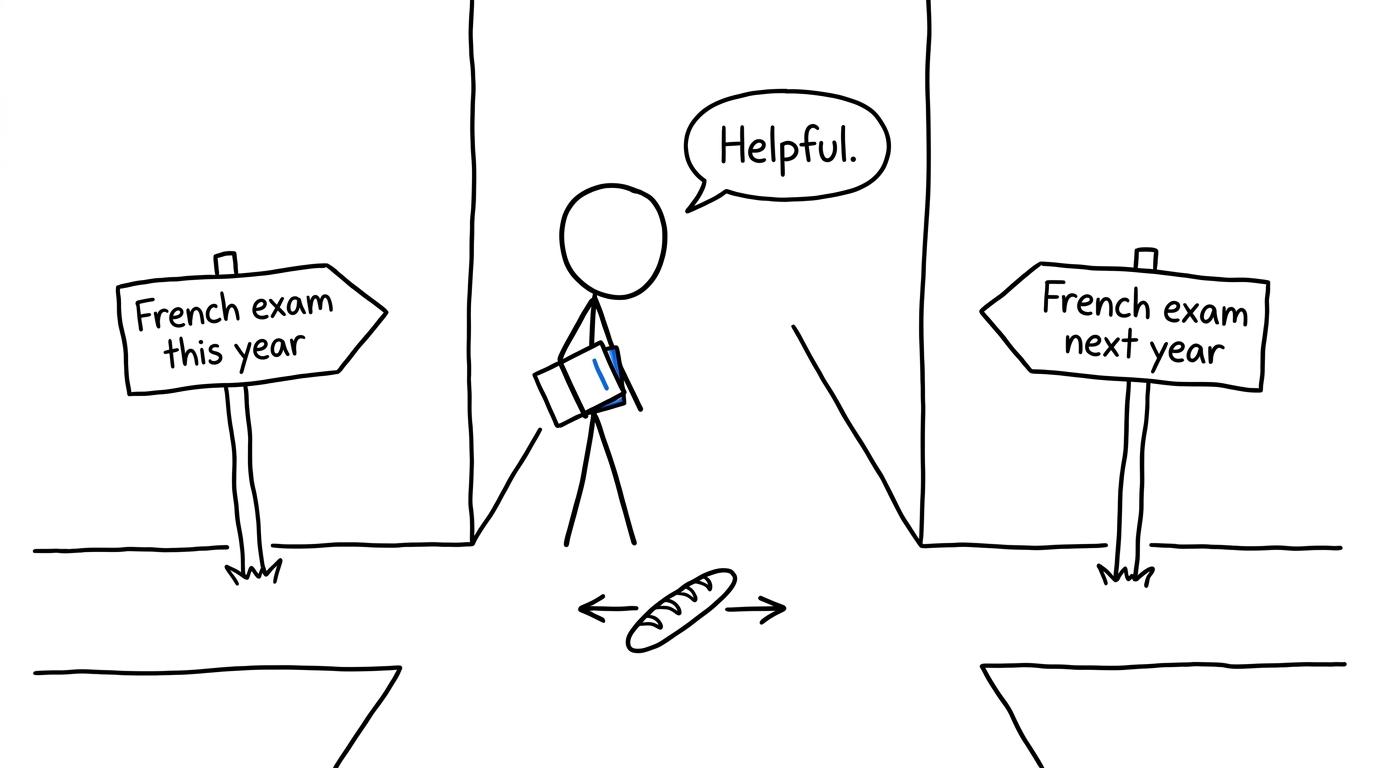 A student choosing between taking French this year or next year
What taking GCSE French early actually involves
Early entry normally means completing the qualification before the usual end of Year 11, often in Year 10. It does not mean sitting a smaller version of the GCSE. You still need to meet the complete specification and take the required assessments for your exam board.
The reformed GCSEs in French taught in England from September 2024 were first assessed in summer 2026. For boards such as AQA and Pearson Edexcel, the qualification covers four areas: listening, speaking, reading and writing. Each contributes 25%25\%25% of the qualification. Students enter either foundation or higher tier and must normally take the same tier across all four components.
Current specifications also place explicit emphasis on vocabulary, grammar, dictation, reading aloud, translation and accurate communication. Exact tasks and timings vary by board, so your school should confirm whether you are following AQA, Pearson Edexcel, Eduqas or another applicable specification.
This matters because classroom fluency can hide uneven preparation. A student may speak confidently but lose marks in dictation. Another may write accurately with time to think but struggle to process a listening recording. Early entry is sensible only when the whole assessment profile is ready.
When GCSE French early entry can be a good idea
You are consistently working at your target grade
A single strong mock is encouraging, but consistency is more persuasive. Look for a pattern across assessments completed at different times and under realistic conditions.
Your teacher should be able to explain why early entry suits you using evidence from all four skills. “You are one of the strongest in the class” is less useful than knowing that your vocabulary recall, grammatical accuracy, listening comprehension and extended responses are all secure.
The course will genuinely be finished
Speeding through the final units is not the same as learning them. GCSE language content is cumulative: later work depends on vocabulary, grammar and pronunciation developed earlier.
Ask for a course map. Check when the remaining content will be taught, when speaking preparation will happen and how much time has been reserved for timed papers. If the plan relies on extensive independent learning during an already busy term, include that workload in your decision.
Finishing early creates a valuable Year 11 plan
Early entry is most useful when the released timetable has a purpose. You might continue French, begin enrichment work or receive more structured time for other GCSE subjects. The arrangement differs between schools, so do not assume that sitting early automatically creates free revision periods.
For a maths student, a well-planned Year 11 could provide more space for weak topics, mini tests and timed papers. The GCSE maths revision timetable guide shows how to turn available time into a repeatable routine rather than letting it disappear.
You cope well with formal assessment
Taking a GCSE early means handling a real speaking assessment and written examinations sooner than most of your year group. That can be manageable for a prepared student, but the experience should not be treated merely as a rehearsal. It produces an actual qualification result.
Practice should therefore include speaking under controlled conditions, timed writing, unfamiliar listening extracts and careful use of mark schemes. Familiarity lowers uncertainty. It does not remove the need to know the course.
When waiting is probably the better decision
One French skill is noticeably weaker
Language grades are built from several components. Strength in reading cannot simply erase weak speaking preparation, and fluent conversation does not guarantee accurate writing.
If one area is still developing quickly, another year may produce a more balanced result. This is particularly important when the weaker component is difficult to improve through last-minute revision, as listening and spontaneous speaking often require repeated practice over time.
Early entry would compete with maths revision
Time is the hidden cost. An early French examination may add speaking practice, vocabulary retrieval and timed papers to a term that already contains maths assessments and coursework or preparation in other subjects.
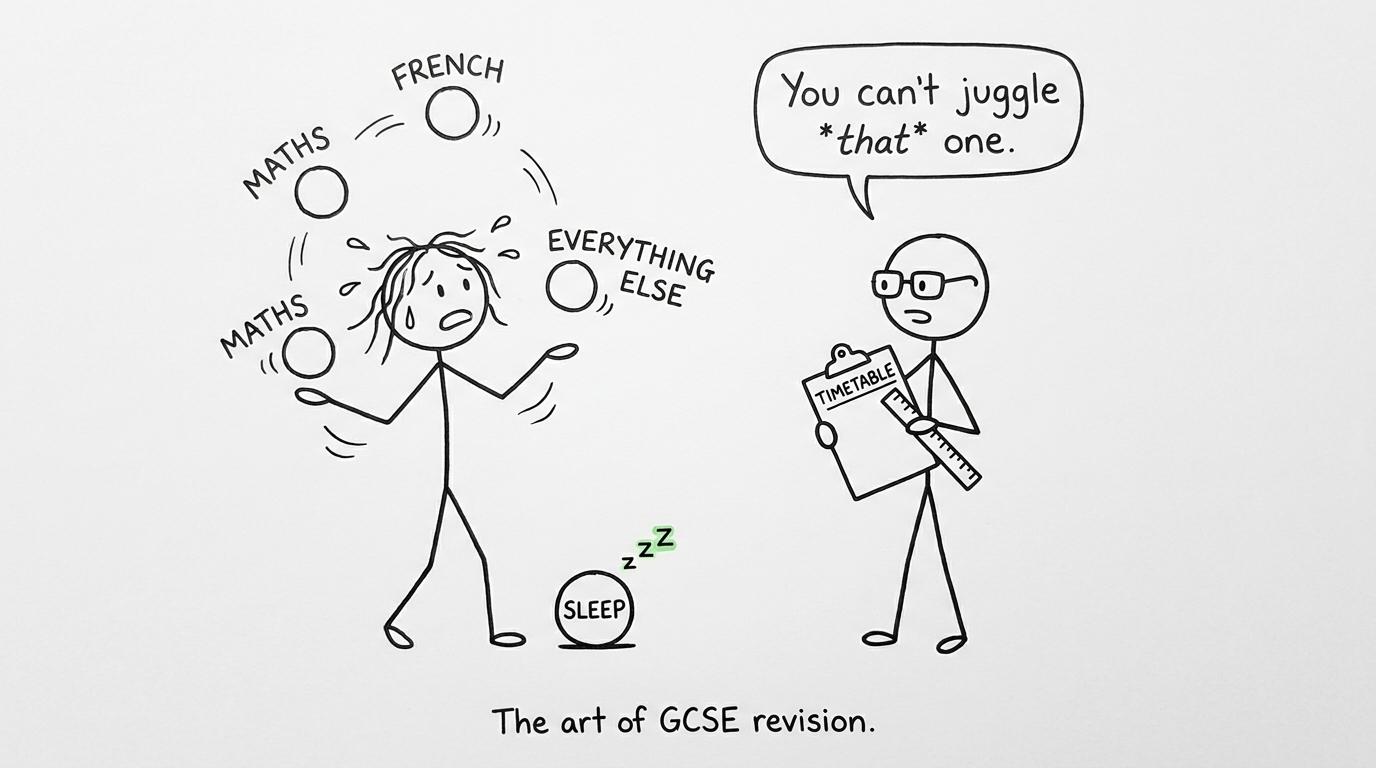 A student juggling French, maths, sleep and everything else
Use your actual week, not an imaginary perfect week. List lessons, homework, travel, activities, rest and revision. If French requires several extra sessions, decide where those sessions will come from.
Maths improves through regular problem solving, not occasional rescue sessions. On crowded days, the 20-minute GCSE maths revision routine can protect continuity. If even that routine becomes difficult to maintain, the early-entry timetable may be too demanding.
You are being rushed towards the wrong tier
Foundation and higher tier serve different grade ranges and contain different demands. For current GCSE French specifications in England, foundation generally makes grades 111 to 555 available, while higher generally targets grades 444 to 999, with limited provision for a grade 333 close below the grade 444 boundary under relevant awarding rules.
Tier decisions should be based on current evidence and your realistic target. Taking foundation early may cap the highest available grade. Taking higher before you are ready may expose you to language and tasks that are not yet secure. Ask when the final tier decision will be made and what evidence will be used.
The main reason is simply to “get it out of the way”
Finishing a subject early can feel efficient, but speed has value only when it preserves quality. A GCSE result may matter for sixth-form entry, future language courses or applications. The possible Year 11 convenience should be weighed against the result you could achieve with another year of development.
The first-entry rule you should ask your school about
In England, Department for Education early-entry rules affect school performance measures. Broadly, where a pupil takes more than one qualification in the same subject with the same discount code, the first qualification taken is normally the one credited in the school’s performance measures, subject to the detailed rules and exceptions applying to the cohort.
This does not mean that a student is legally prevented from taking French again. It does mean that re-entry is not a simple “nothing to lose” plan, and schools may have their own policies about funding, teaching and examination entries.
Before agreeing, ask your examinations officer or head of languages:
- How would an early result affect the school’s performance measures?
- Would the school permit a later re-entry?
- Who would pay any later entry fee?
- What teaching would be available after the early examination?
- How would both attempts be handled when results are presented?
Rules and school arrangements can change, so get an answer for your cohort rather than relying on another student’s experience.
How to protect your maths grade while preparing early
French and maths use different knowledge, but the revision principle is similar: retrieval and practice reveal more than rereading.
Build a weekly plan with separate, protected sessions. In French, rotate the four skills instead of repeatedly choosing your favourite. In maths, diagnose weak topics, complete exam-style questions, mark them and revisit errors.
The GCSE one-month maths revision plan provides a useful structure when the French examination approaches. You can use Edexcel GCSE maths mini tests for shorter timed checks, then move towards Edexcel GCSE maths past papers when you have enough uninterrupted time.
Past papers should diagnose rather than merely occupy an evening. The guide to using Edexcel GCSE maths past papers properly explains the paper, mark, repair and retest cycle. If you are unsure when full papers belong in your plan, read when to start GCSE past papers.
Predicted papers can add fresh exam-style practice near the examination, but they should supplement specification coverage and official past papers rather than replace them. MathsGenie’s Edexcel GCSE maths predicted papers include mark schemes and worked solutions for focused final preparation.
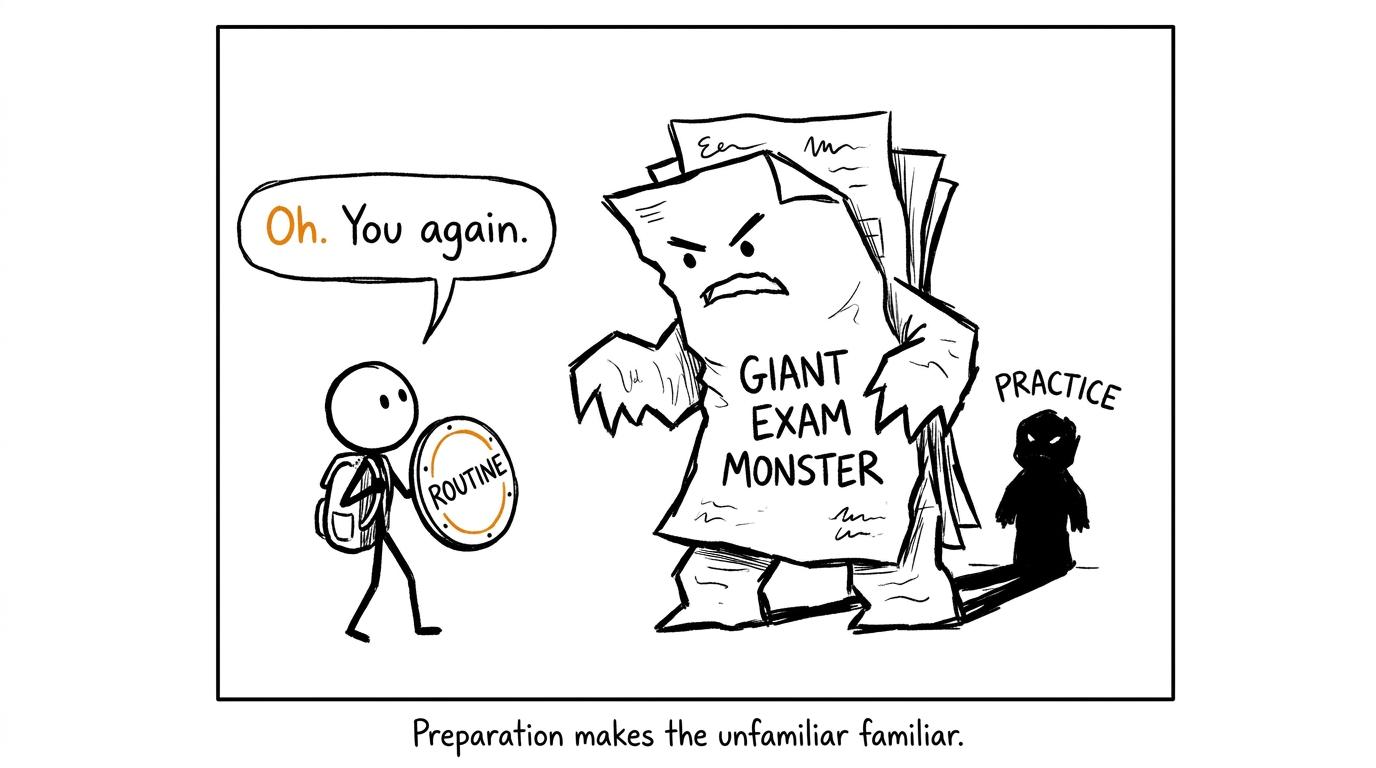 A prepared student meeting the familiar exam-paper monster
Common mistakes when deciding on early entry
Treating ability as proof of readiness
Being talented at French helps, but examination readiness requires complete specification coverage, reliable recall and experience of every assessment format.
Looking only at an overall mock grade
An overall result can conceal a weak component. Review the marks for listening, speaking, reading and writing separately, then ask whether any one area depends too heavily on favourable questions.
Ignoring the speaking-assessment timetable
Speaking assessments may occur before the main written papers. Your preparation plan must work backwards from the actual assessment window given by your school, not just the date of the final written examination.
Assuming a resit removes all risk
A later entry may be possible, but performance-table rules, school policy, entry fees and timetable arrangements make it more complicated than a free second attempt. Clarify the plan before the first entry is submitted.
Sacrificing stronger subjects to finish French early
The best decision considers your full GCSE programme. If intensive French preparation weakens maths, English or another priority subject, the apparent efficiency may be false.
Make the decision from evidence, not momentum
An early GCSE can be a sensible challenge. It can also be an avoidable rush. Agree when the full course will be taught, your four skills are consistently secure, the tier matches your goal and the Year 11 plan has genuine value. Wait when a major skill remains uneven or the workload threatens your wider grades.
Then protect the subjects that continue alongside French. Use MathsGenie as your free maths revision base: follow revision lessons, answer practice questions, use the revision planner, complete mini tests and move on to past papers and predicted papers. Mark schemes and video solutions turn mistakes into next steps, which is the part of revision that actually changes results.