GCSE Food and Nutrition With No Background Knowledge
GCSE food and nutrition no background knowledge: find out whether you can start, what your school decides, and how to catch up quickly and confidently.

The search phrase gcse food and nutrition no background knowledge hides a practical worry: can you begin the course if you have not done much cooking, food science or nutrition before?
The short answer is yes, provided your school allows you to join and you have enough time to complete the required work. Current AQA and Eduqas specifications state that there are no previous learning requirements, while OCR says that no prior learning of the subject or qualification is required. However, exam boards also make clear that schools and colleges can set their own entry requirements.
Starting without the usual Key Stage 3 experience is therefore realistic. It is not effortless. You will need to build practical confidence, learn the theory and catch up with any controlled non-exam assessment work your class has already started.
Your starting checklist
Before changing subjects or joining the course late, find out:
- whether your school permits the change
- which exam board you will follow, usually AQA, OCR or Eduqas
- how much specification content the class has covered
- whether any non-exam assessment, known as NEA, has begun
- which practical techniques you need to demonstrate
- when kitchens, ingredients and teacher supervision are available
- how the course will fit alongside your GCSE maths revision
The first conversation should be with the subject teacher or examinations officer. An exam board may have no formal prerequisite, but only your school can confirm whether joining its particular course is possible.
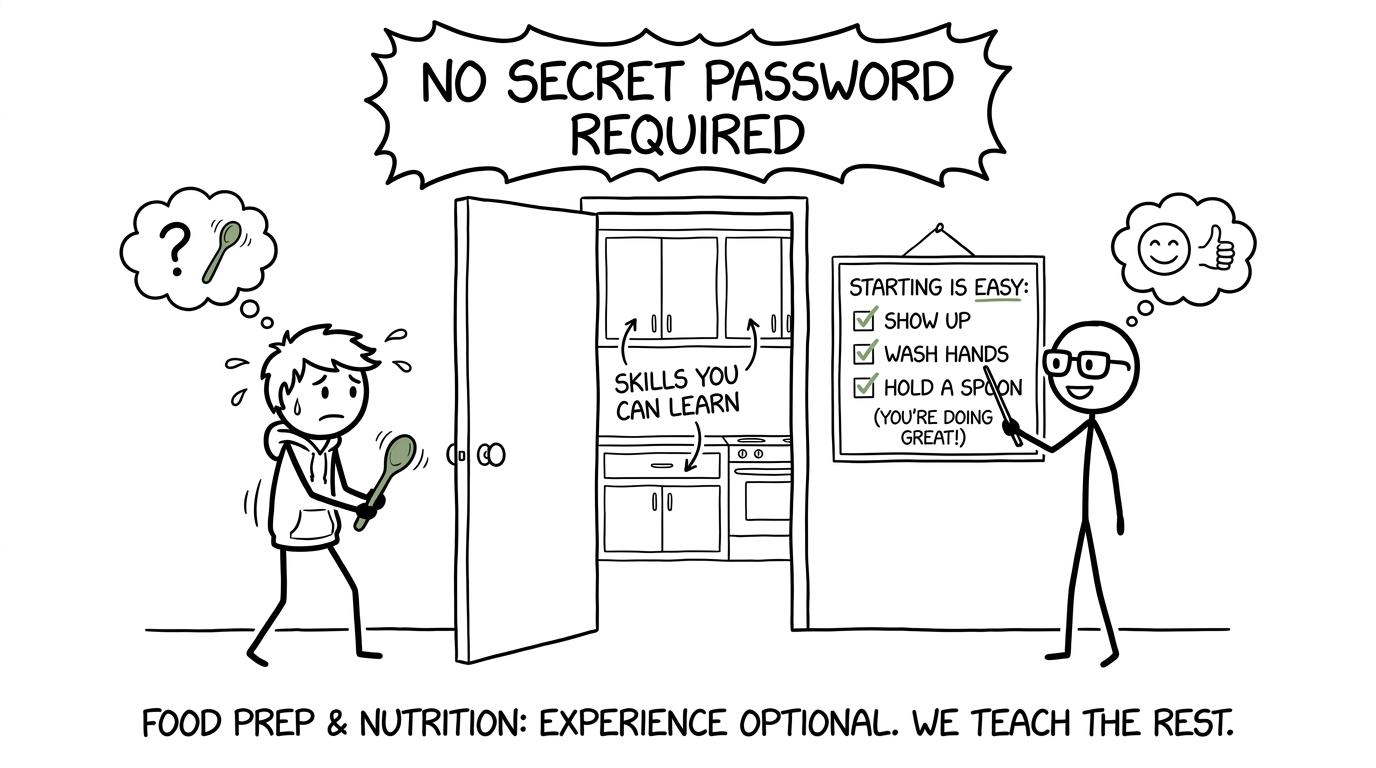 A nervous student discovers that the kitchen classroom has no secret entry password
What GCSE Food Preparation and Nutrition actually involves
The qualification is broader than learning recipes. Across the current specifications, students study nutrition, food science, food safety, food choice, food provenance and practical preparation techniques.
You may need to understand why ingredients behave as they do, plan food for different nutritional needs, evaluate results and justify decisions. Practical work can include accurate weighing, knife skills, using different cooking methods, making sauces and doughs, controlling food safety risks and presenting finished dishes.
Current AQA, OCR and Eduqas courses divide assessment equally between a written examination and NEA, with each contributing 50%50\%50% of the qualification. The exact paper length, task structure and mark allocation vary by board, so use your own specification rather than assuming another class follows the same arrangements.
This balance matters. You cannot catch up solely by reading a textbook. Theory can be revised independently, but practical techniques require safe facilities, ingredients, repetition and feedback. NEA must also be completed under the conditions set by the board and your school.
Which background knowledge is helpful but not essential?
Previous food lessons can make the opening weeks feel more familiar. They may have introduced safe knife handling, hygiene, weighing, basic cooking methods and simple evaluations. Familiarity is useful, but it is not the same as a formal entry requirement.
A stronger predictor of progress is whether you are willing to practise three different kinds of learning.
Subject knowledge
You will need an organised understanding of nutrients, dietary needs, food safety, provenance and the scientific processes involved in cooking. Some terms will initially feel like a new language. A specification checklist turns that language into manageable sections.
Practical competence
Practical confidence grows through repeated, safe performance. Watching a technique is not the same as carrying it out accurately. Ask your teacher which skills are most urgent and which can safely be practised at home with adult permission and supervision.
Analysis and evaluation
Higher-quality responses do more than describe what happened. They connect evidence to food science, nutritional choices or the success of a method. This is similar to showing reasoning in maths: the conclusion matters, but the chain leading to it earns much of the credit.
The maths knowledge you will use
Food Preparation and Nutrition does not require advanced GCSE algebra. However, secure number skills make practical and written work easier. The most useful areas are ratio, proportion, percentages, units, interpreting data and managing time or cost.
Recipe scaling follows proportional reasoning. The general relationship is:
scaled quantity=original quantity×required portionsoriginal portions\text{scaled quantity}=\text{original quantity}\times\frac{\text{required portions}}{\text{original portions}}scaled quantity=original quantity×original portionsrequired portionsNutritional analysis often involves percentages:
percentage=partwhole×100\text{percentage}=\frac{\text{part}}{\text{whole}}\times 100percentage=wholepart×100You may also compare values per portion, interpret tables and charts, measure mass or volume, and organise several processes within a fixed practical session. These are familiar GCSE maths habits placed in a kitchen context.
If those skills feel uncertain, use MathsGenie’s ratio revision guide, conversions and units lesson and direct proportion revision. The percentage change practice questions can also strengthen the accuracy needed when working with quantities and nutritional data.
Do not worry about whether you take foundation or higher tier maths. Food Preparation and Nutrition is not split into those tiers. Your maths tier does not decide whether you can succeed in the subject.
 A recipe book and calculator reluctantly join forces to help with homework
How to catch up quickly if your school allows it
Fast catch-up works best when you separate urgent gaps from knowledge that can be developed gradually. Trying to learn everything at once usually produces activity without much retention.
Audit the specification first
Ask for the exact specification and your department’s teaching plan. Create three columns:
| Status | Meaning |
|---|---|
| Secure | You can explain or perform it independently |
| Developing | You recognise it but need practice |
| New | You have not yet learnt it |
Compare your audit with what the class has already completed. Prioritise content linked to upcoming lessons, practical work and NEA preparation rather than beginning automatically at the first page.
Build a practical skills ladder
Ask your teacher to identify the techniques you need first. Begin with safe use of equipment, accurate weighing and measuring, hygiene, basic preparation and control of time. Then move towards combinations of techniques and more demanding dishes.
Keep a concise practical record after each session. Note the technique attempted, what evidence showed success, what went wrong and the single adjustment you would make next time. This prepares you to analyse rather than merely recount your work.
Learn theory through retrieval
Divide the content into small sections and test yourself without notes. Nutrient functions, sources, deficiencies, food poisoning controls and scientific processes are easier to retain when recalled repeatedly than when highlighted repeatedly.
A useful session has four stages:
- learn one compact section
- close the notes and retrieve it
- answer a few relevant questions
- correct omissions immediately
Protect your GCSE maths time
A new subject can consume every available evening because the gap feels urgent. That is risky if maths is also approaching an important assessment.
Use a weekly plan with fixed limits. MathsGenie’s GCSE maths revision timetable explains how to combine topic learning, practice and timed papers. If time is short, the one-month GCSE revision plan provides a more concentrated structure.
The principle is simple: schedule both subjects before either one expands to fill the week.
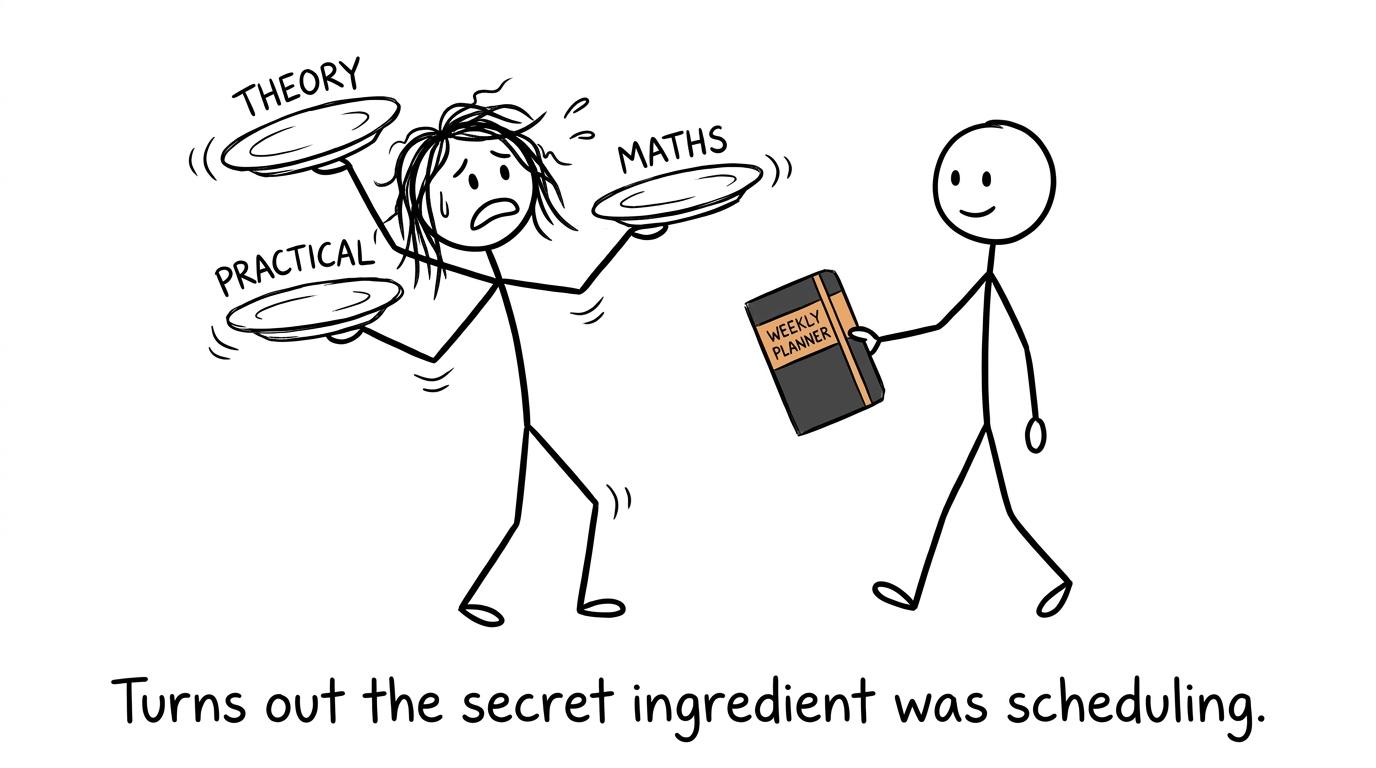 A student balances theory, practical work and maths until a planner arrives
What if you are joining after the course has started?
The later you join, the more important the school’s judgement becomes. Missing classroom theory can often be repaired through focused revision. Missing practical teaching or supervised assessment may be harder to resolve.
Ask specifically:
- Has the class begun or completed any NEA work?
- Can the school provide the required supervised time?
- Are there practical sessions you cannot safely reproduce independently?
- Is there enough curriculum time left to cover the whole specification?
- What evidence will the teacher use to decide whether the move is workable?
Do not attempt to recreate assessed NEA work privately or use another person’s material. Your teacher must follow the board’s rules on supervision, authentication and assessment. A school refusing a late transfer may be responding to these constraints rather than doubting your ability.
Common mistakes when starting without prior knowledge
Assuming the course is mainly cooking
Practical skill is central, but so are nutrition, food science, safety, analysis and evaluation. Revise the complete specification rather than collecting recipes.
Learning impressive dishes before core techniques
Complexity is not automatically quality. Secure control, appropriate techniques, sound planning and informed evaluation matter more than choosing something dramatic before you are ready.
Ignoring units and proportions
A misplaced unit or incorrect scale factor can affect the whole outcome. Write units clearly, check whether quantities are mass or volume, and estimate whether your adjusted amount is sensible.
Treating practical notes as a diary
A list of actions does not explain why an outcome occurred. Connect observations to ingredients, methods, temperature, timing, nutrition or food science.
Sacrificing every other subject
Catch-up should be concentrated, not endless. Use a timetable and continue practising core maths skills. If you need to rebuild topics in a sensible sequence, follow MathsGenie’s guide to the best order for learning GCSE maths.
A realistic decision
Taking GCSE Food Preparation and Nutrition without the usual background knowledge is realistic when three conditions are met: your school approves the entry, there is enough time for practical and assessed work, and you are prepared to catch up systematically.
You do not need to arrive knowing everything. You do need an honest map of what is missing.
Begin by speaking to the food teacher, confirming your exam board and auditing the specification. Then build practical skills in a safe sequence while strengthening the ratio, percentage and measurement skills that support the course.
For maths, make MathsGenie your free revision base. Use revision lessons and practice questions to repair individual gaps, mini tests to check retention, and mark schemes and video solutions to understand lost marks. As exams approach, add predicted papers and past-paper practice without abandoning the topics that still need attention.
Background knowledge saves a little time. A clear plan, careful practice and useful feedback usually matter far more.