GCSE Food and Nutrition Handwriting Speed: Does It Matter?
GCSE food and nutrition handwriting speed: learn when slow writing affects marks, how to improve exam timing, and when to ask your school for support.
The clock can become strangely loud in a written exam. You know the food science, you understand the question, but your hand seems to be working several sentences behind your brain. If you are worried about GCSE food and nutrition handwriting speed, the short answer is reassuring: slow handwriting does not automatically lose marks. Examiners reward relevant knowledge, application and analysis, not the number of words you produce.
But speed can matter indirectly. If slow writing prevents you from finishing, developing longer answers or making your handwriting readable, it may limit the evidence an examiner can reward. The goal is therefore not to write as fast as possible. It is to produce enough clear, relevant material within the available time.
The quick handwriting and timing checklist
Before changing your handwriting, check what is actually happening:
- Complete a section of a paper under timed conditions.
- Mark where you reached when the time ended.
- Separate handwriting problems from knowledge and planning problems.
- Check whether your final answers remain readable.
- Practise concise, structured responses rather than longer ones.
- Ask a teacher or SENCo about support if writing is persistently difficult, painful or unusually slow.
- Use the timing printed on the paper for your particular exam board and specification.
This matters because a student who appears to write slowly may really be spending too long deciding what to say. Another may write quickly but fill the page with material that does not answer the command word. Speed alone tells you very little.
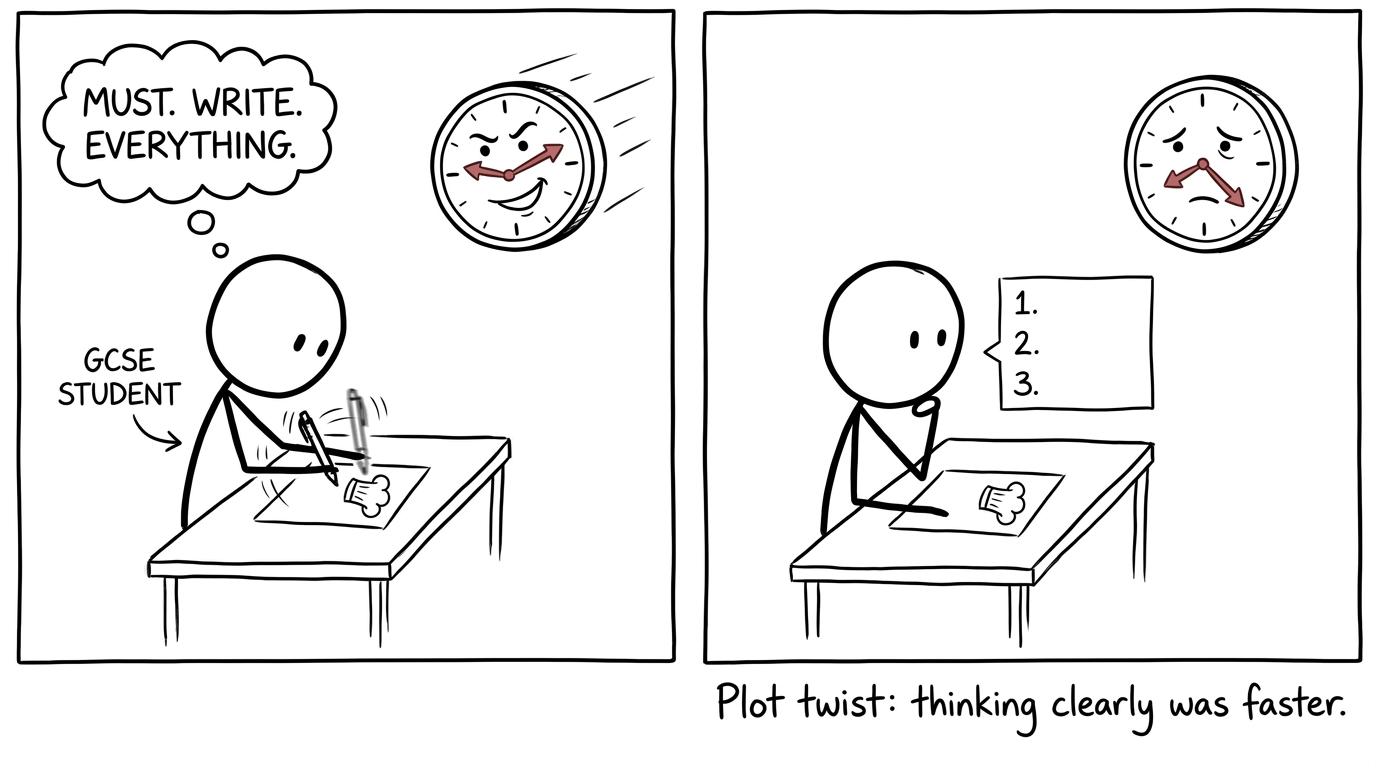 A student discovers that clear thinking can beat racing the exam clock
Does slow handwriting genuinely cost marks?
There is normally no separate mark for handwriting speed in GCSE Food Preparation and Nutrition. The written paper assesses subject knowledge and the quality with which you apply, analyse and evaluate it. Slow handwriting becomes a marks problem only when it affects what reaches the page.
That can happen in three ways.
You leave questions unfinished
An examiner can only reward the evidence you provide. If a response worth several marks is blank because an earlier question absorbed too much time, the lost opportunity is real even though your handwriting speed was not itself assessed.
This is why timed practice is diagnostic. Do not merely ask, “Did I know the content?” Ask, “Could I communicate it in the time available?” The same distinction matters in maths, where knowing a method is not quite the same as completing it accurately under pressure. The MathsGenie GCSE maths revision hub provides timed papers, topic questions and solutions for building that second skill.
Your answer is too brief to earn the available marks
A short answer can be excellent when it contains the required ideas. However, questions using command words such as explain, analyse, evaluate or justify usually require connected reasoning, not an isolated fact.
For example, naming a nutrient is different from explaining its function, linking it to a consumer group and considering the effect of a food choice. You do not need decorative prose, but you do need enough development to meet the question.
Your writing becomes difficult to read
Readable does not mean beautiful. Examiners are accustomed to varied handwriting, corrections and crossed-out work. Nevertheless, they cannot safely infer words that are genuinely illegible.
Keep letters distinct, leave reasonable spaces and avoid shrinking your writing as the clock runs down. If a word is wrong, cross it out once and continue. Repeatedly rewriting whole sentences usually costs more time than it saves.
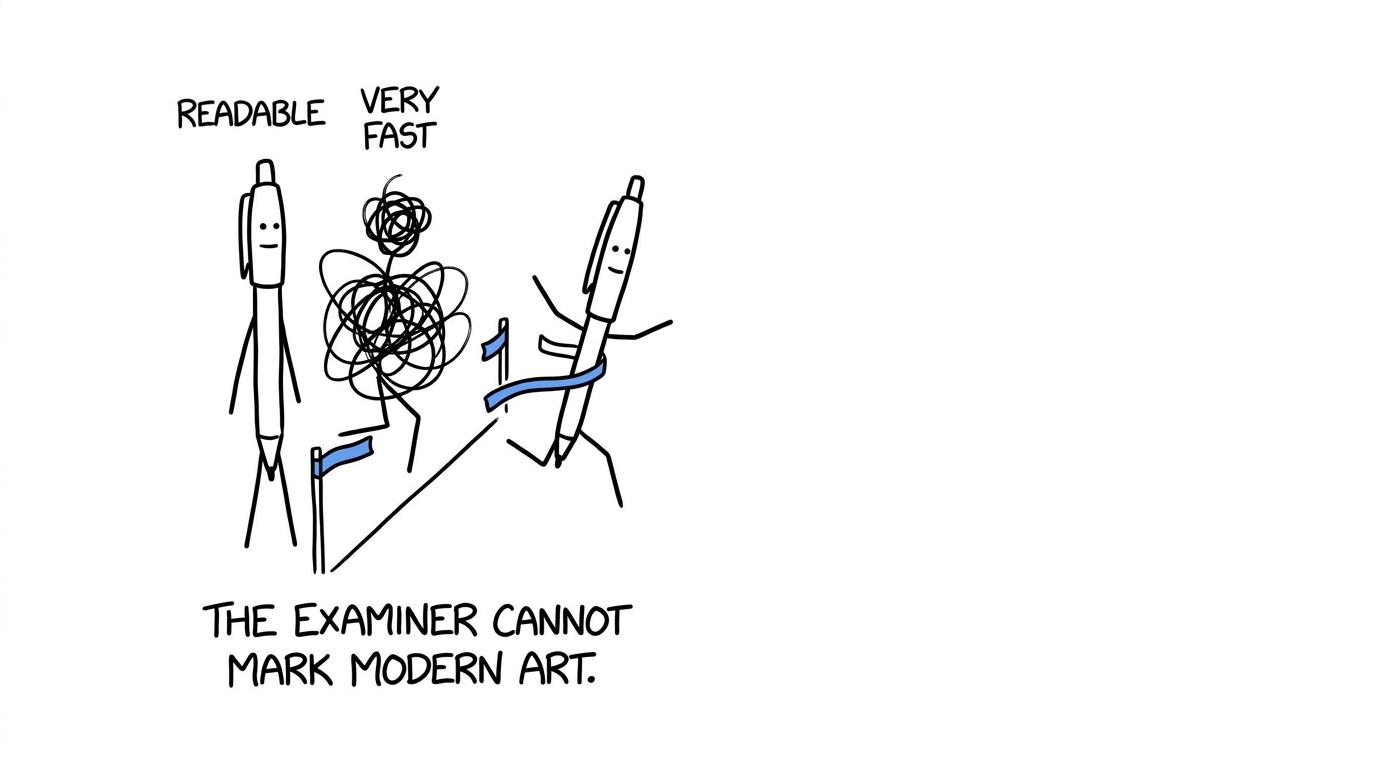 A readable pen calmly beats a very fast pen that scribbles itself into a knot
Know the demands of your own paper
Food Preparation and Nutrition arrangements are not identical across AQA, OCR and Eduqas. Current official specifications show differences in the duration and structure of written assessments. AQA GCSE Food Preparation and Nutrition 858585858585, for example, has a written paper lasting 111 hour 454545 minutes and worth 100100100 marks. OCR GCSE Food Preparation and Nutrition J309 uses a 111 hour 303030 minute written paper worth 100100100 marks. Eduqas also has its own published component structure.
Specifications can be updated, so use the information supplied by your school and read the front cover of the paper carefully. Unlike GCSE maths, Food Preparation and Nutrition is not normally divided into foundation and higher tiers. Do not borrow a timing rule from a different subject, board or specification and assume it applies.
A marks-to-minutes estimate can still provide a useful starting point:
average time per mark=available minutesavailable marks\text{average time per mark}=\frac{\text{available minutes}}{\text{available marks}}average time per mark=available marksavailable minutesIt is only an average. Multiple-choice and short-response items may take less time, leaving more for extended writing and checking. Your teacher may also recommend time for reading and reviewing answers. Follow the shape of your real paper rather than forcing every mark into an identical time slot.
Find out whether handwriting is really the bottleneck
Sit one realistic paper or section before deciding that your hand is the problem. Use the correct time limit, remove notes and record where you were at a few agreed checkpoints.
Afterwards, classify each delay:
- Recall delay: you could not retrieve the food fact or scientific principle.
- Planning delay: you knew the topic but could not organise the response.
- Writing delay: you had a clear answer in mind but could not record it quickly enough.
- Perfection delay: you rewrote acceptable phrases or tried to make every sentence elegant.
- Question-reading delay: you missed a command word or kept returning to the prompt.
This distinction changes the solution. More handwriting drills will not repair weak recall. Equally, rereading notes will not help much if the real obstacle is physical writing fluency.
The process resembles diagnosing weaknesses in maths. Finding your weakest GCSE topics is more productive than vaguely deciding that you are “bad at exams”. Specific problems can be practised; vague worries cannot.
How to manage slow handwriting in the exam
Plan in fragments before writing
For a longer response, spend a brief moment identifying the command word and jotting the main ideas. Your notes can be fragments rather than polished sentences. This prevents the slower habit of writing a paragraph, discovering that it has drifted away from the question and starting again.
A reliable structure is:
- make the relevant point;
- explain why it matters;
- apply it to the food, process or consumer in the question;
- add a judgement when evaluation is required.
This is not a formula to repeat mechanically. It is a way to ensure that each sentence earns its place.
Write concisely, not cryptically
Concise answers remove repetition while preserving explanation. Use subject vocabulary accurately, but do not add every fact you remember. One developed chain of reasoning may be more valuable than several disconnected statements.
Avoid unexplained abbreviations unless they are conventional and unambiguous. Saving a second is not useful if the examiner cannot determine what you mean.
Move on when your time is up
If a question is consuming too much time, leave space and continue. Returning later protects the marks available elsewhere. A short, relevant attempt across the whole paper is usually safer than an excellent opening followed by blank pages.
Protect readability under pressure
Use a pen that you can control comfortably and bring a spare. Relax your grip when possible, keep the paper at a comfortable angle and avoid making your writing artificially tiny. Your objective is sustainable clarity, not calligraphy.
Train speed without making your writing worse
Handwriting improves most usefully when practice resembles the actual task. Copying random paragraphs quickly may train movement, but it does not train recall, selection and exam judgement together.
Instead, choose a real Food Preparation and Nutrition question and:
- plan the response briefly;
- answer it within a sensible time limit;
- check whether every sentence addresses the question;
- ask a teacher whether the handwriting is readable;
- repeat the task on another day.
Increase pace gradually. If faster writing causes missing words, cramped letters or hand pain, stop treating speed as the only target. Clear and complete beats fast and unreadable.
Short, repeated sessions are usually easier to evaluate than an occasional exhausting paper. Maths students can apply the same principle through mini tests and timed revision planning, then progress to full papers once accuracy is stable.
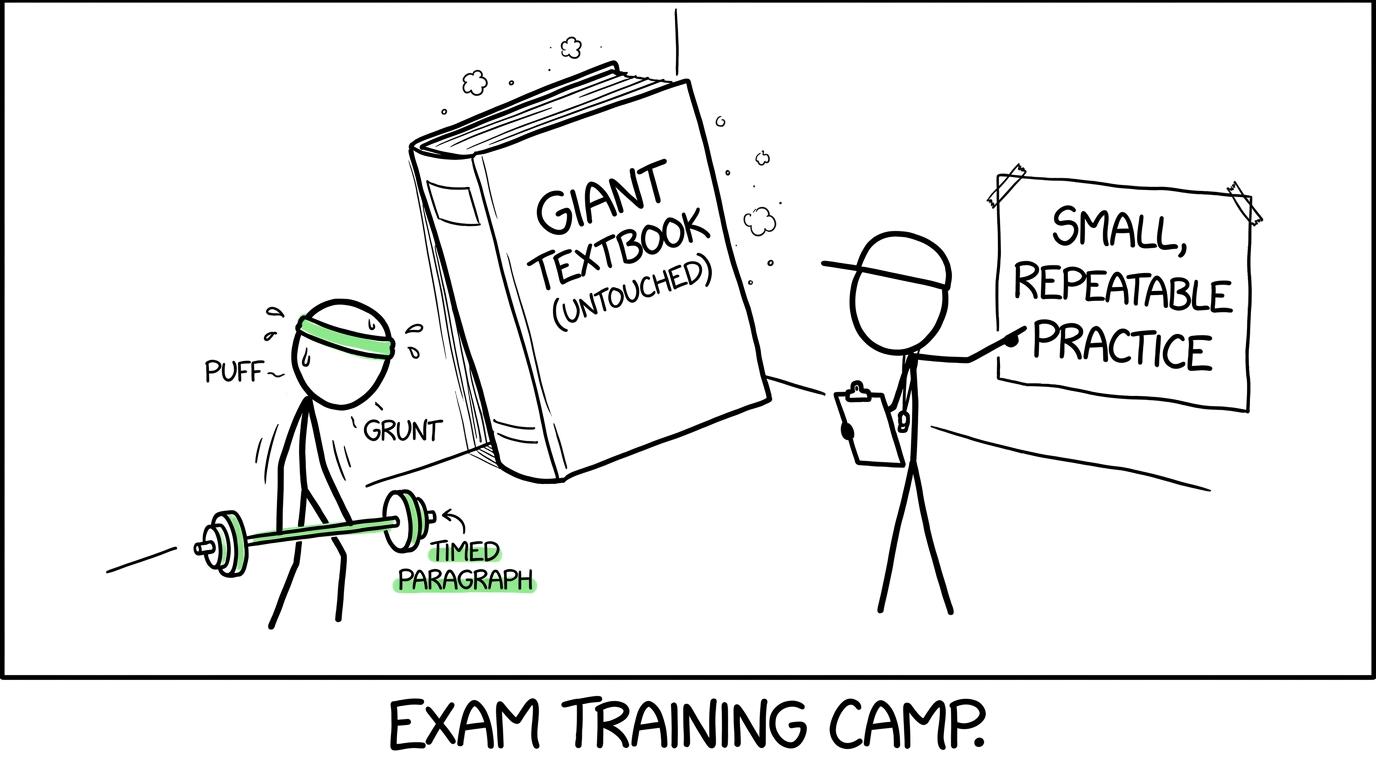 A student builds exam stamina through small repeatable practice rather than wrestling a giant textbook
When to ask about access arrangements
Ordinary variation in handwriting speed does not automatically qualify a student for extra time or a word processor. However, persistent and significant difficulty may need formal consideration, particularly where there is a disability, learning difficulty, medical condition or temporary injury.
Current JCQ guidance allows schools and colleges to consider arrangements such as extra time, a word processor, supervised rest breaks or other reasonable adjustments where the relevant requirements are met. The arrangement must reflect evidence of need and, in many cases, the student's normal way of working. A measure of writing speed may form part of the evidence for extra time, but a single self-timed result does not establish eligibility.
Speak to your teacher, exams officer or SENCo early. Do not wait until the week of the examination. Rules and evidence requirements are updated, and your school must follow the JCQ process applying to the relevant academic year. If writing causes pain, fatigue or loss of function, tell an appropriate adult rather than trying to train through it.
Common handwriting and exam-timing mistakes
Trying to make every sentence perfect
The examiner needs a clear answer, not a published essay. Planning briefly and continuing forwards is usually better than repeatedly rewriting an acceptable opening.
Confusing length with quality
More words do not guarantee more marks. Repetition uses time without adding evidence. Let the command word and mark allocation guide the depth of your answer.
Practising only without a timer
Untimed revision can build knowledge, but it cannot show whether you can finish. Combine topic learning with timed sections, just as proper GCSE past-paper practice combines performance, marking and correction.
Starting full papers too early
If your subject knowledge is fragile, a complete timed paper may mainly measure what you have not yet learnt. Build content first, then use sections, mini tests and full papers. The guide to when to start GCSE past papers explains this progression for maths revision.
Ignoring feedback about readability
You already know what you intended to write, so your own script can seem clearer to you than it is to somebody else. Ask a teacher to identify particular words or letter combinations that are difficult to interpret.
Treating panic as proof that you are slow
An anxious pause can feel like a handwriting failure. A realistic GCSE night-before plan helps reduce last-minute overload, while a structured one-week revision plan can turn broad worry into manageable tasks.
Clear thinking matters more than frantic writing
Handwriting speed matters only through its effect on completion, development and readability. You do not need to become the fastest writer in the room. You need to recognise command words, select relevant knowledge, organise it quickly and leave enough clear evidence for the examiner to reward.
Test the problem under timed conditions. If knowledge or planning is slowing you down, address that first. If handwriting remains a significant barrier, speak to your school early about appropriate support.
For your maths exams, put the same lesson into practice with MathsGenie. Start at the free GCSE maths revision hub, use revision lessons and practice questions to strengthen weak topics, then build timing through mini tests, past papers and predicted papers. Mark your work carefully, use the video solutions when a method is unclear, and let each timed attempt make the next one calmer and more complete.