GCSE English Literature vs Language: What Employers See
GCSE English literature vs English language employers: discover which grade matters more for jobs, college applications and UK apprenticeships after Year 11.
A results sheet can make two subjects with similar names feel strangely unequal. English Language sits on one line. English Literature sits on another. Both took years of lessons, yet an application form may offer only one box marked “English”.
For students searching gcse english literature vs english language employers, the short answer is this: English Language is usually the more important and widely requested qualification. Employers, colleges and apprenticeship providers commonly use it as evidence of practical reading and writing. English Literature remains valuable, but it is more often an additional strength than the standard requirement.
That does not mean every organisation follows the same rule. If an advert or course page simply asks for “GCSE English”, check whether either qualification is accepted rather than guessing.
The quick answer
- Employers usually notice English Language first, particularly when checking minimum GCSE requirements.
- Colleges commonly use English Language for entry, although exact requirements depend on the course and provider.
- English Literature can strengthen an application, especially for essay-based, humanities, communication or creative pathways.
- Some apprenticeship rules and vacancies accept qualifications with English in the title, but individual employers may set more specific entry criteria.
- The wording of the actual vacancy or course is decisive. “English”, “English Language” and “English Language or Literature” do not necessarily mean the same thing.
- Maths matters alongside English in many applications, so protect time for both subjects rather than treating revision as a competition between them.
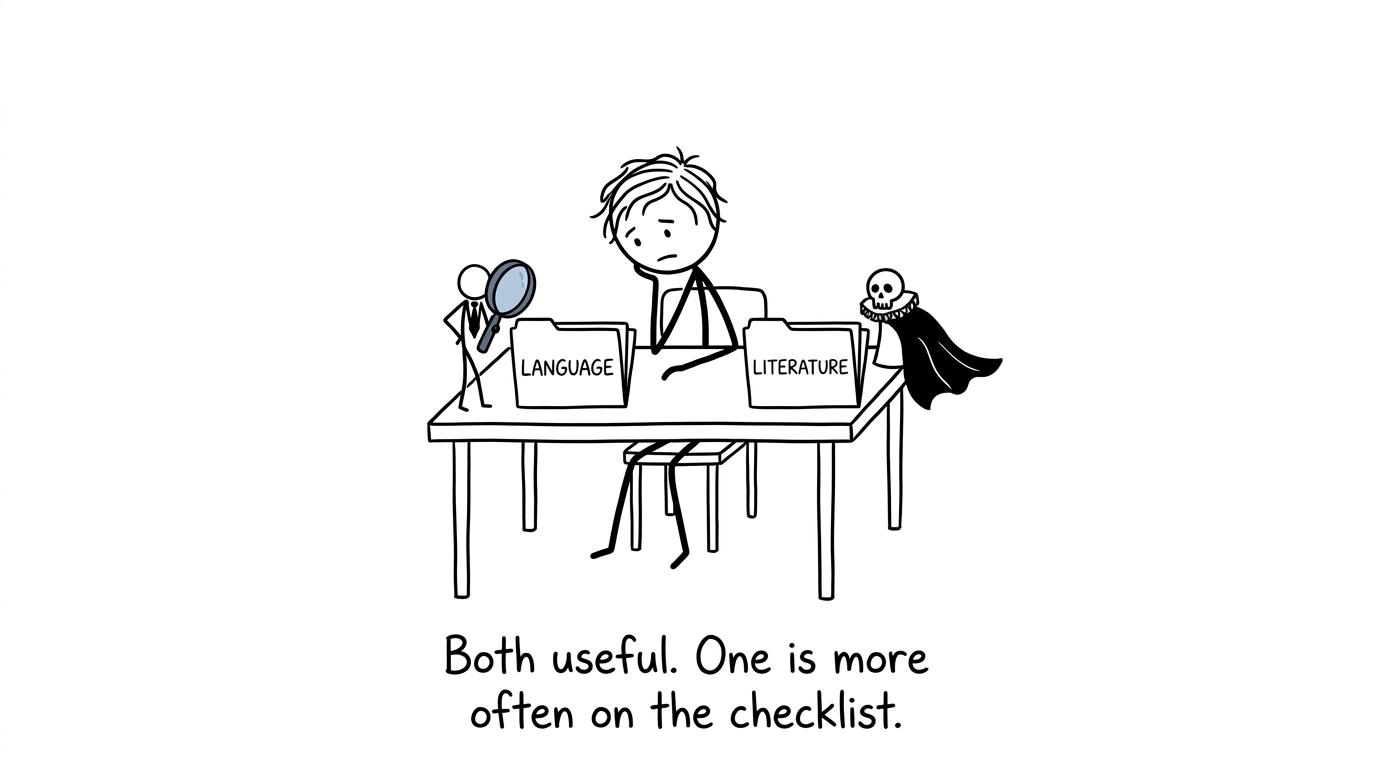 A student comparing English Language and Literature while an employer examines the application checklist
Why English Language is usually noticed first
English Language measures skills that transfer directly into everyday work: understanding unfamiliar information, comparing viewpoints, communicating clearly and writing accurately for a particular audience and purpose.
Current GCSE specifications from exam boards such as AQA assess reading, analysis, evaluation and writing. They also include spoken-language skills through a separately reported endorsement. Edexcel, OCR and Eduqas organise their assessments differently, but the broad emphasis on practical communication remains.
That makes English Language an easy qualification for an employer to place on a checklist. A workplace may involve emails, instructions, reports, customer messages, safety information or short presentations. The GCSE does not prove that someone will perform every workplace task perfectly, but its purpose is immediately recognisable.
Literature develops powerful skills too. Studying novels, plays and poetry requires sustained reading, interpretation, evidence selection and structured argument. The difference is not that Literature lacks value. It is that job and course requirements more often name Language explicitly.
What employers actually check on an application
There is no single GCSE policy followed by every UK employer. Requirements vary by role, sector, apprenticeship level and location. Some employers request a particular grade in English Language and maths. Others ask for several GCSEs including English and maths without distinguishing between Language and Literature. Some entry-level roles place greater weight on the application, interview and relevant experience.
When qualifications are checked, employers are generally trying to answer three practical questions:
- Does the applicant meet the advertised minimum requirement?
- Can the applicant communicate appropriately for this role?
- Does the overall application show reliability, judgement and relevant ability?
A strong Literature grade may contribute positively to the third question. It can suggest that you can follow complex ideas, construct an argument and support a conclusion with evidence. However, it may not replace Language when the vacancy specifically says “GCSE English Language”.
Read the exact wording
Small differences matter:
| Requirement | Sensible interpretation |
|---|---|
| GCSE English Language | Literature should not be assumed to count |
| GCSE English | Ask whether Language, Literature or either is accepted |
| GCSE English Language or Literature | Either named qualification can meet that stated requirement |
| English at Level 2 or equivalent | Check the employer’s list of accepted qualifications |
| Good written communication | The application itself will also provide evidence |
If the wording remains unclear, contact the employer or training provider. A brief factual question is better than rejecting yourself from an opportunity unnecessarily.
Do colleges care more about Language or Literature?
Colleges and sixth forms usually care more about English Language as a general entry qualification. Many courses require a particular result in English and maths, while individual A Levels may add subject-specific conditions.
For example, a provider could require English Language for general admission but expect a strong Literature result for A Level English Literature. An essay-heavy subject might consider both. Another college may accept either GCSE for its general entry threshold. These are provider decisions, so students should check the published requirements for the exact course and entry year.
Post-16 funding rules in England also create circumstances in which students who have not secured the required standard in English must continue working towards an approved qualification. Those rules are not a universal guide to what every employer accepts, and arrangements elsewhere in the UK differ. Your school or college should confirm what applies to you.
The useful principle is simple: Language is generally the safer qualification for broad progression, while Literature becomes especially relevant when the next course names it or relies heavily on literary analysis.
What about apprenticeships?
Apprenticeship vacancies can set their own entry requirements. Official guidance makes clear that some apprenticeships ask for GCSE English and maths, with the precise conditions shown in the vacancy details.
The funding and completion rules can also depend on the apprentice’s age, prior qualifications and the nation in which the apprenticeship takes place. Recent rules in England distinguish between younger and adult apprentices, so old advice found in a forum or social-media post may no longer describe the current position.
Treat each apprenticeship as a separate application:
- read the essential criteria;
- identify whether it says Language, Literature or simply English;
- check the required grade or equivalent qualification;
- ask the training provider if your combination is not listed;
- include both GCSEs accurately where the form allows it.
Never change “English Literature” to “English Language” on an application because the form appears to expect Language. Qualifications can be verified, and accuracy matters more than making a form look tidy.
When English Literature can make a real difference
English Literature is not an invisible GCSE. Its importance depends on context.
It may be especially relevant when applying for English Literature, history, law-related, humanities, media, publishing or other essay-based courses. It can also support an application for roles involving careful reading, research or written explanation. This is evidence of transferable ability, not a guarantee of admission or employment.
Literature may also distinguish between candidates who already meet the basic Language requirement. Once the minimum box is ticked, employers and colleges can consider the wider profile: subject choices, grades, experience, application quality and interview performance.
Think of Language as more frequently opening the gate. Literature may help explain what else you can do once you are through it.
Why maths students should care about this distinction
English and maths often appear together in entry requirements, but they reward overlapping habits. Reading a long GCSE maths question carefully, identifying relevant information and presenting a logical method all depend on communication.
That does not turn algebra into an English assessment. It does mean that vague reading and rushed writing can cost marks even when the underlying maths is understood.
You can build those habits through the MathsGenie GCSE maths revision hub, where free revision lessons and practice questions help you turn methods into clear written solutions. A structured GCSE maths revision timetable can also prevent English revision from taking over every evening before being abandoned for maths the following week.
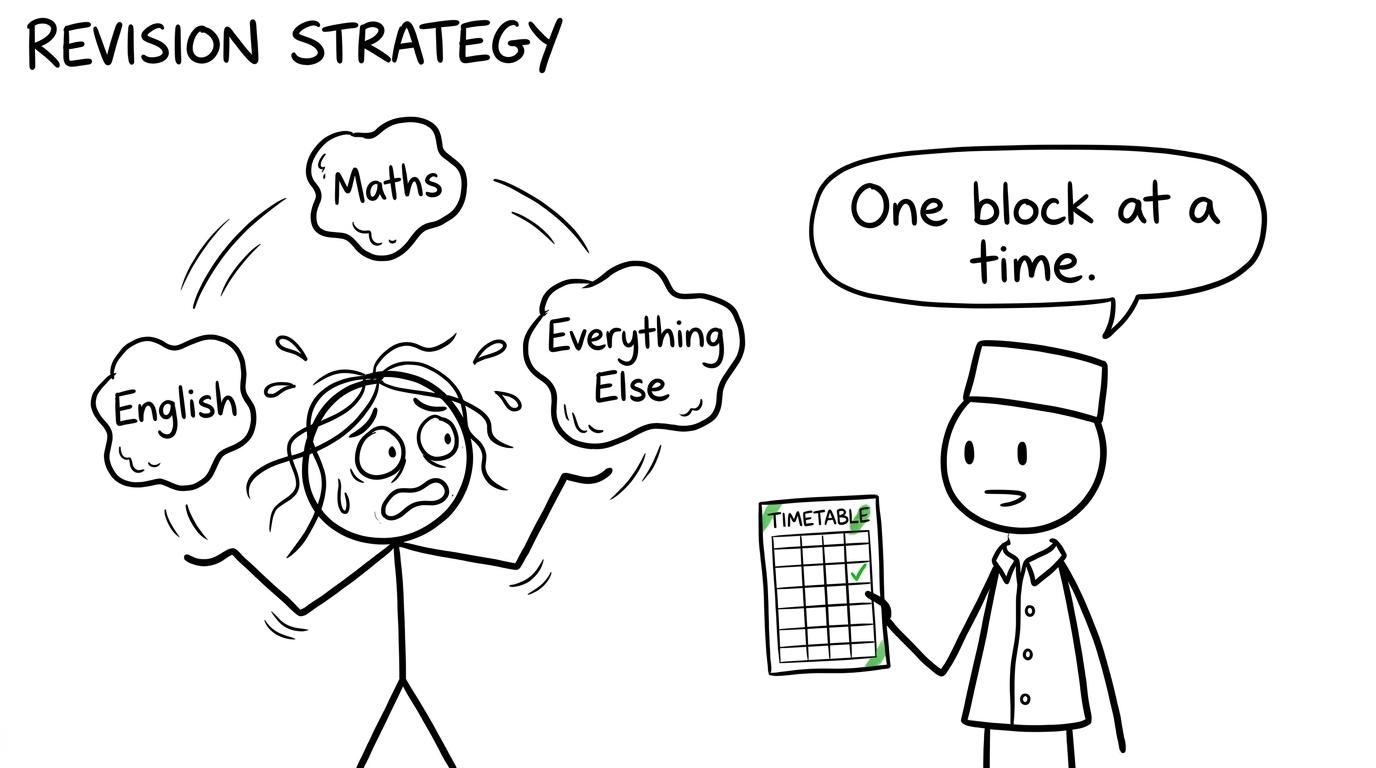 A student juggling English, maths and other subjects beside a calm revision planner
How to balance English and maths revision
The aim is not to decide which subject deserves all your attention. It is to identify which result could close a future door and give that subject consistent time.
Start with three checks:
- Compare your current grades with likely college, sixth-form or apprenticeship requirements.
- Identify the weakest examinable skills in each subject.
- Build short, repeatable sessions around those gaps.
For maths, the one-month GCSE revision plan provides a practical structure. Use topic lessons first, then answer practice questions and mark them immediately. As the exams approach, introduce timed papers rather than waiting until every topic feels finished.
The guide to when you should start GCSE past papers explains how to move from diagnosis to timed practice. You can then use Edexcel GCSE Maths predicted papers alongside official past papers, not as a replacement for them.
A sensible week might contain several focused English sessions, several maths topic sessions and one timed assessment. The exact balance should follow your weaknesses, not the subject you happen to enjoy most.
Common mistakes when comparing the two GCSEs
Assuming Literature always counts as English Language
It may be accepted where a requirement says “English” or expressly allows either subject. It should not be assumed to satisfy a condition that specifically names English Language.
Believing Literature is useless to employers
Its analytical and written skills remain valuable. The more accurate conclusion is that English Language is requested explicitly more often.
Looking only at the overall college requirements
A college may have general entry criteria and separate requirements for an individual course. Check both before choosing subjects or estimating whether you qualify.
Using outdated apprenticeship advice
Rules and funding arrangements can change. Use the current vacancy details and ask the provider about your circumstances.
Neglecting maths because English feels more urgent
Improving one core subject while allowing another to decline merely moves the problem. Use a planner and a diagnostic routine. If a result has already disappointed you, the GCSE maths resit revision plan shows how to turn lost marks into targeted practice.
Completing papers without reviewing them
A paper creates evidence; the review creates improvement. Mark carefully, classify each error and revisit the relevant skill. The article on how many GCSE past papers to complete explains why quality of review matters more than collecting paper totals.
The qualification matters, but the next action matters more
English Language is normally the GCSE that employers and colleges notice first when they need evidence of general literacy. English Literature adds genuine value, particularly for academic and writing-heavy pathways, but it should not automatically be treated as a substitute when Language is named.
Check the wording. Ask when it is ambiguous. Record both qualifications honestly. Then return your attention to what you can still improve.
MathsGenie gives you a free place to do that for GCSE and A Level maths. Begin with a revision lesson, practise the topic, use a mini test to check it, and progress to past papers or predicted papers under timed conditions. Mark schemes and video solutions then show you where the next marks are waiting. Open MathsGenie, choose your exam board and tier, and make your next revision session specific enough to finish today.