Is GCSE English Literature Similar to English Language?
GCSE English Literature similar to GCSE English Language? Compare skills, exam demands and revision workload, then decide whether Language suits you best.
Enjoying a subject does not always mean enjoying its closest neighbour. A student may love discussing a novel but dislike writing against the clock, just as someone can enjoy algebra while finding geometry less natural. So, is GCSE English Literature similar to GCSE English Language? Yes, in several important skills; but the qualifications ask you to use those skills in different ways.
Literature concentrates on studied literary texts, interpretations, themes, characters, contexts and writers' methods. Language focuses more heavily on unseen texts, critical reading and producing your own writing for particular audiences and purposes. If you enjoyed analysing how authors create meaning, Language is a sensible subject to approach with confidence. It is not, however, simply Literature with unfamiliar extracts.
There is also an important practical detail. In England, English Language and English Literature are separate, untiered GCSE qualifications, and many students are entered for both by their school. In Wales, learners beginning the reformed course from September 2025 normally follow an integrated GCSE English Language and Literature single or double award. Always check your school pathway and exam-board specification before treating this as a free subject choice.
The short answer: how much overlap is there?
The overlap is genuine, especially in reading and analysis. A student who is comfortable with Literature is likely to bring several useful habits into Language:
- reading closely rather than settling for the first obvious meaning
- identifying explicit and implicit ideas
- selecting relevant textual evidence
- analysing vocabulary, imagery and structural choices
- explaining effects rather than merely spotting techniques
- comparing ideas or perspectives
- organising a clear, supported argument
- writing accurately in Standard English
The largest differences are preparation and production. Literature usually requires knowledge of set plays, novels and poetry, while Language examinations place unseen material in front of you. English Language also assesses your ability to create sustained writing of your own. Under the subject requirements used in England, reading and writing each account for 50%50\%50% of the qualification, while spoken language is reported separately and does not contribute to the final GCSE grade.
A useful decision checklist is therefore:
- Did you enjoy analysing the writer's choices? That transfers strongly.
- Did you mainly enjoy the stories and characters? Language may feel less familiar.
- Are you comfortable responding to unseen material? That is central to Language.
- Do you enjoy descriptive, narrative or persuasive writing? Language gives this a much larger role.
- Can you manage another examination workload? Look at your whole revision timetable, not one subject in isolation.
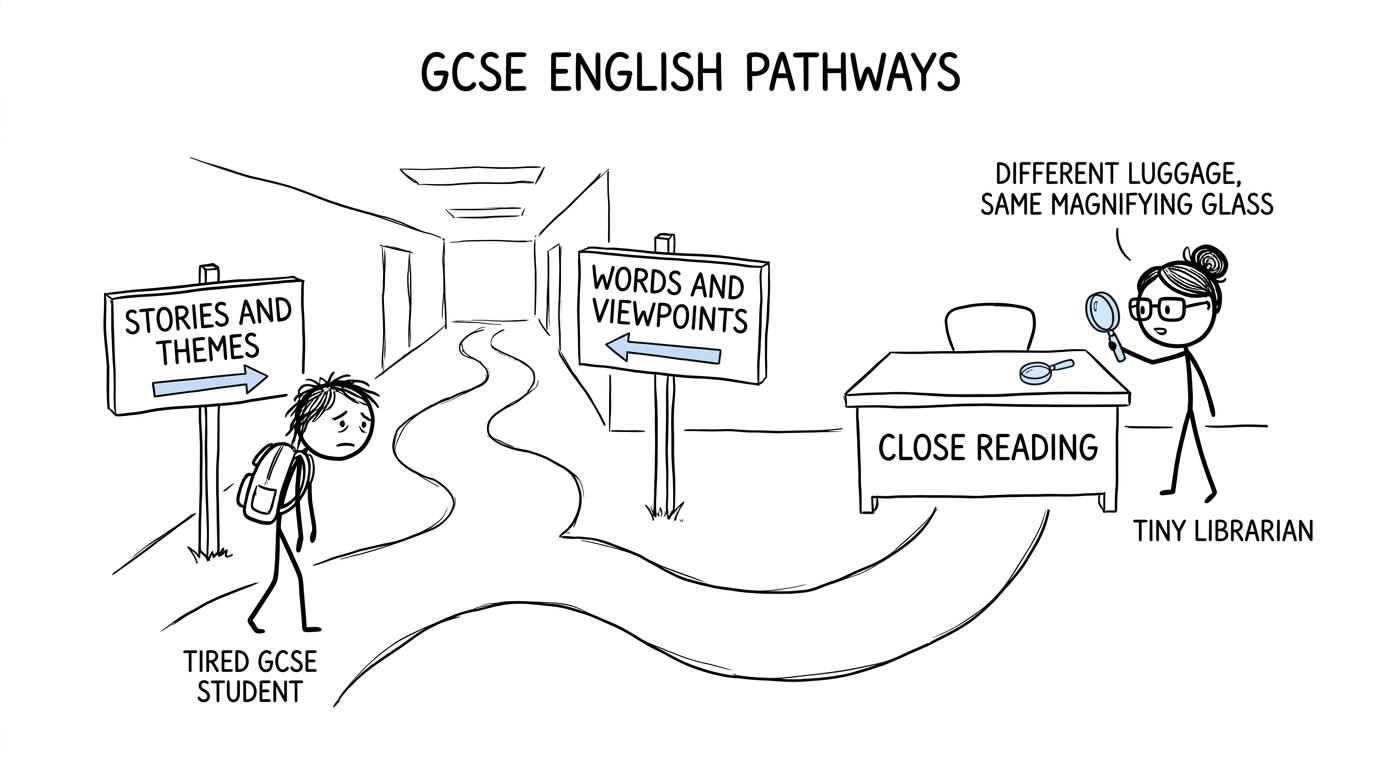 A student discovers that Literature and Language take different paths towards close reading
Where GCSE English Literature and Language are similar
Both reward close reading
In both qualifications, strong answers begin with careful observation. You need to notice what a writer has chosen and consider why that choice matters. Simply naming a metaphor, contrast or short sentence rarely completes the analysis. Examiners are interested in how the choice develops meaning, shapes tone or influences the reader.
This is similar to mathematical reasoning. Writing down an answer without a method may miss available marks; identifying a language feature without explaining its contribution leaves the reasoning unfinished. In both cases, the valuable habit is to connect evidence to a justified conclusion.
Evidence must support interpretation
Literature encourages informed personal responses, but personal does not mean unsupported. Language also asks you to interpret, compare and evaluate texts using appropriate references. Your reading may be thoughtful and original, yet it must remain grounded in what is actually on the page.
That evidence-based discipline is useful far beyond English. GCSE maths students use it when interpreting graphs, checking whether a result is sensible or explaining a conclusion from data. If you want to strengthen that wider exam habit, MathsGenie's guide to finding your weakest GCSE topics shows how to replace vague feelings with evidence from completed questions.
Both require clear written reasoning
A successful English response normally has a line of thought. Each paragraph should contribute something new, evidence should be purposeful, and explanation should answer the question rather than circle around it.
Students who enjoy constructing Literature essays often have an advantage here. They are accustomed to developing an interpretation across several paragraphs. That does not remove the need to learn Language question formats, but it provides a strong foundation.
Writer's methods matter in both
Language and structure are central to both subjects. Literature adds sustained attention to literary form and the relationship between a complete work and its context. Language broadens the range of material, including fiction, literary non-fiction and other substantial non-fiction writing, depending on the paper and board.
The shared core is writer's craft. The surrounding purpose is different.
Where GCSE English Language feels different
The texts are usually unseen
In Literature, revision often centres on known material: plot, character development, themes, poems, contextual understanding and useful references. Exact requirements vary between AQA, Pearson Edexcel, OCR and Eduqas, but substantial knowledge of studied texts is fundamental.
In Language examinations, the reading sources are unseen. You cannot predict the exact subject, setting or viewpoint. Your preparation therefore focuses on repeatable reading methods, question demands and time management rather than memorising content.
Some students find this freeing. There is less material to remember. Others find it uncomfortable because they cannot prepare an interpretation in advance. Enjoying Literature is a positive signal, but your response to uncertainty may matter just as much.
You must produce your own writing
This is the clearest difference. English Language assesses communication for different forms, purposes and audiences. Depending on the board and paper, this may include imaginative, descriptive, narrative or viewpoint writing.
Marks are available not only for ideas but also for organisation, tone, register, vocabulary, sentence control, spelling and punctuation. Under the requirements for GCSE English Language in England, technical accuracy forms 20%20\%20% of the qualification.
A student who loves interpreting Dickens or Shakespeare may not automatically enjoy inventing a description or building a persuasive argument. Conversely, someone who found remembering Literature content difficult may thrive when given freedom to create.
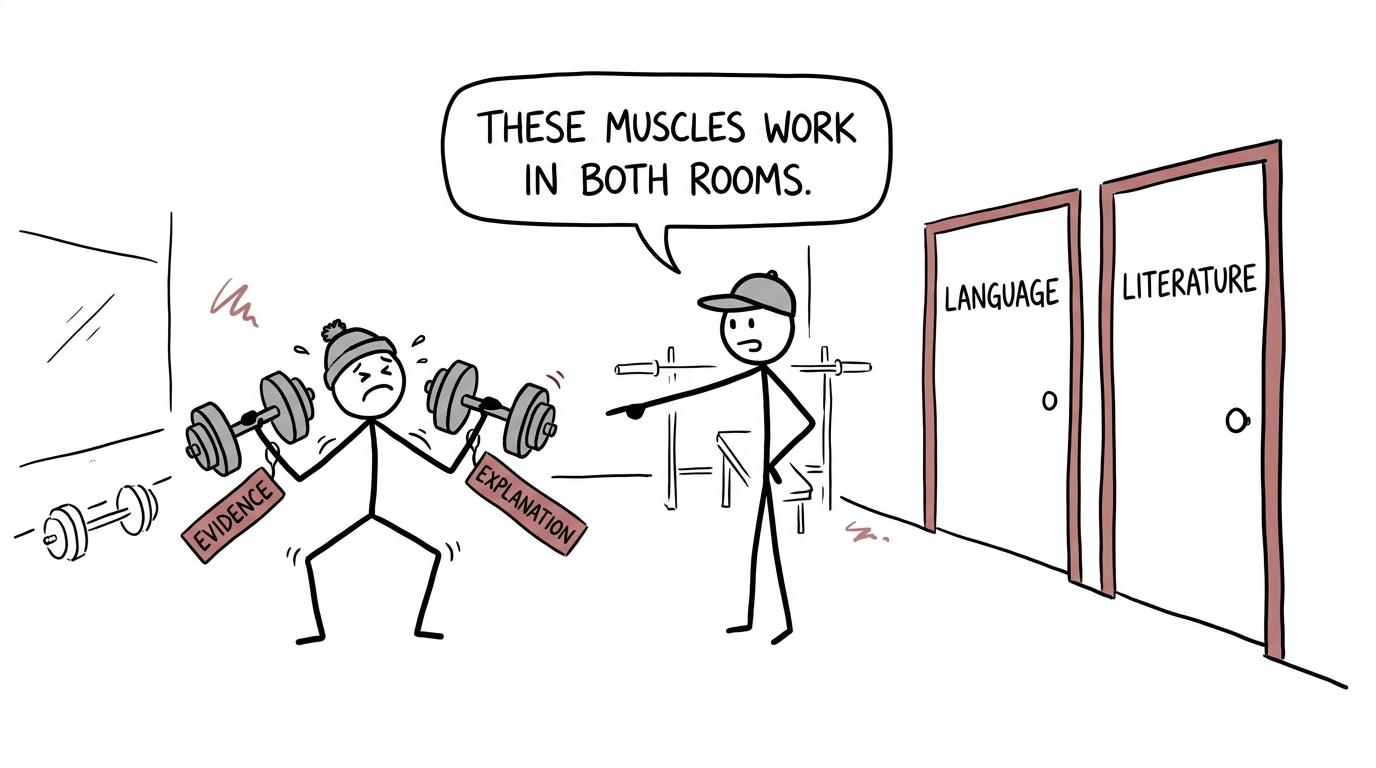 A revision coach explains that evidence and explanation are trained in both English qualifications
Context has a different role
In Literature, understanding relationships between texts and their historical, social or literary contexts is an explicit part of assessment. Context should inform interpretation rather than appear as an unrelated history paragraph.
English Language generally keeps your attention on the supplied source, its purpose and its audience. Background knowledge can help you read intelligently, but you are not revising a bank of contextual material in the same way.
Language tests flexibility more directly
Literature asks what you understand about works you have studied deeply. Language asks whether you can transfer your reading skills to material you have never seen and then switch into writing mode. That movement between tasks makes timing and adaptability particularly important.
Should you try GCSE English Language too?
If the decision is genuinely available to you, Language is worth considering when you enjoyed the analytical process of Literature, not merely particular books. Liking discussion, inference, precise evidence and writer's craft suggests meaningful compatibility.
Be more cautious if your enjoyment depended almost entirely on knowing the story beforehand, having extensive teacher guidance or avoiding creative and transactional writing. None of these concerns means you cannot succeed. They simply identify the parts of Language you should sample before deciding.
Ask your school for the exact specification, assessment structure and entry arrangement. AQA, Edexcel, OCR and Eduqas follow common national assessment principles in England, but their paper structures, source combinations, timings and question styles are not interchangeable. In Wales, check whether your cohort follows the new integrated WJEC qualification rather than separate Language and Literature GCSEs.
The best test is a small, realistic one: inspect an official paper for your board, attempt a reading section and one writing task under controlled conditions, then review the mark scheme. You are not trying to predict a final grade from one attempt. You are discovering whether the work itself holds your attention.
Balancing English with GCSE maths revision
Subject choices are also choices about time. Literature can involve revisiting set texts and quotations; Language improves through regular unseen reading and writing practice; maths requires repeated problem-solving rather than passive rereading.
A balanced week might include short, focused sessions for each subject rather than occasional revision marathons. MathsGenie's GCSE maths revision timetable guide can help you organise those sessions around actual weaknesses. If the exams are close, the one-month GCSE maths revision plan offers a more concentrated structure.
The feedback loop is remarkably similar across subjects:
- attempt an exam-style task without notes
- mark it using the correct criteria or mark scheme
- identify the precise reason marks were lost
- practise that specific weakness
- return to a fresh task and check whether it improved
For maths, you can build this routine with Edexcel GCSE Maths past papers, the wider GCSE predicted papers collection and MathsGenie's advice on using past papers effectively. The principle is the same in English: practice becomes useful when marking changes what you do next.
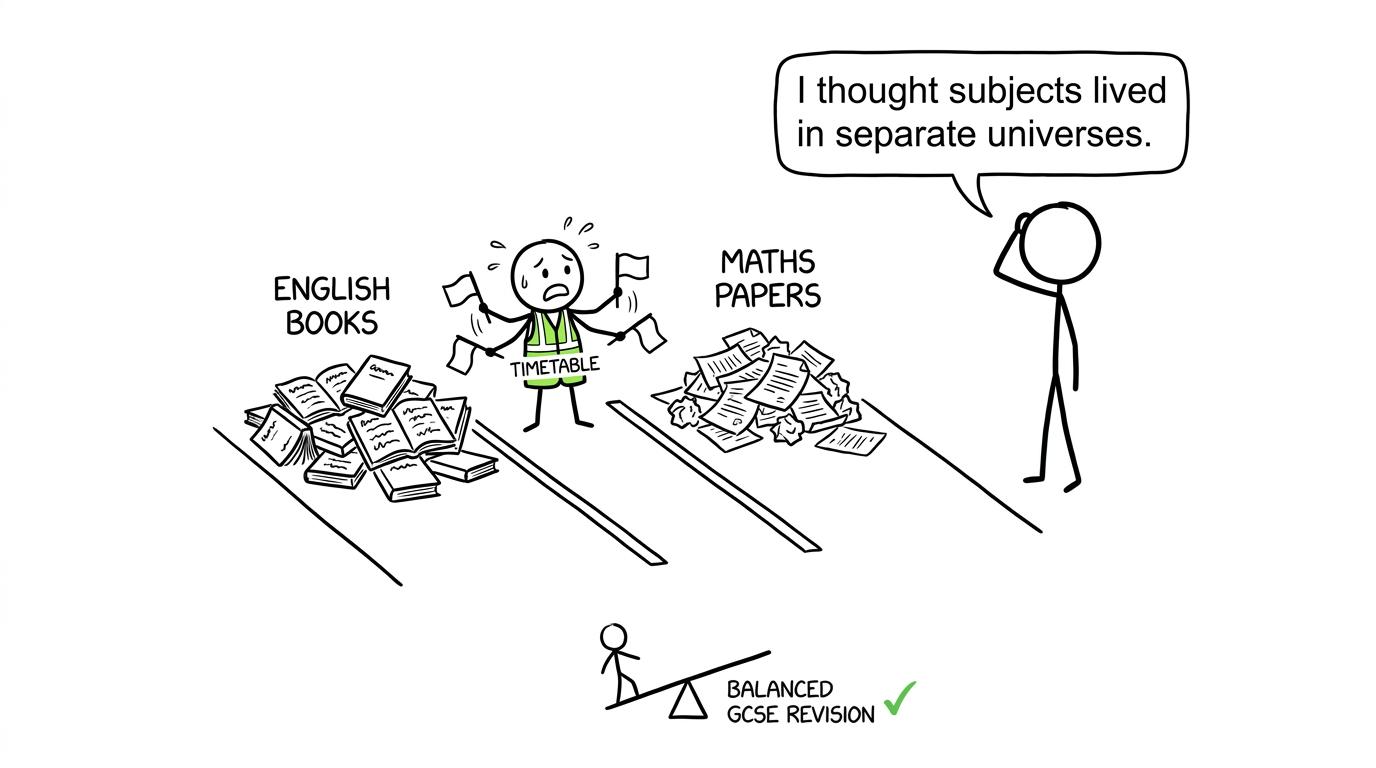 A revision timetable attempts to keep English books and maths papers moving in orderly lanes
Common mistakes when comparing the two GCSEs
Assuming Language is the easier subject
Language may involve less set-text recall, but unseen reading and sustained original writing create different demands. Familiarity and difficulty are not the same thing.
Treating all exam boards as identical
The broad assessment objectives overlap, but paper layouts, timings and tasks vary. Revise from the specification and materials for your own board.
Believing Literature skill guarantees Language success
Analytical reading transfers well. Creative or persuasive writing, adapting register and handling unseen sources still need direct practice.
Revising Language by memorising complete answers
A prepared sentence pattern may provide structure, but an answer must fit the actual source and question. Over-rehearsed responses often become vague because they are trying to survive every possible text.
Letting another subject erase maths practice
A new revision commitment should not quietly remove the repetition maths requires. Use efficient GCSE maths revision methods and shorter timed activities when your week is crowded. Consistency matters more than waiting for a perfectly empty evening.
A thoughtful decision, not a guess
GCSE English Literature and English Language share a real intellectual foundation: close reading, evidence, analysis and clear communication. The difference lies in what surrounds that foundation. Literature rewards deep knowledge of studied works; Language tests flexible reading of unseen texts and the ability to craft your own writing.
If you enjoyed the thinking behind Literature, Language deserves serious consideration. If you mainly enjoyed familiar characters or set stories, sample the unseen reading and writing tasks before deciding. Most importantly, confirm what your school and nation actually offer, because the qualification arrangement is not identical across the UK.
As you balance that decision with maths, let MathsGenie make the numerical side of revision simpler. Use free revision lessons and practice questions to repair individual topics, mini tests to check progress, then past papers and predicted papers to build examination confidence. Mark schemes and video solutions turn each mistake into a clear next step, which is what good revision, in any subject, is really for.