GCSE English Literature Paper 2 Exam Date 2026
GCSE English Literature Paper 2 exam date 2026: check the confirmed day, board details, exam kit and a calm plan for balancing maths revision.
Exam dates have a habit of feeling distant until they suddenly become the organising principle of your week. English quotations compete with algebra, poetry sits beside probability, and every subject appears to need attention at once.
Here is the direct answer: the GCSE English Literature Paper 2 exam date 2026 was Tuesday 19 May 2026 in the morning for AQA, Pearson Edexcel, OCR and Eduqas. Eduqas formally calls it Component 2 rather than Paper 2, but it occupied the same national morning session.
Your personalised school timetable remains the final instruction for your room, arrival time, access arrangements and exact start time. The date is only the first piece of the plan. The useful question is what you should have ready before it, without allowing English preparation to crowd out the maths exams around it.
GCSE English Literature Paper 2 date at a glance
The published summer 2026 timetables gave the following details for the principal exam boards in England and Wales:
| Exam board | Published date and session | Paper | Duration |
|---|---|---|---|
| AQA | Tuesday 19 May, morning | Paper 2: Modern texts and poetry | 222 hours 151515 minutes |
| Pearson Edexcel | Tuesday 19 May, morning | Paper 2: 19th-century novel and poetry since 1789 | 222 hours 151515 minutes |
| OCR | Tuesday 19 May, morning | Paper 2: Exploring poetry and Shakespeare | 222 hours |
| Eduqas | Tuesday 19 May, morning | Component 2: 19th-century prose and poetry | 222 hours 303030 minutes |
These details come from the awarding bodies' summer 2026 timetables. However, an AM session does not mean that every candidate should independently assume the same arrival or starting time. Centres issue their own instructions within the examination regulations, so use the timetable supplied by your school or college.
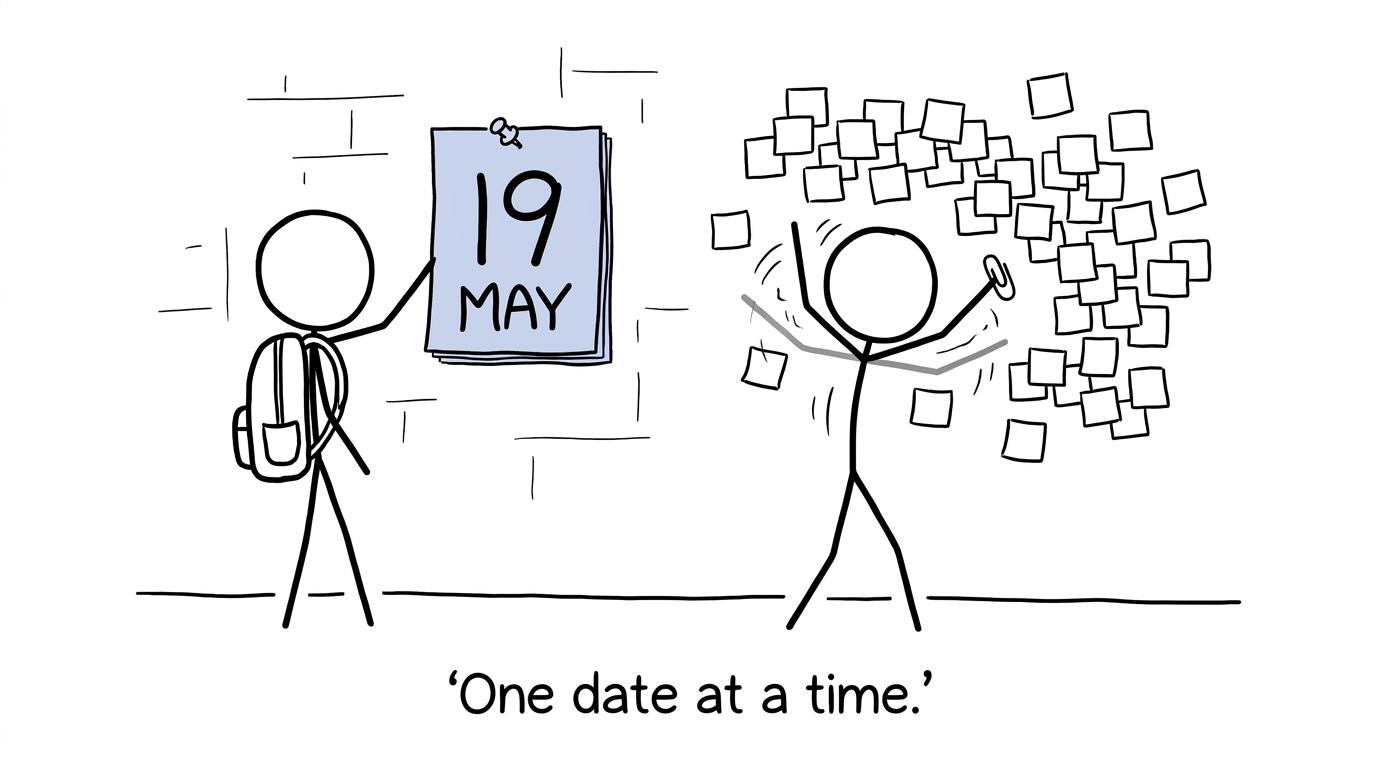 A student pins 19 May to a revision calendar while loose subject notes escape
Your essential Paper 2 checklist
Before the exam, make sure you can answer each of these questions without guessing:
- Which exam board and specification am I taking?
- Is my examination called Paper 2, Component 2 or something else?
- Which set texts, anthology poems and unseen-poetry skills are assessed?
- What time must I arrive at school?
- Which room or seat have I been assigned?
- Do my approved access arrangements appear correctly on my timetable?
- Do I have at least two working black ink pens in a clear pencil case?
- Have I removed my phone, watch, earbuds, notes and other unauthorised items?
- Do I know whom to contact if illness or disruption makes me late?
- Have I kept Wednesday 24 June 2026 available as the national contingency day?
The last point is easy to misunderstand. The contingency day was reserved for an exam moved because of national or significant local disruption. It was not an alternative sitting for a candidate who personally missed an examination.
Check your board, not just the subject name
“English Literature Paper 2” sounds universal. It is not. The date aligned across the four boards above, but the content and duration differed.
AQA
AQA specification 8702 Paper 2 covered modern texts and poetry. Its published duration was 222 hours 151515 minutes. Preparation needed to reflect the modern prose or drama text taught by your school, the relevant poetry anthology cluster and unseen poetry.
Pearson Edexcel
Pearson Edexcel specification 1ET0 Paper 2 assessed a 19th-century novel alongside poetry since 1789, including unseen poetry. The published duration was 222 hours 151515 minutes. Do not assume that an AQA revision checklist maps neatly onto this paper simply because both have the same duration.
OCR
OCR specification J352 Paper 2 was Exploring poetry and Shakespeare, lasting 222 hours. This is an especially clear reminder to check the component title: another board may place Shakespeare on Paper 1.
Eduqas
Eduqas referred to the examination as Component 2. It lasted 222 hours 303030 minutes and covered 19th-century prose, poetry anthology work and unseen poetry. Use the component code and title on your school timetable rather than relying on an informal label.
Text rules and materials must follow the instructions for your exact component. Do not take an annotated text, anthology or revision notes into the room. If a permitted resource is required, your school and the front of the examination paper will specify what is allowed.
What to have ready before the exam
There are two kinds of preparation. One improves the quality of your answers. The other prevents a small practical problem from becoming a large emotional one.
Your knowledge and exam technique
By the final week, you should have:
- a secure understanding of the plot, characters, themes and context for each assessed text;
- a manageable bank of accurate quotations rather than pages of half-remembered ones;
- knowledge of the required anthology poems for your board;
- practice comparing writers' methods and ideas;
- experience responding to unseen poetry under time pressure;
- a timing plan based on your board's sections and marks;
- feedback from marked essays, with recurring weaknesses reduced to a short fix list.
Your teacher is the best source for board-specific essay structure. The goal is not to force every response into a rigid template. It is to answer the precise question, select relevant evidence and explain how the writer creates meaning.
Your practical exam kit
JCQ instructions for the 2025/26 examination year required candidates to write clearly in black ink. A sensible kit was therefore:
- at least two black ink pens;
- a clear pencil case;
- any permitted equipment named by the centre;
- a clear, unlabelled water bottle if your school allows one;
- your candidate details if your school has asked you to remember them.
Watches, including ordinary analogue watches, were not permitted. Phones, earbuds, smart glasses, notes and other unauthorised materials also had to remain outside the examination room or be handed in according to the centre's arrangements. Possessing an unauthorised item can breach the rules even if you never intended to use it.
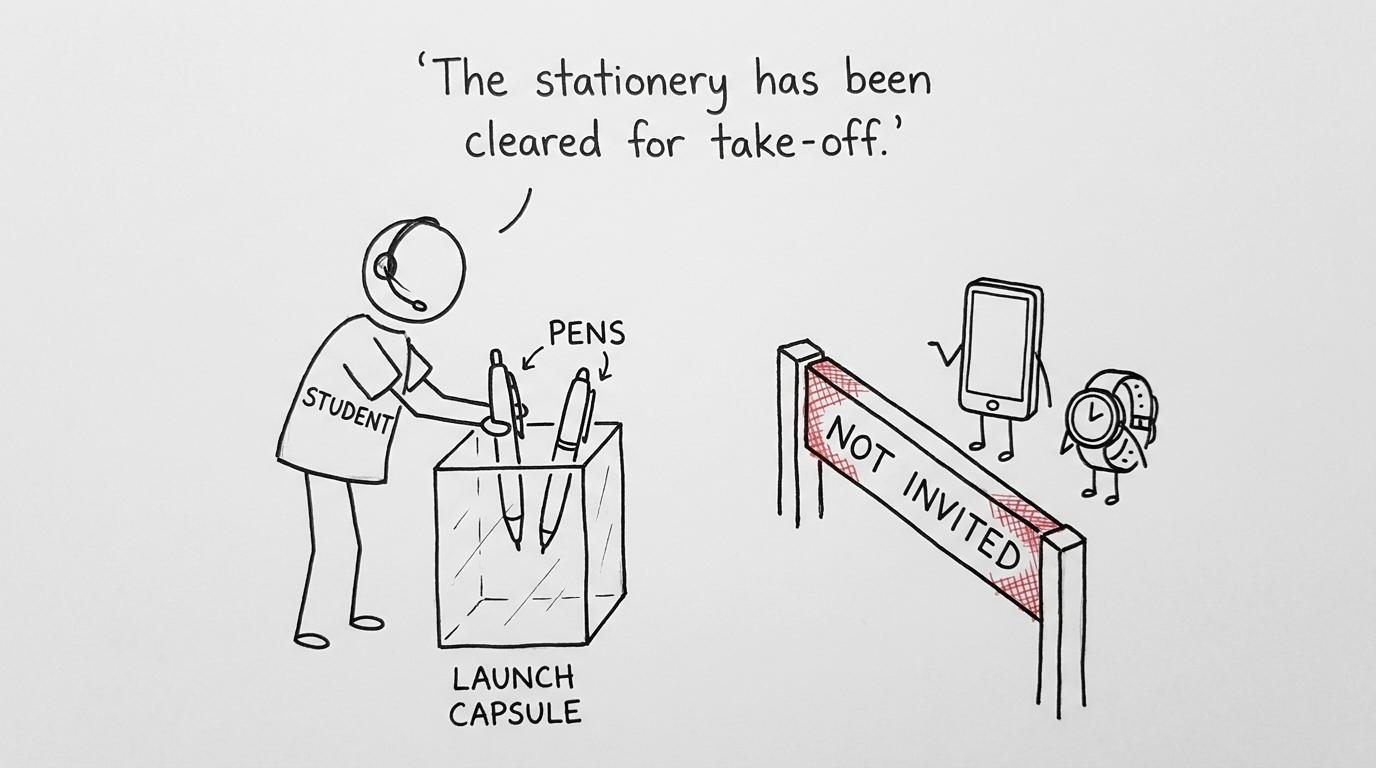 Black pens prepare for launch while a phone and watch wait behind a barrier
How to balance English Literature with GCSE maths
A timetable does more than tell you where to be. It tells you what not to neglect.
Tuesday 19 May sat inside a busy examination period, so revising only the next subject could create a cycle of permanent catch-up. A better approach is to separate revision into a main task and a maintenance task. English Literature can take the larger block immediately before Paper 2, while maths receives a shorter daily session that keeps methods retrievable.
For example, use the GCSE Maths Revision hub to choose one weak area rather than reopening the whole course. A short revision lesson followed by practice questions is more useful than vaguely rereading several topics.
If you are unsure where the gaps are, follow the guide to finding your weakest GCSE topics. Evidence should drive the choice: a lost-mark log from a mini test or past paper is more reliable than revising whichever chapter feels familiar.
A calm revision rhythm
In the days before English Literature Paper 2:
- make English the main session when it is the next examination;
- keep maths alive with one focused topic or short mixed set;
- mark maths work immediately and record the reason for each lost mark;
- return to that skill after English Paper 2 rather than beginning from zero;
- protect sleep instead of extending both subjects late into the night.
The 20-minute GCSE maths revision routine is useful during crowded exam weeks. When more time becomes available, move into GCSE predicted papers and board-appropriate past-paper practice.
Predicted papers are not promises about what will appear. They are fresh exam-style practice. The guide to using predicted GCSE topics sensibly explains why specification coverage and repeated skills matter more than guessing individual questions.
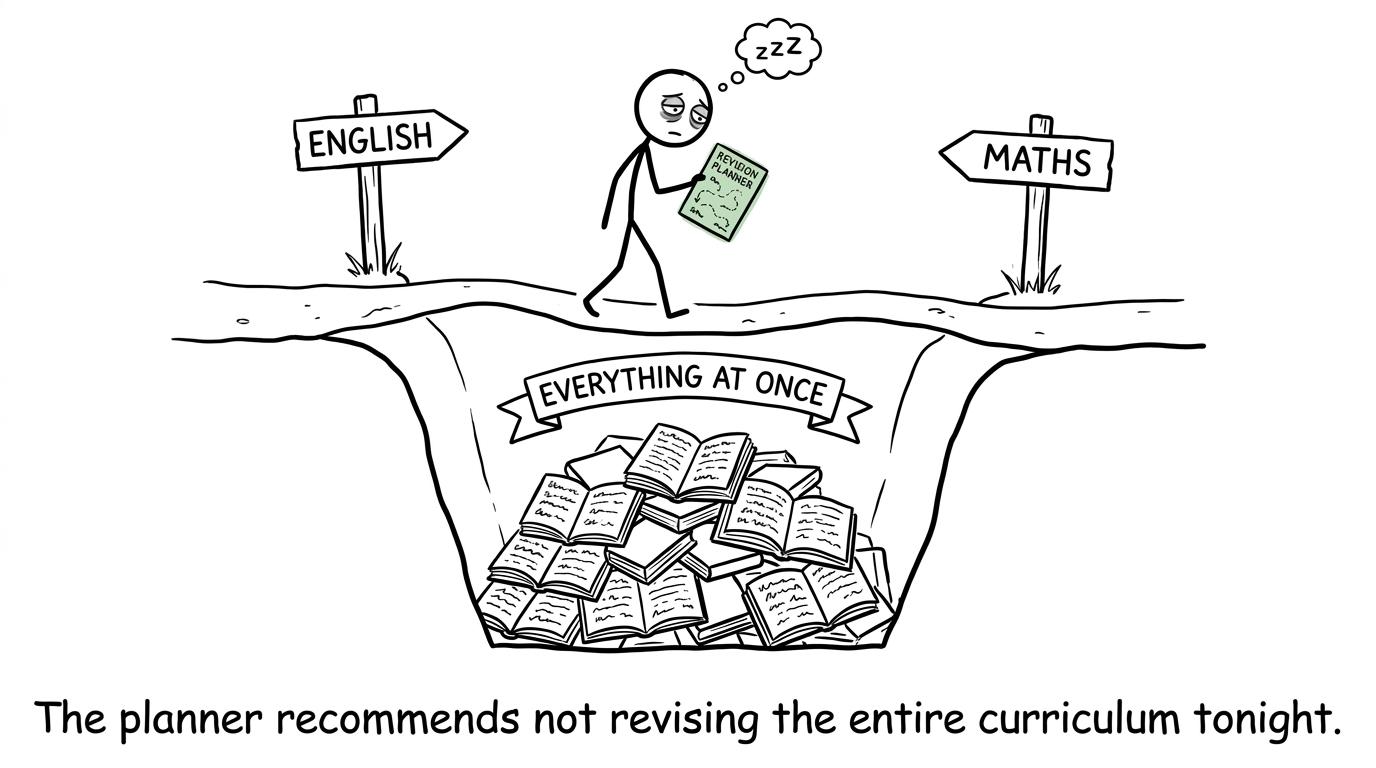 A student follows a planner between English and maths while everything at once falls into a ditch
What to do the evening before Paper 2
The evening before an examination is for reducing uncertainty, not expanding the syllabus.
Confirm your arrival time and location. Pack your clear pencil case. Put prohibited devices somewhere they cannot accidentally follow you into the room. Review your shortest useful materials: quotations, themes, common feedback and the timing decisions you have already practised.
Avoid writing a full essay late at night merely to feel productive. A brief plan or focused retrieval task may expose a gap without exhausting you. Then stop at a sensible time.
For the maths maintenance session, choose a mini test or a small set of questions rather than a full paper. The GCSE maths exam-week checklist provides a simple structure, while the night-before maths plan is useful when your next maths paper is close.
Common mistakes to avoid
Assuming every board has the same Paper 2
The shared date did not create shared content. Check your specification, component code, duration and set texts.
Treating “morning” as a complete instruction
Your school determines the reporting arrangements and gives you the exact start information. Read your personalised timetable and arrive when instructed.
Bringing a watch or phone into the room
JCQ rules prohibited watches and unauthorised electronic devices. Check pockets and your clear pencil case before entering.
Revising quotations without practising analysis
A remembered quotation earns little by itself. You must use evidence to develop a relevant explanation of language, form, structure, character, theme or context as required by the question.
Abandoning maths until English is over
A short maintenance session protects fluency. You do not need to revise everything each day; you need to prevent important methods from becoming unfamiliar.
Using papers without reviewing mistakes
Practice only becomes revision when it changes the next attempt. The guide to starting GCSE past papers shows how to combine timed work, mark schemes and targeted follow-up.
Turn the date into a plan
The date itself was simple: Tuesday 19 May 2026, morning for AQA, Pearson Edexcel, OCR and Eduqas. Good preparation required more: the correct component, the right set texts, a realistic timing strategy, approved equipment and a plan for the other exams surrounding it.
A crowded timetable becomes easier when each session has one job. Prepare properly for English Literature, then keep maths moving through small, deliberate practice.
Use MathsGenie's free GCSE maths revision resources to choose lessons and practice questions, or begin from the main GCSE Maths Revision hub. Build confidence with mini tests, then move to past papers, mark schemes, video solutions and predicted papers. The aim is not to feel busy. It is to arrive at each examination knowing what comes next.