GCSE English Literature Grade 8 Meaning Explained
GCSE English Literature grade 8 meaning explained: discover the ability it represents, how it compares with old grades and what examiners reward.
A results slip can reduce two years of reading, annotation and essay writing to one small number. Sometimes that number creates another question rather than answering one. If you are searching for the GCSE English Literature grade 8 meaning, the direct answer is this: grade 8 is an excellent result, one grade below the highest available, showing a perceptive and consistently convincing response to literary texts.
It indicates performance above the standard anchored to the former grade A. However, the old and new grading systems do not match perfectly, so grade 8 is best understood as sitting between an old A and A*, rather than as an exact replacement for either.
More importantly, it represents a particular quality of thinking. A grade 8 student can usually construct an informed interpretation, analyse language, form and structure closely, select evidence carefully, and connect texts with their contexts without losing sight of the question.
Grade 8 at a glance
Here is the practical overview:
- Grade 8 is the second-highest grade in the 9-1 system used for GCSEs in England.
- It is a strong result and sits above grade 7, whose lower boundary was designed to align with the lower boundary of the former grade A.
- It is not automatically equivalent to a fixed percentage or number of marks.
- Grade boundaries vary by exam board and exam series.
- It reflects performance across the complete qualification, not necessarily the quality of every individual essay.
- It demonstrates perceptive analysis, convincing interpretation and carefully selected textual evidence.
- It leaves a student well prepared for A Level English Literature, although taking the subject remains a personal choice.
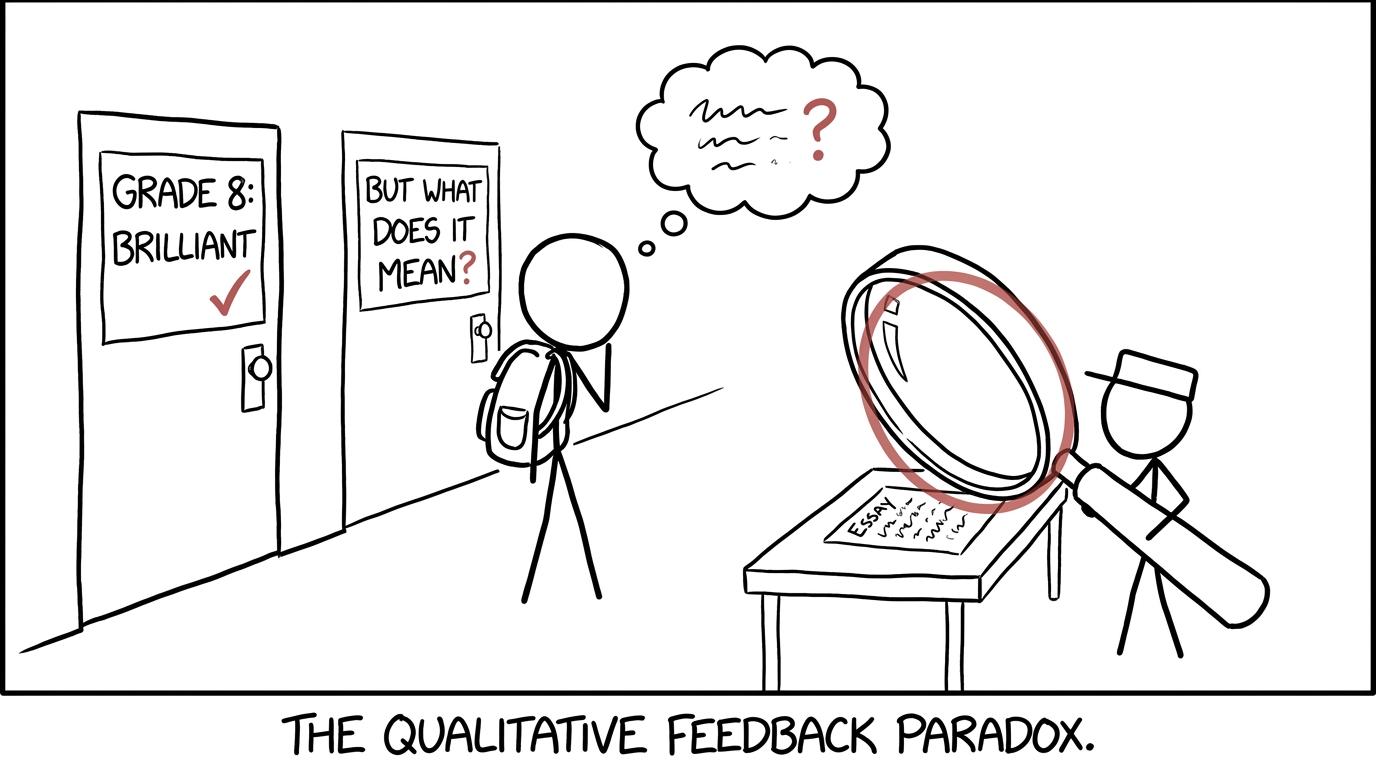 A student wondering what a grade 8 really means while an examiner investigates an essay
What does a grade 8 represent in terms of ability?
The official grade descriptor for grade 8 focuses on sustained quality. That word matters. One impressive paragraph or memorised interpretation is not normally enough; the response needs to remain thoughtful and controlled across the assessment.
A student working at this standard can typically:
- sustain a convincing, informed personal response to explicit and implicit meanings;
- analyse perceptively how writers use language, form and structure;
- integrate judicious textual references into an argument;
- understand perceptively how contexts shape texts and readers' responses;
- make illuminating comparisons where comparison is required.
These are not instructions for a secret essay formula. They describe the qualities examiners are likely to see across strong work.
Interpretation rather than retelling
A grade 8 response does more than recount what happens. It develops a defensible interpretation of why a character, relationship, image or structural choice matters.
The distinction is similar to the difference between remembering a maths formula and knowing when to use it. Knowledge is essential, but high performance comes from selecting and applying that knowledge appropriately.
In English Literature, that means remaining focused on the precise question. Plot knowledge, quotations and context support the argument; they do not replace it.
Perceptive analysis
Perceptive analysis notices meaningful detail and explains its effect within the wider text. It may explore how a word changes the tone, how a structural contrast develops an idea, or how dramatic form influences an audience's response.
This does not require obscure terminology or unnecessarily complicated sentences. Examiners reward analysis, not decoration. A precise explanation of a writer's choice is more valuable than a list of techniques with no developed interpretation.
Carefully chosen evidence
The official descriptor refers to judicious and well-integrated textual references. In practice, this means selecting evidence because it advances the argument, then incorporating it naturally into the discussion.
A large quotation bank can provide confidence, but quantity alone does not create a grade 8 response. Short, flexible references often allow closer analysis and can be adapted to several themes or characters.
Context that illuminates the text
Context earns its place when it improves the interpretation. Historical facts placed beside an essay without explanation are unlikely to demonstrate perceptive understanding.
Strong responses connect context to the writer's ideas, choices or possible audience reactions. The text remains central. Context becomes a lens, not a separate paragraph added because a revision checklist said it must appear.
How does grade 8 compare with the old letter grades?
There is no completely exact conversion between the former A*-G scale and the current 9-1 scale. The systems contain different numbers of grades and were designed to distinguish performance more clearly at the top.
The most useful official reference point is grade 7. Its lower boundary was aligned with the lower boundary of the former grade A. Grade 8 is above that standard, while grade 9 provides a further level of distinction for the very highest performance.
For everyday comparison, grade 8 is often described as falling between the old A and A*. That is helpful shorthand, but it should not be treated as a precise conversion. It would be misleading to say that every grade 8 is simply an old A*, because awarding decisions depend on the specification, exam series and overall performance standard.
The MathsGenie guide to grade 8 in GCSE Maths explains the same grading structure from a maths perspective. The subjects assess different abilities, but grade 8 occupies the same place on the national 9-1 scale.
Is grade 8 a fixed mark or percentage?
No. A grade 8 does not always require the same raw mark, and it does not automatically mean a student achieved a particular percentage.
Awarding organisations set grade boundaries for each exam series after the papers have been taken and marked. Boundaries may move because papers are not identical in difficulty from one series to another. This helps preserve a comparable standard over time rather than demanding an unchanging raw score.
Your required total therefore depends on:
- your exam board, such as AQA, Pearson Edexcel, OCR or Eduqas;
- the exact specification;
- the exam series;
- the total marks available across the qualification;
- the grade boundaries set for that series.
Use the boundary for the complete qualification, not a boundary from another board or an unofficial percentage found online. The GCSE English Literature marks per grade guide explains how to compare marks with the correct board, specification and series.
A further distinction is important for students who are also revising maths. GCSE English Literature is not divided into foundation and higher tiers in the way GCSE Maths is. In maths, tier affects the available grade range and paper content. You can check those differences in the GCSE Maths topics by board and tier guide.
What examiners are actually assessing
Across the main English exam boards, the national assessment objectives cover four broad areas:
- AO1: understanding texts, developing an informed response and supporting interpretations with references;
- AO2: analysing language, form and structure;
- AO3: understanding relationships between texts and their contexts;
- AO4: using vocabulary, sentence structures, spelling and punctuation accurately where assessed.
The precise weighting and the questions on which each objective is assessed can differ between specifications. Always use the specification and mark schemes for your own exam board rather than assuming that advice for one board transfers perfectly to another.
Mark schemes are especially useful because examiners assess the response as a whole. They decide which level best matches its overall qualities, then select a mark within that level. An essay is not usually marked by mechanically awarding one mark for every quotation or technique.
That principle will feel familiar to maths students. A mark scheme reveals what earns credit, but progress comes from understanding why a method or explanation deserves that credit. MathsGenie's guidance on redoing past papers effectively shows how marking, diagnosis and targeted repair can turn feedback into a revision plan.
 An examiner finds clear argument and analysis while a student arrives with a sack of fancy words
How to work towards grade 8 without neglecting maths
Grade 8 preparation should not become endless rereading. The useful cycle is compact: recall, plan, write, mark and improve.
Start by identifying whether marks are being lost through weak text knowledge, vague analysis, poorly selected evidence, undeveloped context or timing. Then practise that weakness directly. A focused paragraph plan may be more useful than another hour of highlighting.
The same approach works in maths. Use the free GCSE Maths revision hub to diagnose topics, revisit a revision lesson and complete related practice questions. Follow that with a mini test or paper section so that revision includes retrieval rather than recognition.
If several subjects are competing for your time, build a realistic weekly rhythm. The one-month GCSE Maths revision plan demonstrates how short topic sessions, marking and timed papers can fit together. The structure can also help you protect specific English Literature sessions instead of allowing one subject to consume every evening.
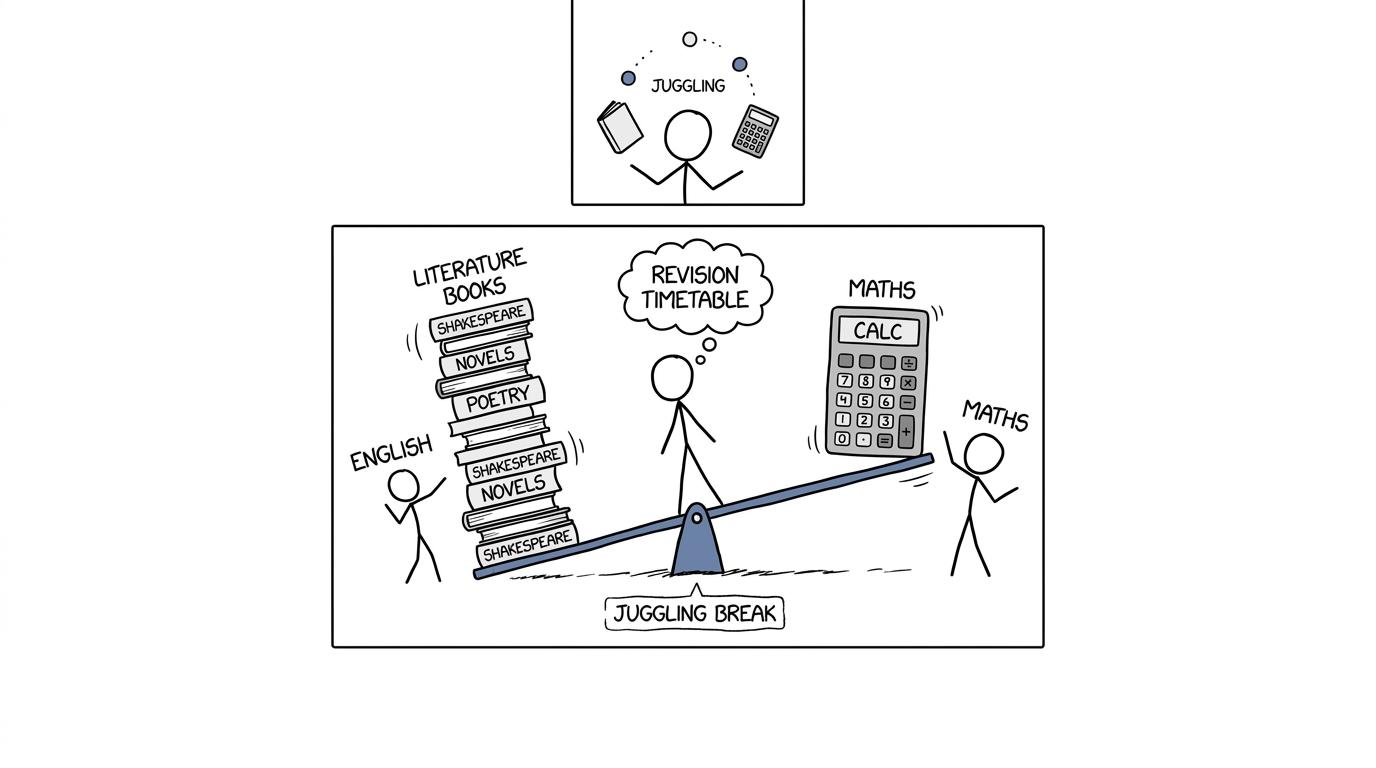 A student balancing literature books and a calculator on a revision timetable
Common mistakes when interpreting or chasing grade 8
Treating grade 8 as a fixed percentage
A percentage from an old paper is not a permanent target. Check the correct qualification boundary for that board and series.
Assuming longer essays automatically earn higher marks
Length can create room for development, but relevance and quality matter more. Repetition, unsupported claims and lengthy plot summary do not become perceptive analysis merely because they fill several pages.
Forcing context into every paragraph
Context should sharpen an interpretation. Detached historical facts can interrupt an otherwise coherent argument.
Memorising essays instead of preparing flexible ideas
The exam question may approach a familiar text from an unfamiliar angle. Secure knowledge of themes, characters, methods and evidence is safer than attempting to reproduce a pre-written response.
Comparing grades across subjects as if the skills were identical
A grade 8 in English Literature and a grade 8 in maths occupy the same position on the grading scale, but they measure different knowledge and abilities. One does not predict the other automatically.
Chasing grade 9 before making grade 8 skills reliable
The most productive target is usually the next weakness, not the next label. Build consistency first. For maths, the best order to learn GCSE Maths topics can help turn a broad ambition into a manageable sequence.
A grade is a summary, not the whole story
A grade 8 in GCSE English Literature represents excellent achievement: convincing interpretation, perceptive analysis, purposeful evidence and a strong understanding of texts and contexts. It is above the standard associated with the old grade A and is commonly described as sitting between A and A*, although no exact conversion exists.
The number matters, but the habits behind it matter more. Read the question carefully. Select rather than unload knowledge. Use feedback. Return to weak areas. Then practise under realistic conditions.
Apply the same calm discipline to your maths preparation. Begin with MathsGenie's GCSE Maths revision resources, strengthen individual topics through free revision lessons and practice questions, and then test your progress with past papers, mark schemes, video solutions and mini tests. Near the exam, use Edexcel GCSE Maths predicted papers alongside official past papers rather than in place of them.
A high grade rarely comes from one dramatic revision session. It is usually built through smaller moments of clear thinking, repeated until they become dependable.