GCSE English Literature and GCSE English Language Together
GCSE English Literature and GCSE English Language together is realistic. Learn what overlaps, what stays separate and how to balance both with maths revision.
The difficult part of choosing GCSEs is rarely understanding each subject in isolation. It is imagining all of them arriving at once: English essays, maths papers, science content and the quiet suspicion that everyone else has a better revision plan.
The short answer to whether you can take GCSE English Literature and GCSE English Language together is yes. In England, they are separate GCSE qualifications, and students can study both during the same period. Their reading and analytical skills overlap, but they have different content, assessments and final grades. Taking both is realistic, provided you treat them as connected subjects rather than identical ones.
There is an important regional exception. In Wales, learners who began the new Made-for-Wales course from September 2025 study an integrated WJEC GCSE English Language and Literature, available as a single or double award, with first awards in summer 2027. Always confirm your exact qualification with your school.
The answer at a glance
Before planning your revision, establish these facts:
- In England, English Language and English Literature are separate, untiered GCSEs.
- You can take both in the same examination year and receive separate grades.
- AQA explicitly designs its Language and Literature specifications to be co-teachable, and other boards share substantial transferable skills.
- English Language focuses on reading unfamiliar texts and producing your own writing.
- English Literature focuses on interpreting studied literary works, supporting ideas with textual references and analysing writers’ methods.
- Revision for one subject can strengthen the other, but it cannot replace subject-specific preparation.
- Assessment details vary between AQA, Pearson Edexcel, OCR and Eduqas, so use your board’s current specification.
That final point matters. Two students may both say they are revising English, while preparing for different paper structures, set texts and timings.
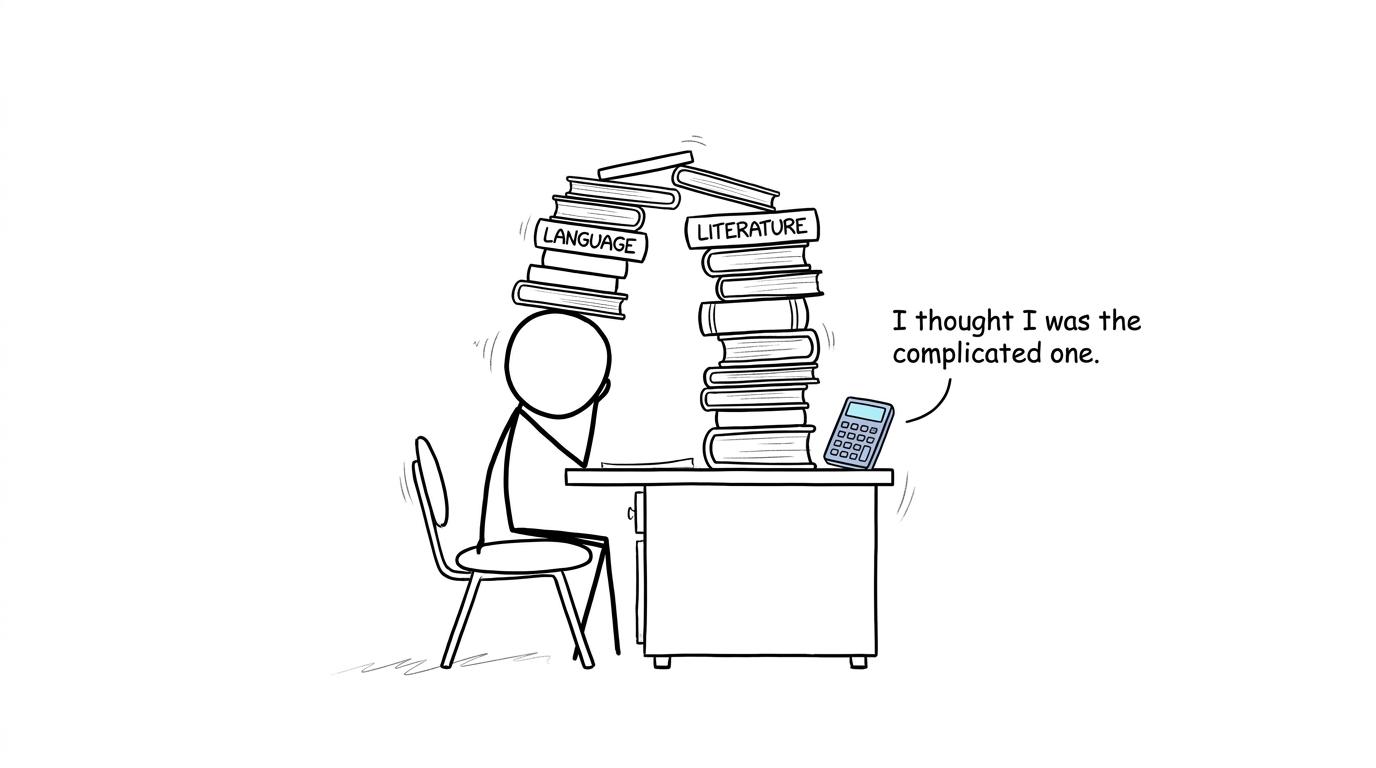 A student balancing English Language and Literature while a calculator watches
Are English Language and English Literature separate GCSEs?
In England, yes. They lead to separate grades and assess related but distinct abilities.
GCSE English Language generally assesses how well you can understand and evaluate unfamiliar material, compare viewpoints and communicate through your own writing. Depending on the exam board, you may encounter fiction, literary non-fiction, journalism or other non-fiction from different periods.
The qualification also includes a compulsory Spoken Language endorsement. This is reported separately as Pass, Merit, Distinction or Not Classified and does not contribute to the numerical English Language grade.
GCSE English Literature assesses your response to literary works studied during the course. The precise selection depends on the board and your school, but specifications can include Shakespeare, a nineteenth-century novel, modern prose or drama, anthology poetry and unseen poetry. You need knowledge of the texts as well as the ability to construct a convincing interpretation.
Neither English qualification in England has foundation and higher tiers. That differs from GCSE Maths, where your tier affects the paper and available grades. When organising maths preparation, begin with the GCSE Maths revision hub and select the correct board and tier.
How much overlap is there between the two subjects?
There is meaningful overlap, especially in reading. It is not complete overlap.
Skills that transfer between both GCSEs
Both subjects reward your ability to:
- understand explicit and implied meanings;
- select relevant evidence from a text;
- analyse language and structure;
- explain the effect of a writer’s choices;
- compare ideas or methods where required;
- organise an argument clearly;
- use accurate spelling, punctuation and grammar.
A habit such as choosing concise evidence and explaining precisely what it reveals can improve responses in both qualifications. Likewise, learning to move beyond identifying a technique towards discussing its purpose is valuable across Language and Literature.
This is why studying the courses together is practical. You are not beginning from zero each time you change lesson. Some of the intellectual machinery travels with you.
What does not overlap
The differences become clear when you look at preparation.
For Literature, you usually need secure knowledge of complete set texts. That can involve remembering significant moments, developing interpretations of characters and themes, understanding relevant context and selecting useful quotations or references.
Language exams primarily test your response to material supplied in the examination. You cannot revise the exact unseen extracts beforehand. Instead, you prepare flexible reading methods, question-specific techniques, vocabulary, sentence control and the ability to write for a given audience, purpose and form.
Literature revision therefore has a substantial knowledge component. Language revision is more dependent on adaptable skills and repeated timed practice. One supports the other, but knowing Macbeth thoroughly will not by itself prepare you to produce an effective article, speech or creative response.
Is taking both at the same time realistic?
Yes. The better question is not whether the timetable contains two English subjects, but whether your revision method recognises their shared and separate demands.
The workload can feel heavier because Literature includes several set texts while Language requires sustained practice. Yet studying them concurrently also creates efficiencies. One careful Literature paragraph can reinforce textual selection and analysis. One Language reading task can sharpen inference and evaluation. The return is greatest when you consciously name the skill being practised.
A realistic plan should include three kinds of English session:
- Shared-skill sessions: analysis, comparison, evidence selection and paragraph organisation.
- Literature-only sessions: set-text recall, quotations, themes, characters, context and essay planning.
- Language-only sessions: unseen reading, creative or transactional writing, technical accuracy and timed responses.
The mistake is to label every session simply “English”. Vague plans create vague work. A specific task such as reviewing one Literature theme or completing one timed Language section is easier to start and easier to evaluate.
The same principle applies to maths. The twenty-minute maths revision routine is useful on busy school days because it protects regular maths practice without demanding an entire evening.
How to balance both English GCSEs with maths revision
English and maths place different demands on memory. Literature needs knowledge that remains retrievable over time. Language needs repeated reading and writing. Maths needs method recall followed by question practice.
A balanced week gives each subject repeated contact rather than assigning one enormous block to each. You might alternate English Language and Literature sessions while keeping shorter, frequent maths sessions between them. The exact timetable matters less than having a repeatable cycle.
For maths, use this sequence:
- choose one weak topic;
- use a short revision lesson to recover the method;
- answer practice questions without copying;
- mark the work immediately;
- record why marks were lost;
- revisit the topic on another day.
The guide to revising GCSE Maths efficiently explains how to build this into a sustainable routine. If you do not yet know what to prioritise, use the method for finding your weakest GCSE topics rather than relying on which subject feels most worrying.
Keep the subjects separate in your revision record
Use one tracker with distinct categories: English Language, English Literature and Maths. Record the task completed, the difficulty and the next action.
For English, the next action might be to improve evidence selection or revisit a character. For maths, it should name the exact topic, such as simultaneous equations or circle theorems. You can check how content is organised for your board with the GCSE Maths topics by exam board and tier.
A revision tracker should reduce decisions, not become another subject to decorate.
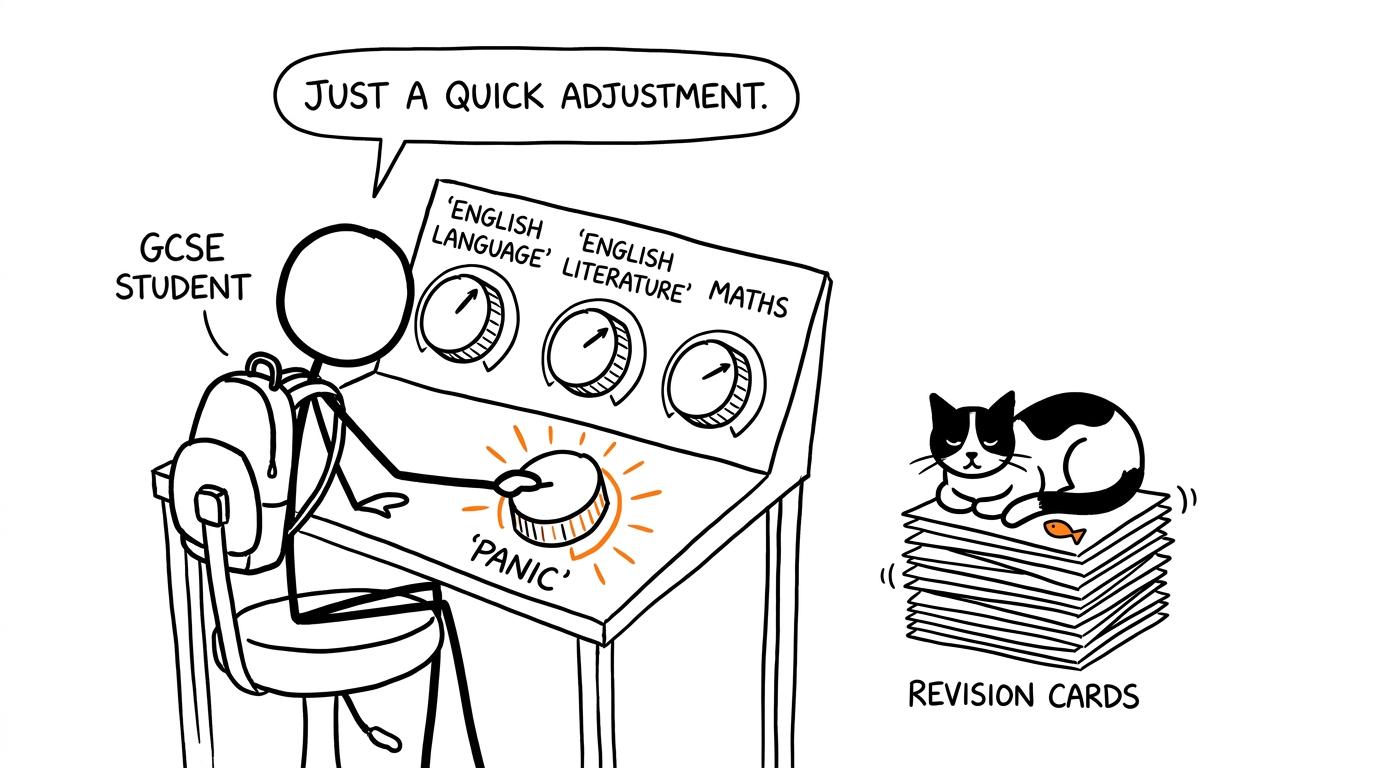 A student calmly controlling English and maths revision while turning down panic
Check your exam board before you revise
AQA, Pearson Edexcel, OCR and Eduqas all assess the required national subject content in England, but their paper structures and task formats differ. Literature set texts also vary.
Do not assume that a technique described for another board matches your question. Check:
- the qualification title and code;
- the number and length of papers;
- your Literature set texts;
- which questions involve comparison;
- the available writing choices;
- the wording of assessment objectives;
- the current specification and any announced text changes.
This habit is equally important in maths. Use MathsGenie’s past-paper library to practise papers that match your board and tier, then compare your work with the official mark scheme and available solutions.
Common mistakes when taking both English GCSEs
Assuming one grade covers both subjects
In England, the qualifications are separate and normally produce separate grades. If a sixth form, college or future course specifically asks for English Language, do not assume that English Literature is automatically interchangeable. Read the entry requirement carefully and ask the institution if its wording is unclear.
Revising Literature as if it were Language
General analytical confidence is not enough. Literature requires detailed familiarity with the works your class has studied. Leaving all quotation, theme and character revision until the final weeks creates unnecessary pressure.
Revising Language by memorising rigid answers
The reading material is unseen, so a prepared response may not fit. Learn how to interpret the question, select evidence and adapt your writing instead of forcing every task into one memorised structure.
Spending all evening on essay subjects
English tasks can expand to fill whatever time you give them. Set a clear endpoint so that maths does not disappear from the timetable. Short, regular practice protects fluency better than waiting for one free weekend.
Treating predicted papers as predictions of certainty
Fresh exam-style material can be valuable, but it should supplement rather than replace official past papers and topic practice. MathsGenie’s GCSE predicted papers are most useful after you have diagnosed and repaired your weaker topics.
Build a revision system that recognises the overlap
Taking both English qualifications is not like carrying two completely unrelated subjects. They share a foundation: attentive reading, precise evidence and clear communication. But each has its own final stretch. Literature asks you to bring knowledge of studied works; Language asks you to adapt to unfamiliar material and create effective writing.
Once that distinction is clear, the workload becomes easier to organise. Revise shared skills efficiently, protect time for subject-specific preparation and keep maths active through regular question practice.
MathsGenie can provide the maths side of that system for free. Start with revision lessons and practice questions, check your work using mark schemes and video solutions, then build confidence through mini tests, past papers and predicted papers. As examinations approach, use the GCSE Maths exam-week checklist to keep the final days calm, specific and useful.