

GCSE English Language and Literature Spec Changes
GCSE English Language and Literature spec changes explained: check grading, assessment, texts and older resources before planning revision for your exams.
The most dangerous revision resource is not always the one with a wrong answer. Sometimes it is the one that was perfectly accurate five or ten years ago.
The main GCSE English Language and Literature spec changes happened when reformed GCSEs were introduced in England, with first teaching from 2015 and first examinations in 2017. Grades changed from A* to G to 9-1, controlled assessment largely disappeared, courses became linear and English Literature examinations became closed book. More recent updates tend to be smaller and board-specific, but they can still affect set texts, anthologies, administrative rules and question guidance.
If you are preparing for GCSE maths as well as English, this matters because revision time is limited. An old guide can quietly train you for the wrong task. Before using it, check the exam board, specification code, publication date and current assessment structure.
The quick specification checklist
Before committing time to any English resource, confirm:
- whether you take AQA, Pearson Edexcel, OCR or Eduqas;
- that it covers the current GCSE rather than the older A* to G qualification;
- whether it is for English Language, English Literature or both;
- that its paper names and question formats match your board;
- that its Literature texts and poetry anthology match your school’s choices;
- whether any stated exam support was only a temporary arrangement;
- that the accompanying mark scheme uses the current assessment objectives.
This is the English equivalent of checking your board and tier before opening a maths paper. A beautifully completed resource for the wrong specification is still the wrong resource.
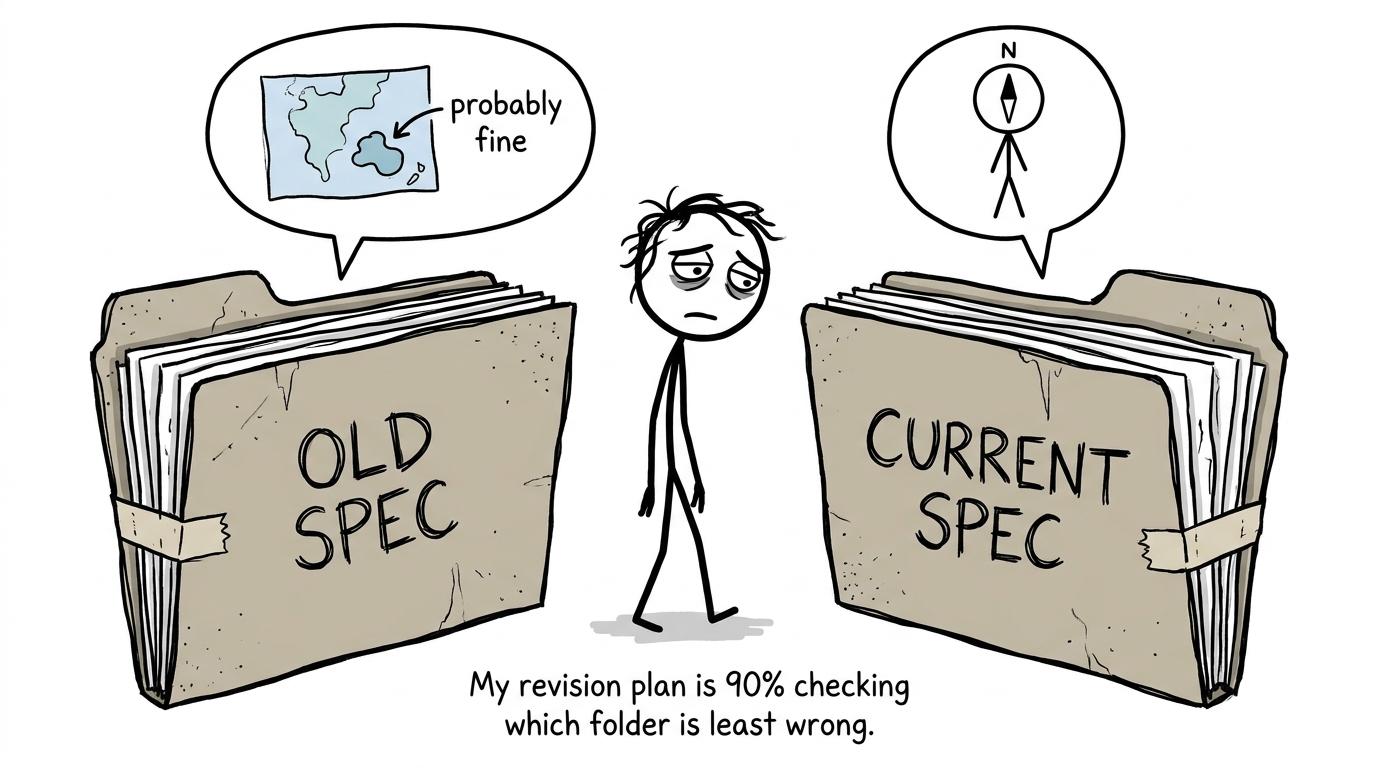 A student choosing between an old specification folder and a current specification compass
What changed when the reformed GCSEs arrived?
Many resources described as “old” belong to the qualification that existed before the 2015 reforms. Those materials are not automatically useless, but their assumptions may no longer match the examination you will sit.
Numerical grades replaced letter grades
The reformed qualifications in England use grades 9-1 rather than A* to G, with grade 9 as the highest grade. Old books discussing A*, C-grade targets or legacy grade boundaries therefore belong to an earlier system.
The underlying skill in a good question may remain valuable. Its stated grade level, however, cannot simply be translated into a current grade. Grade boundaries are set for each examination series, so a claim that a fixed mark “guarantees” a particular grade should always be treated cautiously.
Assessment became linear
Current GCSE English qualifications in England are linear. The written examinations are taken at the end of the course rather than building a final grade through modular examinations and controlled assessments.
This changes how revision should feel. You need to retain knowledge of Literature texts across the course and sustain reading and writing performance under timed conditions. A legacy workbook centred on completing controlled-assessment folders will not recreate that demand.
English Language became fully examination based
Current GCSE English Language specifications assess reading and writing through written examinations. National subject requirements give reading and writing equal weighting at 50%50\%50% each.
The examination texts are unseen and are drawn from the nineteenth, twentieth and twenty-first centuries. Students must interpret information, analyse language and structure, compare viewpoints, evaluate texts and produce writing suited to a particular audience, form and purpose.
Accuracy matters too. The national requirements state that vocabulary, sentence structures, spelling and punctuation account for 20%20\%20% of the qualification through the relevant writing assessment objective. An old resource that treats technical accuracy as a minor finishing touch may therefore distort your priorities.
Spoken Language is reported separately
Speaking and listening used to contribute differently under older qualifications. In the current English Language GCSE in England, Spoken Language is compulsory but does not contribute to the numerical GCSE grade. It is assessed by the centre and reported separately, normally as Pass, Merit, Distinction or Not Classified.
That does not make it optional. It means an older resource may be misleading if it adds speaking and listening marks to a predicted English Language grade.
English Literature became more exam focused
The reformed Literature GCSE requires demanding coverage, including Shakespeare, a nineteenth-century novel, post-1914 British literature and poetry from 1789 onwards. Unseen poetry is also part of the required content.
The written assessments are closed book. Students cannot take clean copies of the studied texts into the examination, although papers may provide extracts where the board’s question design requires them. Revision now depends more heavily on secure knowledge of plot, character, themes, context and carefully selected quotations.
Older coursework essays can still demonstrate thoughtful analysis, but they do not reproduce the memory, timing or question-selection decisions required by a closed-book examination.
What has changed more recently?
The central structure introduced in 2015 has not been replaced for current students in England. Most recent changes are refinements rather than another complete redesign. That distinction matters: a resource from a few years ago may still be useful, while one from the legacy qualification may be fundamentally misaligned.
Exam boards periodically publish new specification issues, notices and support materials. For example, Pearson Edexcel’s August 2024 English Language specification update added declarations concerning the use of artificial intelligence to Spoken Language documentation. This is important for assessment administration, but it did not create an entirely new written examination structure.
Set-text changes can be more significant for students. Eduqas introduced a new GCSE English Literature anthology for first teaching in September 2025 and first examination in summer 2027. Its previous anthology is examined for the last time in summer 2026. A poetry guide can therefore be recent, polished and still belong to the wrong cohort.
There are also separate reforms in Wales. New WJEC qualifications are being introduced on a different timetable, including a unitised English Language and Literature qualification with its first award in summer 2027. Do not confuse that qualification with Eduqas GCSEs designed for centres in England. The name on the front of the book is not enough; the qualification title, code and examination year must agree.
Temporary examination arrangements are another source of confusion. Materials produced during the pandemic period may refer to exceptional choices, advance information or altered assessment arrangements. Do not assume those concessions apply now unless your exam board explicitly confirms them for your examination series.
Why exam-board matching matters
AQA, Pearson Edexcel, OCR and Eduqas must all satisfy national subject-content and assessment requirements in England. They do not, however, use identical papers.
Paper timings, section order, source combinations, writing prompts, mark totals, prescribed texts and poetry anthologies can differ. Even when two boards assess the same skill, their command words and mark-scheme expectations may package it differently.
That is why generic practice should build a skill, not define your final exam strategy. Board-specific specimen papers, recent past papers and current mark schemes should teach you what the real paper looks like.
Use this four-part label on every resource you keep:
- Board: AQA, Edexcel, OCR or Eduqas
- Code: the exact qualification code
- Subject: Language or Literature
- Series: the examination year for which it is intended
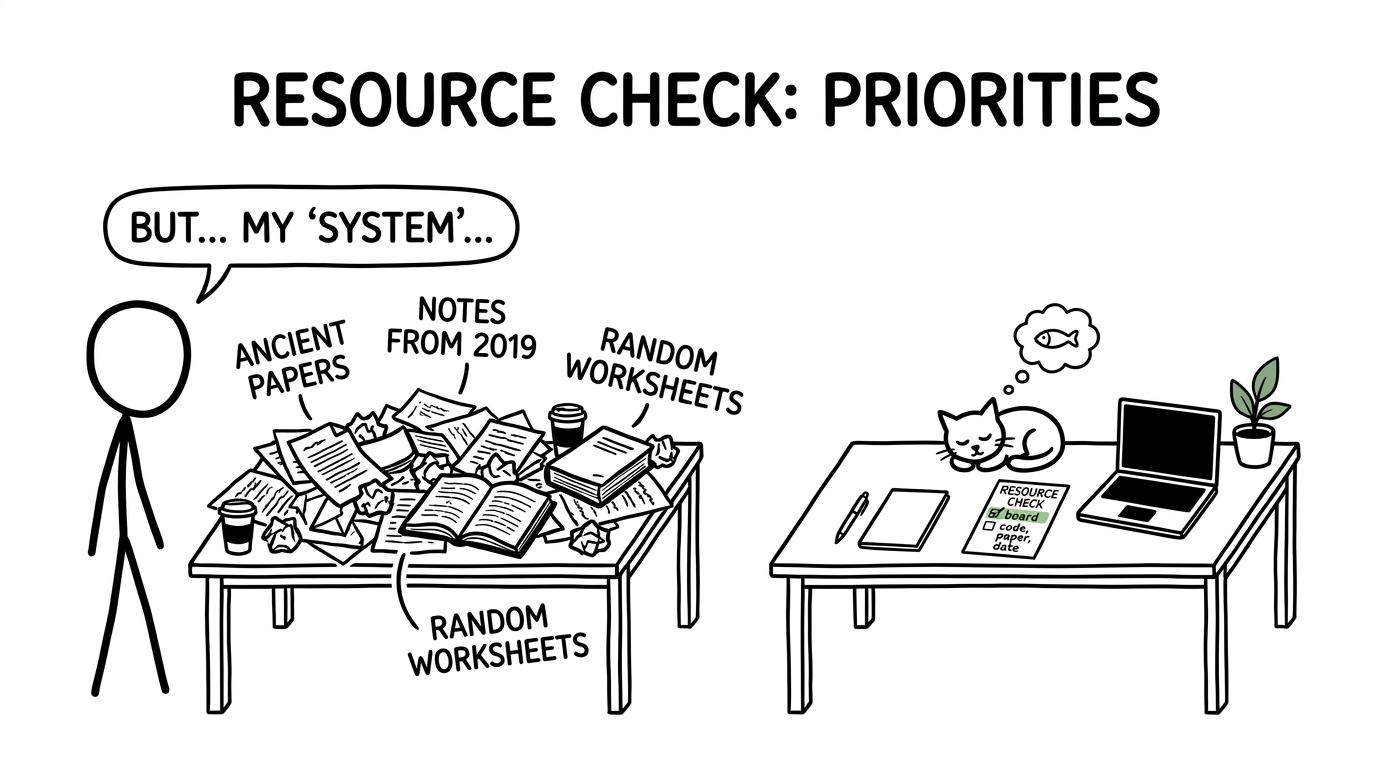 A cat approving a neatly checked revision desk rather than a pile of random old papers
How to decide whether an older resource is useful
Age alone is a poor test. Relevance is better.
Keep resources that teach transferable skills
A strong explanation of inference, textual evidence, paragraph organisation, punctuation or comparative language may remain useful. A thoughtful discussion of a set text can also help if your current specification still includes that text and the interpretation is accurate.
Use these resources for learning, then test the skill with a current board-specific question. This separates enduring knowledge from outdated assessment advice.
Replace resources tied to an old assessment model
Be wary when a resource:
- uses A* to G grades as if they were current;
- refers to controlled assessment contributing to the final grade;
- includes speaking and listening marks in the Language result;
- assumes copies of complete Literature texts are available in the exam;
- teaches discontinued anthology poems or set texts;
- shows paper timings or mark totals that differ from your specification;
- presents temporary pandemic arrangements as permanent rules.
If one of those features appears, verify everything else before using the resource.
Let the current specification be the final authority
Specifications can be reissued with clarifications. Exam boards themselves warn that older supporting material may occasionally conflict with the latest specification. Your teacher and the current official qualification page should therefore settle any disagreement.
A sensible hierarchy is: current specification first, official assessment materials second, teacher guidance third, then commercial or inherited revision resources.
Protecting maths revision time while checking English resources
For students preparing for maths examinations, the lesson is broader than English. Revision works best when the material matches the examination you will actually take.
Start maths planning from the GCSE Maths Revision hub, where resources are organised by exam board. If your week already feels crowded, the 20-minute maths revision routine provides a repeatable structure without asking you to revise every subject at once.
A practical weekly system is to give each session one purpose. Check an English text list in one session. Complete a maths topic lesson in another. Marking and corrections should have their own space. The GCSE maths revision timetable guide can help you create that separation.
When you need evidence rather than guesswork, use the method in how to find your weakest GCSE topics. In English, that evidence might reveal weak comparison or inaccurate writing. In maths, it might reveal recurring losses in algebra or geometry. The principle is the same: diagnose, practise, mark, correct and retest.
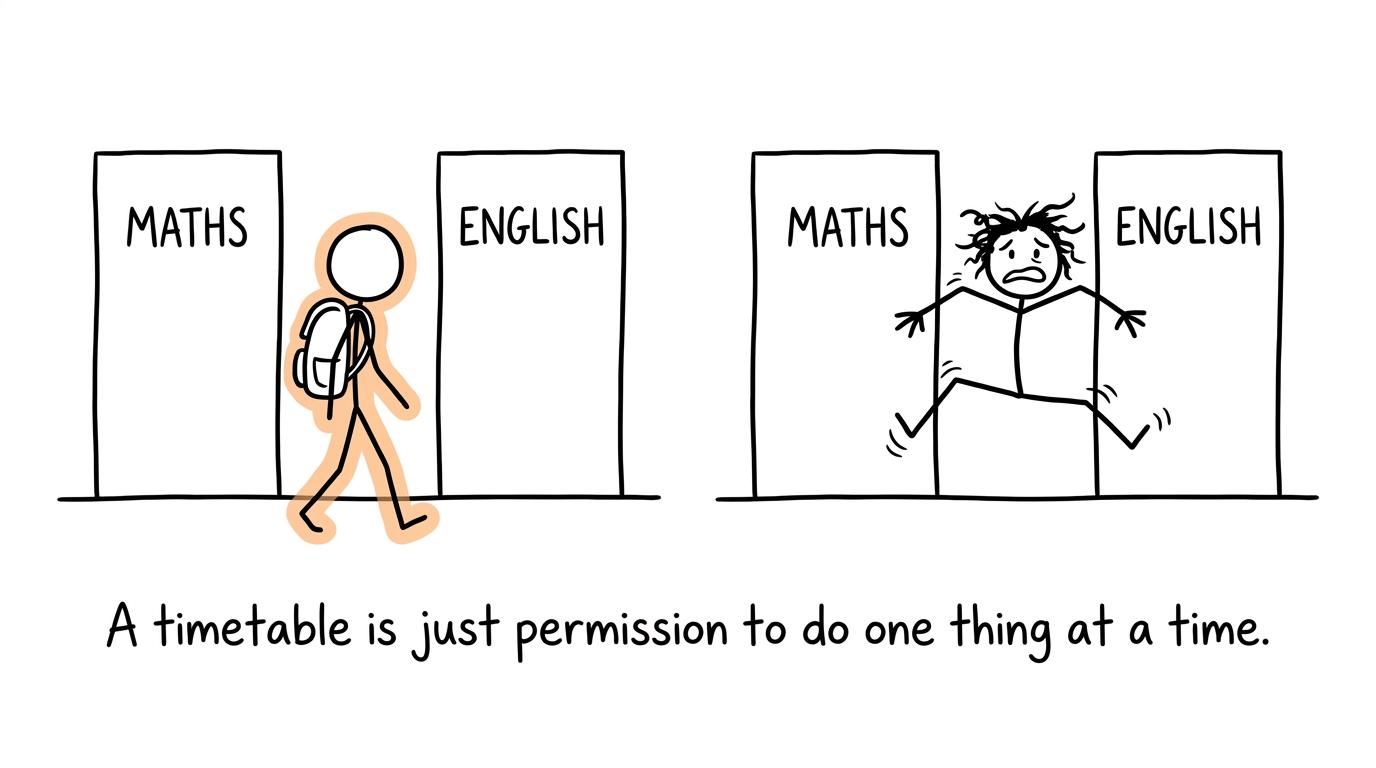 One student alternating calmly between maths and English while another tries to do both at once
Common mistakes when using older revision materials
Trusting the publication date without checking the edition
A book may have been reprinted recently without being rewritten for a changed anthology or specification. Check the qualification code and examination coverage inside it.
Mixing Language and Literature requirements
English Language uses unseen reading material and assesses your own writing. English Literature examines studied literary works as well as required unseen material. Strategies overlap, but the qualifications are not interchangeable.
Assuming every exam board uses the same format
National assessment objectives create common ground, not identical question papers. Practising another board’s material can build skills, but it should not replace preparation for your own board.
Learning a mark scheme mechanically
Mark schemes reward evidence of particular skills, not a collection of magic phrases. Read current examiner materials and practise adapting your response to the actual question.
Allowing resource checking to become procrastination
Once you have confirmed the board, code, subject and series, begin practising. The purpose of checking is to protect revision time, not consume it.
Make the specification your map
The biggest English specification changes are no longer new, but their consequences still sit inside cupboards, shared drives and second-hand revision guides. Older material can offer excellent teaching. It simply should not be allowed to define an examination it was never written for.
Check your exact board and specification, confirm your set texts, then use current papers and mark schemes to shape practice. Apply the same discipline to maths: choose the correct board and tier, identify weak topics and turn mistakes into the next revision task.
MathsGenie gives you the free tools to do that. Begin with the one-month GCSE maths revision plan, learn through revision lessons and practice questions, then introduce papers at the right stage using the guide to when you should start GCSE past papers. Finish with mini tests, mark schemes, video solutions and predicted papers, all chosen for the examination in front of you, not the one students sat years ago.










