

GCSE English Language and Literature Paper 2
GCSE English Language and Literature Paper 2 explained: compare timings, question types and revision priorities across AQA, Edexcel, OCR and Eduqas.
The phrase “Paper 2” sounds reassuringly specific. Then you open your revision folder and discover two different subjects, several exam boards and question formats that do not neatly agree with one another.
Here is the useful answer first: GCSE English Language and Literature Paper 2 are separate exams. Language generally tests how you interpret unseen texts and produce your own writing. Literature tests your knowledge of studied texts and poetry, often alongside unseen material. The exact timing, content and mark allocation depend on whether you take AQA, Edexcel, OCR or Eduqas.
For students also preparing for maths exams, that distinction matters. You would never revise a higher calculator paper as though it were a foundation non-calculator paper. English deserves the same precision.
Paper 2 checklist before you revise
Before memorising quotations or completing a practice response, confirm:
- whether the exam is English Language or English Literature;
- your exam board and qualification code;
- the paper or component title;
- the duration and total marks;
- which texts are studied and which are unseen;
- whether every question is compulsory;
- whether you must compare texts;
- how much writing, planning and checking time you need.
Do not build a revision plan from a friend’s timetable unless they take the same specification. Exam-board differences are not minor details. They can change the entire character of the paper.
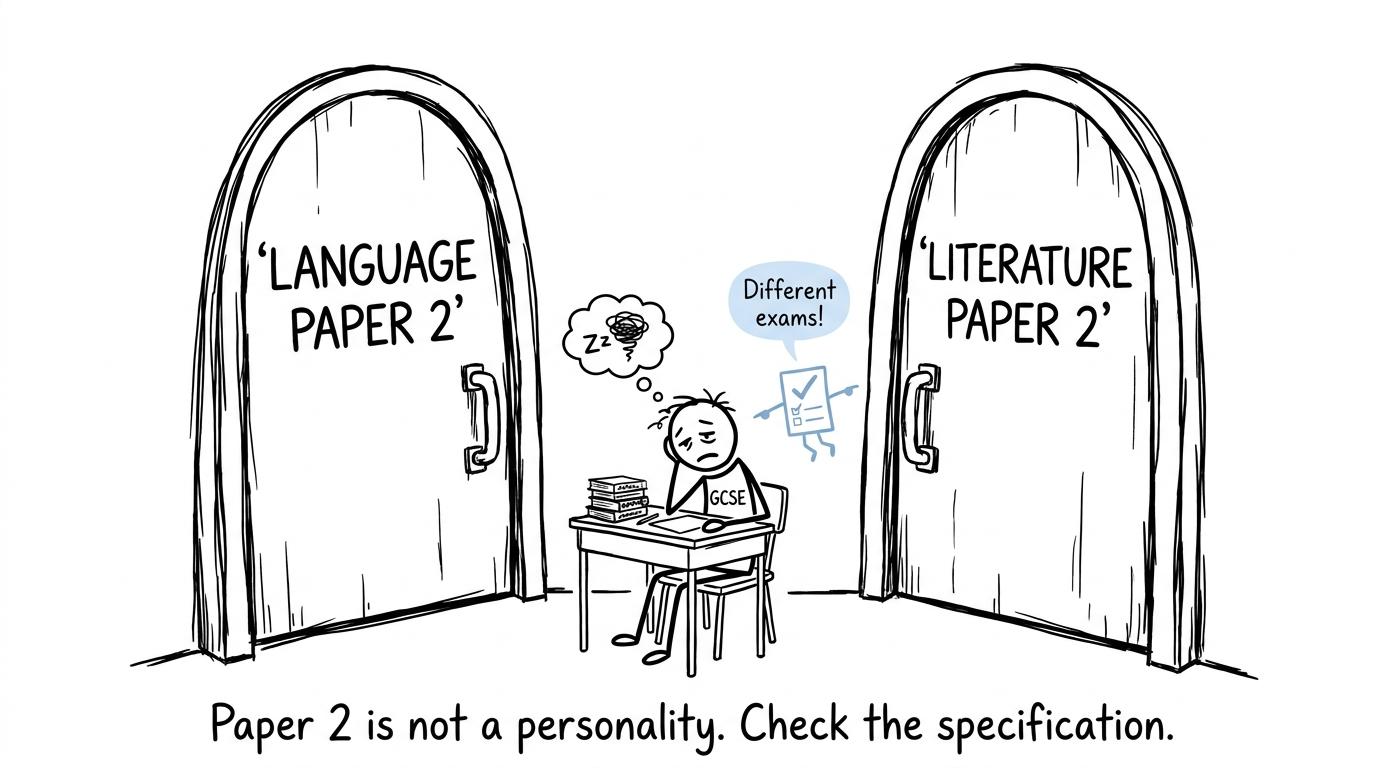 A student discovers that Language Paper 2 and Literature Paper 2 are different exams
What is different about English Language Paper 2?
English Language Paper 2 normally combines unseen reading with extended writing, but the kind of reading and writing varies significantly by board.
AQA Language Paper 2
AQA calls this paper Writers’ Viewpoints and Perspectives. It lasts 111 hour 454545 minutes, carries 808080 marks and represents 50%50\%50% of the English Language GCSE.
Section A is worth 404040 marks. You read two linked unseen sources from different periods and genres: one non-fiction text and one literary non-fiction text. The questions move through retrieval, synthesis, language analysis and comparison. Their values are 444, 888, 121212 and 161616 marks.
Section B is also worth 404040 marks. You complete one extended task presenting a viewpoint for a specified audience, purpose and form. Of those marks, 242424 reward content and organisation while 161616 reward technical accuracy.
Compared with AQA Paper 1, the main shift is from fiction and creative writing to viewpoints, comparison and persuasive or argumentative writing. Paper 2 favours students who can identify what writers think, explain how they communicate it and adapt their own voice to a real audience.
Edexcel Language Paper 2
For the established Pearson Edexcel English Language qualification, Paper 2 is Non-fiction and Transactional Writing. It lasts 222 hours 555 minutes, carries 969696 marks and contributes 60%60\%60% of the qualification.
The reading section uses unseen twentieth- and twenty-first-century non-fiction or literary non-fiction. Its questions include analysis and comparison. The writing section offers transactional tasks, with candidates selecting one task to complete.
This is not the same timetable or question ladder as AQA. An AQA timing video or question-number strategy should therefore not be copied blindly into an Edexcel paper.
OCR and Eduqas Language components
OCR demonstrates why “Paper 2 is the non-fiction paper” is not a universal rule. OCR’s second examined component, Exploring Effects and Impact, lasts 222 hours, carries 808080 marks and contributes 50%50\%50%. It focuses on unseen twentieth- or twenty-first-century literary prose, which may include literary non-fiction, followed by creative writing.
Eduqas Component 2 lasts 222 hours and contributes 60%60\%60%. It uses nineteenth- and twenty-first-century non-fiction in its reading section and includes two compulsory transactional or persuasive writing tasks.
The broad skills overlap across boards, but the route through them does not. Check the front of an official paper before deciding what “Language Paper 2” means for you.
What is different about English Literature Paper 2?
Literature Paper 2 replaces the flexibility of your own ideas with a different challenge: retrieving knowledge accurately and shaping it around the question actually asked.
AQA Literature Paper 2
AQA Paper 2 is Modern Texts and Poetry. It lasts 222 hours 151515 minutes, carries 969696 marks and accounts for 60%60\%60% of the Literature GCSE. All AQA Literature assessments are closed book, although required stimulus material is printed in the paper.
There are three sections:
- Modern texts: one essay from a choice of two on the prose or drama text you studied.
- Anthology poetry: comparison of one named poem printed in the paper with another poem from your studied cluster.
- Unseen poetry: one response to an unseen poem, followed by a comparison with a second unseen poem.
Compared with AQA Literature Paper 1, which covers Shakespeare and the nineteenth-century novel, Paper 2 is broader and longer. It favours flexible knowledge: themes, character development, writers’ methods, relevant context and quotations that can serve several possible questions.
Edexcel Literature Paper 2
Edexcel Paper 2 is Nineteenth-century Novel and Poetry since 1789. It lasts 222 hours 151515 minutes, carries 808080 marks and contributes 50%50\%50% of the qualification.
Students answer on a studied nineteenth-century novel, compare anthology poems and compare two unseen contemporary poems. The paper is closed book, although specified extracts and poems are provided where required.
Again, the title “Literature Paper 2” does not guarantee AQA content. Under Edexcel, the nineteenth-century novel appears here rather than on Paper 1.
OCR and Eduqas Literature
OCR Literature Component 2 lasts 222 hours and contributes 50%50\%50%. Its focus is a thematic poetry cluster and a studied Shakespeare play. That is markedly different from AQA’s combination of a modern text, anthology poetry and unseen poetry.
Eduqas arranges its Literature content differently again. Students must use the current specification and their school’s set-text list because component content and prescribed anthologies can change between assessment cycles.
A reliable habit is to treat your specification like a map. Maths students can use the same approach through the GCSE Maths revision hub, where board and paper choices are separated before practice begins.
How the question styles differ
Language asks, in effect, what can you discover and produce now? Literature asks what can you retrieve, interpret and argue from what you studied?
In Language Paper 2, expect some combination of:
- locating explicit information;
- making inferences;
- summarising or synthesising ideas;
- analysing language and structure;
- comparing viewpoints or methods;
- writing for a defined audience, purpose and form.
In Literature Paper 2, expect:
- a clear argument responding to the exact wording;
- references or quotations from studied texts;
- analysis of language, form and structure;
- relevant contextual understanding where assessed;
- comparison between poems or texts;
- interpretation of unseen poetry on the day.
This changes how you revise. Language improves through repeated unseen practice, annotation and controlled writing. Literature requires retrieval of textual knowledge, followed by practice adapting that knowledge to unfamiliar questions.
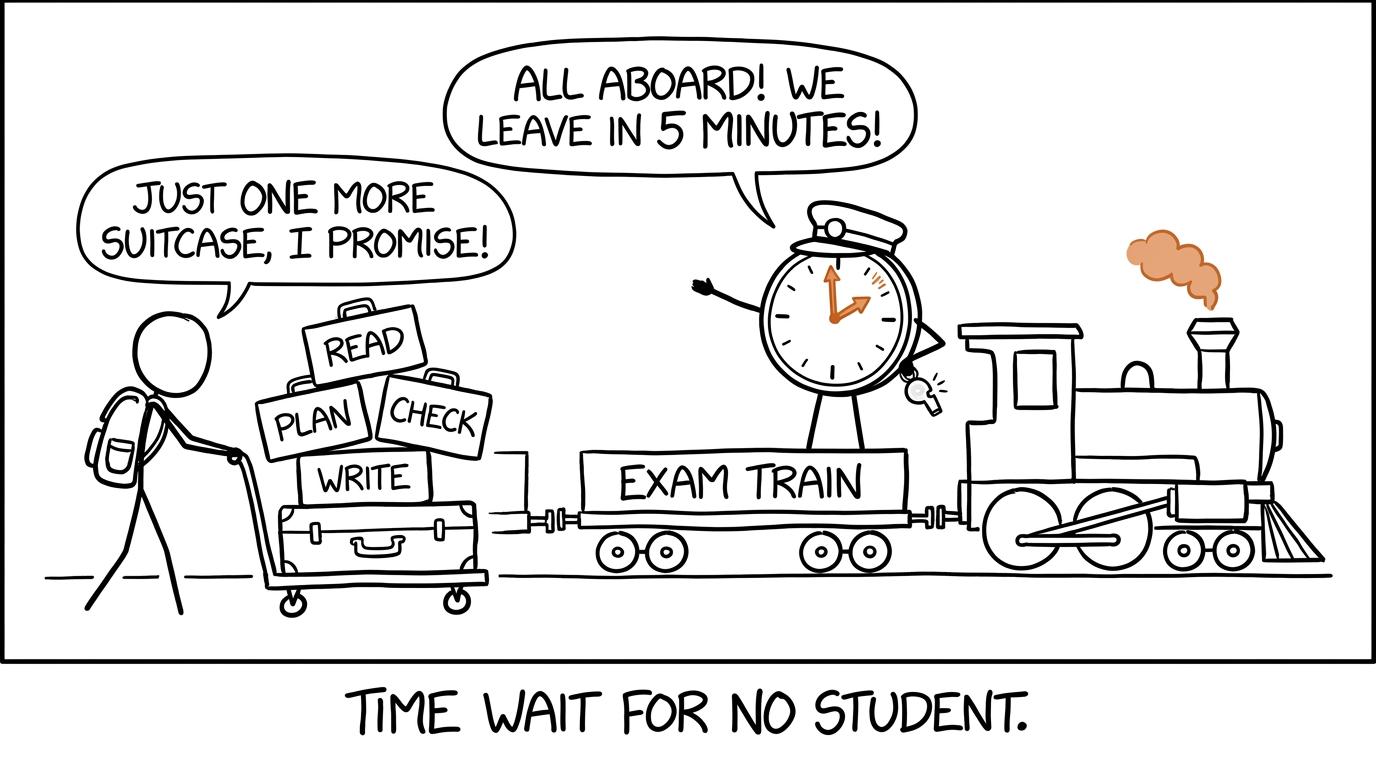 An exam clock conducts a train carrying reading, planning, writing and checking time
How to manage Paper 2 timing
Timing advice should begin with your own board’s official paper, not a universal internet rule. Read any guidance printed on its front cover and use mark values to judge the expected depth.
For AQA Language, a sensible practice model is to protect roughly 151515 minutes for reading both sources and questions, around 454545 minutes for the reading responses, and around 454545 minutes for planning, writing and checking the viewpoint task. This is a practice framework, not an additional exam-board rule.
For AQA Literature, divide the 135135135 minutes across the modern text, anthology comparison and two unseen tasks according to their demands and marks. Build a small allowance for selecting questions and planning. Test the plan under timed conditions, then adjust it using evidence from what you actually finish.
The same principle works in maths. A revision plan becomes useful only when it survives contact with a real paper. MathsGenie’s guide to when to start GCSE past papers explains how to progress from short sections to full timed practice.
A practical revision strategy for both English papers
Separate knowledge from performance
For Literature, knowledge includes plot, themes, character arcs, quotations, methods and context. Performance is turning that material into a focused argument under time pressure.
For Language, knowledge includes the assessment objectives, analytical vocabulary and conventions of forms such as articles, letters and speeches. Performance is applying them to sources and tasks you have never seen.
Revise both layers. Knowing twenty quotations is not enough if none answers the question. Knowing the features of a speech is not enough if your argument loses focus.
Use short feedback loops
Complete one question under time, check it against the official mark scheme and identify one improvement. Then attempt a different question requiring the same skill.
This attempt, mark, fix, retest cycle is also central to finding your weakest GCSE topics. MathsGenie’s free revision resources provide mini tests, practice papers, mark schemes and predicted papers for applying the loop to maths alongside English revision.
Build a realistic weekly plan
Alternate retrieval with timed performance. A Literature session might focus on recalling flexible evidence for one theme, while a Language session might contain one comparison or transactional-writing task.
Avoid filling every evening with full papers. Short, marked practice reveals more than an exhausting paper that is never reviewed. If exams are close, adapt the structure in MathsGenie’s one-week GCSE revision plan to balance English with foundation or higher-tier maths.
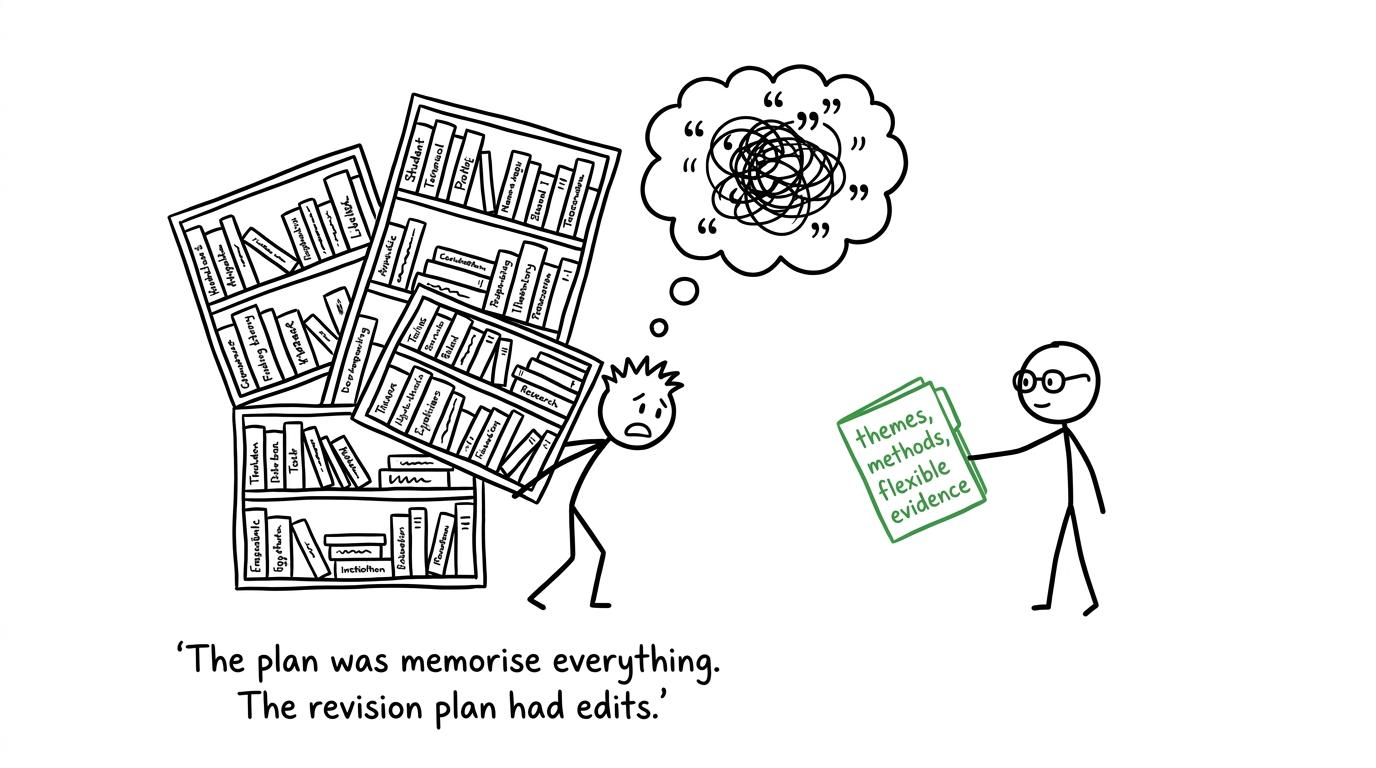 A huge quotation library competes with a small folder of flexible evidence
Common Paper 2 mistakes
Revising the wrong board
AQA, Edexcel, OCR and Eduqas do not use one shared Paper 2 structure. Write your board, qualification and paper title at the top of your revision plan.
Treating Language and Literature as one exam
Language rewards transferable reading and writing skills. Literature additionally depends on secure knowledge of set texts. They need connected but distinct revision methods.
Giving every question equal time
A short retrieval question should not consume the time needed for extended comparison or writing. Use marks and official guidance to control depth.
Feature spotting without explaining effects
Naming a metaphor, rhetorical question or structural shift is only the beginning. Explain what it communicates, how it shapes the reader’s response and why it supports the writer’s purpose.
Forcing memorised Literature material into the answer
A polished paragraph that does not address the question is still unfocused. Select evidence after deciding your argument, not before.
Neglecting technical accuracy
Sentence control, spelling and punctuation matter in Language writing. Leave time to check agreement, paragraphing, sentence boundaries and commonly confused words.
Go into Paper 2 knowing what you are sitting
Paper 2 becomes less intimidating when it stops being a vague label. Identify the qualification, learn the exact sections, practise the question types and refine a timing plan against official papers.
Then bring the same discipline back to maths. Use MathsGenie’s board-and-tier GCSE guide to confirm what you are preparing for, learn through free revision lessons and practice questions, and test yourself with past papers, predicted papers, mini tests, mark schemes and video solutions. If the exam is tomorrow, the GCSE maths night-before plan will help you make the final evening calm and useful.
The goal is not to predict every question. It is to make the paper familiar enough that your attention can go where it belongs, on the answer in front of you.










